


France and England Battle Multiple Wildfires as Record Heat Grips Europe

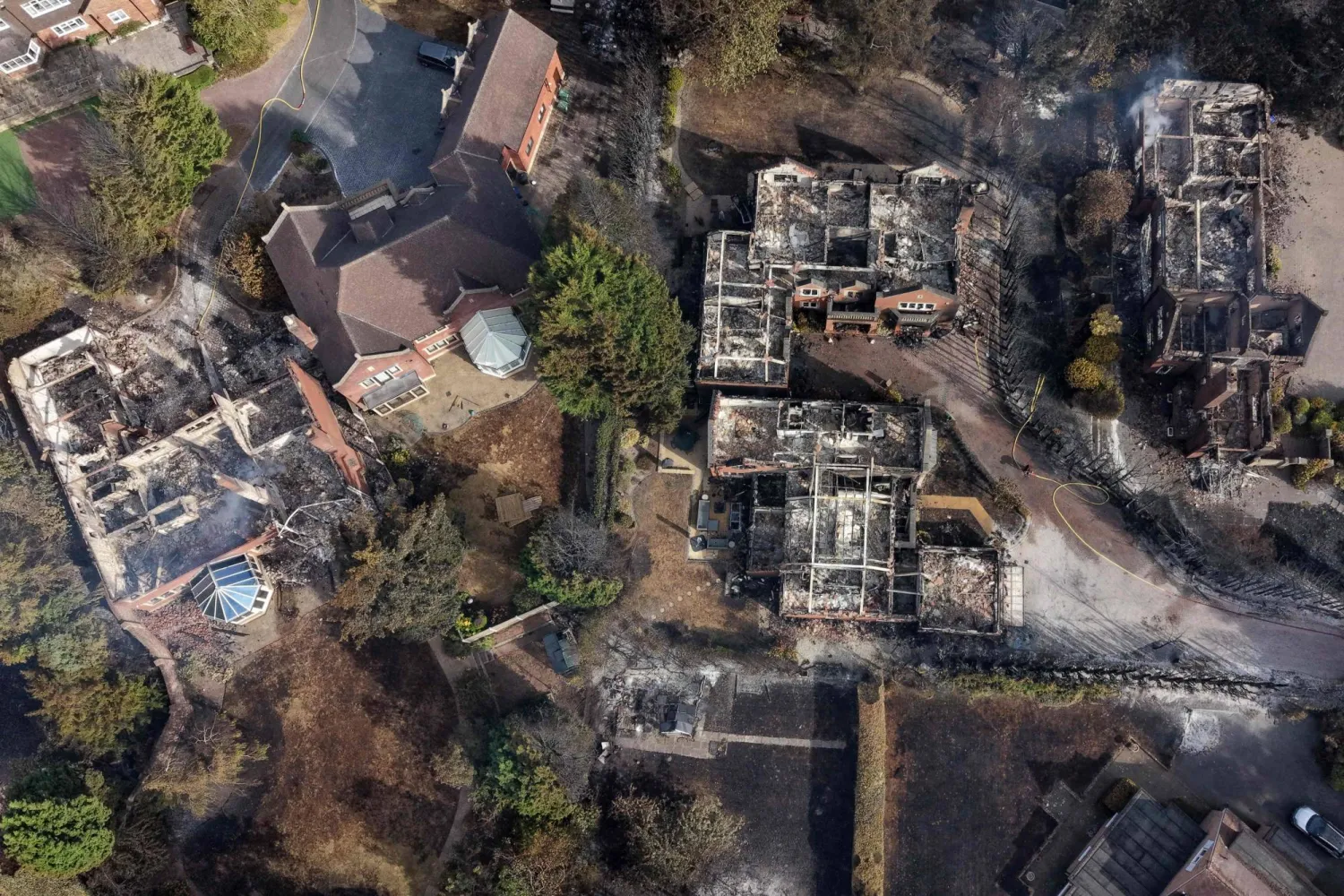
An aerial view shows smoke rising from fire-damaged houses, south of Stourbridge town center in central England on August 14, 2026. (Photo by Darren Staples / AFP)
TT

France and England Battle Multiple Wildfires as Record Heat Grips Europe

An aerial view shows smoke rising from fire-damaged houses, south of Stourbridge town center in central England on August 14, 2026. (Photo by Darren Staples / AFP)

Firefighters across France and in central England struggled against multiple fires Friday as a new wave of record-breaking heat baked a swath of Europe, their task further complicated by exceptionally parched landscapes.

With France experiencing its driest year ever, a new fire raced through woodlands overnight in the Landes region on the southwest coast. The blaze forced more than 500 people to evacuate their homes in the town of Luglon as hundreds of firefighters deployed to the area, the regional administration said Friday.

It’s one of several fires scorching forests around France this week, including in normally cooler and wetter regions in the north and Brittany. A historic fire devoured forests near Bordeaux last month and pushed a quarter of a million people from their homes.

Meanwhile, efforts to contain a wildfire in Germany were complicated by unexploded World War II munitions, and shifting winds in Croatia spread flames deeper into a coastal suburb and forced more than 1,000 people to flee.

After the UK recorded its hottest day of the year on Thursday, wildfires raced across the West Midlands and saw several houses burned to the ground. They have been “one of the most significant” incidents the region’s fire service has ever dealt with, chief fire officer Simon Tuhill said.

Some 1,017 wildfires have been recorded in England and Wales this year, according to data from the National Fire Chiefs Council.

The fires came on the hottest day of the year, when temperatures reached 38.1 degrees Celsius (100.6 degrees Fahrenheit) in west London.

In France, temperatures Thursday approached 41 C (106 F) in several areas, from Aquitaine in the southwest to the Rhone River valley in the east, according to the national weather service. They were forecast to reach similar levels Friday before dropping over the weekend.
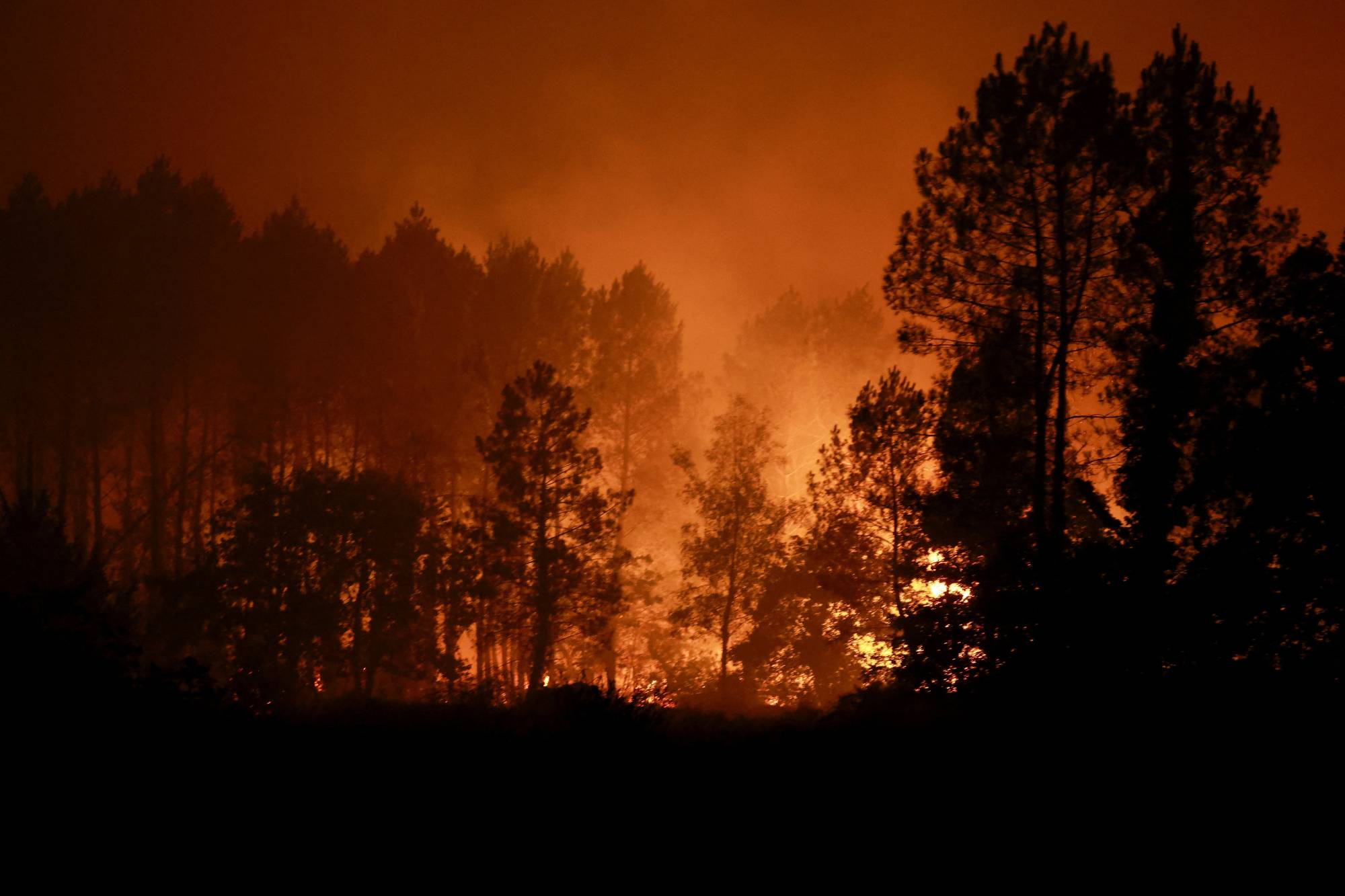
 

Flames engulf trees as a wildfire burns in Luglon, France, August 14, 2026. REUTERS/Stephanie Lecocq

The historic temperatures are linked to human-caused climate change, and are hitting countries more designed for long cold seasons and ill-equipped for this sort of heat, with limited air conditioning.

Firefighters battle forest fire in Germany All 1,800 residents of the village of Gey in Germany’s North Rhine-Westphalia state were evacuated after a wildfire in the nearby Hürtgen forest threatened to reach their homes. Nearly 300 hectares (1.16 square miles) of forest were ablaze on Friday morning, The Associated Press quoted local authorities as saying.

Unexploded ordnance from World War II in the forest hampered firefighting efforts, German news agency dpa reported. Explosions could be heard as the munitions detonated during the fire, forcing firefighters to stay out of the area for safety.

The fire advanced to within 300 meters (1,000 feet) of Gey, which sits on the edge of the forest near the Belgian border. Overnight a shift in wind direction raised the risk that the flames could reach Gey by morning, prompting officials to order the initial evacuation.

The cause of the blaze remains unknown, and authorities have not ruled out further evacuations in the area.

Hundreds of personnel have been deployed to battle the fire, with the German army sending tanks and firefighting helicopters providing air support.

In Croatia, 14 people were hospitalized, of whom seven remained in life-threatening condition early Friday from a fire that raged overnight by the coastal town of Omis and forced more than 1,000 people to evacuate their homes.

The fire erupted late Thursday in an Omis suburb and quickly spread because of strong wind. Public broadcaster HRT said the blaze came close to the town’s center, and parts of Omis were left without electricity while many cars were burned.

Croatian media published photos from a crowded sports hall in Omis where people crammed on beds and on the floor. Witnesses told HRT that people were jumping into the sea after boats also caught fire.

Firefighters put out the blaze by Friday morning as other crews in planes headed further south toward the Peljesac peninsula where another wildfire broke out overnight.

Meanwhile, in northern Greece, more than 300 vacationers and residents were evacuated by sea Thursday after a wildfire swept through a pine forest and threatened seaside homes, authorities said.



Don’t Ban Children from Social Media, Estonia Tells EU

The TikTok app icon on a smartphone in this illustration taken October 27, 2025. (Reuters)
TT

Don’t Ban Children from Social Media, Estonia Tells EU

The TikTok app icon on a smartphone in this illustration taken October 27, 2025. (Reuters)

The European Union should make social media platforms change instead of banning children from using the apps, Estonia's digital minister told AFP Monday, just over a week before the EU is due to announce an age limit.

Estonia has been a lone voice in opposing the EU's plans to restrict children's access to social media, instead calling for online platforms to change.

EU chief Ursula von der Leyen is expected to announce a social media ban on September 16, with officials saying an age limit of 13 or 15 is under discussion.

But IT-savvy Estonia argues the tech giants have prime responsibility for making their popular platforms safer for minors.

"As children are members of the information society, it's actually the platforms who should change," Estonian Justice and Digital Affairs Minister Liisa-Ly Pakosta said.

"The best interests and rights of the child must guide platforms' design, and that is useful for the whole society," she said in a video interview.

Pakosta pointed to the EU's content law known as the Digital Services Act (DSA) as one way for the bloc to demand platforms change.

She argues for instance that the EU's recommendations for platforms under the DSA to protect children online should be made legally binding.

The EU has already deployed the law to probe Meta's Facebook and Instagram as well as TikTok, and told the platforms to change their "addictive" designs.


‘Slumping’ South Korean Corals Worry Divers, Scientists Studying Climate Change

Kang Do-hyung, principal research scientist at Korea Institute of Ocean Science and Technology and former Oceans and Fisheries Minister, checks corals with researchers at a lab called Jeju Tropica, in Jeju, on Jeju Island, South Korea, August 20, 2026. (Reuters)
TT

‘Slumping’ South Korean Corals Worry Divers, Scientists Studying Climate Change

Kang Do-hyung, principal research scientist at Korea Institute of Ocean Science and Technology and former Oceans and Fisheries Minister, checks corals with researchers at a lab called Jeju Tropica, in Jeju, on Jeju Island, South Korea, August 20, 2026. (Reuters)

Ko Myeong-hyo loved the vibrant color and thriving life of South Korea's soft corals when she first began diving off the coast of Jeju island six years ago, looking to harvest seafood for sale.

"Watching the coral garden collapse and turn white, it was so disorienting," Ko says now, after two years of rising temperatures and harsher weather brought by climate change have led to many corals slumping over and dying.

"I was afraid the whole sea might be collapsing."

The "slumping" phenomenon is showing up again this year, says the Paran Ocean Citizen Science Center, a group of divers who monitor the island's UNESCO-listed soft corals, mostly around uninhabited islets south of Jeju.

Roughly half of one cluster off the islet of Beomseom has been struggling in past months, the group says.

Unlike hard corals supported by rigid calcium carbonate skeletons, soft corals rely on internal fluid pressure to keep upright. Environmental changes can disrupt that pressure, leading them to sag or collapse.

"If another large-scale 'slumping' happens, corals partially recover and ‌then a lot ‌break off and deteriorate again, and that keeps repeating, their capacity to recover just keeps declining," ‌said ⁠researcher Kim Taihun.

Kim ⁠and Anna Beate Jöst, a colleague at the Korea Institute of Ocean Science and Technology (KIOST), documented Jeju's 2024 soft coral slumping event for the first time in a May article in the journal Scientific Reports.

In an email, Korea Heritage Service, which manages the soft coral colonies designated a national monument, said it has monitored the situation this year and will keep up long-term research to identify the reasons for the changes.

The Oceans Ministry, which oversees marine protected species and areas such as soft corals, added that it plans detailed investigation to gauge the scale of damage.

EL NINO COULD WORSEN THIS YEAR'S EVENT

Kim said this year's event looked similar to that of 2024, but could worsen should high water temperatures persist ⁠through September, and the El Nino weather phenomenon may trigger typhoons and heavy rains.

But he called for ‌consistent and quantitative monitoring of the loss of soft corals through slumping, citing a ‌lack of research support.

Climate change has hit corals globally, with perhaps the world's most famous colonies on Australia's Great Barrier Reef getting the most attention.

A record ‌heatwave has parched the Korean peninsula this year while heavy rains have pelted the south.

Coral researchers say such weather conditions, as ‌well as water flowing down from China's Yangtze River to affect the area's salinity, are potential triggers for "slumping".

Jeju's waters have given safe harbor to soft coral communities, sensitive to environmental conditions and living on the edge of tolerable conditions in the northernmost limit of coral distribution in the East China Sea.

Soft coral functions as the nursery underpinning Jeju's marine ecosystem, and soft coral communities reside in the UNESCO-listed Jeju Island Biosphere Reserve.

"The seaweed sea, the coral ‌sea, is the foundational ecosystem underlying Jeju's marine ecology," said Yoon Sanghoon, an environmental expert at Paran.

"So if this base ecosystem collapses, there's a real possibility the entire marine ecosystem could collapse."

Over the ⁠past decade, marine heatwaves around ⁠Korea have extended almost four times longer, at 83.3 days, weather authorities say.

RIPPLING IMPACT

Paran, formed in 2023 by Jeju residents concerned by marine changes, brings together office workers, traditional divers and documentary filmmakers who flock there for monthly dives.

They plunge to the coral bed to take photograph and document changes they provide to scientists.

While Ko, a third-generation Jeju "haenyeo" or "sea woman", can dive to a depth of as much as 8 m (26 ft) relying on her own breath, she carries an oxygen tank on coral dives to greater depths.

The warming waters have affected the seabed in other ways, said her mother, 70-year-old Son Choon-sook, who began diving 45 years ago, when species such as turban shells, abalone and sea cucumber were abundant and thick seaweed festooned the rocks.

"I've worked at the sea for about 45 years, earned money, and sent my children to school on it," she said. "Now the catch has run dry, and it makes me very sad."

The thinning catch of the past few years follows summers that make the water too hot for species to spawn, she added, and her workday has shrunk to three hours from five formerly, as there is less to gather, but partly also for reasons of health.

Ko said her most recent dives in the summer have worried her again. "Rather than the beautiful coral shapes, I feel like I'm seeing more sick coral now," she added.


Can Dogs Sniff Cancer? AI Joins the Hunt in India

A growing body of global research suggests dogs can be trained to detect cancer and other human illnesses. Idrees MOHAMMED / AFP
TT

Can Dogs Sniff Cancer? AI Joins the Hunt in India

A growing body of global research suggests dogs can be trained to detect cancer and other human illnesses. Idrees MOHAMMED / AFP

When rescue dog Chloe is not tumbling across the grass on a farm outside India's tech capital Bengaluru, she is learning to sniff human breath for cancer with a little help from AI.

Fitted with a 3D-printed helmet and harness packed with sensors, Chloe is part of experimental efforts to use dogs' extraordinary sense of smell to develop a non-invasive test for the disease.

A growing body of global research suggests dogs can be trained to detect cancer and other human illnesses, from Parkinson's to Covid-19.

The Bengaluru-based startup Dognosis is using AI to analyze dogs' brain activity, respiration and body language -- turning their reaction to scent into data.

"In an hour, they can do thousands of sniffs," co-founder Akash Kulgod, 26, told AFP. "Each sniff can evaluate a sample."

Dognosis hopes to launch commercially next year, which it says would make it the third company of its kind, after firms from Germany and Israel.

Early detection can make a crucial difference to cancer survival rates, but in India many patients are diagnosed only after the disease has advanced.

Dog sniffs could provide an easy and affordable first layer of screening to be deployed at scale, finding potential cases for further testing.

As it chases commercial approval, Dognosis -- backed by venture-capital firms including Accel India -- is collaborating with government medical institutions for its research.

Chloe, a Labrador mix, is one of 15 dogs being coached by the startup, clad in customized data-gathering helmets.

"It's like a doggy 'Iron Man' suit," said Kulgod, who comes from a family of doctors and studied cognitive science at the University of California, Berkeley.

- 'Promising' study -

Research suggests diseases can alter the chemicals released by the body, creating distinctive odors.

Dogs have around 300 million scent receptors, compared to about five million in humans.

The testing method is simple: a patient breathes into a cotton mask for about 10 minutes, and the mask is then sealed in a bag and taken to the lab. Patients do not meet the dogs.

A recent Dognosis study of more than 1,500 participants, involving six hospitals in Karnataka state, was published in the Journal of Clinical Oncology.

The company said it achieved an accuracy rate of more than 90 percent across seven major types of cancer, and now plans to test in real-world programs.

Cancer specialists in Bengaluru independent of the project voiced cautious optimism.

"The study is promising, as an early signal," said Santhosh Kumar Devadas, head of oncology at Ramaiah Memorial Hospital.

"But they need to do the study with a much larger group before we make any definitive conclusions."

Neelesh Reddy, a senior consultant oncologist at Manipal Hospitals, told AFP that "only time will tell how this technology will be useful to the actual patients".

- Dog 'work-life balance' -

India has described cancer as a major public health concern, saying one in nine of its 1.4 billion people are likely to develop the disease.

Dognosis says it aims to improve "proactive and preventative medicine" while boosting "human-canine communication".

Most of the dogs are beagles, along with some Malinois and Shepherd mixes, brought on board through adoption or legal breeders.

But only the best are selected, said Kulgod. The dog team individually lists each animal on the company website as an official "sniffer", alongside their photographs.

All have a great "work-life balance", with work time limited to around 30-45 minutes a day, he added.

At a center called "Sniffspace", dogs test human samples on platforms equipped with automatic feeders dispensing dog treats.

Kulgod's co-founder Itamar Bitan, 28, who spent four years in an Israeli special-forces canine unit, said the dogs were trained using "positive reinforcement" to detect a "specific funky smell" for a reward.

"Some of the dogs run directly to the feeder expecting rewards, some dogs freeze, some dogs will scratch the sample with excitement," Bitan said.

"But, as long as the machine that learns how the dogs react to the sample is very consistent... we don't really mind."