


France and England Battle Multiple Wildfires as Record Heat Grips Europe

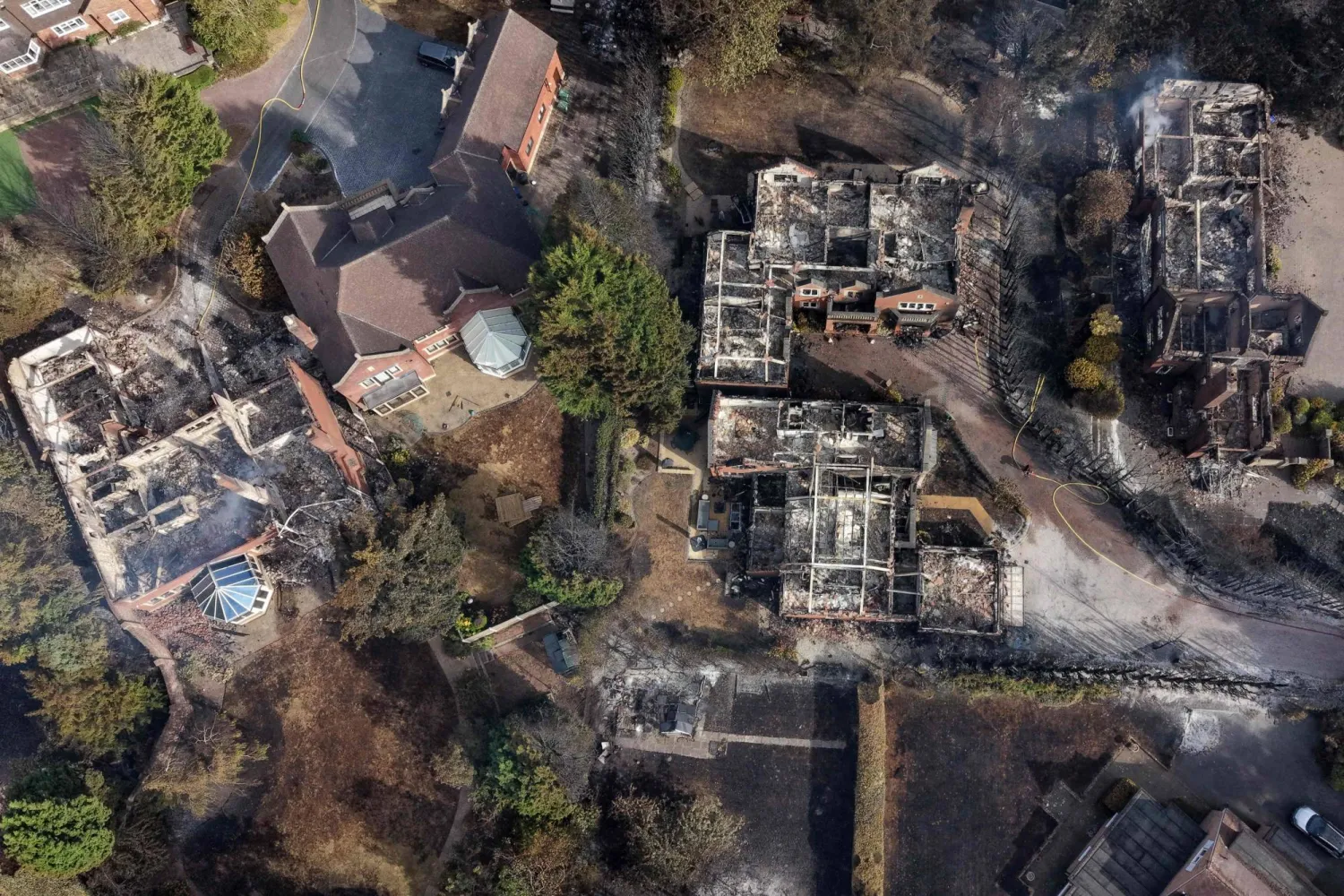
An aerial view shows smoke rising from fire-damaged houses, south of Stourbridge town center in central England on August 14, 2026. (Photo by Darren Staples / AFP)
TT

France and England Battle Multiple Wildfires as Record Heat Grips Europe

An aerial view shows smoke rising from fire-damaged houses, south of Stourbridge town center in central England on August 14, 2026. (Photo by Darren Staples / AFP)

Firefighters across France and in central England struggled against multiple fires Friday as a new wave of record-breaking heat baked a swath of Europe, their task further complicated by exceptionally parched landscapes.

With France experiencing its driest year ever, a new fire raced through woodlands overnight in the Landes region on the southwest coast. The blaze forced more than 500 people to evacuate their homes in the town of Luglon as hundreds of firefighters deployed to the area, the regional administration said Friday.

It’s one of several fires scorching forests around France this week, including in normally cooler and wetter regions in the north and Brittany. A historic fire devoured forests near Bordeaux last month and pushed a quarter of a million people from their homes.

Meanwhile, efforts to contain a wildfire in Germany were complicated by unexploded World War II munitions, and shifting winds in Croatia spread flames deeper into a coastal suburb and forced more than 1,000 people to flee.

After the UK recorded its hottest day of the year on Thursday, wildfires raced across the West Midlands and saw several houses burned to the ground. They have been “one of the most significant” incidents the region’s fire service has ever dealt with, chief fire officer Simon Tuhill said.

Some 1,017 wildfires have been recorded in England and Wales this year, according to data from the National Fire Chiefs Council.

The fires came on the hottest day of the year, when temperatures reached 38.1 degrees Celsius (100.6 degrees Fahrenheit) in west London.

In France, temperatures Thursday approached 41 C (106 F) in several areas, from Aquitaine in the southwest to the Rhone River valley in the east, according to the national weather service. They were forecast to reach similar levels Friday before dropping over the weekend.
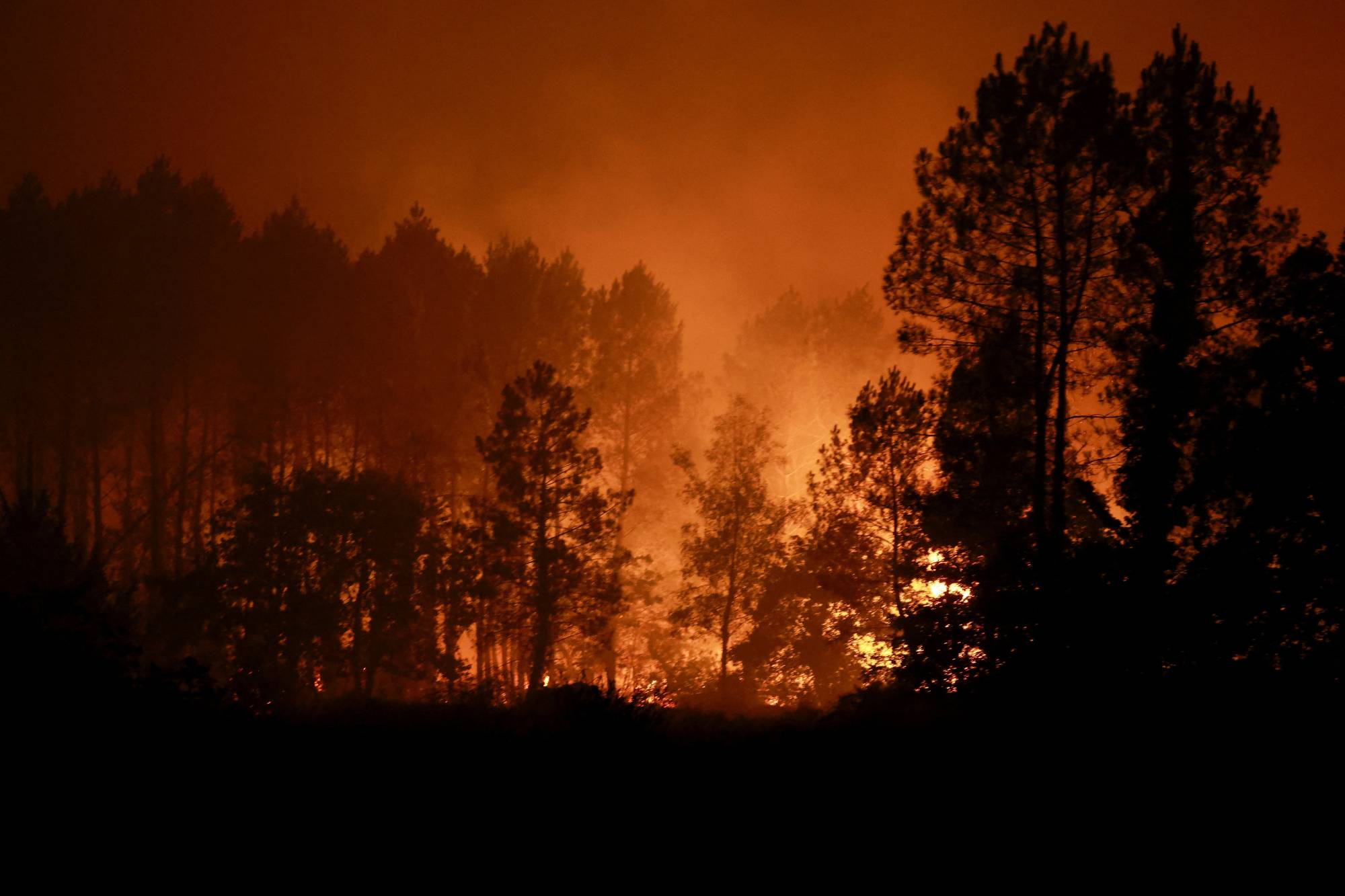
 

Flames engulf trees as a wildfire burns in Luglon, France, August 14, 2026. REUTERS/Stephanie Lecocq

The historic temperatures are linked to human-caused climate change, and are hitting countries more designed for long cold seasons and ill-equipped for this sort of heat, with limited air conditioning.

Firefighters battle forest fire in Germany All 1,800 residents of the village of Gey in Germany’s North Rhine-Westphalia state were evacuated after a wildfire in the nearby Hürtgen forest threatened to reach their homes. Nearly 300 hectares (1.16 square miles) of forest were ablaze on Friday morning, The Associated Press quoted local authorities as saying.

Unexploded ordnance from World War II in the forest hampered firefighting efforts, German news agency dpa reported. Explosions could be heard as the munitions detonated during the fire, forcing firefighters to stay out of the area for safety.

The fire advanced to within 300 meters (1,000 feet) of Gey, which sits on the edge of the forest near the Belgian border. Overnight a shift in wind direction raised the risk that the flames could reach Gey by morning, prompting officials to order the initial evacuation.

The cause of the blaze remains unknown, and authorities have not ruled out further evacuations in the area.

Hundreds of personnel have been deployed to battle the fire, with the German army sending tanks and firefighting helicopters providing air support.

In Croatia, 14 people were hospitalized, of whom seven remained in life-threatening condition early Friday from a fire that raged overnight by the coastal town of Omis and forced more than 1,000 people to evacuate their homes.

The fire erupted late Thursday in an Omis suburb and quickly spread because of strong wind. Public broadcaster HRT said the blaze came close to the town’s center, and parts of Omis were left without electricity while many cars were burned.

Croatian media published photos from a crowded sports hall in Omis where people crammed on beds and on the floor. Witnesses told HRT that people were jumping into the sea after boats also caught fire.

Firefighters put out the blaze by Friday morning as other crews in planes headed further south toward the Peljesac peninsula where another wildfire broke out overnight.

Meanwhile, in northern Greece, more than 300 vacationers and residents were evacuated by sea Thursday after a wildfire swept through a pine forest and threatened seaside homes, authorities said.



Social Media Use on the Rise Among Australian Under-16s After Ban

The TikTok logo is displayed on signage outside TikTok social media app company offices in Culver City, California on September 30, 2025. (AFP)
TT

Social Media Use on the Rise Among Australian Under-16s After Ban

The TikTok logo is displayed on signage outside TikTok social media app company offices in Culver City, California on September 30, 2025. (AFP)

Australian under-16s are increasing their use of social media apps, such as Instagram and TikTok, despite a world-leading ban, data provided by a parental control software company showed Wednesday.

Australia implemented legislation barring children from social media platforms in December, with the UK, France and others following suit.

Youngsters' use of social media fell across the board when the legal restrictions were first implemented, data from parental control app Qustodio showed.

But since then their social media activity has climbed -- even approaching pre-ban levels for some apps.

The use of apps TikTok, Instagram and Snapchat among 10–12-year-olds and 13- to 15-year-olds was on the rise, data from parental control app Qustodio showed.

In the case of video-sharing site TikTok, 25.9 percent of 13-15 year-olds are still using the app -- just over a percentage point lower than before the ban came into force.

And use among 10–12-year-olds was just 0.06 percentage points below where it was before the ban.

"They could be accessing these platforms with VPNs, or obfuscating their ages," Yasmin London, Global Online Safety Expert for Qustodio, said.

"But it could really be as simple as they're just accessing these apps because the restrictions aren't working."

The data also showed children increasingly turning to messaging platform WhatsApp, which is not affected by the ban.

Qustodio said the data was gathered by analyzing anonymized monthly social media app usage among Australian children and showed the percentages of kids that had used the app for more than five consecutive minutes at least once in a given month.

Australian officials have said the ban is designed to protect children from online bullying and "predatory algorithms".

A team of Australia-based researchers in a peer-reviewed study published in June found little evidence to suggest teenagers have turned away from social media as a consequence, however.

New Zealand's government also this week said it would introduce legislation that could see firms like Meta fined up to 10 percent of their global revenue if they fail to comply.


Drought-Hit Danube Gives Way to Fossil Hunt in Bulgaria

This photograph taken on August 21, 2026, shows unidentified remains found in the dried-out Danube riverbed near the village of Ryahovo, during an organized fossil hunt after a record low water level revealed mammoth bones there at the end of July. (AFP)
TT

Drought-Hit Danube Gives Way to Fossil Hunt in Bulgaria

This photograph taken on August 21, 2026, shows unidentified remains found in the dried-out Danube riverbed near the village of Ryahovo, during an organized fossil hunt after a record low water level revealed mammoth bones there at the end of July. (AFP)

Volunteers scanned the dried-up bank of the Danube in northern Bulgaria, close to where receding waters laid bare mammoth bones last month, hoping to find more fossilized fragments exposed by Europe's parching drought.

"I've found a tooth!" exclaimed Aleksandar Denkov, a 30-year-old amateur photographer, holding up a yellowish fragment protruding from the sand.

Denkov last week joined some 20 other volunteers, many hoping to find more mammoth fossils during the search organized by the regional history museum of the nearby city of Ruse, around 250 km (155 miles) northeast of Sofia.

Though their hopes were not fulfilled, the group found remains of a mammal -- "probably an aurochs or a European bison," according to the museum -- a horse jawbone in a subfossil state and a cluster of fossilized oysters dating back around 60 to 65 million years.

Europe's drought, exacerbated by human-induced climate change according to experts, has seen major rivers slow to a trickle, causing serious problems for cargo shippers and nuclear plants normally cooled by river water.

But the low waters have also revealed remains and historical artefacts not seen for decades -- or even millennia.

Finds in recent weeks along the Danube, Europe's second-longest river, have included World War II shipwrecks in Austria and Serbia and the remains of two German soldiers and a motorbike in the middle of Budapest.

- 'Close to history' -

Ruse Regional History Museum curator Krasimir Kirov said the museum decided to organize the field day "to teach people how to recognize different finds, show them what they might uncover, and give them safety tips."

"After the mammoth was discovered, I started getting dozens of calls from people telling me about what they'd found," he told AFP.

Last month, a resident of the village of Ryahovo -- some 30 kilometers from Ruse -- spotted by chance what museum specialists then identified as a mammoth jaw bone, fragments of tusks, part of a shoulder blade and a femur.

Announced on social media, the initiative to gather near Ryahovo for a guided search quickly sparked keen interest, with requests already pouring in for the next outing, according to Kirov.

The search began with a few instructions: the volunteers must advance in a line and, if someone spots something, raise a hand so that the whole group stops.

Above all, they must not touch any metal objects, which could be ammunition or explosives.

But the walk had barely begun when the line broke apart: enthusiasm won out over discipline.

"It's a very rare opportunity to feel this close to history," Ekaterina Yordanova, a 34-year-old psychologist, told AFP.

"Seeing the Danube in this state is worrying, but it also gives us the chance to discover new things."

Vladimir Tsvyatkov, a 44-year-old business owner, said he, his wife and their two children mainly came "for the adventure".

Having grown up on the banks of the river, he said he had "never seen the Danube so dried up."

- WWII remnants -

Further upstream in Bulgaria, the low Danube levels have also allowed archaeologists to document the foundations of a bridge, more than two km long, inaugurated under Emperor Constantine I in 328.

And elsewhere along the Danube, World War II weaponry and other remnants have been found.

In central Austria, two wrecks of German warships are protruding from the water.

Damaged in fighting with American tanks in 1945, they were later sunk by their own crews, according to local media.

In Serbia, near Prahovo, the receding river has likewise exposed wrecks of German warships, which were among dozens sunk by their own side in 1944 in an attempt to slow the Soviet Red Army's advance along Europe's second-longest river.

And in Budapest, a motorbike and the remains of two German soldiers were found, according to the German War Graves Commission.

The findings come as vast tracts of many of Europe's largest rivers have fallen to levels never recorded before in the month of July, according to data from European climate observatory Copernicus.


Too Small for Fries: Drought Shrinks Belgian Potatoes

This photograph shows small-caliber potatoes growing in a field in the village of Nandrin on August 14, 2026. (AFP)
TT

Too Small for Fries: Drought Shrinks Belgian Potatoes

This photograph shows small-caliber potatoes growing in a field in the village of Nandrin on August 14, 2026. (AFP)

Mathieu Comijn inspected rows of potatoes in a field of cracked earth and browned leaves, pulling from the ground tubers barely the size of ping-pong balls.

"How do you expect to make fries out of these?" asked the Belgian farmer in frustration, as he uprooted another plant and examined it.

"Normally, they should be at least four times this size," he said.

Like many Belgian farmers this summer, Comijn's harvest in Amay, near the eastern city of Liege, has been hit by a devastating combination of weather extremes.

First, a spate of heavy rain and storms at the end of spring weakened the soil. Then, as elsewhere in Europe, exceptionally hot and dry conditions followed -- blamed by scientists on man-made climate change.

That caused the soil to harden into compact clumps in which potatoes "cannot breathe properly" and struggle to grow, the farmer explained.

"It's a disaster," the 30-year-old told AFP. "I've never seen anything like it."

The problem for Comijn is that all these rows of Bintje potatoes, a prized variety in Belgium, were destined to become long, golden fries -- a beloved staple in a country dotted by "friteries" or "frituren", street stalls specializing in the stuff.

Yet with just a month to go before the harvest, set for around September 20, none are larger than the palm of his hand. The only silver lining is that their flavor has not been spoiled by their diminished size.

- 'Too painful' -

Comijn's father Stephane has been so distressed by the situation that he refused to visit the field for several days.

"It's too painful," said the septuagenarian, wiping his forehead. The former head of the family farm struggles to remember weather this dry in the region -- except, perhaps, during a historic heatwave in 1976.

But good harvest or bad, the Comijn family, who grow 500 hectares (1,236 acres) of potatoes, still have supply contracts to meet.

As the world's top exporter of frozen fries, Belgium applies strict rules to its potato trade.

Before the harvest, growers and processors negotiate both delivery volumes and prices.

To help fulfil part of their commitments, the Comijns will draw on stocks from last year, when the harvest was exceptionally abundant.

"We had started throwing some of them away," Stephane Comijn explained, to make space for this year's crop.

"But now they're worth money," he said, standing in front of a refrigerated warehouse kept at 10C, where mountains of 2025 potatoes remain in storage.

- Supply crunch -

But Stephane Comijn knows using last year's stocks will not be enough.

"We're going to have to use varieties that aren't as good," he lamented. "People at the fry shops complain. You can explain to them that it's because of the drought, but they don't understand."

Bernard Lefevre, the president of the national union of fry vendors, sought to put things into perspective.

"There's always a problem," said Lefevre, who has worked in the sector for a quarter-century.

"Either there are too many potatoes, like last year, and prices collapse, so producers say it's a catastrophe, or it's the opposite extreme.

"And yet, year after year, we manage to get through it."

But with supplies under pressure, fry prices are likely to heat up too -- and for Lefevre, who represents 4,500 fry shops across Belgium, that is no small matter.

"Aside from illness in the royal family, the second worst piece of news a Belgian can hear is that the price of a cone of fries is going up," he told AFP.