

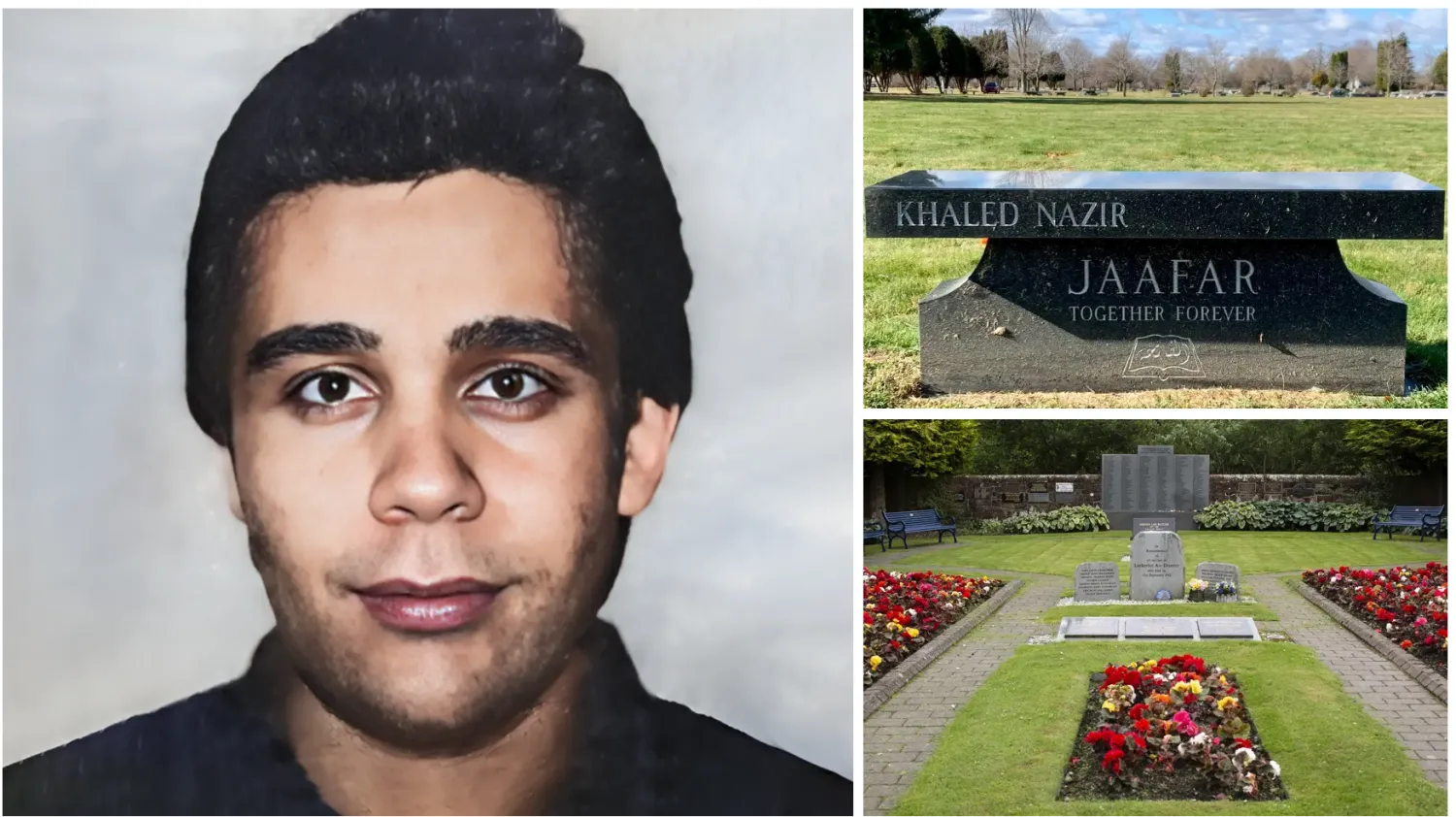

Passenger 53 on Flight 103: The Lebanese-American Haunted by Lockerbie in Life and Death

A photo of Lebanese-American Khaled Nazir Jaafar and his memorial. (Lockerbie Legacy Foundation website)
TT

Passenger 53 on Flight 103: The Lebanese-American Haunted by Lockerbie in Life and Death

A photo of Lebanese-American Khaled Nazir Jaafar and his memorial. (Lockerbie Legacy Foundation website)

On Dec. 21, 1988, Lebanese-American Khaled Nazir Jafaar boarded Pan Am Flight 103, traveling from Frankfurt to New York via London. He could not have known that the journey would end over the quiet Scottish town of Lockerbie or that his death would become entangled in one of the 20th century’s most complex criminal and political investigations.

The Boeing 747 exploded over Lockerbie, killing 270 people. As wreckage scattered across the Scottish countryside, Jafaar’s story was transformed from that of a young immigrant with plans for his future into the subject of conspiracy theories, accusations and intelligence intrigue stretching from Beirut to Washington.

The case has returned to public attention with “The Bombing of Pan Am 103,” a BBC-Netflix drama starring Patrick J. Adams and Peter Mullan. Beyond the politics of the international prosecution, the series examines the victims, their families and the initial investigation.

Among those stories is Jafaar’s. The architecture student, who occupied seat 53K, became a focus of early suspicion largely because of his background.

Born in Lebanon’s Bekaa Valley, Jafaar grew up in a family that emigrated to the United States and settled in Detroit, Michigan. At 20, he was studying architecture and hoped to build his future there.

A winter trip to Lebanon to visit family before Christmas abruptly ended those plans.

In the immediate aftermath of the bombing, investigators scrutinizing the passenger list quickly focused on Jafaar, the only Arab aboard the flight. His Lebanese origins and the fact that his journey began in Frankfurt fueled theories that he might have been a suicide bomber or an unwitting carrier of explosives planted in his luggage by Palestinian or Iranian groups.

His family in Detroit was left with the ordeal of mourning their son while confronting a terrorism stigma that followed his name in the international media for years.

Jafaar subsequently became central to an alternative theory of the Lockerbie bombing advanced for years by defense teams and prominent journalists.

The theory alleged that, because of his travel between Lebanon and Germany, Jafaar had been unwittingly drawn into a drug-smuggling network operating under the protection of the CIA and US Drug Enforcement Administration as part of a covert operation linked to efforts to secure the release of American hostages held in Beirut.

According to that scenario, the Popular Front for the Liberation of Palestine-General Command penetrated the protected route at Frankfurt Airport and substituted a suitcase containing a radio packed with Semtex for a drug shipment associated with Jafaar. The bomb was then allegedly transferred through a feeder flight to London Heathrow and loaded aboard Flight 103 without inspection.

Jafaar’s name also became intertwined in intelligence reports and competing theories with that of Badri Hassan, a figure linked to Libyan intelligence and to Swiss electronics company MEBO, which manufactured timers connected to the bombing investigation.

These claims helped sustain for years the so-called suitcase-switch theory and allegations that a protected drug-smuggling route had been exploited to place the bomb aboard the aircraft.

But forensic evidence presented before the special Scottish court ultimately pointed investigators in another direction.

Travel records and subsequent inquiries established that Jafaar had not checked luggage into the Boeing 747’s cargo hold. He carried two small pieces of hand luggage into the passenger cabin, including a cylindrical cloth bag.

After the explosion, investigators recovered both bags largely intact near Langholm, about 13 kilometers east of Lockerbie. They still contained Jafaar’s identification, wallet and some cash.

Technical examinations found no traces of explosives, burning or internal charring in his hand luggage. The findings showed that the bomb had detonated in the main baggage container, away from Jafaar and his seat, undermining claims that he had knowingly or unknowingly carried the explosives.

The court cleared Jafaar of involvement and convicted Libyan intelligence officer Abdelbaset al-Megrahi, concluding that the bomb suitcase had originated in Malta rather than through Jafaar in Frankfurt.

Despite his exoneration, Jafaar’s name remained embedded in the political history of Lockerbie — the story of a young Lebanese-American whose architectural ambitions ended aboard Flight 103 and whose reputation became another casualty of the bombing.



Moto Guzzi’s Renovated Lake Como Headquarters Welcomes Motorcycle-Bound Aficionados

Riders and visitors enjoy Guzzi motorcycles displayed at the museum during the Guzzi opening inaugurating its completely redeveloped historic factory and new museum as the motorcycle maker celebrates its 105th anniversary, in Mandello del Lario, Thursday, Sept. 3, 2026. (AP)
TT

Moto Guzzi’s Renovated Lake Como Headquarters Welcomes Motorcycle-Bound Aficionados

Riders and visitors enjoy Guzzi motorcycles displayed at the museum during the Guzzi opening inaugurating its completely redeveloped historic factory and new museum as the motorcycle maker celebrates its 105th anniversary, in Mandello del Lario, Thursday, Sept. 3, 2026. (AP)

After extensive renovation by the Italian motorcycle manufacturer Moto Guzzi, aficionados this year had fresh reasons for a pilgrimage to the lakeside spot where their beloved two-cylinder bikes are hand-built.

Thousands of Moto Guzzi riders pulled up Saturday for an annual gathering and informal ride along the winding lakeside roads. They started arriving on Thursday for the unveiling of the headquarters, new museum and expanded factory on the shores of northern Italy’s Lake Como.

The headquarters, nestled between a mountainside and the lakeshore, received an additional 5,500 square meters (nearly 60,000 square feet) for factory space and the museum that honors the iconic brand that has been owned by Vespa-maker Piaggio since 2004. Works took five years and cost more than 50 million euros ($58 million).

Timothy Bennett, who lives in the US state of Georgia, was making his second trip to the headquarters after attending a toned-down 100th anniversary celebration during the pandemic. His first Moto Guzzi — made distinctive by its dual cylinders projecting from either side of the bike — was an 850-T, and now he owns a 2018 California 1400 Touring.

“I’ve owned a Moto Guzzi since my 20s,” said Bennett, 58. “The first time I saw one in a magazine, I thought it looked very interesting. And then I went ahead and saved up some money and bought a used one, and fell in love.”

This year, Bennett and other visitors to the World Guzzi Days could peek through new observation points to see workers hand-assembling the motorcycles, just as they have for 105 years. The company prides itself on its processes.

“Moto Guzzi is handmade, it is an artisanal product, it’s a piece of art,” said Matteo Boddi, head of manufacturing for the Piaggio Group. “And we never substitute automation for this core part. Automation is for safety and for sustainability.”

The new factory includes the addition of an automation belt to move parts and engines through the factories and robotics to transport the finished motorcycles for their final test. The factory expansion potentially doubles the maximum production to 30,000 motorcycles a year.

“We tried to make an accessible place both for passionate motorcyclists and people who are just curious about motorcycles being made in Italy, on Lake Como, and may never even have heard of Moto Guzzi before,” said US architect Greg Lynn.

Celebrity spottings and weddings have long been a pastime at Lake Como, known for its majestic views of the Alps. The lake is featured in the James Bond film Casino Royale, and George Clooney owns a villa on its shore. But that glitz isn't why the Moto Guzzi fans turn out in droves.

Roland Rampnoux has been visiting the factory regularly since 1980 and belongs to a 150-strong Moto Guzzi club in Paris. He was impressed by the factory, but his interest was mostly in the bikes and the camaraderie.

“I like the mentality of the people who ride them,” Rampnoux said. “When you see a Moto Guzzi it is immediately recognizable. It is a legendary brand.”


Sydney Sweats in Spring Hot Spell, Faces ‘Extreme’ Bushfire Risk

A ferry passes in front of apartments in Sydney, Australia, August 18, 2026. (Reuters)
TT

Sydney Sweats in Spring Hot Spell, Faces ‘Extreme’ Bushfire Risk

A ferry passes in front of apartments in Sydney, Australia, August 18, 2026. (Reuters)

Australia's most ‌populous city Sydney baked in a burst of sweltering spring heat on Saturday, raising the risk of bushfires and prompting authorities to issue a ban on lighting fires.

The heat comes as a powerful El Nino weather pattern in the Pacific, expected to be among the strongest in decades, drives hotter and drier ‌conditions across ‌southern Australia during the September-November spring ‌season.

On ⁠Saturday, the nation's ⁠weather forecaster said temperatures in the New South Wales capital, home to 5.6 million people, were set to hit 33 degrees Celsius (91.4 degrees Fahrenheit), nearly 13C above average.

At Sydney Airport, the temperature ⁠was already 28.6C (83.48F) at 11:30 ‌a.m. (0130 GMT)local ‌time, more than seven degrees above the September mean ‌maximum temperature, according to forecaster data.

"Fresh ‌to strong and gusty northwesterly winds developing during the morning, combined with dry, unseasonably warm conditions, will result in elevated fire dangers ‌across the Greater Sydney Region today," the forecaster said.

State fire authorities ⁠issued ⁠a total fire ban for Sydney where they rated fire risk as "extreme", the second highest danger rating.

Climate change is causing extreme heat and fire weather to become more common in Australia, a bushfire-prone country of around 27 million. In January, thousands of firefighters battled bushfires in the southeast that razed homes, cut power to thousands of homes and burned swathes of bushland.


How Haze from Indonesian Fires Impacts Southeast Asia

This aerial photo taken from a commercial plane shows haze from Indonesian forest fires blanketing a residential district in Kuching, the capital city of Sarawak state on the island of Borneo on September 5, 2026. (AFP)
TT

How Haze from Indonesian Fires Impacts Southeast Asia

This aerial photo taken from a commercial plane shows haze from Indonesian forest fires blanketing a residential district in Kuching, the capital city of Sarawak state on the island of Borneo on September 5, 2026. (AFP)

Thick smog has blanketed parts of Indonesia as the vast archipelago for weeks battles to contain fires that have burned large swathes of Borneo and Sumatra.

The hazardous smoke has led to an increase in respiratory problems, forced schools to close, and has been drifting to neighbouring countries including -- Malaysia, Singapore, and the Philippines.

Here's what to know:

- Where are the fires? -

Most of the fires are concentrated on Borneo island, home to vast tropical jungle that Indonesia shares with Brunei and Malaysia, as well as Sumatra.

So far this year, nearly 300,000 hectares of land have burned in Indonesia, according to an independent estimate from the Nusantara Atlas portal.

Indonesia saw an uptick in carbon emissions since late July, and by the end of last month the levels were comparable to previous El Nino years of 2015 and 2019, Copernicus Atmosphere Monitoring Service (CAMS) senior scientist Mark Parrington told AFP.

"We're seeing already now... really extreme fire emissions comparable to those previous strong El Nino years, and also the extent of the smoke and the haze and the air quality impacts," Parrington said.

Fires in the archipelago have released more than 23 million metric tons of carbon emissions between August 28 and September 3, according to CAMS' Fire Emission Watch portal.

It was higher than 20.7 million metric tons of emissions from fires over the same period in 2015, which was a strong El Nino year.

- What causes the fires? -

Analysts said that the El Nino weather phenomenon, which the United Nations said this week could turn out to be the strongest in four decades, has contributed to creating drier conditions in Indonesia and made it easier for fires to spread.

But slash-and-burn land-clearing practices also contributed to the damage, said David Gaveau, founder of the Nusantara Atlas.

"El Nino does not ignite fires. It creates the dry conditions that allow human-started fires to escape and become very large," he told AFP.

The fires are difficult to extinguish because many occurred on peatlands, a wetland ecosystem with layers of partially decomposed organic materials that become flammable when dry.

Between January and August this year, more than 210,000 hotspots were detected in peatland areas across the country, according to NGO Pantau Gambut.

"Peat is a naturally wet ecosystem and stores large amounts of organic material. When peat is drained, this organic material is converted into fuel," Pantau Gambut spokesman Wahyu Perdana said.

- What is the impact? -

More than five million people across Borneo and Sumatra are directly exposed to the health risks from haze, deputy health minister Dante Saksono Harbuwono said last month.

Over 1.4 million students were attending classes remotely, with many schools closed due to worsening air quality, an education ministry official said this week.

In Malaysia, soaring pollution levels prompted the government on Friday to declare an emergency in a region of the Sarawak state in Borneo, with nearly 650 schools closed next week.

In the Philippines, air quality was slowly returning to normal after a week of reaching "very unhealthy" and "severely unhealthy" PM 2.5 levels that saw officials shutter schools in cities and provinces citing the drifting haze.

The haze also drove air quality in Singapore's central region to an "unhealthy" level on Friday, the country's National Environment Agency data showed.