

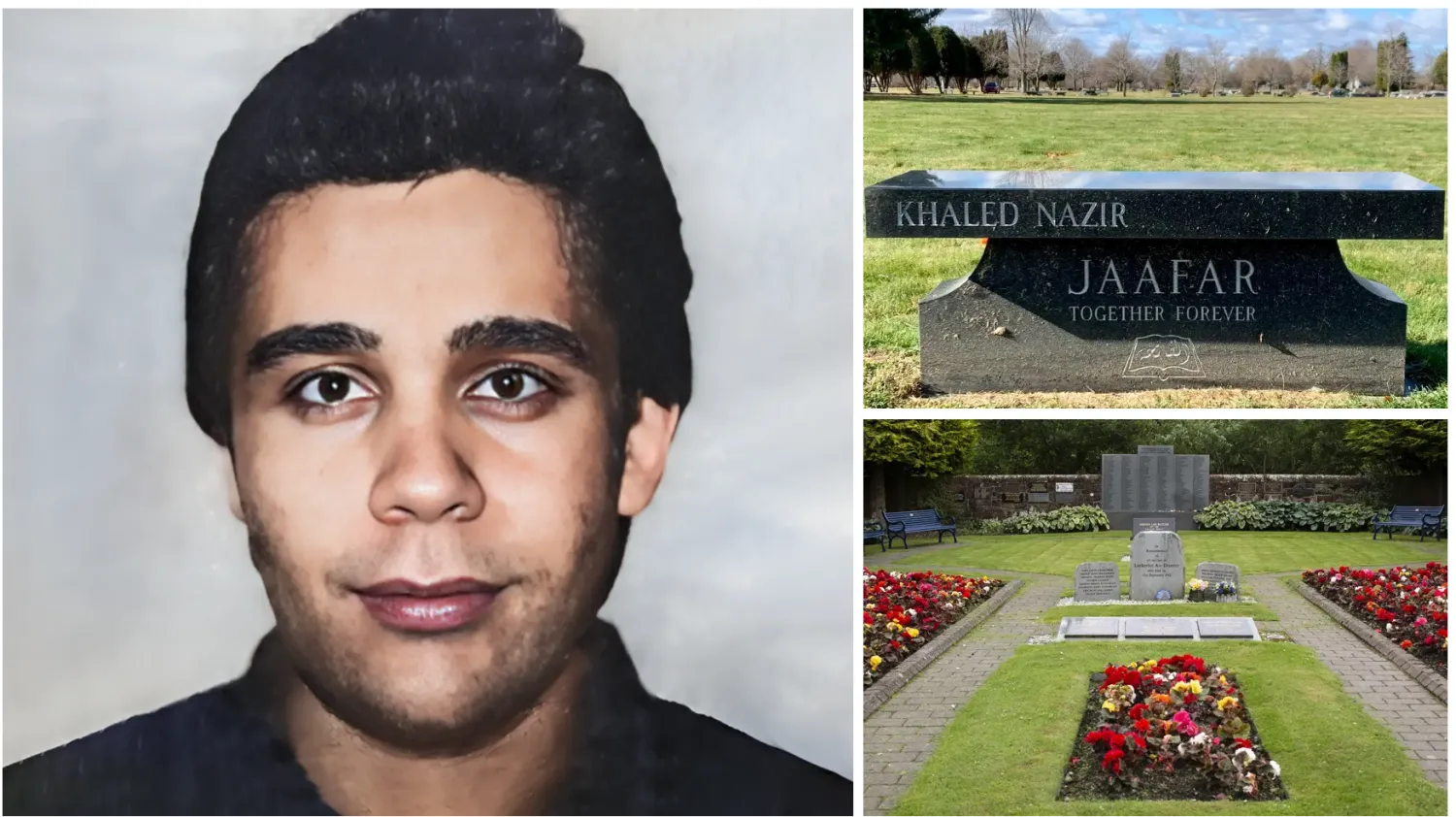

Passenger 53 on Flight 103: The Lebanese-American Haunted by Lockerbie in Life and Death

A photo of Lebanese-American Khaled Nazir Jaafar and his memorial. (Lockerbie Legacy Foundation website)
TT

Passenger 53 on Flight 103: The Lebanese-American Haunted by Lockerbie in Life and Death

A photo of Lebanese-American Khaled Nazir Jaafar and his memorial. (Lockerbie Legacy Foundation website)

On Dec. 21, 1988, Lebanese-American Khaled Nazir Jafaar boarded Pan Am Flight 103, traveling from Frankfurt to New York via London. He could not have known that the journey would end over the quiet Scottish town of Lockerbie or that his death would become entangled in one of the 20th century’s most complex criminal and political investigations.

The Boeing 747 exploded over Lockerbie, killing 270 people. As wreckage scattered across the Scottish countryside, Jafaar’s story was transformed from that of a young immigrant with plans for his future into the subject of conspiracy theories, accusations and intelligence intrigue stretching from Beirut to Washington.

The case has returned to public attention with “The Bombing of Pan Am 103,” a BBC-Netflix drama starring Patrick J. Adams and Peter Mullan. Beyond the politics of the international prosecution, the series examines the victims, their families and the initial investigation.

Among those stories is Jafaar’s. The architecture student, who occupied seat 53K, became a focus of early suspicion largely because of his background.

Born in Lebanon’s Bekaa Valley, Jafaar grew up in a family that emigrated to the United States and settled in Detroit, Michigan. At 20, he was studying architecture and hoped to build his future there.

A winter trip to Lebanon to visit family before Christmas abruptly ended those plans.

In the immediate aftermath of the bombing, investigators scrutinizing the passenger list quickly focused on Jafaar, the only Arab aboard the flight. His Lebanese origins and the fact that his journey began in Frankfurt fueled theories that he might have been a suicide bomber or an unwitting carrier of explosives planted in his luggage by Palestinian or Iranian groups.

His family in Detroit was left with the ordeal of mourning their son while confronting a terrorism stigma that followed his name in the international media for years.

Jafaar subsequently became central to an alternative theory of the Lockerbie bombing advanced for years by defense teams and prominent journalists.

The theory alleged that, because of his travel between Lebanon and Germany, Jafaar had been unwittingly drawn into a drug-smuggling network operating under the protection of the CIA and US Drug Enforcement Administration as part of a covert operation linked to efforts to secure the release of American hostages held in Beirut.

According to that scenario, the Popular Front for the Liberation of Palestine-General Command penetrated the protected route at Frankfurt Airport and substituted a suitcase containing a radio packed with Semtex for a drug shipment associated with Jafaar. The bomb was then allegedly transferred through a feeder flight to London Heathrow and loaded aboard Flight 103 without inspection.

Jafaar’s name also became intertwined in intelligence reports and competing theories with that of Badri Hassan, a figure linked to Libyan intelligence and to Swiss electronics company MEBO, which manufactured timers connected to the bombing investigation.

These claims helped sustain for years the so-called suitcase-switch theory and allegations that a protected drug-smuggling route had been exploited to place the bomb aboard the aircraft.

But forensic evidence presented before the special Scottish court ultimately pointed investigators in another direction.

Travel records and subsequent inquiries established that Jafaar had not checked luggage into the Boeing 747’s cargo hold. He carried two small pieces of hand luggage into the passenger cabin, including a cylindrical cloth bag.

After the explosion, investigators recovered both bags largely intact near Langholm, about 13 kilometers east of Lockerbie. They still contained Jafaar’s identification, wallet and some cash.

Technical examinations found no traces of explosives, burning or internal charring in his hand luggage. The findings showed that the bomb had detonated in the main baggage container, away from Jafaar and his seat, undermining claims that he had knowingly or unknowingly carried the explosives.

The court cleared Jafaar of involvement and convicted Libyan intelligence officer Abdelbaset al-Megrahi, concluding that the bomb suitcase had originated in Malta rather than through Jafaar in Frankfurt.

Despite his exoneration, Jafaar’s name remained embedded in the political history of Lockerbie — the story of a young Lebanese-American whose architectural ambitions ended aboard Flight 103 and whose reputation became another casualty of the bombing.



Typhoon Saudel Heads West After Pounding Japan’s Southwestern Remote Islands, Injuring 2

Shops cover their merchandise in plastic to protect it from the rain as Typhoon Saudel passes in Naha on August 26, 2026. (AFP)
TT

Typhoon Saudel Heads West After Pounding Japan’s Southwestern Remote Islands, Injuring 2

Shops cover their merchandise in plastic to protect it from the rain as Typhoon Saudel passes in Naha on August 26, 2026. (AFP)

A powerful typhoon headed west over the East China Sea on Wednesday after slamming Okinawa and other remote southwestern Japanese islands, causing blackouts, flight cancellations and threatening landslides. Two people were slightly injured.

Typhoon Saudel was about 180 kilometers (112 miles) northwest of Okinoerabu island, packing winds of up to 144 kph (89 mph) as of late morning Wednesday as it headed toward China's eastern coast, the Japan Meteorological Agency said.

Saudel left two people with minor injuries, the Fire and Disaster Management Agency and prefectural officials said Wednesday.

A 78-year-old woman suffered a head injury when she was blown by the wind and fell to the ground outside her home in the city of Uruma on the island of Okinawa.

In nearby Amamioshima island, a woman in her 70s fell from the stairs during a blackout caused by the typhoon, according to NHK public television.

Some 150 flights to and from Okinawa's Naha airport have been canceled. The typhoon also caused power outages for more than 30,000 homes in Kagoshima prefecture, which includes the Amami area, the Kyushu Electric Power Co. said.

More than 23 centimeters (9 inches) of rain fell in the Amami region over the past 24 hours, the JMA said, predicting more rain of up to 10 centimeter (3.9 inches) in the area and up to 12 centimeters (4.7 inches) of rainfall on Okinawa through midday Thursday.

The agency issued a landslide warning for the Amami region.


Australian Police Hunt Thieves in $250,000 Oyster Heist

Oysters are a staple of brunch menus and seafood buffets across Australia. (Getty Images)
TT

Australian Police Hunt Thieves in $250,000 Oyster Heist

Oysters are a staple of brunch menus and seafood buffets across Australia. (Getty Images)

Australian police said Wednesday they were on the hunt for thieves who made off with hundreds of thousands of oysters.

The mollusks have an estimated total value of Aus$350,000 (US$250,000) and were lifted from an oyster farm near the town of Taree, north of Sydney, New South Wales police said.

Over three hundred bags, containing 400,000 oysters, were stolen.

Police are urging the public to come forward with any information they might have about the theft, which they said happened "earlier this year" but was only reported to them on Tuesday.

Oysters are a staple of brunch menus and seafood buffets across Australia, with local varieties famed for their rich, creamy flavor.

Oyster grower Ryan Freeman told national broadcaster ABC he had lost a third of his stock.

"We probably get through 35,000 to 40,000 dozen at Christmas time," he said.

"That's why the thieves would have targeted them because they're not going to be far off, they're going to be able to sell them this Christmas," he added.

"It's going to have a massive impact."


New NASA Telescope to Probe Dark Energy, Dark Matter and Exoplanets

NASA's Nancy Grace Roman Space Telescope stands after engineers and technicians working inside the Payload Hazardous Servicing Facility mated the observatory to its payload adapter and a strut payload attach fitting, a specialized piece of hardware designed for large, heavy loads at NASA's Kennedy Space Center in Cape, Canaveral, Florida, US August 7, 2026 NASA/Jolearra Tshiteya via REUTERS
TT

New NASA Telescope to Probe Dark Energy, Dark Matter and Exoplanets

NASA's Nancy Grace Roman Space Telescope stands after engineers and technicians working inside the Payload Hazardous Servicing Facility mated the observatory to its payload adapter and a strut payload attach fitting, a specialized piece of hardware designed for large, heavy loads at NASA's Kennedy Space Center in Cape, Canaveral, Florida, US August 7, 2026 NASA/Jolearra Tshiteya via REUTERS

NASA is preparing to launch its next flagship space observatory, one that scientists plan to use to investigate some of the universe's biggest mysteries including dark energy and dark matter, while also testing gravity at vast scales and hunting for planets beyond our solar system.

The launch of the Nancy Grace Roman Space Telescope, a roughly $4 billion project, is planned for Sunday at NASA's Kennedy Space Center in Florida, with the observatory to be lofted into orbit aboard a SpaceX Falcon Heavy rocket. The launch comes nine months ahead of schedule, according to US space agency officials.

Roman is a follow-on to the Hubble Space Telescope, launched in 1990, and the James Webb Space Telescope, launched in 2021, and has capabilities that can expand on the knowledge gained by those pioneering observatories, both of which continue to operate.

The new telescope's panoramic view of space and its rapid survey speeds offer the opportunity for scientists to study the cosmos as never before, with wide-field surveys examining its structure, composition and evolution.

"Roman's vast reach will allow us to find the weird, the rare and the unusual," Julie McEnery, Roman's senior project scientist ⁠at NASA's Goddard ⁠Space Flight Center in Maryland, told reporters.

"Roman's primary instrument combines exquisite performance and sensitivity with the ability to quickly and efficiently survey the large regions of the sky," Reuters quoted McEnery as saying.

The telescope's main survey will take more than a year, McEnery said.

"The survey will contain over two billion galaxies and enable us to study how the structures in our universe — the stars, the galaxies, the clusters of galaxies — grew and evolved. We'll also measure how our universe has expanded over time. And these are the keys that will allow us to unlock the fundamental nature of dark matter and dark energy and the fabric of the universe itself," McEnery said.

The Big Bang event roughly 13.8 billion years ago initiated the universe, and ⁠it has been expanding ever since. Scientists in 1998 disclosed that this expansion was actually accelerating, with an invisible force called dark energy as the hypothesized reason.

The universe's contents include ordinary matter — stars, planets, gas, dust and all the familiar stuff on Earth — as well as dark matter and dark energy, whose physical nature remains unknown. Ordinary matter represents perhaps 5% of the contents. Dark matter, known through its gravitational influences on galaxies and stars, may represent about 27%. Dark energy may represent about 68%.

"The key questions are: Is dark energy simply a property of empty space that remains constant over time, or does it evolve in time?" cosmologist Mustapha Ishak of the University of Texas at Dallas, a member of Roman's scientific collaboration, told Reuters.

"The recent results from the DESI — Dark Energy Spectroscopic Instrument — collaboration indicate tantalizing hints of a time evolution of dark energy.

Could the observed acceleration instead indicate that our theory of gravity needs modification on the largest scales? Answering these questions is one of the most important goals of modern cosmology," Ishak said.

Physicist Albert Einstein in 1915 presented his theory of general ⁠relativity explaining gravity, and it ⁠remains foundational.

Roman will map how galaxies cluster and how matter bends light through a phenomenon called gravitational lensing.

"These measurements allow us to test whether Einstein's theory remains valid across billions of light-years or whether modifications to gravity (theory) are required," said Ishak. "This is important because it addresses one of the most fundamental questions in physics: What law governs the universe on its largest scales?"

To date, more than 6,350 exoplanets — planets outside our solar system — have been discovered, as scientists search for evidence of potential life beyond Earth.

Roman will conduct one of the most comprehensive searches ever for exoplanets. It is expected to discover thousands of new ones and provide the first statistical census of planetary systems similar to our own. It also will demonstrate new technology to directly image some relatively nearby exoplanets.

After launch and separation from the rocket, the telescope will travel toward a location called Lagrange Point 2, situated about a million miles (1.6 million km) from Earth, about four times the distance to the moon. Webb also resides at this orbital location. Hubble is in low-Earth orbit.

Roman's mission is planned for five years, though NASA said the telescope may have enough fuel for five additional years. US President Donald Trump's administration tried during both his first and second terms to reduce or eliminate funding for Roman, but Congress preserved it.

The telescope is named after Nancy Grace Roman, NASA's first chief astronomer. Roman died in 2018 at age 93.