

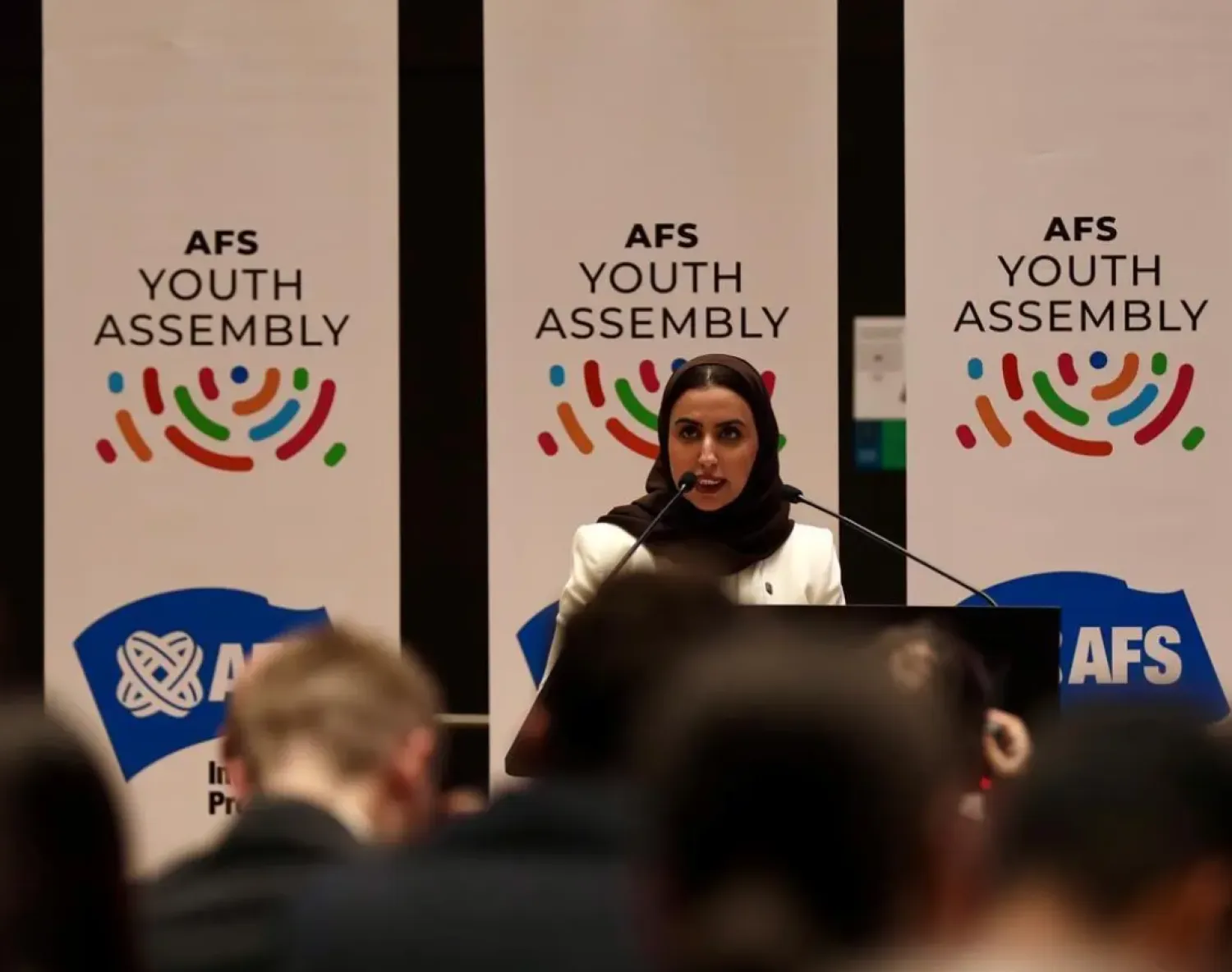

Misk Foundation and UN Youth Office Announce Establishment of Global Network for Youth

The network is the first platform of its kind established by Misk  - SPA
The network is the first platform of its kind established by Misk - SPA
TT

Misk Foundation and UN Youth Office Announce Establishment of Global Network for Youth

The network is the first platform of its kind established by Misk  - SPA
The network is the first platform of its kind established by Misk - SPA

The Mohammed bin Salman Foundation (Misk), in collaboration with the United Nations Youth Office, announced on Tuesday the establishment of the Global Network for Youth, a new international network connecting independent global organizations working to serve youth with leadership and policymaking pathways at the global level.

The announcement was made during the convening of the AFS Youth Assembly in Geneva, coinciding with International Youth Day.
The Global Network for Youth will be officially launched during the United Nations General Assembly in New York in September 2026, SPA reported.

The network is the first platform of its kind established by Misk in collaboration with the UN Youth Office, building on a partnership between the two dating back to 2018.

It brings together independent youth-focused organizations from different regions and provides tailored pathways enabling young people to participate in global policymaking and decision-making.

The network operates around four pillars: strengthening young people's capacities in public policy and advocacy; creating clear pathways to UN platforms and global forums; amplifying diverse youth voices and those of underrepresented groups; and equipping member organizations with tools, data, and shared knowledge.



Cat Missing For 10 Years Returns Home on Owner's 30th Birthday

Charlie's owners described her as a “bit fiery”. (Lucy Roberston)
TT

Cat Missing For 10 Years Returns Home on Owner's 30th Birthday

Charlie's owners described her as a “bit fiery”. (Lucy Roberston)

A 13-year-old tabby cat that went missing 10 years ago has found her way back home.

Her owners Lucy and Hannah Robertson were “heartbroken” in April 2016 when Charlie, then three-years-old, disappeared.

As an outdoor cat, Charlie would spend her days roaming the streets but one day, after recently moving to a new area, she never returned home.

The family spent months looking, never finding any leads.

But last month, the “impossible” happened on Lucy's 30th birthday, they received a call from the vet saying Charlie had been found.

Hannah, 37, moved from Newbridge to Abercarn, in Caerphilly county, a few miles away, 10 years ago.

Within three days, Charlie, whom she described as a “bit fiery,” had vanished.

“We did have one or two tip-offs... we tried to find her, but we kept missing her,” Hannah said. “We never lost hope. But sadly, we just couldn't find her,” she told BBC Radio Wales Drive.

Lucy said that, despite having asked around, as well as posting on Facebook, there was no sign of Charlie.

“It was heartbreaking. We were scared that she had been knocked over or that she wasn't around anymore,” she said.

But on 29 July, Hannah was left “gobsmacked” after receiving a call from a veterinary practice in Abercarn saying Charlie had been found.

A person living nearby had found Charlie living in bushes, feeding the supposed stray for weeks before taking her to the vets, who called Hannah from the number found on the microchip.

The vet was also “really shocked” to find out the cat had been missing for a decade, Hannah said.

The friendly tabby was in great health, her fur was fine and she did not look “disheveled.”

“She's been on an adventure,” Hannah said, and that she guessed “we'll never know” what happened to Charlie.

Lucy said their beloved pet had recognized them “straight away,” describing it as “lovely, because we didn't expect that.”

“She doesn't look much different at all, she looks exactly the same as the old photos we have of her,” she said.

Lucy said that it “is a bit of a work in progress” getting her used to living with their other pets, “but we're definitely getting there.”

However, Charlie had been loving the “food and attention,” Lucy said and was just as friendly as she was 10 years ago.

She had also been enjoying the “attention”, Lucy said. “Right now I feel like she knows she's a bit of a celebrity.”


Whales Spark Joy in New York but Face Threats from Boat Traffic

A humpback whale surfaces in the Atlantic Ocean off the coast of New York City on August 13, 2026. TIMOTHY A. CLARY / AFP
TT

Whales Spark Joy in New York but Face Threats from Boat Traffic

A humpback whale surfaces in the Atlantic Ocean off the coast of New York City on August 13, 2026. TIMOTHY A. CLARY / AFP

"WHALE AT ONE O'CLOCK!"

Eager cruise passengers zipping around New York's southern shores rush to the starboard bow: a humpback whale is up for air, a breathtaking sighting set against Manhattan's iconic skyline.

Such scenes are no longer uncommon in the city's waterways, sparking excitement for animal lovers but also forcing new policy efforts to protect whales venturing into one of the busiest port regions in the United States, said AFP.

Once hunted to near extinction, the rebound of humpback whales is considered among the conservation movement's greatest success stories.

And a growing cohort of mostly juvenile humpbacks are thriving off New York's coast, where food is now plentiful.

"People fly to different parts of the world to go on safari, and what I think a lot of people don't realize is that the marine safari is right out here," said Carl LoBue, New York oceans director at The Nature Conservancy.

The marine scientist who grew up on nearby Long Island told AFP that in the past, whale sightings were an "incredibly unusual event."

LoBue now spots the marine mammals basically every time he's out on the water. He generally sees humpbacks but sometimes other species including the still critically endangered North Atlantic Right whale.

The new normal is "spectacular," he said.

"I never thought that I would see whales like this off the coast of New York."

- Cleaner water, climate change and more fish -

Humpbacks were once mainly migratory visitors, traversing the New York Bight -- the marine region that extends off the city, Long Island and New Jersey -- while traveling between foraging grounds further north and breeding areas in the Caribbean.

But more recently, a confluence of factors has made New York's coast less of a highway and more of a stomping ground.

One is the resurgence of whale populations thanks to government action including the Endangered Species Act, as well as a cleaner habitat supported by air and water protections.

Another is the existence of relatively new statutes that support growing schools of the Atlantic menhaden, an oily fish with a variety of industrial uses like commercial bait and omega-3 supplements.

It is also a staple for whales, dolphins and seabirds.

Humpbacks, which can grow to the size of a large city bus, can feast on some 3,000 pounds (1360 kilograms) of fish a day.

Climate change also plays a role in the surge of New York-area whale sightings.

Warming waters are impacting bait fish distributions, encouraging whales to stray from tradition to find food, said Chris St. Lawrence, a naturalist who conducts whale watching tours and also works for Gotham Whale, a marine research organization that tracks whales in the Bight.

When Gotham began formally monitoring in 2012, they had just five whales in their catalog.

Today, St. Lawrence said the organization sees 80 to 100 unique whales annually, and just identified its 500th individual whale seen around New York City since tracking began.

Some routinely put on a show: NYC0318, a whale also seen by AFP on a recent outing, often charms whale watchers with sensational lunge-feeds, breaching the water and prompting shrieks of delight.

- Maritime traffic dangers -

Gotham is able to distinguish between the animals largely thanks to "fluke prints": whales have unique patterns on the underside of their tails, similar to human fingerprints, St. Lawrence explained.

But many whales are also identifiable by their scars, including from collisions with everything from tankers, cargo and cruise ships to fishing boats and recreational vessels.

Because while New York offers bountiful food, it also hosts heavy maritime traffic, posing fresh threats to the whale population.

In 2016, humpbacks in the New York area were delisted as endangered, but just one year later the US National Oceanic and Atmospheric Administration (NOAA) declared an "Unusual Mortality Event" along the Atlantic coast.

The designation under the US Marine Mammal Protection Act tracks unexpected die-offs and triggers investigation. For humpbacks, it remains in effect.

Vessel strikes and entanglements are leading causes of whale deaths, according to advocacy groups and government trackers worldwide.

Just this month, New York Governor Kathy Hochul signed the Whale Awareness Act, which requires integrating marine mammal protection efforts and education into state boater safety courses and vessel registration.

LoBue has worked to develop educational materials, including an online course that teaches seafarers how to recognize whale behavior, report sightings and avoid collision.

He noted that even the most seasoned fishermen "didn't grow up driving boats around whales because they didn't used to be here."

"We're all needing to learn some new skills," he said.

"Nobody wants to hit a whale."


NCW, NEOM Celebrate First Striped Hyena Birth

Striped hyenas play an important ecological role by feeding on carcasses and carrion - SPA
TT

NCW, NEOM Celebrate First Striped Hyena Birth

Striped hyenas play an important ecological role by feeding on carcasses and carrion - SPA

The National Center for Wildlife (NCW), in collaboration with NEOM, has documented the first birth of a striped hyena following the reintroduction of two breeding pairs into NEOM Nature Reserve. The birth is a positive indication of the hyenas’ successful adaptation to the reserve and their ability to reproduce in the wild.

According to a press release issued by the NCW, the birth marks another milestone in NCW’s wildlife breeding and reintroduction programs, which include dedicated efforts for predator species aimed at restoring their natural roles within ecosystems.

Prior to the release, two pairs of striped hyenas were selected and underwent a rehabilitation program at one of NCW’s wildlife care facilities, SPA reported.

The program included veterinary examinations, health monitoring, and preparation for their transition into the wild. A specialized NCW team also conducted a field assessment of the reintroduction site to verify its readiness and ecological suitability for the hyenas.

NCW CEO Dr. Mohammed Qurban said: "This is the first striped hyena birth following their reintroduction, and it marks an important milestone in the center’s wildlife breeding and reintroduction programs.”

He emphasized that reintroducing species into their natural habitats represents an advanced stage in establishing populations capable of surviving and reproducing in the wild and restoring their ecological roles.

Striped hyenas play an important ecological role by feeding on carcasses and carrion. Their populations have declined in parts of their natural range due to several threats, particularly hunting and poisoning.