

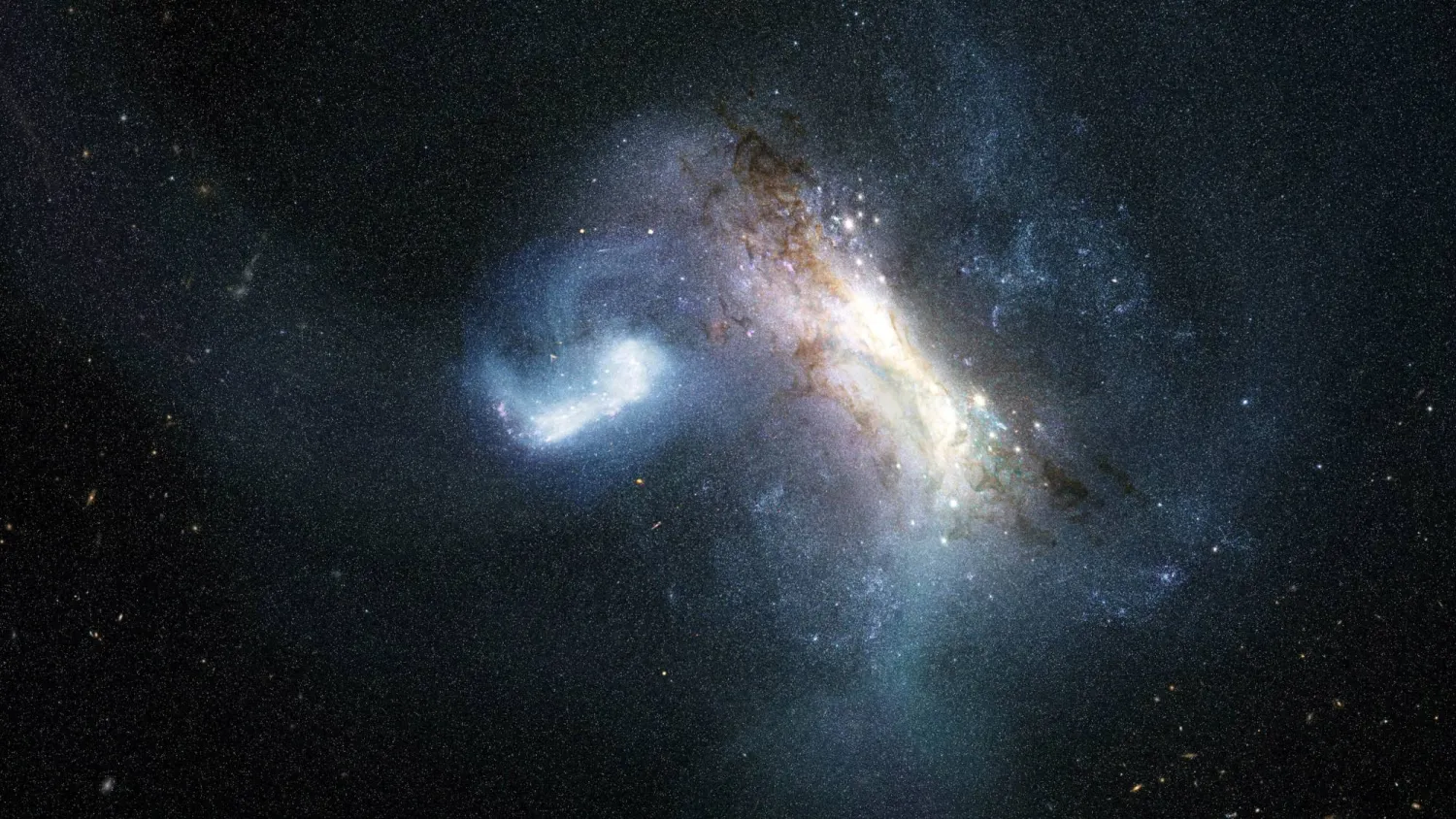

The Milky Way Devoured Smaller Galaxy About 11.8 Billion Years Ago

The collision about 11.8 billion years ago, when a dwarf galaxy known as LKH collided with the Milky Way and merged with it, appears in an artist's concept released on August 17, 2026.  NASA, ESA, Joseph Olmsted (STScI)/Handout via REUTERS
The collision about 11.8 billion years ago, when a dwarf galaxy known as LKH collided with the Milky Way and merged with it, appears in an artist's concept released on August 17, 2026. NASA, ESA, Joseph Olmsted (STScI)/Handout via REUTERS
TT

The Milky Way Devoured Smaller Galaxy About 11.8 Billion Years Ago

The collision about 11.8 billion years ago, when a dwarf galaxy known as LKH collided with the Milky Way and merged with it, appears in an artist's concept released on August 17, 2026.  NASA, ESA, Joseph Olmsted (STScI)/Handout via REUTERS
The collision about 11.8 billion years ago, when a dwarf galaxy known as LKH collided with the Milky Way and merged with it, appears in an artist's concept released on August 17, 2026. NASA, ESA, Joseph Olmsted (STScI)/Handout via REUTERS

The Milky Way, a large and spiral-shaped galaxy that is home to hundreds of billions of stars including our sun, has taken a long and complicated path to achieve its current dimensions, as illustrated by new research documenting a milestone event early in its history.

Scientists observing clusters of stars congregated near the Milky Way's center have discovered evidence that our galaxy swallowed a smaller galaxy roughly 11.8 billion years ago, when the universe was less than 15% of its current age. The event represents the Milky Way's earliest-known galactic merger and shows how it grew not only by forming its own stars but by merging with smaller galaxies caught in its gravitational pull.

The smaller galaxy is classified as a dwarf galaxy, differentiating it from larger galaxies like the Milky Way. The researchers estimate that it contained stars with a mass equivalent to 500 million times that ⁠of the sun ⁠at the time of the merger, about a quarter the size of what the Milky Way was at the time.

The researchers used the orbiting Hubble and Gaia telescopes to study stellar clusters, each containing hundreds of thousands of stars, inhabiting a region spanning the Milky Way's innermost 20,000 light-years, gauging their age, chemical composition and trajectory. A light-year is the distance light travels in a year, 5.9 trillion miles (9.5 trillion km).

These stars became part of the Milky Way after a galactic merger that occurred about 2 billion years after the Big Bang event that initiated the ⁠universe, they said. The dwarf galaxy where they originated was given the name Low-energy-Kraken-Heracles, or LKH, in recognition of three earlier studies that examined the possibility of such a primordial merger.

"The key finding of our research is the unambiguous discovery of the first merger event experienced by our galaxy in its infancy," said astrophysicist Davide Massari of the National Institute for Astrophysics, or INAF, in Bologna, Italy, lead author of the study published in the journal Nature Astronomy.

Whether the Milky Way's early growth was fueled by homegrown star formation or a galactic merger has been a matter of debate, Reuters quoted Massari as saying. The new study indicates that the merger infused the Milky Way early in its history with a large volume of stars and interstellar gas that feeds star formation, as well as the mysterious substance called dark matter.

"I would say that from the point of view of stars, the merger ⁠was rather peaceful, with ⁠no star-to-star crashes. But from the point of view of the gas, the merger was more 'explosive' — likely, the collision between the gas from LKH and that from the Milky Way triggered the formation of many stars," Massari said.

Massari said there are probably many stars that originally formed in the dwarf galaxy that still are buried in the inner regions of the Milky Way, some of them inside stellar clusters. Because of all the interstellar dust in this region, however, it is very difficult to identify individual stars, Massari said.

The Milky Way is known to have been involved in two other massive galactic mergers. It absorbed a dwarf galaxy called Gaia-Sausage-Enceladus about 1.8 billion years after the LKH merger. And over the past approximately 6 billion years it has been combining with the Sagittarius dwarf galaxy.

"Every single one of these mergers had an influence on the events that have led to the formation of our own solar system, and ultimately of Earth," Massari said. "This is why I think that reconstructing the pieces of the Milky Way's past effectively contributes to answering the big question about, 'Where do we come from?'"



Saudi Film Commission Participates in the 2026 Toronto International Film Festival

Saudi Film Commission Participates in the 2026 Toronto International Film Festival
TT

Saudi Film Commission Participates in the 2026 Toronto International Film Festival

Saudi Film Commission Participates in the 2026 Toronto International Film Festival

The Saudi Film Commission is participating in the 51st edition of the Toronto International Film Festival (TIFF), scheduled to take place from September 10 to 20, 2026, in Toronto, Canada, the Saudi Press Agency said on Sunday.

The Commission will have a dedicated Saudi pavilion and an official delegation, joined by representatives from Film AlUla, the Red Sea International Film Festival, and the King Abdulaziz Center for World Culture (Ithra), marking Saudi filmmaking’s presence at one of the world’s most prominent film events.

This participation reflects the Commission’s commitment to building international partnerships and creating collaboration opportunities across the film sector, contributing to the sustainable growth of Saudi Arabia’s cinema industry and strengthening the Kingdom’s position as an attractive destination for film production.

The Saudi pavilion at TIFF 2026 will showcase the Commission’s work developing the film sector and highlight the range of filming locations across the Kingdom, helping attract filmmakers and international production companies. Through this participation, the Commission also aims to strengthen engagement with international media outlets and film institutions as well as promote the Kingdom’s incentive programs and production ecosystem to industry decision-makers.

TIFF is one of the world’s leading film events and one of the most important launch platforms ahead of the awards season. Founded in 1976 in Toronto, the festival has grown into a major gathering point for filmmakers, critics, and film institutions worldwide.

Its 51st edition is expected to feature a wide international lineup of films from numerous countries, alongside the TIFF Film Market, which will be held at the Metro Toronto Convention Centre from September 10 to 16.


Cooking Was Already an Artform in Bronze Age Syria

What they once ate now tells the story of how they lived (SPA)
TT

Cooking Was Already an Artform in Bronze Age Syria

What they once ate now tells the story of how they lived (SPA)

While the folk of Bronze Age Europe were mostly making do with simple stews and bread, people in Syria were already importing ingredients and using pots of differing temperatures to support “sophisticated” cuisine, researchers said on Friday.

The evidence from Danish experts suggests people living in what is now the city of Hama 4,500 years ago were already enjoying dishes of simmered goat, gazelle and cereals, AFP reported.

The city’s cooks used pots with different heating properties depending on the type of meal they were about to prepare, much as we choose between cast-iron or non-stick frying pans today.

Mette Marie Hald, from the National Museum of Copenhagen, and her team reached the conclusion after examining animal bones, plant remains and fats from inside cooking pots found in the city.

“It feels a bit modern, actually, the way that you have different pots and you have different sort of serving wares,” the archaeobotanist told AFP.

Locally produced pots were made from clay and calcite, while others were made from clay mixed with basalt and were imported from as far away as China.

Meals could be prepared with imported ingredients such as gazelle, which itself came from much further east.

Hald said the evidence of “sophisticated cooking” they had uncovered in Hama was supported by recipes written down in much later periods.

Danish archaeologists started digging in Hama in the first half of the 20th century, she said, so there has been quite a lot of research on everyday life there.

But she added that they had not really focused on food culture before.

“This is a period of kingdoms, well-organised cities and stratified societies,” she said.

“In that way, it’s not surprising that they also knew sophisticated cooking. I think the surprising element is we can actually prove it.”


Coastal Erosion Forces Cancellation of California Music Festival

MALIBU, CALIFORNIA - SEPTEMBER 10: People gather near erosion damage along a beach access road to Point Dume, which remains closed due to the erosion from powerful surf and high tides earlier this summer, on September 10, 2026 in Malibu, California. Mario Tama/Getty Images/AFP
TT

Coastal Erosion Forces Cancellation of California Music Festival

MALIBU, CALIFORNIA - SEPTEMBER 10: People gather near erosion damage along a beach access road to Point Dume, which remains closed due to the erosion from powerful surf and high tides earlier this summer, on September 10, 2026 in Malibu, California. Mario Tama/Getty Images/AFP

A music festival set to feature The Killers, Olivia Dean and Jack White was cancelled Friday because the California beach where it was to be held has been eaten away by coastal erosion.

The two-day Ocean Way Festival had been planned for later this month in Santa Monica, but waves up to 15 feet (4.5 meters) and storm runoff has left the beach in the city near Los Angeles badly degraded, forcing local officials to pull the plug.

"Storm surf generated by Hurricane Marie and runoff from a storm drain outfall eroded a large portion of the festival site," AFP quoted a statement from the city of Santa Monica as saying.

The storm, which churned the waters of the Pacific over the last week, stripped sand off the beach, making it no longer safe to hold the festival there, the city said.

"The surf took the beach we planned this on, and we cannot put tens of thousands of festival-goers on that sand until it's safe," said Mayor Caroline Torosis.

The coastal city of Santa Monica -- the official end point of Route 66 -- has a wide stretch of golden sand and a large wooden pier that features frequently in American television shows and movies.

News of the festival cancellation came days after the pounding surf opened a huge sinkhole on the driveway of a beachfront home belonging to Oscar-winning US actor Nicolas Cage.

Officials in Malibu, which sits just north of Santa Monica, have ordered the evacuation of 31 homes because of the danger posed by the hole.

Further south, at least seven homes in Dana Point were declared uninhabitable after the coast on which they sit rapidly eroded, with one house collapsing into the sea.

A similar problem has occurred in nearby Laguna Beach.

The waters of the Pacific Ocean have been unsettled in recent weeks by a series of tropical storms, with some of them developing into hurricanes.

Scientists say a near-record strength El Nino climate episode is warming the ocean's waters and creating extra volatility.

While the phenomenon is part of a natural cycle, human-caused climate change is thought to be super-charging the heating and exacerbating its effects.