


Italian Scientists Bet on Octopus to Fight Crab Invasion

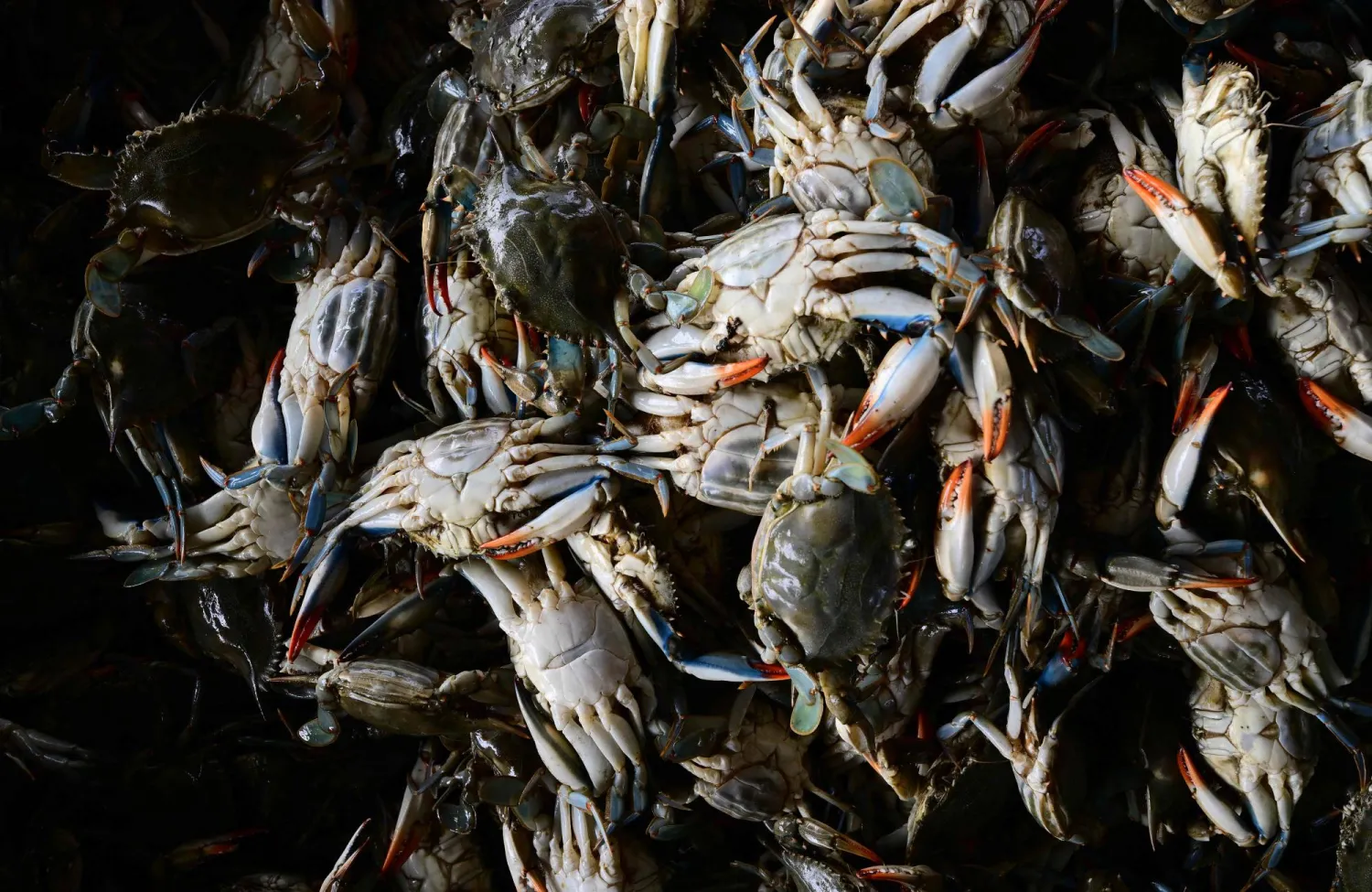
Live blue crabs harvested by local fishermen in the Po river are seen in a waste bucket at Scardovari, Italy, northeast Italy, on June 26, 2026. (AFP)
TT

Italian Scientists Bet on Octopus to Fight Crab Invasion

Live blue crabs harvested by local fishermen in the Po river are seen in a waste bucket at Scardovari, Italy, northeast Italy, on June 26, 2026. (AFP)

From a fishing trawler in the Adriatic, Italian scientists gently release thousands of tiny octopuses in the hope of fighting an invasive crab species that has devastated local fisheries.

A team from the University of Bologna is betting that the common octopus can help contain the burgeoning population of blue crab -- a voracious crustacean that has ravaged shellfish production in the Adriatic.

"We chose the octopus because, in the wild, it is a formidable predator of crustaceans," Antonio Casalini, one of the researchers, told AFP.

Native to the North American Atlantic coast, blue crabs arrived in the Mediterranean decades ago, likely transported via ballast water from ships.

But their numbers have ballooned in recent years, with the government and fishing groups linking the boom to warming waters and climate change.

With sharp, blue-tinted claws that are particularly apt at prying open shells, they have wreaked havoc in Italy's northeast -- one of Europe's top clam producing regions.

Authorities in Bologna's Emilia-Romagna region said last year the species has caused almost 17 million euros ($20 million) in damages there since 2022.

Farming and fishing group Coldiretti has put the figure at about 200 million for the whole of Italy, with the northern Veneto region also badly affected.

"It eats everything including young clams lying on the seabed," said Davide Sanulli a fishermen and mussels farmer with thick eyebrows and grizzled hair, said of the crab.

In lagoon-like areas off the Po River delta "it has caused a massacre", added the 64-year-old, who is helping the university project.

Excellent swimmers and weighing up to one kilogram (2.2 pounds), the crabs have few natural predators -- something the researchers are hoping to change.

- Crab-eaters -

Launched last year and funded by the Emilia-Romagna region, the "Octo-Blu" project seeks to increase octopus numbers as a counterweight to the hard-shelled invaders.

The team breeds octopus hatchlings in white water tanks at a lab in the port town of Cesenatico.

When ready, the tiny invertebrates are scooped out by the thousands into a large plastic bag and taken out to sea, sometimes using Sanulli's rugged blue fishing boat.

The hatchlings are then released near underwater reefs where the group has laid cement-and-clay artificial dens to help the octopuses thrive.

Some 80,000 have been let out since June, an amount the research team is seeking to double by the end of August, hoping to see a few grow into fully developed octopuses.

"The idea is to establish a small community close to shore so that it can better combat the spread of the blue crab," said Casalini, an aquaculture technician.

The project has some clear drawbacks.

The common octopus is not prone to live in the sandy, warm waters typical of the lagoon areas where the blue crab is making the most damage, making its potential impact there negligible -- something the researchers are well aware of.

Other experts have suggested that seabass could be more effective at crab-fighting and the Bologna University team is also looking at eels, which are avid eaters of crustacean eggs, to complement the octopus's efforts.

Yet, if replicated, the pilot could still help limit blue crab numbers and the related impact on the Adriatic coast's marine environment, Casalini said.

"Blue crabs have an incredible reproductive potential and fertility rate," said Pietro Emmanuele, another University of Bologna researcher, noting a single crab lays millions of eggs, most of which hatch.

Although only some hatchlings reach adulthood, were an octopus to catch even a single female, it would make a difference, he said.



Centenarians Living in Japan Exceed 100,000 for the First Time

Elderly people rest under the shade of a tree in Tokyo, Sunday, Sept. 14, 2014. (AP)
TT

Centenarians Living in Japan Exceed 100,000 for the First Time

Elderly people rest under the shade of a tree in Tokyo, Sunday, Sept. 14, 2014. (AP)

The number of people aged 100 or older in Japan surpassed a record 100,000 this year, the latest government figures show, underscoring the country's rapidly aging and declining population.

The Health and Welfare Ministry statistics released Tuesday show Japan now has 107,677 centenarians, up 7,914 from the previous year and exceeding the 100,000 mark for the first time. Nearly 88% of them are women.

Kyoto resident Fuyo Kishimoto was recently recognized as the oldest Japanese woman at age 114. Japan's oldest male is 112-year-old Hikaru Kato from Kumamoto in southern Japan.

The figures were released to mark this year’s Sept. 15 Respect the Aged day, when healthy and active centenarians are honored by the government with a letter from Prime Minister Sanae Takaichi.

“I'm very pleased that many people are living a long, healthy and active lives,” Health Minister Kenichiro Ueno told reporters Tuesday, citing progress in medical technology, healthy lifestyle and diet as contributing factors.

Ueno noted the importance of maintaining a sustainable social security system as the population continues to age and decline.

Many younger people, however, are not optimistic about their future.

The National Institute of Population and Social Security Research last week released the results of a survey indicating more than 20% of both men and women who are single and aged between 18 and 34 have no intention of ever marrying, with nearly half saying they see no benefit in marriage.

Ueno acknowledged the reasons for marriage reluctance among young people include the high costs of raising and educating children and the mental and physical burden on working parents. He said the government will continue addressing their concerns and attempt to turn around problems related to Japan's aging population and dwindling births.

Japan’s drastic population decline is inevitable, experts say, noting the country's total fertility rate dropped to a record low 1.14 in 2025, far below the 2.1 children needed to be born to each Japanese woman to maintain the current population.

Japan’s total population during the 2020 census stood at 126 million, almost 30% of which were 65 or older. Experts estimate there will be a decline to 87 million by 2070 with nearly 40% aged 65 or older, according to the national institute.

There were 153 people aged 100 or older in Japan when centenarian surveys began in 1963. They exceeded 1,000 in 1981 and surpassed 10,000 in 1998, according to the Health and Welfare Ministry.


Spanish Scientists Find 1st Evidence of Diplodocus Dinosaur in Europe

FILE PHOTO: A diplodocus skeleton named "Misty" is seen at Summers Place Auctions in Billingshurst, southern England November 25, 2013. REUTERS/Luke MacGregor/File Photo
TT

Spanish Scientists Find 1st Evidence of Diplodocus Dinosaur in Europe

FILE PHOTO: A diplodocus skeleton named "Misty" is seen at Summers Place Auctions in Billingshurst, southern England November 25, 2013. REUTERS/Luke MacGregor/File Photo

Spanish paleontologists say they have found the first evidence that Diplodocus, the iconic long-necked dinosaur, once roamed Europe, according to research published on Tuesday in the Journal of Vertebrate Paleontology.

Researchers from the Dinopolis Foundation in Teruel in eastern Spain recovered fossils comprising 14 caudal vertebrae and several chevron bones of one specimen ⁠from sediments dating back ⁠around 150 million years.

"The anatomical study and evolutionary analyses we conducted have allowed us to identify the El Castellar specimen as belonging to the genus ⁠Diplodocus. It is one of the most complete diplodocids discovered to date in Europe and represents the first evidence of this genus outside North America," lead author Sergio Sanchez Fenollosa wrote, according to Reuters.

Alberto Cobos, managing director of the Dinopolis Foundation and a co-author of the study, said the ⁠specimen ⁠likely measured around 25 meters (82 feet) in length. It joins a growing list of giant Jurassic sauropods found in the Teruel area.

First identified from fossils found in Wyoming in 1877, the herbivorous Diplodocus, known for its long neck, whip-like tail and four sturdy legs, is among the world's most recognizable dinosaurs.


Giant Jellyfish Surprises Free Diver Off Welsh Coastline

The lion's mane jellyfish was spotted near the Pembrokeshire coast (Getty)
TT

Giant Jellyfish Surprises Free Diver Off Welsh Coastline

The lion's mane jellyfish was spotted near the Pembrokeshire coast (Getty)

A free diver has said he “couldn’t believe his luck” after spotting a giant jellyfish off the Welsh coastline.

Iestyn Morgan, from Pembrokeshire, said the lion’s mane was the “length of a bus” with a size of about 10 to 15 meters, according to BBC.

The 21-year-old conservationist, who records footage for social media to raise awareness about the “threat our seas are facing,” said it was the first lion’s mane he had seen in Wales.

More commonly found in the colder waters off Scotland, a marine biologist said although the lion’s mane sting was “nasty,” it was not dangerous.

Morgan said he was swimming near Trefin Beach in Pembrokeshire when he spotted the tentacles in the water.

“Three turned to 10, and then to 20. They just kept on coming,” he added.

The jellyfish was so big the tentacles went “beyond the range of visibility.”

He initially thought it was a compass jellyfish, which are native to UK waters, before realizing it was too big.

“It must have been the length of a bus or small train. I couldn't believe how big it was.”

The Wildlife Trusts said the lion's mane jellyfish gets its name from its long tentacles, and has “all the beauty and bite of a lion.”

They can grow up to 3 meters in length, but the tentacles - which are used to catch their prey - can exceed 30 to 36.5 meters making it one of the longest animals on Earth.

Marine biologist Dr. Cathy Lucas, from the University of Southampton, said Morgan’s video showed the animal’s incredible length.

“The tentacles are so long and so fine you might not even see them,” she said, recalling how during field work in Scotland divers would get bits of tentacles on them when there were no jellyfish around.

“They still sting after they break off,” she said, adding that while the sting was “nasty” and “the worst in the UK,” it was not dangerous.