

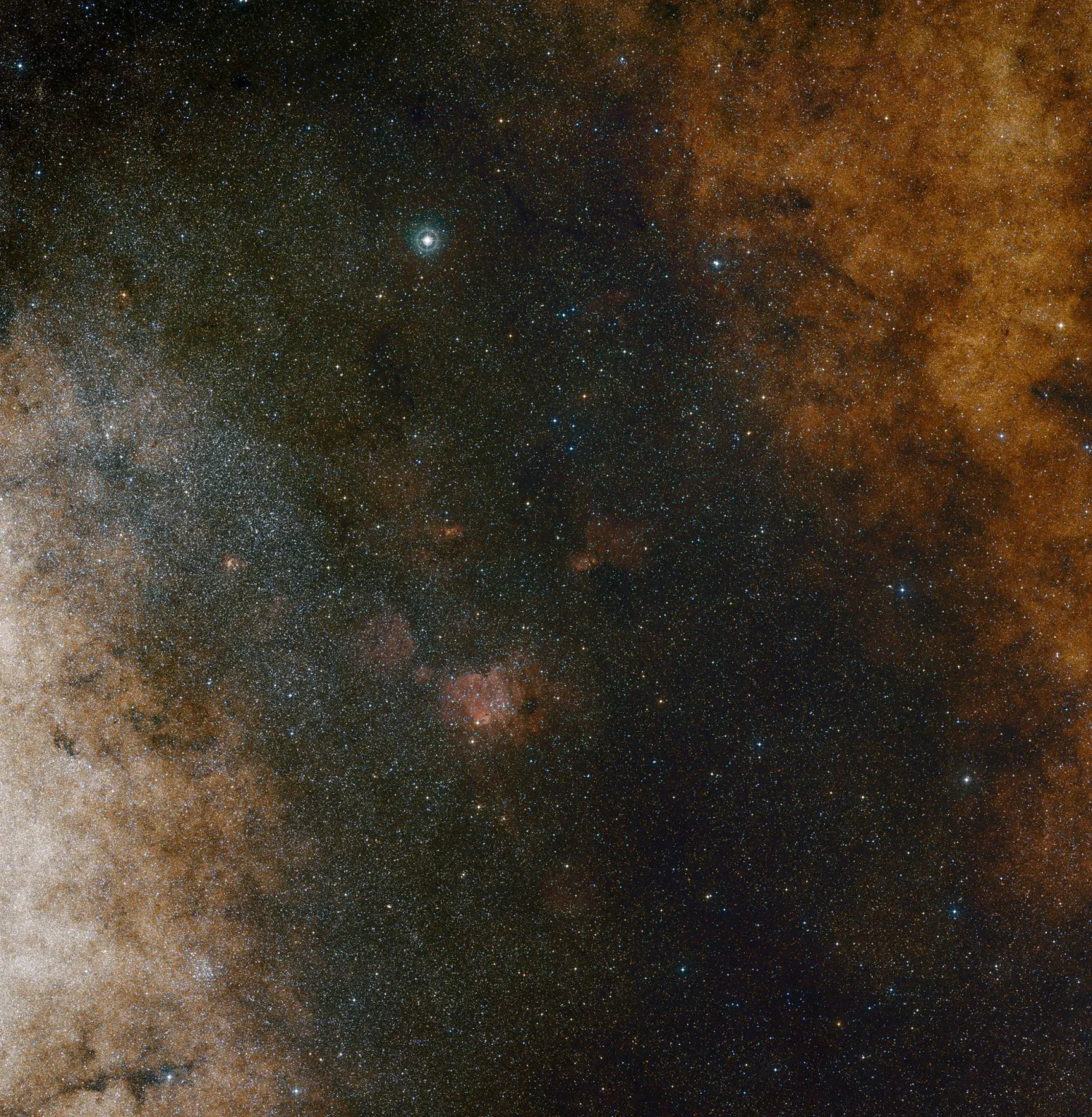

Fastest-known Star Zooms Under Milky Way Black Hole's Influence

Black holes are extremely dense objects with such strong gravity that light cannot escape them (Reuters)
TT

Fastest-known Star Zooms Under Milky Way Black Hole's Influence

Black holes are extremely dense objects with such strong gravity that light cannot escape them (Reuters)

Scientists have detected the fastest-known star, a stellar speedster that is zooming around the supermassive black hole residing at the center of our galaxy and might hold the key to measuring the spin of this celestial beast for the first time.

The star, around 50% more massive and five times brighter than our sun, travels at speeds up to about 56 million miles (90 million km) per hour as it orbits the Milky Way's central black hole — named Sagittarius A*, or Sgr A*. That is more than 8% the speed of light. No other star in our galaxy or elsewhere has ever been clocked at that speed.

The star, named S301, is traveling in a highly elliptical path around Sgr A*, taking about 8.7 years to complete an orbit. Its closest approach to the black hole is about 11.5 times Earth's orbital distance from the sun, a metric called an astronomical unit. That means the star's nearest pass is somewhat more than the planet Saturn's ⁠orbital distance from ⁠the sun. But at its farthest, S301 is about 1,360 astronomical units from Sgr A*, Reuters reported.

Black holes are extraordinarily dense objects with gravity so strong that not even light can escape. Sgr A* possesses about 4 million times the sun's mass and is located about 26,000 light-years from Earth. A light-year is the distance light travels in a year, 5.9 trillion miles (9.5 trillion km).

While Sgr A* presently is in a quiescent state, its gravitational pull is considerable — meaning it could gulp down stars or other material straying too close. But the researchers said S301 should remain safe from the black hole's wrath.

"Its orbit will not decay ⁠anytime soon. So the orientation of the orbit will change, but it is not in danger of being swallowed," said astrophysicist Stefan Gillessen of the Max Planck Institute for Extraterrestrial Physics in Germany, one of the leaders of the research published on Wednesday in the journal Nature.

No other star is known to orbit as close to Sgr A* as this one. So how did S301 end up with this crazy orbit?

Gillessen said it appears that S301 originally was part of a two-star system called a binary, gravitationally bound to a stellar partner. But the two stars at some point ventured too close to the black hole while traveling through space, and the subsequent three-way gravitational interaction wreaked havoc.

"One star shoots out from the center of the Milky Way traveling at high speed and even leaving the galaxy. The other star is stuck forever on an orbit close to the black hole. That is S301," Gillessen said.

The researchers observed S301 using the ⁠European Southern Observatory's Chile-based Very Large ⁠Telescope Interferometer. The continuing influence that Sgr A* exerts on S301 during its orbit may enable scientists to better understand the black hole, including possibly measuring its spin.

"Currently, there is very little that we know about the rotation of Sgr A*," said study co-author Felix Mang, a doctoral student at the Max Planck Institute for Extraterrestrial Physics.

Black holes are believed to rotate, so much so that they twist the very fabric of space and time around them. But confirming this spin is difficult because black holes do not emit or reflect light, rendering them invisible.

"We only can see their rotation by seeing the effect on the space around them," Gillessen said.

The researchers said that the motion of S301 remains sensitive to Sgr A*.

"The star during its orbit comes so close to Sgr A* that it actually will feel the spin of Sgr A*," Gillessen said.

"It is not a wobble — like in back and forth — but rather the star gets pushed onto a slightly different orbit each time it passes the black hole. That means that by observing that change in orbit for another good decade, we should be able to directly determine the spin of the black hole. Such a measurement is unheard of, so far," Gillessen added.



Australia Races to Shield Little Penguins from H5N1 Bird Flu

This handout photo taken on August 13, 2024 and released by Phillip Island Nature Parks on August 20, 2026 shows tourists watching the "Penguin Parade" at Phillip Island Nature Parks in Victoria. (Photo by Handout / Phillip Island Nature Parks / AFP)
TT

Australia Races to Shield Little Penguins from H5N1 Bird Flu

This handout photo taken on August 13, 2024 and released by Phillip Island Nature Parks on August 20, 2026 shows tourists watching the "Penguin Parade" at Phillip Island Nature Parks in Victoria. (Photo by Handout / Phillip Island Nature Parks / AFP)

Australian wildlife workers have launched an unprecedented effort to vaccinate wild populations of little penguins against the highly contagious H5N1 avian influenza.

Hundreds of thousands of tourists a year flock to viewing areas and boardwalks to watch the diminutive sea birds waddle ashore and along the beach in the evenings on the eastern coast's Phillip Island.

The stars of this "penguin parade" are from a wild colony on the island, numbering up to 40,000 seabirds at the height of the breeding season in the southern hemisphere's spring and summer.

It is the world's biggest single colony of little penguins, which have a life span of about six years with habitats in southern Australia -- mostly Tasmania -- and New Zealand.

Also known as fairy penguins, they are the tiniest species of the semi-aquatic sea birds, barely reaching knee height and weighing about the same as a standard bag of sugar.

Now, like the rest of Australia's wild bird population, they face the threat of H5N1, which breached the continental landmass for the first time in June and has since started to spread in local wildlife.

The virus was detected this month in a Phillip Island penguin that had died, the first infection in the colony by a pathogen that has caused severe disease and death in birds worldwide.

In response, wildlife teams started to vaccinate birds in the colony this week, said James Todd, chief biodiversity officer for the state of Victoria in which the island lies.

"This is unprecedented. There has been no vaccination of this scale in a wild population anywhere in the world," Todd said.

The H5N1 vaccination program, which also covers a popular little penguin population at a breakwater in the Melbourne beach suburb of St Kilda, is a challenge, he said.

"Trying to vaccinate wild populations is almost impossible, partly because you need two doses of the vaccine," Todd told AFP.

But wildlife experts are very familiar with the little penguins' burrows at Phillip Island and St Kilda, he said.

The birds, in turn, are accustomed to floodlights for the "penguin parade" tourist attraction, as well as being periodically handled by veterinarian scientists for monitoring of their health.

Vaccination teams aim to inoculate about 5,000 little penguins closest to the visitor areas, the state official said, in a program that is likely to last weeks and months, not days.

Ideally, the H5N1 vaccine should be administered in two doses with a gap of three-to-four weeks, Todd said.

"Given that we're in a bit of a state of urgency here, experts have said that it's okay to even think about you know one to two weeks," he said, though a final decision had yet to be taken.

Vaccination teams can pick up the penguins from their burrows and may try to corral some as they come ashore on the beach, using microchips to track those that have been given a shot, Todd said.

"They're wild animals -- they'll squawk and try to, you know, peck you, and do all that sort of stuff -- but as I said, the team down there are very used to handling these animals," he explained.

"If you and I were doing it, we'd probably drop the thing straight away."


Queen Camilla Says it Was Difficult to Keep King Charles' Cancer Diagnosis Private

King Charles and Queen Camilla alongside their Coronation State Portraits at the National Gallery in London on May 6, 2025. (AFP)
TT

Queen Camilla Says it Was Difficult to Keep King Charles' Cancer Diagnosis Private

King Charles and Queen Camilla alongside their Coronation State Portraits at the National Gallery in London on May 6, 2025. (AFP)

Britain's Queen Camilla has spoken publicly for the first time about how hard it was to keep her husband King Charles' cancer diagnosis initially private.

Buckingham Palace revealed in February 2024 that the British monarch was undergoing treatment for an undisclosed form of cancer.

He is still receiving treatment but said last December than an early diagnosis and effective intervention meant this could be scaled back, according to Reuters.

A week before the palace made the announcement, Camilla visited a Maggie's cancer support center at a London hospital and in a video released on behalf of the ⁠charity on Wednesday, she said it had been hard not to talk about her husband's own illness.

“I remember coming to see a Maggie's just after the king being diagnosed. Nobody could say anything at the time, that was quite difficult,” Camilla told Laura Lee, the chief executive of Maggie's of which the queen is president.

“I almost said something but, you know, I felt that it wasn't the time to say, (I) looked at everybody who was suffering and all the relations, and I think it made me realize even more how important these ⁠places were.

“I was just longing to let it out but obviously I couldn't.”

In the film, produced to mark Maggie's 30th anniversary, Camilla spoke of looking after her “poor husband” and how he was determined to keep working.

“Look at my husband, nothing stopped him,” she said. “He just said, this is ⁠my way I'm going to cope with it.”

Maggie's has said that the revelation that Charles and his daughter-in-law Kate, the Princess of Wales, had undergone treatment for cancer and their willingness to speak ⁠publicly about coping with the illness had had a huge positive impact on fellow sufferers.

“The king's openness about his diagnosis has undoubtedly helped others to be more open themselves ⁠and to now hear the Queen's completely understandable and natural response as a wife, shines a light on why it is so important that family and friends also get the support they need,” Lee said.


Is Space Tourism Finally Ready for Takeoff?

Researcher for the International Institute for Astronautical Sciences (IIAS), Kellie Gerardi, experiences weightlessness on a Zero Gravity plane. (AFP)
TT

Is Space Tourism Finally Ready for Takeoff?

Researcher for the International Institute for Astronautical Sciences (IIAS), Kellie Gerardi, experiences weightlessness on a Zero Gravity plane. (AFP)

New York - Stefano Montali

In 2001, Dennis Tito, an American entrepreneur, paid a reported $20 million for a voyage to the International Space Station aboard a Russian Soyuz spacecraft, officially becoming the first space tourist.

“It was eight days of euphoria,” he said from the steppes of Kazakhstan after returning to Earth.

Twenty-five years later, the frenzy surrounding the initial public offering of SpaceX, along with the recent success of NASA’s Artemis II mission, has people dreaming of space travel again.

The modern space tourism landscape is more robust and commercial than when Tito took flight.

For one, it is dominated by private, billionaire-led companies: Richard Branson’s Virgin Galactic, Elon Musk’s SpaceX and Jeff Bezos’ Blue Origin lead the way, though their short-term plans have diverged in recent months.

As of this year, about 140 people have traveled to space as tourists, most of them on short trips to and from the edge of the atmosphere. But broader plans for more ambitious spaceflights — trips that take passengers on longer journeys, in orbit — haven’t materialized beyond a handful of billionaire-financed exceptions.

All the while, the development of a wider market for space tourism has been hampered by delays, rising costs and shifting corporate and governmental priorities.

Here’s what to know about the current state of space tourism and where it might be heading.
Today, a vast majority of commercial spaceflights are suborbital, and Branson’s Virgin Galactic is the main provider. In a round trip of about 90 minutes, tourists ascend close to the Karman line, the internationally recognized boundary for space, about 62 miles above sea level, where they experience several minutes of weightlessness.

Jamila Gilbert flew aboard Virgin Galactic’s final test flight before it began offering commercial services in 2023. In a recent interview, she said she remembered unstrapping her seatbelt and floating around inside the cabin while Earth loomed ethereally outside her window.

“Everything that you have ever known has lived within the bounds of it,” she said, “and all of a sudden you’re looking at it from above.”

Before the flight to space, tourists must undergo three days of training at the company’s Spaceport America, in New Mexico, which includes medical checks, mission briefings and both physical and mental preparation.

On launch day, a Virgin Galactic launch vehicle called the VMS Eve climbs for about 50 minutes to around 50,000 feet, before releasing the attached spaceship that will ferry passengers the rest of the way to the Karman line.

“When you escape the atmosphere,” said Gilbert, “you’re suddenly in the quietest place you’ve ever been.”

Virgin Galactic has flown 32 passengers to space since 2018.

The price of a ticket was initially $200,000, and it has climbed steadily since.

After a two-year pause, the company resumed ticket sales this year with a price tag of $750,000 per seat.

This summer, the company is testing its new SpaceShip, which increases passenger capacity to six, up from four. Suborbital trips are expected to resume by the end of the year.

There are around 650 passengers waiting for a spot aboard a Virgin Galactic flight. But if all goes to plan, most are expected to fly by 2027 or 2028, when the company said it plans to have the capability to fly 750 passengers to space per year.

“We have people who wanted to fly to space their whole lives,” said Clare Pelly, the vice president for astronaut operations, “including some who saw the moon landing and said, ‘I will do that one day.’”

The company’s customers, she said, are joined more by a shared set of values and life goals than a particular demographic, and 60 countries are represented on the waiting list.

“It sounds a little cheesy,” said Pelly, “but we deal with people’s lives and dreams.”

The company estimates that around 300,000 people globally have the appropriate net worth and desire to take part in a suborbital trip, a number that company officials predict will grow about 8% annually.

Virgin Galactic said it planned to substantially increase the accessibility of suborbital space travel in coming years as it adds new flights. Several more spaceships are being built, and there are plans for at least one more spaceport in Europe or the Middle East.

“Just like summiting Everest isn’t going to be for everyone, neither will flying to space,” said Gilbert. “But the optionality that was never there before to have this experience is alive and well now.”

Others may be getting out of the tourism game. Blue Origin, Bezos’ competing operation, announced after the completion of its 38th successful suborbital trip in January that it would pause its New Shepard private passenger program for at least two years.

In suspending its suborbital operations, the company said that it would instead focus on building an orbital rocket and developing a lunar lander for NASA.

Unlike Virgin Galactic, whose vehicles take off like normal airplanes, Blue Origin rockets launch vertically, and their suborbital flights last about 11 minutes. A total of 92 people have flown to space aboard the New Shepard reusable rocket, which flies autonomously.

Compared with suborbital travel, orbital trips are far more technically challenging and require that spacecraft reach significantly higher speeds.

SpaceX, Musk’s company, offers tourists the opportunity to enter orbit aboard Crew Dragon, billed as “the first private spacecraft to take humans to the space station.”

These private trips last three to six days, require up to nine months of extensive training and cost about $200 million for four passengers. So far, about two dozen tourists have made the journey, including a cryptocurrency tycoon, an e-commerce billionaire and the friend of a sweepstakes winner.

Axiom Space, a Houston-based company, has taken more than 20 private passengers since 2022 on SpaceX rockets to stay on the International Space Station.

Tickets cost from about $55 million to $65 million per seat, with trips lasting up to about two weeks. Axiom is also competing to build the space station’s replacement — NASA and its international partners plan to discontinue the ISS at the end of 2030 — as the world’s first commercial space station.

Some experts, like Rachel Fu, a professor of tourism and hospitality at the University of Florida, predict that a plethora of tourist experiences will become available in the coming years — orbital hotels, research labs, lunar missions.

Others predict that as more entities begin operating in space, a more crowded ecosystem will bring new challenges, including how countries and companies will coexist there.

The defining question, Fu said, is no longer “Can we go?” but rather “Can we stay, operate and thrive?”

The New York Times
