

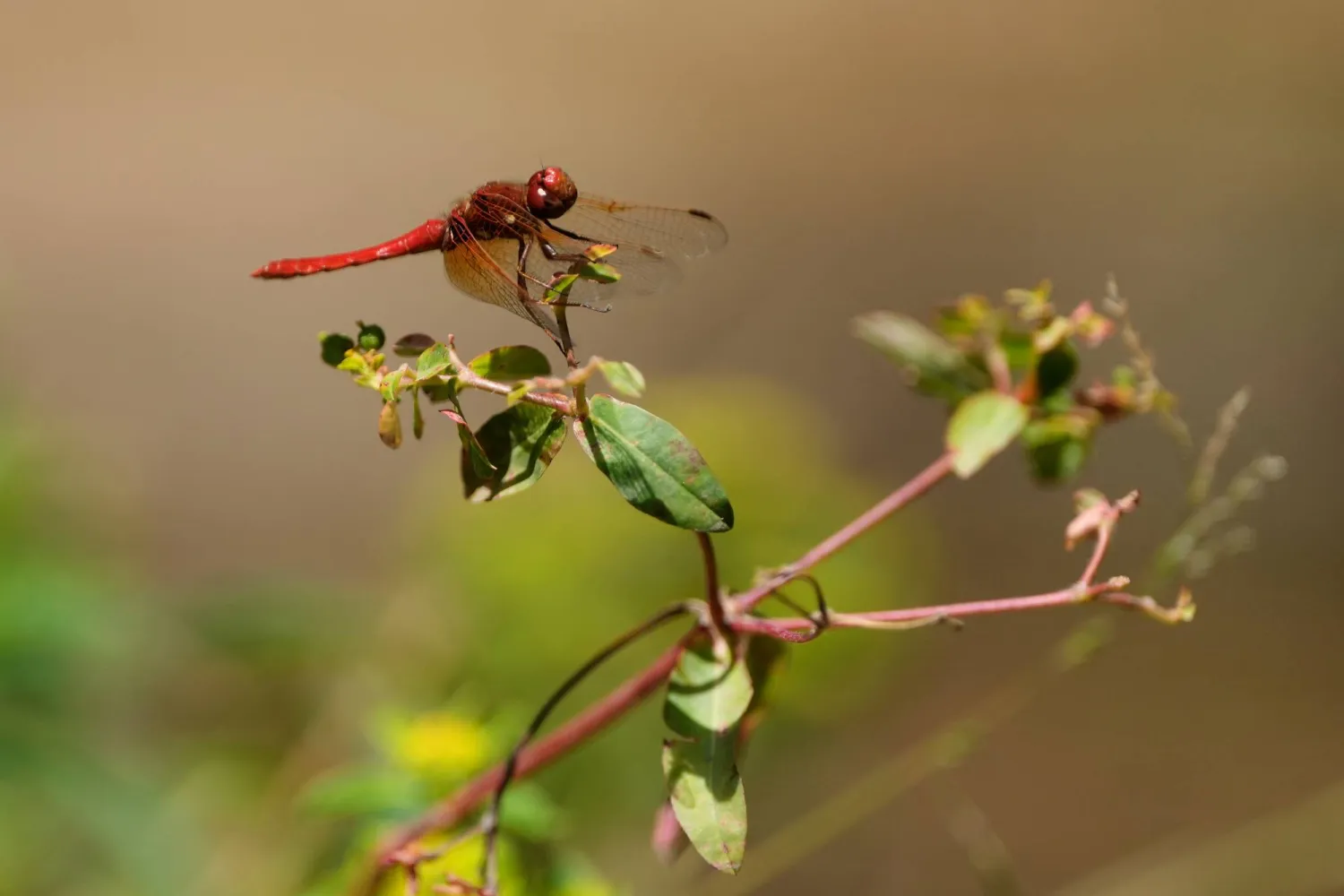

Unusual Dragonfly Swarms Sweep Across California after Warm Spring Rains

A dragonfly rests on a plant at the Lake Merritt Dragonfly Habitat Garden in Oakland, Calif., Friday, Aug. 21, 2026. (AP Photo/Jeff Chiu)
TT

Unusual Dragonfly Swarms Sweep Across California after Warm Spring Rains

A dragonfly rests on a plant at the Lake Merritt Dragonfly Habitat Garden in Oakland, Calif., Friday, Aug. 21, 2026. (AP Photo/Jeff Chiu)

Californians are spotting swarms of dragonflies flitting around parks, chasing mosquitoes in ponds and hunting flies on farms, a phenomenon experts say was likely fueled by unusually warm spring rains.

Peter Veilleux, who owns a nursery in Oakland, said he started noticing the dragonflies — at one point spotting about 100 flying together — while walking his dog at a park near his house and around the city’s Lake Merritt.

“It’s been amazing to see them,” Veilleux said, adding that he started seeing big groups of dragonflies in July.

He was so awed by the sight that he posted about it on Facebook, asking if anyone else was seeing the formidable predators in such large numbers.

Dozens of people commented about their own sightings in the San Francisco Bay Area and elsewhere in California.

Warm monsoon storms likely fueled dragonfly surge It is common to see dragonflies during the summer months, when they emerge from freshwater as flying insects. But this year’s large numbers are probably due to the warm monsoon storms that came through the state in late spring and early summer, said Kathy Biggs, a dragonfly expert and co-author of the book “Dragonflies of California.”

She said most are likely wandering gliders, a highly migratory dragonfly that can appear in large numbers when conditions line up. Dragonflies, which can fly at speeds of up to 35 mph (56 kph), use air pressure changes to help them fly great distances, Biggs said.

“We could say that they’re surfing the pressure system, the monsoon,” she added, according to The Associated Press.

Joe Del Bosque said he noticed swarms of them earlier this month at his farm in Fresno County, flying 10 to 20 feet (3 to 6 meters) above him.

“We do have them every year, but we had more than normal,” he said.

Del Bosque said he was happy to see the flying hunters because they eat aphids, whiteflies and fruit flies that feed on his crops. The insects, along with ladybugs working on the plants, are excellent pest control because they eat tiny insects on the plants and larger winged ones, like adult aphids and moths, he said.

“They are like little fighter jets,” Del Bosque said. “They zoom in for other insects and capture them in the air.”

Dragonflies spend most of their lives in water Dragonflies spend most of their lives wingless and underwater. Their life cycle begins after female and male dragonflies mate and the female dragonfly lays tiny eggs in freshwater. After the eggs hatch, the young dragonflies, called nymphs, live underwater for at least six months and for up to five years for some species. They start hunting then and feed on mosquito larvae, tadpoles, and even other nymphs.

Once they emerge from the water, they shed their skin and transform into four-winged insects that can move their forewings and hindwings independently. This allows them to fly forward, backward, up and down, and hover perfectly in place.

But their life as flying animals is short, lasting a few weeks or months. They spend it looking for new lakes, rivers and ponds, preying on tiny insects and attempting to repeat the cycle of life.

“They’re super agile, super strong flying insects with really good vision, really good eyes, and really strong flight muscles, and they are voracious predators that are out there feeding on mosquitoes nonstop,” said Chris Grinter, senior collection manager of entomology at the California Academy of Science in San Francisco.

Grinter said dragonflies are among the most effective predators in nature, with more than 90% of their hunts ending successfully.

“They can eat hundreds of mosquitoes a single day,” he said.

Dragonflies have awed humans for thousands of years. To Native Americans, a dragonfly is a symbol of purity and happiness. In Japan, they symbolize power, agility and victory. In some European folklore, they were considered to represent evil or bad luck.

To attract them to your garden, Biggs recommends avoiding pesticides and building fishless ponds and sunny areas with perches.

There are about 70 dragonfly species in California, but most are not migratory and remain near where they emerged, Biggs said.

Some of them might be out the very first thing in the spring, even as the snow is melting, and some of them are out in the Mojave Desert in the driest, hottest places in California, Grinter said.

Biggs said the migratory species keep moving on, ‘surfing’ high-pressure systems in the air.

“They could be somewhere a few days and then leave,” she said.


‘Crying Face’ is Officially Number 1 Emoji, Could Also be Showing Your Age

Emojis are a digital language for conveying meaning (Shutterstock)
TT

‘Crying Face’ is Officially Number 1 Emoji, Could Also be Showing Your Age

Emojis are a digital language for conveying meaning (Shutterstock)

Emojis have become an integral feature of modern communication. As a new icon is crowned the most popular symbol of the last year on record, The Independent looked at what its mixed meaning could do to our brains.

That little yellow circle with tears streaming down its face has officially been named the most popular emoji worldwide, according to data from Google shared with The New York Times.

While the original cry-laughing face and its diagonal sibling have traditionally been used to convey joy digitally, their overuse has essentially rendered them a bit toe-curling.

Want to show your age? Send one to anyone below the age of 30 and see them send a (dead from laughing) skull back. Honorable mentions also go to: the two beers emoji, the monkey covering its eyes and the sunglasses smiley. They can all get – unless used with irony – firmly in the digital bin.

Much like with new fashion drops or sought-after artwork, the appeal of an emoji in 2026 stems from its originality.

So, it’s no surprise to find that, although young people are conveying the same emotions as everyone else using a smart phone, the images being used to express them have evolved: the wilting rose (93rd most used) instead of the broken heart, the praying hands instead of thumbs up, And then we come to the Moai statue, which has become the 33rd most used emoji up from 482nd in 2021.

The New York Times says, is used now instead of raised eyebrows or the routine deadpan smiley.

While it’s easy to dismiss emoji use as irrelevant or childish, the symbols have become a language in their own right, with more and more people leaning on the icons to convey meaning.

Although emojis play increasingly critical communicative functions, studies have found that frequency of use decreases among older adults, who may struggle to adapt to new forms of non-verbal communication due to lack of confidence.

In Adolescence, emojis like the red pill were used in incel subcultures, which police struggled to decode without a teen’s help, On the flip side, a recent study by researchers at Bournemouth University found that emojis can trigger similar neural response patterns to those involved in processing real human facial expressions.

“This suggests that emojis are not simply fun additions to digital communication but may be processed by the brain in ways comparable to genuine facial cues. In this sense, emojis can function as meaningful emotional signals during online interaction,” said the study’s lead, Madeline Molly Ely.

So, whether you are perceiving this year’s most popular emoji as joy or sorrow, could actually be having an impact on your brain.


Indonesia Intensifies Aerial Firefighting as Forest Fires Scorch Multiple Provinces

In this aerial photo released by Indonesia's National Disaster Mitigation Agency (BNPB) on Friday, Aug. 21, 2026, smoke billows as a wildfire rages through a peatland forest in Bulungan, North Kalimantan, Indonesia. (BNPB via AP)
TT

Indonesia Intensifies Aerial Firefighting as Forest Fires Scorch Multiple Provinces

In this aerial photo released by Indonesia's National Disaster Mitigation Agency (BNPB) on Friday, Aug. 21, 2026, smoke billows as a wildfire rages through a peatland forest in Bulungan, North Kalimantan, Indonesia. (BNPB via AP)

Indonesia on Monday intensified ground and aerial firefighting operations as huge blazes in central and western parts of the country scorched thousands of hectares of forests and peatland, created a choking haze that blanketed cities and crossed borders.

Indonesian authorities have been battling fires driven by an intensifying El Nino pattern and a prolonged dry season, generating dense smoke that crossed into Malaysia and Brunei, according to Indonesia’s National Disaster Management Agency, or BNPB.

The BNPB said Monday that fires remain active in several regions, while large-scale suppression efforts continue in fire-prone provinces including West, Central and South Kalimantan on Borneo island and in Riau, South Sumatra and Jambi on Sumatra island. The fires are part of a broader surge in wildfire activity across Indonesia this year.

After visiting areas devastated by forest and peatland fires in Central Kalimantan on Saturday, Indonesian President Prabowo Subianto flew to fire-affected Riau province on Sumatra island, where more than 11,500 hectares (28,400 acres) have burned, to encourage authorities to get the haze cloud under control.

Prabowo vowed the government would continue supporting firefighting operations, including through the deployment of additional water-bombing helicopters and oxygen supplies for firefighters. According to The Associated Press, he urged authorities to “thoroughly document and report the work being carried out by firefighting teams” directly to him.

The Transportation Ministry said it has authorized the use of 35 foreign-registered aircraft to support wildfire response operations, including water-bombing missions and aerial patrols.

The ministry said the aircraft can be rapidly redeployed to disaster-hit areas as conditions change, while complying with Indonesian aviation safety regulations.

The Environment Ministry satellite data on Monday showed South Sumatra recorded the highest number of hot spots nationwide with 1,429, followed by West Kalimantan with 1,226 and Central Kalimantan with 811. East Kalimantan logged 576 hot spots, ahead of Riau with 503, while West Papua and Jambi recorded 468 and 458 hot spots, respectively.

Forestry Ministry data indicated that nearly 94,000 hectares (232,000 acres) burned in July alone.

Drought, strong winds and dry vegetation have complicated efforts to contain the fires, BNPB said in a statement on Monday. Some hot spots remained inaccessible to more than 10,700 ground firefighters who were deployed as of Sunday, prompting local officials to request additional water-bombing support and firefighting vehicles.

Cloud-seeding resumed over Kalimantan on Monday, with 30 helicopters for water-bombing and aerial patrol missions, and another 22 helicopters covering Sumatra.

Fires are a regular problem during dry season in Indonesia, a vast archipelago nation of more than 17,000 islands, and often strain relations with neighbors.

Plantation owners and traditional farmers often start fires to clear land for farming. It triggers hazardous haze that reduces visibility, disrupts land and air transportation and threatens public health, sometimes affecting neighboring countries in Southeast Asia.

Meanwhile, Malaysia has suffered severe smoke from the fires, with its eastern state of Sarawak among the hardest hit, prompting the closure of nearly 600 schools and affecting about 200,000 students, the Sarawak government said.


New Zealand’s PM Proposes Banning Children from Using Social Media

 New Zealand's Prime Minister Christopher Luxon speaks to media during a visit to aircraft manufacturing company "NZ Aero" with Thailand's Prime Minister Anutin Charnvirakul (not pictured) in Auckland on August 21, 2026. (AFP)
New Zealand's Prime Minister Christopher Luxon speaks to media during a visit to aircraft manufacturing company "NZ Aero" with Thailand's Prime Minister Anutin Charnvirakul (not pictured) in Auckland on August 21, 2026. (AFP)
TT

New Zealand’s PM Proposes Banning Children from Using Social Media

 New Zealand's Prime Minister Christopher Luxon speaks to media during a visit to aircraft manufacturing company "NZ Aero" with Thailand's Prime Minister Anutin Charnvirakul (not pictured) in Auckland on August 21, 2026. (AFP)
New Zealand's Prime Minister Christopher Luxon speaks to media during a visit to aircraft manufacturing company "NZ Aero" with Thailand's Prime Minister Anutin Charnvirakul (not pictured) in Auckland on August 21, 2026. (AFP)

New Zealand's Prime Minister Christopher Luxon has unveiled a proposed law banning children younger than 16 from using social media platforms, citing what he said Monday was “harm being done to a generation” of young people.

However, the bill hasn't yet attracted enough support to pass into law because two of the three parties in Luxon's coalition government will vote against it. Passage would require support from opposition lawmakers, who have yet to decide how they would vote.

There also wasn't enough time for lawmakers to hold a vote on the proposal before Parliament dissolved on Oct. 1 ahead of November’s election, Luxon said. Bills are required to pass three rounds of voting, usually over a period of months, before they become law.

Proposal comes after other countries enact age bans If reelected, Luxon is seeking to make his government the latest worldwide to enact age restrictions for social media platforms after dozens of countries have either introduced or are mulling such measures.

He said 2025 research showed a third of New Zealand teenagers spent at least five hours a day on social media.

“Social media is exposing them to harmful content, addictive technology and pressures they are not equipped to deal with and it’s affecting their family life, mental health, sleep, and education,” Luxon said.

The proposal would require social media platforms including Instagram, TikTok, Snapchat and Facebook, to “take reasonable steps” to check users were older than 16, according to material supplied by Luxon's party Monday. This could include “existing account information, facial age estimation, digital ID services and formal ID,” the material said.

Excluded from the proposed law are messaging platforms such as WhatsApp, online gaming platforms like Roblox and AI apps with productivity uses, including ChatGPT, Gemini and Copilot.

No penalties are proposed for parents or children, but tech firms could be fined up to 10% of their global revenue for failing to meet their obligations. Platforms regularly used by children would be required to assess and report on the risks their networks posed, Luxon said.

Prospect of a ban has divided New Zealand's government Luxon's government has mulled such a law since Australia's world-first social media ban for under 16-year-olds took effect in December 2025. However, it's been vehemently opposed by the other two parties that make up the government along with Luxon's center-right group National — libertarian ACT and populist NZ First.

Both minor parties repeated Monday their plans to vote against the law. Lawmakers from the largest opposition party, center-left Labour, haven't decided if they'd vote for it, leader Chris Hipkins said Monday.

Since Australia's law came into force, countries including Canada, Brazil and Indonesia have enacted bans too, while many other countries are studying or developing laws. Child safety advocates and some parents have welcomed age restrictions, while privacy groups say the rules can be cheated and that forcing users to supply identification raises privacy concerns.

In January, a month after Australia's ban was enacted, social media platforms told an Australian regulator they had revoked access to about 4.7 million accounts identified as belonging to children.

Luxon's government enacted a ban in 2024 on the use of cellphones during the school day for students of all ages.
