


Climate Change Hits Trout and Salmon in UK’s Prized Chalk Streams

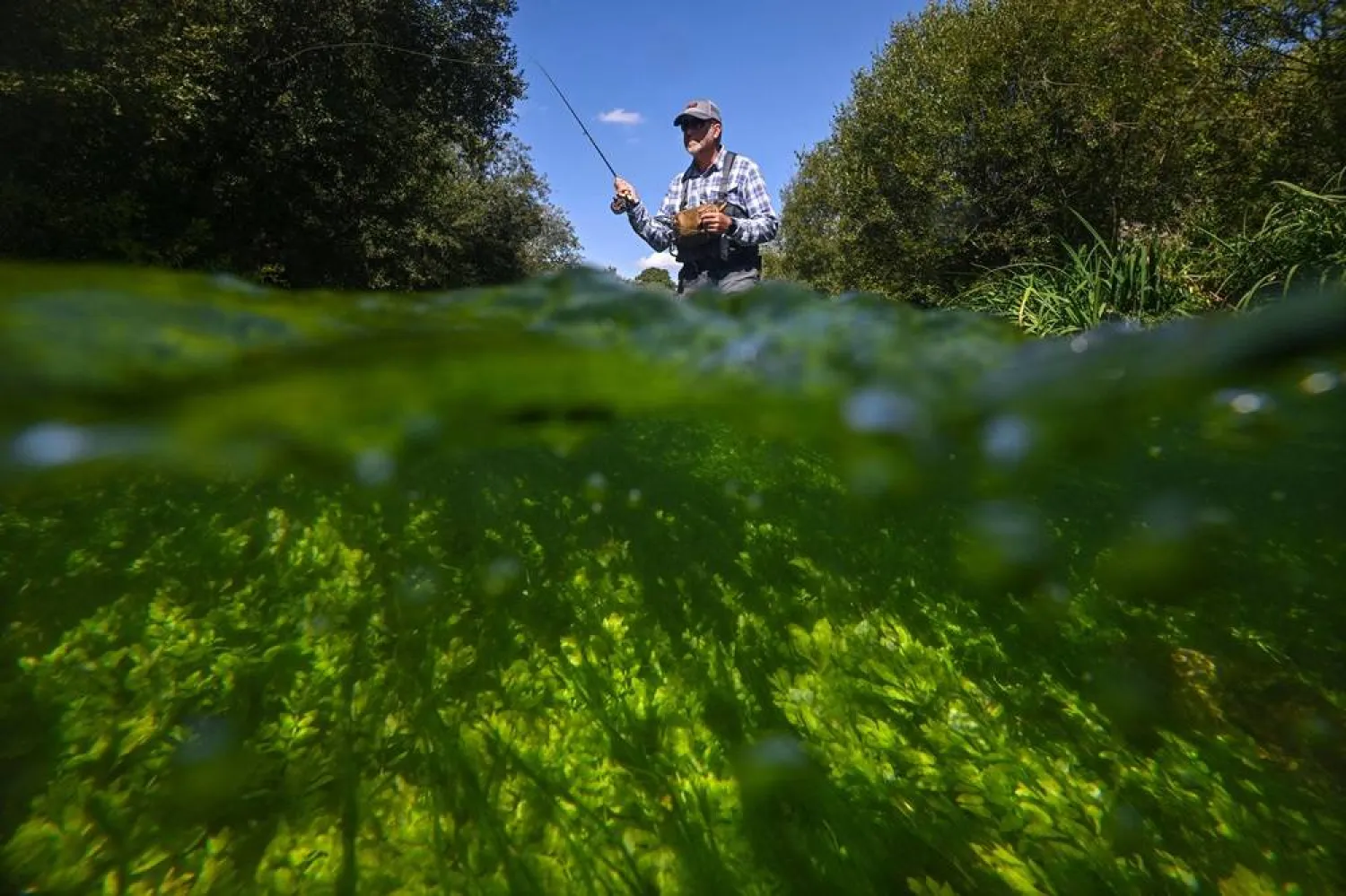
This photo taken on August 25, 2026 shows Bob Wellard, director of the Piscatorials Society, fly-fishing in the Candover Brook, a chalk stream tributary of the River Itchen, near Winchester, Hampshire, southern England. (AFP)
TT

Climate Change Hits Trout and Salmon in UK’s Prized Chalk Streams

This photo taken on August 25, 2026 shows Bob Wellard, director of the Piscatorials Society, fly-fishing in the Candover Brook, a chalk stream tributary of the River Itchen, near Winchester, Hampshire, southern England. (AFP)

A fly fisherman cast his line into the crystal-clear waters of the Itchen, a chalk stream in Hampshire in southern England, home to salmon and trout hit by climate change.

A summer of record-breaking temperatures and drought is threatening the ecological balance of rare chalk streams -- rivers formed on chalk beds that are largely unique to England -- and the fish that depend on them.

Wading through a branch of the Itchen near Winchester, Robert Wellard, director of fisheries at the Piscatorial Society and a recreational angler, dipped a thermometer into the clear water, drawing a reading of 17C.

"We should be more around 12 or 13 degrees" in August, said Kathryn Boler, manager of the Freshwater Programme for the Hampshire and Isle of Wight Wildlife Trust.

Chalk streams, which are fed naturally by underground springs filtered through porous chalk bedrock, are known for their clear, cool and mineral-rich waters where fish such as brown trout and salmon thrive.

Out of 200 rivers of this type recorded in the world, 85 percent are found in England, according to the Wildlife Trust, which looks after the UK's nature reserves.

These unique habitats have been at the forefront of climate change for years, with this summer's successive heatwaves and bone-dry conditions warming the water, depleting groundwater reserves and reducing river flows.

"This year it's been unique in the sense that we have had them (heatwaves) pretty much back-to-back. And so that puts a huge amount of stress on the natural environment," said Wellard.

During heatwaves, "we've seen water temperatures... creeping up well above their normal temperature range," said Wellard, noting that water temperatures this summer reached levels which start affecting wild fish.

Several angling clubs -- which primarily practice catch-and-release fishing -- have temporarily limited activity to reduce the stress on the fish.

- 'Trapped' -

In water temperatures above 19C, salmon and trout experience "extra stress on their bodies", said Boler, as it reduces the oxygen available in the water and increases the physiological needs of fish.

The Itchen chalked up a high of 21.7C in July, according to figures by the Environment Agency (EA), an arm's-length government body which deals with environmental protection in England.

Falling river flows in drought conditions also expose the fish to predators.

For Atlantic salmon, which come to chalk streams to spawn and are already classified as endangered, the situation is particularly concerning.

"With the lower flow, salmon are effectively more trapped, and more susceptible to predation from things like harbor seals and cormorants," explained Paul Vignaux, who heads a local association for landowners and anglers in the Itchen.

In 2022, only 180 salmon came to spawn in the Itchen. Preliminary figures for last year counted 250 individuals -- 32 percent of the threshold considered necessary for the species' conservation, Vignaux noted.

This summer was also difficult for young freshwater salmon, the Environment Agency said in its July salmon count of the Itchen and another nearby chalk stream the Test, with their "abundance and size ... far lower than usual".

According to an EA model, the average temperature of rivers where brown trout live in England is expected to exceed the tolerable limit "at most sites by 2070".

The critical threshold for salmon is expected to be exceeded in half of their habitats by 2080.

Scientists say that climate change is increasing the frequency and intensity of heatwaves, drought and other extreme weather conditions.

Combined with river pollution, chalk streams are facing the perfect storm as declining water flows also cause pollutants to become more concentrated.

In July, wastewater treatment company Southern Water admitted discharging pollutants in 2023 into the Test.

Scientists, environmentalists and anglers are calling for agencies to restore rivers to a more natural state, reduce water extraction and plant trees to improve shade.

"It's really essential that as much water as possible stays in the rivers," said Boler.


Indonesia Conducts Water Bombing to Contain Wildfires Near Future Capital

A drone view shows firefighters spraying water in an attempt to extinguish a wildfire in Soeharto Hill Forest Park, North Penajam Paser in East Kalimantan province, Indonesia, September 3, 2026. (Public Relations Office of the Nusantara Capital City Authority/Handout via Reuters)
TT

Indonesia Conducts Water Bombing to Contain Wildfires Near Future Capital

A drone view shows firefighters spraying water in an attempt to extinguish a wildfire in Soeharto Hill Forest Park, North Penajam Paser in East Kalimantan province, Indonesia, September 3, 2026. (Public Relations Office of the Nusantara Capital City Authority/Handout via Reuters)

Indonesian authorities carried out a water bombing operation on Saturday to prevent wildfires from spreading in the future capital city Nusantara, a city official told AFP.

The archipelago is constructing a new capital city in Borneo, home to vast tropical jungle, to replace sinking and traffic-clogged Jakarta.

The country is also fighting to contain wildfires that have burned large swathes of Sumatra and Borneo, which caused choking haze that has drifted across the border to Malaysia, Singapore and the Philippines.

Fires have been intensifying since mid-August in buffer areas outside the core area in Nusantara, where the city's development is concentrated, Nusantara authority environment and natural resources deputy Myrna Asnawati Safitri said.

It prompted authorities to carry out a water bombing operation to complement on-the-ground firefighting efforts, she added.

"The function of water bombing is not only to extinguish fires but also to accelerate cooling in areas that have been extinguished by ground firefighters," Myrna said.

The operation will last until Sunday, but Myrna said it can be extended if necessary.

So far, Nusantara's construction has not been hampered by wildfires or haze, she said.

Then-president Joko Widodo revived the long-proposed capital move from Jakarta when he won a second term in 2019.

But construction has slowed down under his predecessor Prabowo Subianto, as the former general prioritized his welfare programs including a free meal scheme for students.

As president-elect, Prabowo said he wanted to "continue, if possible finish" the capital move, but since taking office in 2024 he has yet to express any plans to sign the presidential decree needed to shift from Jakarta.

His spokesman Prasetyo Hadi said Nusantara should be ready to host the executive, legislative and judicial branches of the government before the move can take place, local media reported.


Moto Guzzi’s Renovated Lake Como Headquarters Welcomes Motorcycle-Bound Aficionados

Riders and visitors enjoy Guzzi motorcycles displayed at the museum during the Guzzi opening inaugurating its completely redeveloped historic factory and new museum as the motorcycle maker celebrates its 105th anniversary, in Mandello del Lario, Thursday, Sept. 3, 2026. (AP)
TT

Moto Guzzi’s Renovated Lake Como Headquarters Welcomes Motorcycle-Bound Aficionados

Riders and visitors enjoy Guzzi motorcycles displayed at the museum during the Guzzi opening inaugurating its completely redeveloped historic factory and new museum as the motorcycle maker celebrates its 105th anniversary, in Mandello del Lario, Thursday, Sept. 3, 2026. (AP)

After extensive renovation by the Italian motorcycle manufacturer Moto Guzzi, aficionados this year had fresh reasons for a pilgrimage to the lakeside spot where their beloved two-cylinder bikes are hand-built.

Thousands of Moto Guzzi riders pulled up Saturday for an annual gathering and informal ride along the winding lakeside roads. They started arriving on Thursday for the unveiling of the headquarters, new museum and expanded factory on the shores of northern Italy’s Lake Como.

The headquarters, nestled between a mountainside and the lakeshore, received an additional 5,500 square meters (nearly 60,000 square feet) for factory space and the museum that honors the iconic brand that has been owned by Vespa-maker Piaggio since 2004. Works took five years and cost more than 50 million euros ($58 million).

Timothy Bennett, who lives in the US state of Georgia, was making his second trip to the headquarters after attending a toned-down 100th anniversary celebration during the pandemic. His first Moto Guzzi — made distinctive by its dual cylinders projecting from either side of the bike — was an 850-T, and now he owns a 2018 California 1400 Touring.

“I’ve owned a Moto Guzzi since my 20s,” said Bennett, 58. “The first time I saw one in a magazine, I thought it looked very interesting. And then I went ahead and saved up some money and bought a used one, and fell in love.”

This year, Bennett and other visitors to the World Guzzi Days could peek through new observation points to see workers hand-assembling the motorcycles, just as they have for 105 years. The company prides itself on its processes.

“Moto Guzzi is handmade, it is an artisanal product, it’s a piece of art,” said Matteo Boddi, head of manufacturing for the Piaggio Group. “And we never substitute automation for this core part. Automation is for safety and for sustainability.”

The new factory includes the addition of an automation belt to move parts and engines through the factories and robotics to transport the finished motorcycles for their final test. The factory expansion potentially doubles the maximum production to 30,000 motorcycles a year.

“We tried to make an accessible place both for passionate motorcyclists and people who are just curious about motorcycles being made in Italy, on Lake Como, and may never even have heard of Moto Guzzi before,” said US architect Greg Lynn.

Celebrity spottings and weddings have long been a pastime at Lake Como, known for its majestic views of the Alps. The lake is featured in the James Bond film Casino Royale, and George Clooney owns a villa on its shore. But that glitz isn't why the Moto Guzzi fans turn out in droves.

Roland Rampnoux has been visiting the factory regularly since 1980 and belongs to a 150-strong Moto Guzzi club in Paris. He was impressed by the factory, but his interest was mostly in the bikes and the camaraderie.

“I like the mentality of the people who ride them,” Rampnoux said. “When you see a Moto Guzzi it is immediately recognizable. It is a legendary brand.”


Sydney Sweats in Spring Hot Spell, Faces ‘Extreme’ Bushfire Risk

A ferry passes in front of apartments in Sydney, Australia, August 18, 2026. (Reuters)
TT

Sydney Sweats in Spring Hot Spell, Faces ‘Extreme’ Bushfire Risk

A ferry passes in front of apartments in Sydney, Australia, August 18, 2026. (Reuters)

Australia's most ‌populous city Sydney baked in a burst of sweltering spring heat on Saturday, raising the risk of bushfires and prompting authorities to issue a ban on lighting fires.

The heat comes as a powerful El Nino weather pattern in the Pacific, expected to be among the strongest in decades, drives hotter and drier ‌conditions across ‌southern Australia during the September-November spring ‌season.

On ⁠Saturday, the nation's ⁠weather forecaster said temperatures in the New South Wales capital, home to 5.6 million people, were set to hit 33 degrees Celsius (91.4 degrees Fahrenheit), nearly 13C above average.

At Sydney Airport, the temperature ⁠was already 28.6C (83.48F) at 11:30 ‌a.m. (0130 GMT)local ‌time, more than seven degrees above the September mean ‌maximum temperature, according to forecaster data.

"Fresh ‌to strong and gusty northwesterly winds developing during the morning, combined with dry, unseasonably warm conditions, will result in elevated fire dangers ‌across the Greater Sydney Region today," the forecaster said.

State fire authorities ⁠issued ⁠a total fire ban for Sydney where they rated fire risk as "extreme", the second highest danger rating.

Climate change is causing extreme heat and fire weather to become more common in Australia, a bushfire-prone country of around 27 million. In January, thousands of firefighters battled bushfires in the southeast that razed homes, cut power to thousands of homes and burned swathes of bushland.
