


Europe's Summer Drought Threatens Fish in Rivers, Lakes and Farms

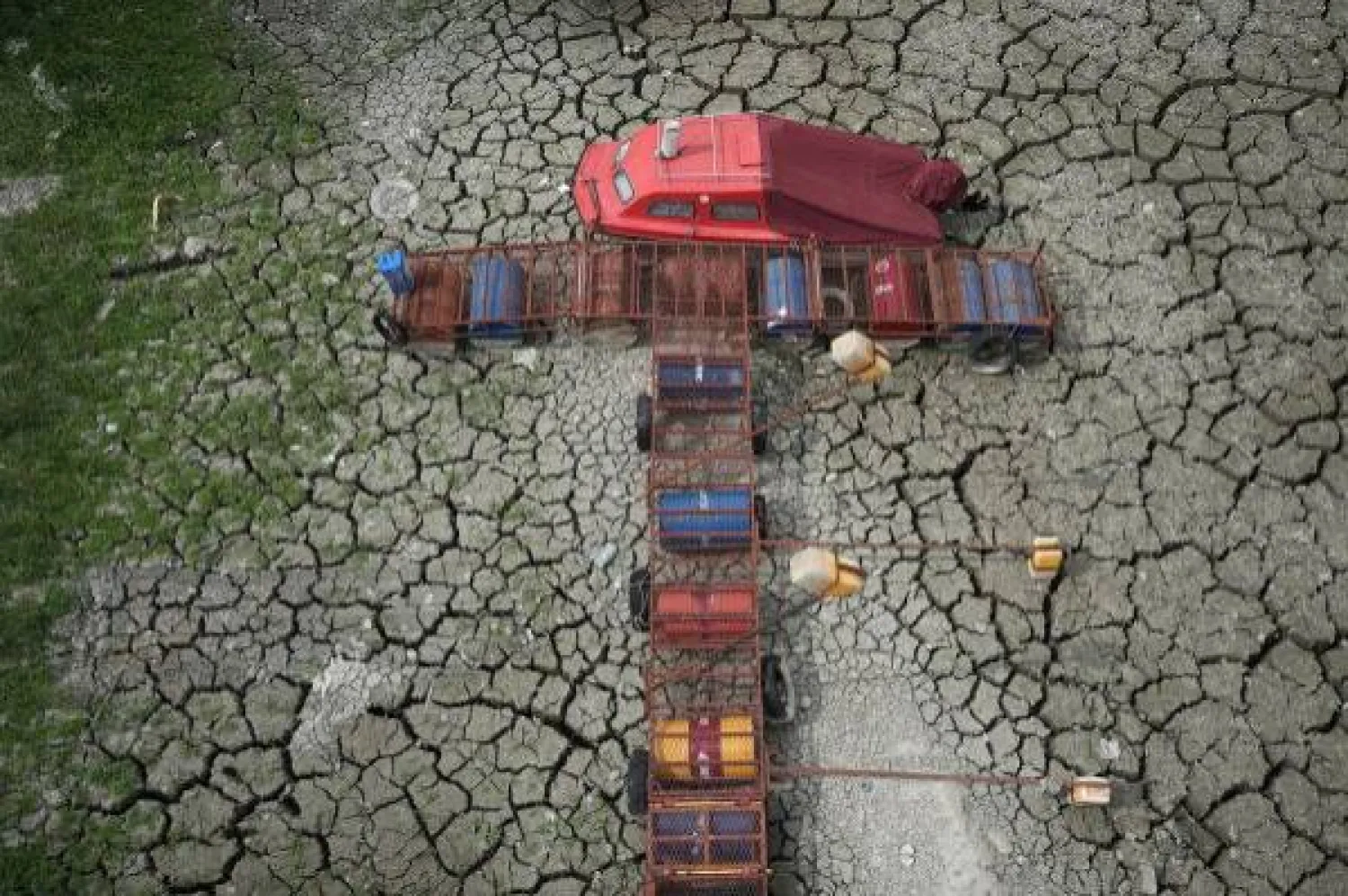
A boat sits on dry ground as water levels have dropped on the Danube in Petrovaradin, Serbia, Tuesday, August 25, 2026. (AP Photo/ Darko Vojinovic)
TT

Europe's Summer Drought Threatens Fish in Rivers, Lakes and Farms

A boat sits on dry ground as water levels have dropped on the Danube in Petrovaradin, Serbia, Tuesday, August 25, 2026. (AP Photo/ Darko Vojinovic)

Small boats stand idle on cracked ground in a shriveled side channel of the Danube River in northern Serbia, where the water has receded into a couple of shrinking ponds under pressure from extreme drought and heat. Fish circle in the shallow waters.

“This is all we have, these two little ponds that are full of juvenile fish,” fisherman Dusan Jovanovic said. He said the fish are in danger because there is too little water and its temperature is over 30 degrees Celsius (86 degrees Fahrenheit).

“If they start to die, they will all die at once,” Jovanovic said.

Persistent drought and scorching heat this summer have ravaged ecosystems and businesses across the region, from a lake in Slovenia and the side channel of the Danube in Serbia, to fish farms in Bosnia, the Czech Republic, Romania and Hungary.

The fish industry has been hit especially hard, with damage estimated in the millions of euros (dollars). This is adding to the already high toll caused by problems with energy and water supplies, devastated crops, losses in river traffic and trade, The Associated Press said.

Finding themselves unprepared for this year's crisis, countries and businesses are now pondering ways to minimize the effects of future extreme weather events that scientists have tied to human-induced climate change.

Hungary's fish die as entire country faces extreme drought

Around 99% of Hungary’s lands are currently under severe or extreme drought conditions, according to the national meteorological service. Desertification, a process where vegetation recedes because of high heat and low rainfall, threatens much of the Great Hungarian Plain.

Among the most affected are Hungary’s roughly 27,000 hectares (67,000 acres) of fish ponds. The country’s Agriculture and Food Economy Ministry said last week that “persistent heat and water shortages” had led to 1,588 hectares (3,924 acres) of those ponds drying out, causing the deaths of nearly 280 metric tons of fish at 20 farms.

The estimated revenue loss from the damage was 1.3 billion forints ($4.2 million), the ministry said. Producers say replacing lost fish could take years. Sometimes, operators were forced to drain one pond and divert its water to save fish in another, the Hungarian Aquaculture and Fisheries Inter-branch Organization said in early August.

Repeated drought over years hurts Romanian fish farmers

For fish farmers in Romania, especially those cultivating carp, this year’s blistering heatwave follows severe droughts in 2023 and 2024, the effects of which are still being felt, says Catalin Platon, president of ROMFISH National Association of Fish Producers.

In carp production, Platon said, the production cycle is three or four years.

“So what we lost in 2023 has (had an) impact every year since," he explained. Water-use policies that prioritized irrigation for agriculture during the previous droughts, “left us with no water for the fish,” Platon complained.

Czech fish farmers take emergency measures

Fish farmers across the Czech Republic have taken various emergency measures: reducing or suspending feeding to reduce oxygen use, aerating the ponds or draining them when necessary.

The Czech Fishing Association officials say sustained rainfall could ease the immediate crisis, but long-term measures are needed to retain more water in the landscape.

Jan Sokolik, a technician at the Rybarstvi Trebon fishery, explained that “some ponds that were actually low on water have already been fished, but they were all marginal ponds.”

“Now we’re just starting to plan what to do with the big ponds,” he said.

Bosnian trout breeders ‘looking to survive summer’

Veljko Budjen owns a trout farm near Trebinje in southeast Bosnia. He said hot and dry summers have brought serious problems in the mainly mountainous country famous for its trout restaurants.

“Trout is a cold water fish, which requires cold water with a lot of oxygen,” he said. “So during the summer you are forced to reduce trout production and feeding so the business can just barely survive.”

One option, he said, is to add liquid oxygen to the water during summer months. Otherwise, he said, “you wait for the first rain.”

Slovenians pump water into a lake in an attempt to save fish Emergency teams have been pumping water into Lake Pristava in eastern Slovenia, a favorite spot for fishermen, to try to prevent a mass suffocation of fish from lack of oxygen and water chestnut overgrowing to cover the lake surface.

Firefighters have pumped in 8 million liters (2 million gallons) of water but they still fear it's not enough.

"We are surprised that any fish has survived at all,” Danijel Fras, from the Pesnica Lenart Fishing Association, told public broadcaster RTV Slovenia.

In Serbia, fishermen said the only solution for the endangered fish in the Danube side channel in Novi Sad is to move them to another location.

“The temperatures this year are extreme,” Jovanovic, the Serbian fisherman, said. "No one can remember anything like this.”



Indonesia Conducts Water Bombing to Contain Wildfires Near Future Capital

A drone view shows firefighters spraying water in an attempt to extinguish a wildfire in Soeharto Hill Forest Park, North Penajam Paser in East Kalimantan province, Indonesia, September 3, 2026. (Public Relations Office of the Nusantara Capital City Authority/Handout via Reuters)
TT

Indonesia Conducts Water Bombing to Contain Wildfires Near Future Capital

A drone view shows firefighters spraying water in an attempt to extinguish a wildfire in Soeharto Hill Forest Park, North Penajam Paser in East Kalimantan province, Indonesia, September 3, 2026. (Public Relations Office of the Nusantara Capital City Authority/Handout via Reuters)

Indonesian authorities carried out a water bombing operation on Saturday to prevent wildfires from spreading in the future capital city Nusantara, a city official told AFP.

The archipelago is constructing a new capital city in Borneo, home to vast tropical jungle, to replace sinking and traffic-clogged Jakarta.

The country is also fighting to contain wildfires that have burned large swathes of Sumatra and Borneo, which caused choking haze that has drifted across the border to Malaysia, Singapore and the Philippines.

Fires have been intensifying since mid-August in buffer areas outside the core area in Nusantara, where the city's development is concentrated, Nusantara authority environment and natural resources deputy Myrna Asnawati Safitri said.

It prompted authorities to carry out a water bombing operation to complement on-the-ground firefighting efforts, she added.

"The function of water bombing is not only to extinguish fires but also to accelerate cooling in areas that have been extinguished by ground firefighters," Myrna said.

The operation will last until Sunday, but Myrna said it can be extended if necessary.

So far, Nusantara's construction has not been hampered by wildfires or haze, she said.

Then-president Joko Widodo revived the long-proposed capital move from Jakarta when he won a second term in 2019.

But construction has slowed down under his predecessor Prabowo Subianto, as the former general prioritized his welfare programs including a free meal scheme for students.

As president-elect, Prabowo said he wanted to "continue, if possible finish" the capital move, but since taking office in 2024 he has yet to express any plans to sign the presidential decree needed to shift from Jakarta.

His spokesman Prasetyo Hadi said Nusantara should be ready to host the executive, legislative and judicial branches of the government before the move can take place, local media reported.


Moto Guzzi’s Renovated Lake Como Headquarters Welcomes Motorcycle-Bound Aficionados

Riders and visitors enjoy Guzzi motorcycles displayed at the museum during the Guzzi opening inaugurating its completely redeveloped historic factory and new museum as the motorcycle maker celebrates its 105th anniversary, in Mandello del Lario, Thursday, Sept. 3, 2026. (AP)
TT

Moto Guzzi’s Renovated Lake Como Headquarters Welcomes Motorcycle-Bound Aficionados

Riders and visitors enjoy Guzzi motorcycles displayed at the museum during the Guzzi opening inaugurating its completely redeveloped historic factory and new museum as the motorcycle maker celebrates its 105th anniversary, in Mandello del Lario, Thursday, Sept. 3, 2026. (AP)

After extensive renovation by the Italian motorcycle manufacturer Moto Guzzi, aficionados this year had fresh reasons for a pilgrimage to the lakeside spot where their beloved two-cylinder bikes are hand-built.

Thousands of Moto Guzzi riders pulled up Saturday for an annual gathering and informal ride along the winding lakeside roads. They started arriving on Thursday for the unveiling of the headquarters, new museum and expanded factory on the shores of northern Italy’s Lake Como.

The headquarters, nestled between a mountainside and the lakeshore, received an additional 5,500 square meters (nearly 60,000 square feet) for factory space and the museum that honors the iconic brand that has been owned by Vespa-maker Piaggio since 2004. Works took five years and cost more than 50 million euros ($58 million).

Timothy Bennett, who lives in the US state of Georgia, was making his second trip to the headquarters after attending a toned-down 100th anniversary celebration during the pandemic. His first Moto Guzzi — made distinctive by its dual cylinders projecting from either side of the bike — was an 850-T, and now he owns a 2018 California 1400 Touring.

“I’ve owned a Moto Guzzi since my 20s,” said Bennett, 58. “The first time I saw one in a magazine, I thought it looked very interesting. And then I went ahead and saved up some money and bought a used one, and fell in love.”

This year, Bennett and other visitors to the World Guzzi Days could peek through new observation points to see workers hand-assembling the motorcycles, just as they have for 105 years. The company prides itself on its processes.

“Moto Guzzi is handmade, it is an artisanal product, it’s a piece of art,” said Matteo Boddi, head of manufacturing for the Piaggio Group. “And we never substitute automation for this core part. Automation is for safety and for sustainability.”

The new factory includes the addition of an automation belt to move parts and engines through the factories and robotics to transport the finished motorcycles for their final test. The factory expansion potentially doubles the maximum production to 30,000 motorcycles a year.

“We tried to make an accessible place both for passionate motorcyclists and people who are just curious about motorcycles being made in Italy, on Lake Como, and may never even have heard of Moto Guzzi before,” said US architect Greg Lynn.

Celebrity spottings and weddings have long been a pastime at Lake Como, known for its majestic views of the Alps. The lake is featured in the James Bond film Casino Royale, and George Clooney owns a villa on its shore. But that glitz isn't why the Moto Guzzi fans turn out in droves.

Roland Rampnoux has been visiting the factory regularly since 1980 and belongs to a 150-strong Moto Guzzi club in Paris. He was impressed by the factory, but his interest was mostly in the bikes and the camaraderie.

“I like the mentality of the people who ride them,” Rampnoux said. “When you see a Moto Guzzi it is immediately recognizable. It is a legendary brand.”


Sydney Sweats in Spring Hot Spell, Faces ‘Extreme’ Bushfire Risk

A ferry passes in front of apartments in Sydney, Australia, August 18, 2026. (Reuters)
TT

Sydney Sweats in Spring Hot Spell, Faces ‘Extreme’ Bushfire Risk

A ferry passes in front of apartments in Sydney, Australia, August 18, 2026. (Reuters)

Australia's most ‌populous city Sydney baked in a burst of sweltering spring heat on Saturday, raising the risk of bushfires and prompting authorities to issue a ban on lighting fires.

The heat comes as a powerful El Nino weather pattern in the Pacific, expected to be among the strongest in decades, drives hotter and drier ‌conditions across ‌southern Australia during the September-November spring ‌season.

On ⁠Saturday, the nation's ⁠weather forecaster said temperatures in the New South Wales capital, home to 5.6 million people, were set to hit 33 degrees Celsius (91.4 degrees Fahrenheit), nearly 13C above average.

At Sydney Airport, the temperature ⁠was already 28.6C (83.48F) at 11:30 ‌a.m. (0130 GMT)local ‌time, more than seven degrees above the September mean ‌maximum temperature, according to forecaster data.

"Fresh ‌to strong and gusty northwesterly winds developing during the morning, combined with dry, unseasonably warm conditions, will result in elevated fire dangers ‌across the Greater Sydney Region today," the forecaster said.

State fire authorities ⁠issued ⁠a total fire ban for Sydney where they rated fire risk as "extreme", the second highest danger rating.

Climate change is causing extreme heat and fire weather to become more common in Australia, a bushfire-prone country of around 27 million. In January, thousands of firefighters battled bushfires in the southeast that razed homes, cut power to thousands of homes and burned swathes of bushland.