
Coral Bleaching Occurring Too Frequently for Reefs to Recover, Scientists Say

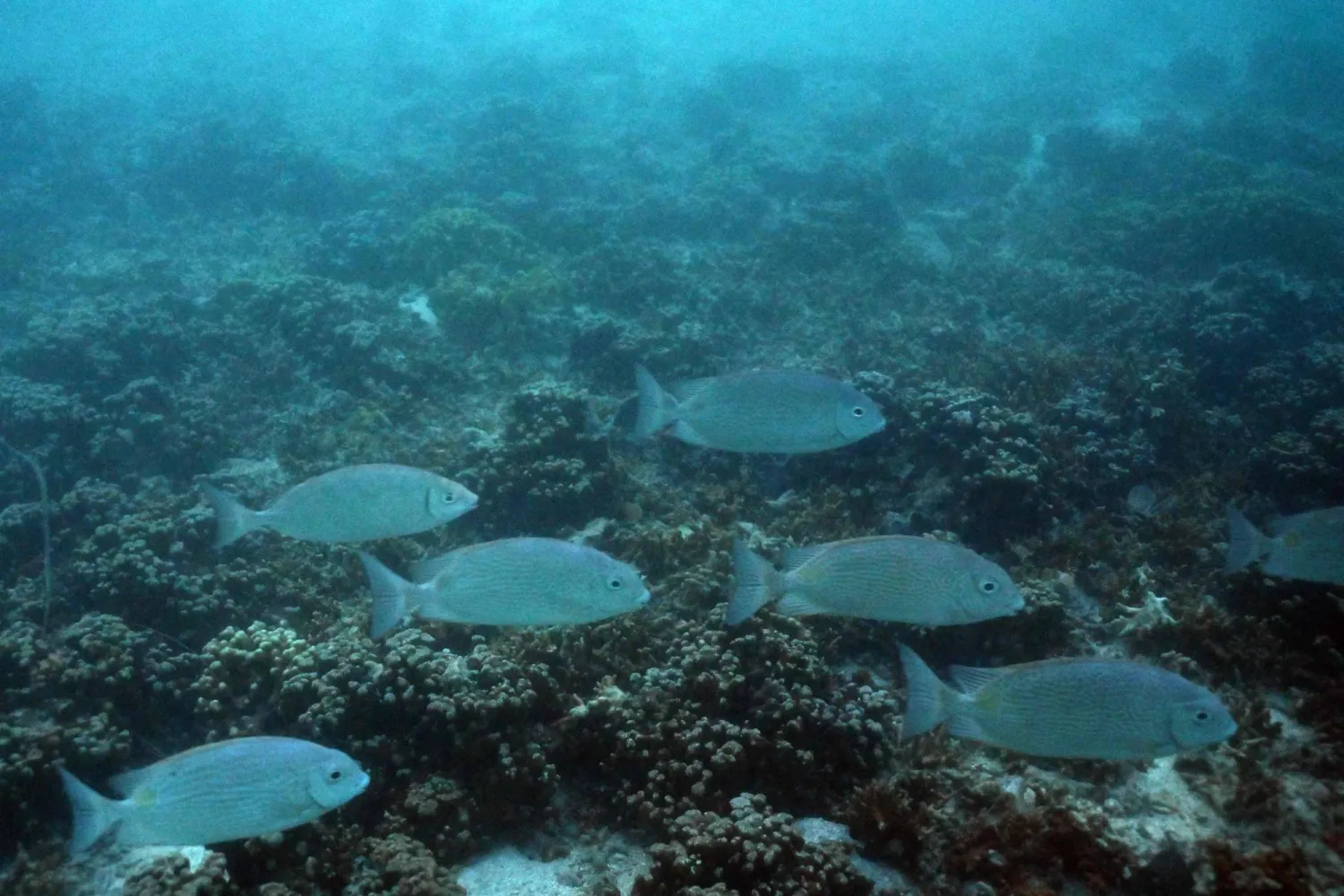
Fish swim in a coral reef in waters off Koror, Palau, on August 30, 2026. (AFP)
TT

Coral Bleaching Occurring Too Frequently for Reefs to Recover, Scientists Say

Fish swim in a coral reef in waters off Koror, Palau, on August 30, 2026. (AFP)

Coral reefs are experiencing bleaching events so frequently that they no longer have time to recover before the next one strikes, with global coral cover now well below normal levels and at risk of irreversible decline, scientists said on Monday.

The world's coral reefs sustain a quarter of all marine life, make coastlines more resilient and provide food and livelihoods for millions of people, but their survival has been threatened by pollution and increasingly frequent mass bleaching caused by soaring ocean heat.

The gap between bleaching events once stretched for decades, but now averages just five or six years, a group of ‌scientists known as the ‌Global Coral Reef Monitoring Network said in a report based ‌on ⁠more than 40 ⁠years of data from nearly 37,000 reef sites in 120 countries and territories.

"If we give them enough time, they have the capacity to recover," lead author Manuel Gonzalez Rivero said. "But we haven't seen that amount of time being allowed. In fact, the frequency of those bleaching events has pretty much doubled."

Bleaching occurs when corals expel the colorful algae living in their tissues. Without the algae delivering nutrients to the corals, they become pale and vulnerable to starvation and disease. While a ⁠bleached coral is not dead, ocean temperatures need to cool off if ‌it is to have any hope of recovery.

The ‌report's release comes as Pacific leaders gather in Palau on Monday for the annual Pacific Islands Forum. ‌The leaders are expected to coordinate climate priorities before the COP31 climate conference later this ‌year.

Its findings provide further evidence of the impact that climate change is having on fragile coral reef ecosystems, with hard coral cover shrinking 9.5% below the historical average over the 2020-2024 period.

"We had 40 years of coral cover around the world that had remained relatively unchanged until 2010," Gonzalez Rivero said. "Since 2010 ‌there has been a very steep change."

'STAIRCASE OF DECLINE'

Scientists recorded the world's first mass bleaching event in 1998 and three more ⁠have occurred since 2010.

When ⁠temperatures fall, the reefs can recover relatively quickly. Over 2017-2019, reefs gained 6% coral cover, nearly offsetting the 6.6% loss from the 2016 bleaching event.

The latest bleaching in 2023 was the most extensive on record, impacting 77% of the world's coral reef areas, part of what Gonzalez Rivero described as a "staircase of decline".

With El Niño weather patterns intensifying and ocean surface temperatures reaching a record high of 21.1 degrees Celsius (69.98°F) on August 22, another bleaching event could strike the world's reefs this year, he said.

"It is very likely given the temperatures."

Rapid cuts in emissions and the management of local threats — including unsustainable fishing and excessive coastal development — could limit further losses, the report said.

"We must act now to halt this decline and invest in solutions that reduce pressures and build resilience," said David Obura, chair of the Intergovernmental Science-Policy Platform on Biodiversity and Ecosystem Services.

"Delayed action risks locking in irreversible losses."


Italy Taking Action Against Paid Beaches

A view of the colorful houses and boats in the harbor of Marina Corricella on Procida Island, Italy. (Shutterstock)
TT

Italy Taking Action Against Paid Beaches

A view of the colorful houses and boats in the harbor of Marina Corricella on Procida Island, Italy. (Shutterstock)

Authorities are cracking down harder on illegal structures on Italy’s beaches as exorbitant prices are charged for umbrellas and lounge chairs.

In Ostia, the city beach of the capital Rome, several privately operated beach resorts have been closed on the orders of the city administration, according to dpa.

In the middle of peak season, two commercial beach resorts are currently being demolished. A public beach, which will be freely accessible to everyone at no cost, is to be built in their place. Similar efforts are underway in other regions, such as Liguria and Apulia.

Along Italy’s 7,500-kilometer Mediterranean coastline, there are thousands of privately operated beach resorts that rent out lounge chairs and umbrellas—a tradition that has developed over decades.

Currently, the average rental fee for two lounge chairs and an umbrella is about 40 euros per day. Now, however, authorities in several regions are taking action against the practice of allowing people access to the beach only if they pay for it. Another source of frustration is that high fences and walls block access in many places.

Yet, just as elsewhere in Europe, the coastline in Italy actually belongs to the state. By law, the shoreline should be freely accessible to everyone, everywhere, at no cost. However, more than half of the beaches are leased to private operators.

Officially, there are more than 7,300 so-called “Stabilimenti Balneari” in Italy. Most of them are family-run businesses.

The authorities’ stricter approach is also linked to a 2006 EU directive, the implementation of which in Rome has been repeatedly postponed.

According to the directive, government concessions for beach sections must be put out to tender on a regular basis because the land is public property. This process is now set to begin in 2027.


Schoolchildren Leaving Critical Thinking to AI

FILE - The OpenAI logo is displayed on a mobile phone in front of a computer screen with output from ChatGPT, March 21, 2023, in Boston. (AP Photo/Michael Dwyer, File) 
TT

Schoolchildren Leaving Critical Thinking to AI

FILE - The OpenAI logo is displayed on a mobile phone in front of a computer screen with output from ChatGPT, March 21, 2023, in Boston. (AP Photo/Michael Dwyer, File) 

Schoolchildren are dispensing with analytical thinking as they increasingly lean on artificial intelligence, a fast-changing technology that many teenagers struggle to understand, a new survey shows, according to dpa.

The research, published in August by US-based media advice organization Common Sense Media, showed that pupils are foregoing “critical thinking” as the use of chatbots in the classroom expands.

Around 40% of those asked said they suspected that using AI is not helping them learn, agreeing that relying on chatbots means they generate fewer ideas of their own.

Around six in ten of the approximately 1,000 participants who use AI do so to get an answer to their schoolwork, with a quarter not bothering to rephrase the response and 31% changing the wording to make the response sound like their own.

In cases where schools block AI platforms, six in ten pupils turned to personal devices to access chatbots for help with assignments.

However, almost three-quarters of those surveyed said they have not been instructed or advised how to use AI “safely.”

“Students understand that AI threatens learning, but the reality is that it is too tempting and convenient for them to look the other way,” said Common Sense Media chief executive Jim Steyer, who called on adults to provide children with skills to use the technology “responsibly.”

Previous research has suggested that adults - including those in elite professions - are as susceptible as teenagers to letting AI do their thinking for them.

In 2025, Microsoft found multiple signs of reduced cognitive effort and less critical thinking in a survey of over 300 knowledge workers.

The latest findings were published as another poll showed that, for the first time, a majority of young adults are “more concerned than excited" about AI, with only 10% of under-30’s feeling “excited.”

Published by the Pew Research Center, the survey found 52% of all age groups deeming themselves as concerned that AI could lead to mass unemployment.


Saudi, Syrian Broadcasting Authorities Sign MoU to Strengthen Cooperation

The Saudi Broadcasting Authority and the General Authority for Radio and Television in Syria signed a memorandum of understanding (MoU) in Riyadh on Sunday to strengthen relations and develop cooperation in radio and television. (SPA)
TT

Saudi, Syrian Broadcasting Authorities Sign MoU to Strengthen Cooperation

The Saudi Broadcasting Authority and the General Authority for Radio and Television in Syria signed a memorandum of understanding (MoU) in Riyadh on Sunday to strengthen relations and develop cooperation in radio and television. (SPA)

The Saudi Broadcasting Authority and the General Authority for Radio and Television in Syria signed a memorandum of understanding (MoU) in Riyadh on Sunday to strengthen relations and develop cooperation in radio and television, the Saudi Press Agency reported.

Minister of Media Salman Al-Dossary and Syrian Minister of Information Khaled Zaarour attended the signing ceremony. The MoU was signed by Saudi Broadcasting Authority CEO Ali bin Abdullah Al-Zaid and Director General of the Radio and Television Authority in Syria Alaa Barselo.

The MoU provides for the exchange of audio and visual programs in areas of mutual interest, including culture, education, science, entertainment, sports, and news. It also covers the exchange of information and expertise, visits between experts and specialists, and the organization of conferences, seminars, and workshops, as well as making use of available opportunities of mutual interest.