
Can Pineapples Thrive in Africa’s Sahel? A Burkina Faso Farmer Says the Answer Is Yes

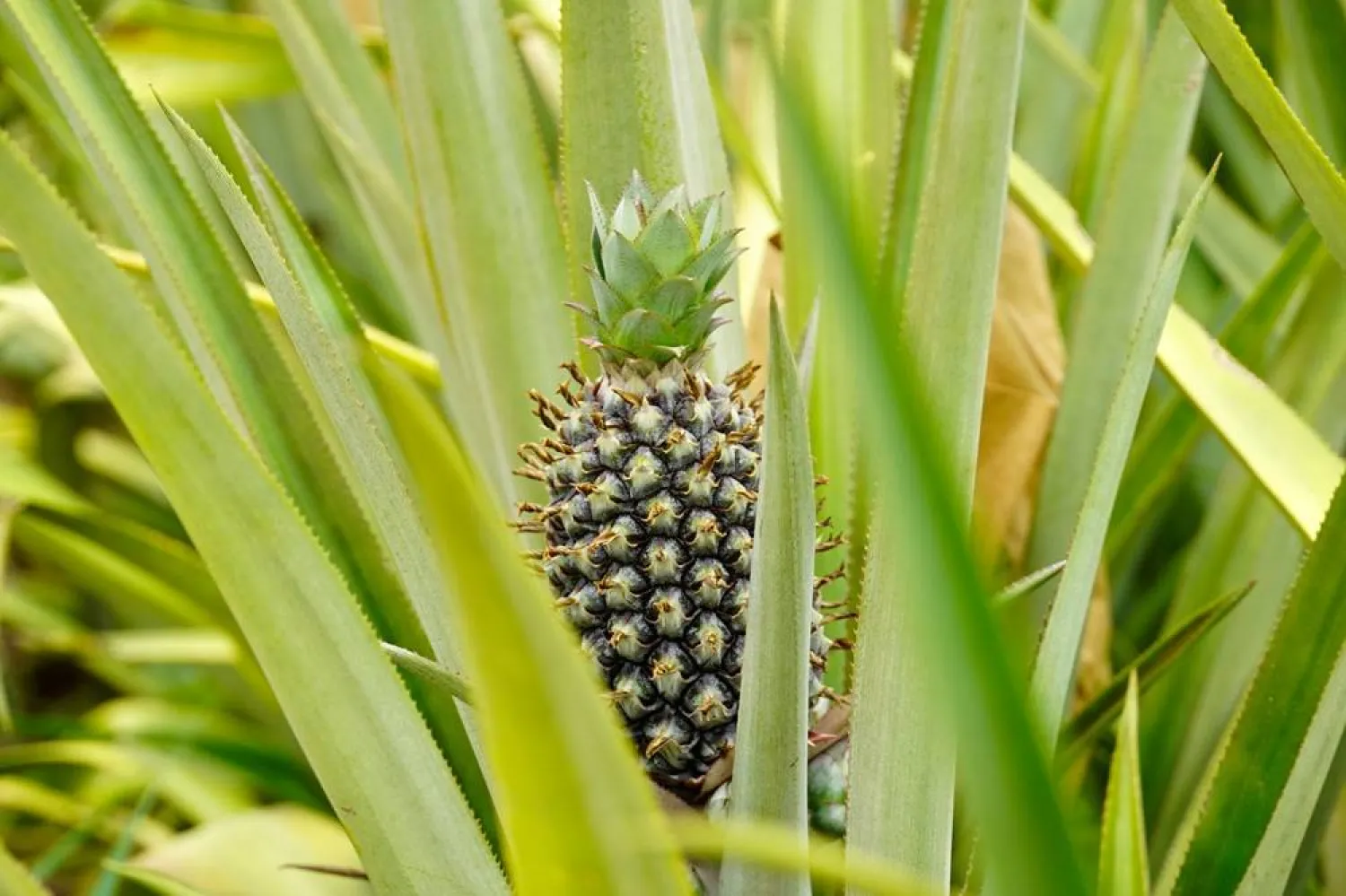
A pineapple grows on Djoda Farm in Matourkou, near Bobo-Dioulasso, Burkina Faso, Thursday, May 7, 2026. (AP)
TT

Can Pineapples Thrive in Africa’s Sahel? A Burkina Faso Farmer Says the Answer Is Yes

A pineapple grows on Djoda Farm in Matourkou, near Bobo-Dioulasso, Burkina Faso, Thursday, May 7, 2026. (AP)

The soil beneath Oumarou Compaoré's boots is sandy and stony. It’s hardly the lush setting usually needed to support growing pineapples.

But this farm in landlocked Burkina Faso is part of national efforts to reduce overall reliance on imports and adapt to an ever-harsher climate in the dry heat of Africa’s Sahel region. Pineapples have long been seen as exotic fruit grown by richer coastal neighbors, and more expensive than the mangoes that grow outside many Burkinabe homes.

“People told us that here we could only grow cotton, maize or sorghum,” Compaoré said at the farm he founded in 2018 outside the western city of Bobo-Dioulasso, where he drives around in a van with an inscription that reads, “Pioneer in pineapple production in the Sahel.”

His pineapple initiative, inspired in part by border closures during the COVID-19 pandemic, is one of the more unusual projects challenging the idea that people in Burkina Faso must rely on neighbors for much of what they eat.

“Because the fruit was in short supply, we were able to sell it easily,” said Compaoré, who also had been growing papayas with little profit. Now his pineapple field has grown to about 50 hectares (124 acres).

The country's military leaders have taken note. Their economic growth plan is tied heavily to agriculture. Pineapples are now part of the government's formal development plan as it seeks to boost food self-sufficiency for the country of 24 million people.

While there are no available government data on pineapple production, farmers say more of them are venturing into it.

As of November, pineapple fields had expanded to around 100 hectares (248 acres) in the administrative region that includes Compaoré's farm, the regional director of agriculture, Adanabou Eric Pascal, told local media at the time. Kola Jean, the agricultural engineer at Compaoré's farm who helps to train others on pineapple farming, estimated that over 100 farmers are now getting into production.

Under Capt. Ibrahim Traoré, who took power after a coup in 2022, Burkina Faso has presented food production as a sovereignty issue.

It suspended rice imports in April this year with a stated goal of facilitating local production. It inaugurated two factories for tomato paste, a local staple, in 2024.

And at a major supermarket in the capital, Ouagadougou, there is a section dedicated to locally grown food — like shea butter, corn and cassava flour and drinks like mango juice — labeled, “Let’s consume what we produce."

All are steps toward shaking off the dependence on imports that for decades has exposed millions of people to shifting transport costs and other price shocks.

Hunger remains widespread. A decadelong security crisis that has left extremists in control of large swathes of territory has disrupted access to farmland and markets. Many people have been displaced. UN agencies have said some 2.7 million people face acute food insecurity during the annual lean season when stocks from the previous harvest run low and market prices peak.

Other farmers are being inspired

Mdme Kaba Séré, a pineapple farmer in Houet Province, said she used to work in the nonprofit sector but switched to farming in 2023 following international aid cuts.

She recalled being told at a young age that pineapples cannot grow in the Sahel, the dry strip of land south of the Sahara. Then she was trained on pineapple cultivation by Compaoré.

“We saw what Oumarou was doing and thought: It is possible, why not?” said Séré, who has expanded her farm to about 60,000 seedlings.

"With pineapple, there is profit,” she said. “It has impacted my entire family because thanks to this I have been able to support them.”

Because pineapples had long been seen as rare in Burkina Faso, farmers say the business is lucrative because it's easy to find buyers even before the fruit hits the market.

But hurdles include investments in everything from fertilizer to irrigation and reliable transport.

Pineapples require a lengthy growing period of up to two years, plus reliable access to water. Compaoré said he irrigates part of his land from a well, but digging wells is an investment many farmers cannot afford.

The climate can be problematic, too. Farmers are finding ways to adapt, including by irrigating with cool water in the evening during intense heat, said Pascal Bazongo, a professor of soil science and natural resource management at Burkina Faso’s University of Fada N’Gourma and an expert involved with Compaoré's farm.

Compaoré is upbeat about future innovations and better yields. On recently acquired plots, about 30 workers moved through the field as music played from a loudspeaker. Their goal that day, he said, was to plant roughly 60,000 pineapple seedlings.

He expects the new fields to produce between 60 and 75 metric tons (66-83 tons) of pineapples, with a projected revenue of about 35 million CFA francs, or roughly $62,000.

“We could even make the country self-sufficient in this fruit,” he said.


Satellites Show Earth Lost More Than 12 Trillion Tons of Ice from Greenland, Antarctica in 47 Years

Two groups from the Poseidon Expeditions tour company look at a glacier in the Scoresby Sund, Sept. 7, 2023, in Greenland. (AP)
TT

Satellites Show Earth Lost More Than 12 Trillion Tons of Ice from Greenland, Antarctica in 47 Years

Two groups from the Poseidon Expeditions tour company look at a glacier in the Scoresby Sund, Sept. 7, 2023, in Greenland. (AP)

About 12.5 trillion tons (11.3 trillion metric tons) of ice from glaciers in Greenland and Antarctica have melted since 1979, which is enough frozen water to stack ice five feet deep across the continental United States, according to a major scientific report.

A warming Earth is accelerating the melting of the planet's two major ice sheets, with five-sixths of the melt not coming from hotter air, but from warmer waters eating away at the ice sheets from below and the sides, with glaciers flowing into the oceans, according to a study in Wednesday's journal Scientific Data. That's bad news for future sea level rise, the study's authors said.

“The ice sheets are melting away fast,” said study co-author Eric Rignot, an ice scientist at University of California, Irvine. “We are melting the polar regions, sea level is rising worldwide and will exacerbate the vulnerability of coastal regions.”

Huge numbers for ice melt, people flooded

The numbers behind the melt are both mind-bogglingly huge and deceptively small.

All that melted ice turned into nearly 3 quadrillion gallons of water (11.3 quadrillion liters), which pushed global sea levels up about an inch (3.1 centimeters) since 1979, on top of other climate factors raising ocean heights, the report said.

An inch may not sound like much, but for every third of an inch (or centimeter) of sea level rise, another 2 to 3 million people get flooded at least once a year, said lead study author Ines Otosaka, an ice scientist at Northumbria University in England.

The Jakobshavn glacier in Greenland is now retreating up to 164 feet (50 meters) a day, Otosaka said.

The international collaboration of polar scientists, headed by the European Space Agency, had in the past only looked at ice sheet melt since the 1990s based on European satellite data. But by incorporating NASA satellites, the scientists were able to chart ice sheet volumes in Antarctica back to 1979 and in Greenland back to 1972.

The melting is accelerating

“There is a clear trend that the ice sheets are losing more mass and it has been increasing from decade to decade, especially if you look at the ice being discharged to the ocean," Otosaka said. "And that’s quite clear that there’s a link to climate change.”

It showed that in the 1970s, 1980s and into the 1990s, the ice sheets were relatively stable, but then melt started happening and it really kicked in during the 2010s, Otosaka said.

“That’s something to be concerned about as it shows that the changes are tracking decades behind global warming, which means we can expect them to continue for decades more — even if we are able to stop heating the planet,” said study co-author Andrew Shepherd, also of Northumbria.

The accelerating numbers seemed to pause from 2020 to 2023, but the study's authors said it more reflected short-term weather variations not long-term trends. Otosaka said the study stopped with 2023 data, but she's looked at measurements since and found the accelerating trend has picked back up.

A lot of the stability in Antarctica was because East Antarctica had record snowfall, which compensated for the rapid melting in the less stable West Antarctic Ice Sheet, the authors said.

The three-year hiatus was “just a bump in the record,” Rignot said. “The long rise is climate and the threat is crystal clear.”

Worrying about a collapse scenario

The biggest changes scientists saw are in what they call dynamic processes, which are more abrupt and active than the slow steady melting from the air, and that's something prone to trigger runaway “tipping points,” Otosaka said.

New York University ice scientist David Holland, said that's what concerns him “because most of the ice loss is dynamical and that is exactly what you would expect in an ice sheet instability collapse scenario.”

The international team used 45 independent surveys and 27 different satellites. “The use of relatively independent methods gives me greater confidence in the result,” said Holland, who wasn't part of the study. “The upward trend is real.”

“The ‘wild cards’ of Antarctic mass loss continue to pose a challenge for human management of the planet — a clear and present danger, but many decades in the future,” said University of Colorado ice scientist Ted Scambos, who wasn't part of the study. “We are now as a society smart enough to know the future, but not prudent enough to act upon the knowledge.”


Centenarians Living in Japan Exceed 100,000 for the First Time

Elderly people rest under the shade of a tree in Tokyo, Sunday, Sept. 14, 2014. (AP)
TT

Centenarians Living in Japan Exceed 100,000 for the First Time

Elderly people rest under the shade of a tree in Tokyo, Sunday, Sept. 14, 2014. (AP)

The number of people aged 100 or older in Japan surpassed a record 100,000 this year, the latest government figures show, underscoring the country's rapidly aging and declining population.

The Health and Welfare Ministry statistics released Tuesday show Japan now has 107,677 centenarians, up 7,914 from the previous year and exceeding the 100,000 mark for the first time. Nearly 88% of them are women.

Kyoto resident Fuyo Kishimoto was recently recognized as the oldest Japanese woman at age 114. Japan's oldest male is 112-year-old Hikaru Kato from Kumamoto in southern Japan.

The figures were released to mark this year’s Sept. 15 Respect the Aged day, when healthy and active centenarians are honored by the government with a letter from Prime Minister Sanae Takaichi.

“I'm very pleased that many people are living a long, healthy and active lives,” Health Minister Kenichiro Ueno told reporters Tuesday, citing progress in medical technology, healthy lifestyle and diet as contributing factors.

Ueno noted the importance of maintaining a sustainable social security system as the population continues to age and decline.

Many younger people, however, are not optimistic about their future.

The National Institute of Population and Social Security Research last week released the results of a survey indicating more than 20% of both men and women who are single and aged between 18 and 34 have no intention of ever marrying, with nearly half saying they see no benefit in marriage.

Ueno acknowledged the reasons for marriage reluctance among young people include the high costs of raising and educating children and the mental and physical burden on working parents. He said the government will continue addressing their concerns and attempt to turn around problems related to Japan's aging population and dwindling births.

Japan’s drastic population decline is inevitable, experts say, noting the country's total fertility rate dropped to a record low 1.14 in 2025, far below the 2.1 children needed to be born to each Japanese woman to maintain the current population.

Japan’s total population during the 2020 census stood at 126 million, almost 30% of which were 65 or older. Experts estimate there will be a decline to 87 million by 2070 with nearly 40% aged 65 or older, according to the national institute.

There were 153 people aged 100 or older in Japan when centenarian surveys began in 1963. They exceeded 1,000 in 1981 and surpassed 10,000 in 1998, according to the Health and Welfare Ministry.


Spanish Scientists Find 1st Evidence of Diplodocus Dinosaur in Europe

FILE PHOTO: A diplodocus skeleton named "Misty" is seen at Summers Place Auctions in Billingshurst, southern England November 25, 2013. REUTERS/Luke MacGregor/File Photo
TT

Spanish Scientists Find 1st Evidence of Diplodocus Dinosaur in Europe

FILE PHOTO: A diplodocus skeleton named "Misty" is seen at Summers Place Auctions in Billingshurst, southern England November 25, 2013. REUTERS/Luke MacGregor/File Photo

Spanish paleontologists say they have found the first evidence that Diplodocus, the iconic long-necked dinosaur, once roamed Europe, according to research published on Tuesday in the Journal of Vertebrate Paleontology.

Researchers from the Dinopolis Foundation in Teruel in eastern Spain recovered fossils comprising 14 caudal vertebrae and several chevron bones of one specimen ⁠from sediments dating back ⁠around 150 million years.

"The anatomical study and evolutionary analyses we conducted have allowed us to identify the El Castellar specimen as belonging to the genus ⁠Diplodocus. It is one of the most complete diplodocids discovered to date in Europe and represents the first evidence of this genus outside North America," lead author Sergio Sanchez Fenollosa wrote, according to Reuters.

Alberto Cobos, managing director of the Dinopolis Foundation and a co-author of the study, said the ⁠specimen ⁠likely measured around 25 meters (82 feet) in length. It joins a growing list of giant Jurassic sauropods found in the Teruel area.

First identified from fossils found in Wyoming in 1877, the herbivorous Diplodocus, known for its long neck, whip-like tail and four sturdy legs, is among the world's most recognizable dinosaurs.