



Global Warming Will Exceed Limit, UN Says as it Maps Path to Get Back Below Danger Zone

This aerial picture shows a villager walking between dried-up rice fields with cracked soil caused by a prolonged dry season at Wening Galih village in Bogor, West Java on August 28, 2026. (AFP)
TT

Global Warming Will Exceed Limit, UN Says as it Maps Path to Get Back Below Danger Zone

This aerial picture shows a villager walking between dried-up rice fields with cracked soil caused by a prolonged dry season at Wening Galih village in Bogor, West Java on August 28, 2026. (AFP)

In a strategic retreat in the fight against climate change, the United Nations has acknowledged that Earth has lost its chance to prevent some of the worst of global warming's harms. So now the world must figure out how to get temperatures below the danger zone and back to safety, officials say.

Earth is soon going to exceed the safe temperature threshold agreed upon by the world in the 2015 Paris climate accord because of warming from the burning of coal, oil and gas, according to a bleak first-of-its-kind report issued by the United Nations Environment Program Wednesday.

Instead of giving up, scientists and UN officials recommend trying to limit excessive warming and then bring the temperature back down to the agreed-upon threshold. But it still will mean decades of increased weather-related disasters, rising seas, extinctions and melting ice and glaciers.

“Humanity is speeding past the limit to avoid climate catastrophe,” United Nations Secretary-General António Guterres said.

After a period of over-the-limit warming, the new strategy envisions getting back below the limit by ending fossil fuel use and developing some kind of way to suck industries' carbon dioxide out of the air.

“It's a reality check. We have to live with this warmer world,” said report co-author Richard Betts, a climate scientist at the University of Exeter. “But there's still a lot we can do to limit warming.”
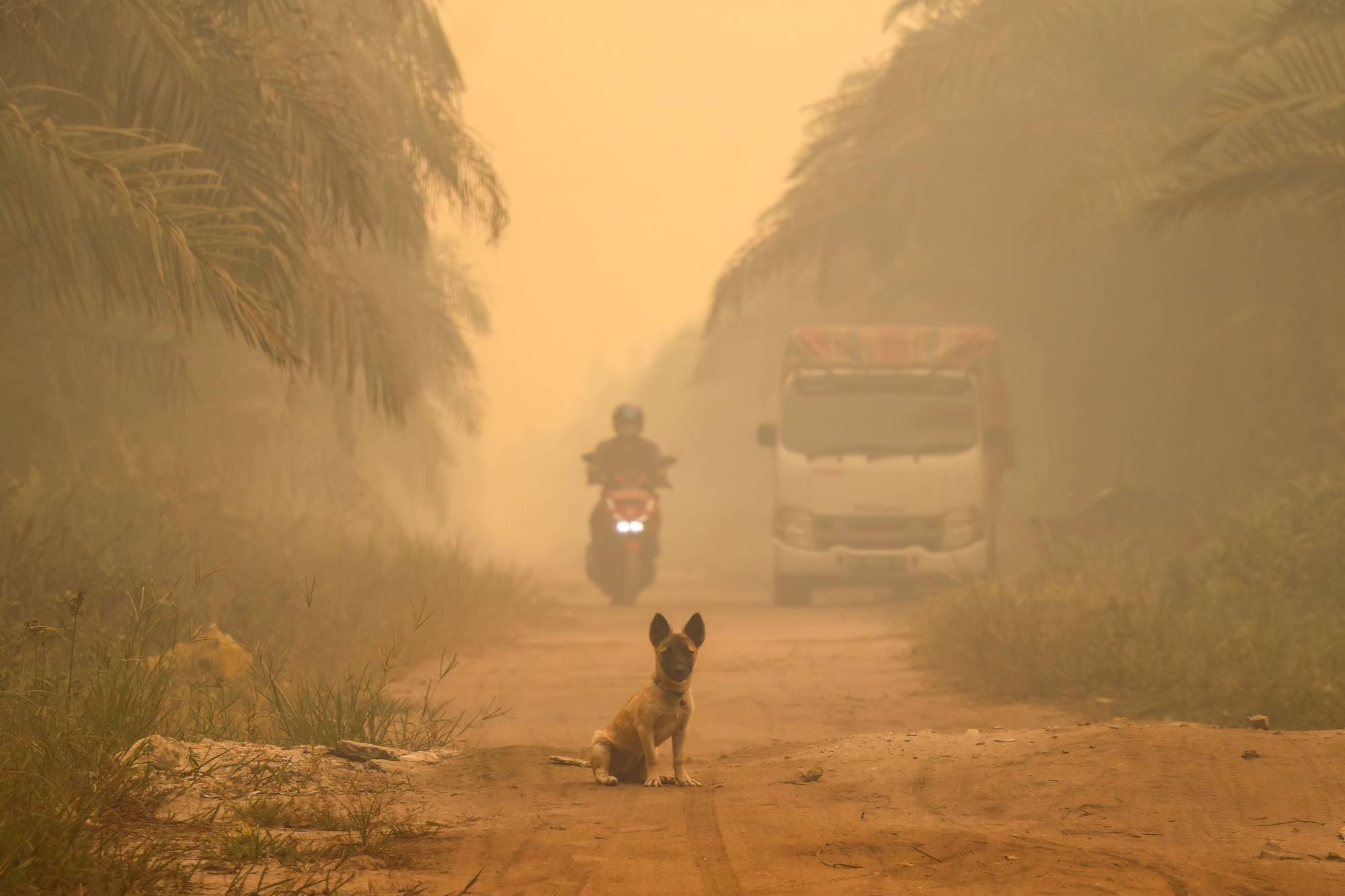
A dog sits in the middle of a haze-shrouded road caused by forest and land fires in Palangkaraya city, Central Kalimantan, on August 28, 2026. (AFP)

Passing the longtime warming threshold

After the Paris climate accord, the United Nations ordered its climate science arm to study different warming limits. A goal of 1.5 Celsius (2.7 Fahrenheit) above mid-19th century temperatures became generally accepted after the scientists found dramatic impacts that affect people and the planet at 2 degrees Celsius (3.8 degrees Fahrenheit) but not at 1.5 degrees.

The world is now at 1.4 C (2.5 F) above pre-industrial levels, some scientists have calculated. The measure is based on a 20-year average, rather than a single year's temperatures.

Despite experts saying there's no way to limit warming to 1.5 degrees, UN officials long maintained the 1.5 window was still open. Wednesday's report finally admitted that the world will cross the 1.5 threshold “in the next few years.”

The report said the most optimistic scenario has warming peaking at 1.8 C (3.2 F) around mid-century if countries pursue ambitious climate goals, but that governments' current policies should push temperatures to 2.6 C (4.7 F) above pre-industrial levels by 2100.

So instead of preventing warming of 1.5 degrees, now the UN said it wants policymakers to “prepare for and navigate a future” in which the globe crosses that limit and then corrects course and cools temperatures. The report envisions that global temperatures will pass 1.5 “within the next few years,” follow a hump-shaped path of more warming, peak, then gradually cool to below the 1.5 mark, ideally by the end of the century. The report and experts call it “overshoot.”

“Let’s be very clear, 1.5 target is still the goal. But now we need to approach it differently from above,” said UNEP Executive Director Inger Andersen.

The 1.5 limit is not “some magical climate cliff” where it’s just game over, said University of Victoria climate scientist Andrew Weaver, who wasn’t part of the study. “Every tenth of a degree we avoid still means less damage.”

Limiting how high temperatures go past threshold is key

It's most important to first limit the new peak temperature and then reduce the amount of time above 1.5 degrees, Andersen said.

But the world likely will be in that overshoot period for “many, many decades,” Betts said.

Every five years of delay in reducing emissions adds at least a tenth of a degree to peak warming, said report co-author Joeri Rogelj, a climate scientist at Imperial College London.

“If we act now we can limit overshoot,” the report said. “Not a safe world, but safer than remaining above” 1.5 degrees for the long term.

“This is among the bleakest UN climate reports I have read. It carries the unmistakable tone of desperation, frustration and urgency — but not resignation,” Weaver said.

Climate scientist Bill Hare, CEO of Climate Analytics, said that “although UNEP does a good job of describing the hole we've dug ourselves into, it does a poor job of showing us that there's a way out.”

A photograph taken on August 24, 2026 shows a cornfield with dry ears, in Figarol, southwestern France. Due to the repeated heatwaves that have hit the south-west, Sébastien Maylin will be able to “barely cover the cost” of his fertilizer and seeds. (AFP)

Adapting to a deadlier, hungrier, thirstier world

Governments need to increase efforts to adapt to worsening warming, which hits the poor hardest, “because some impacts simply cannot be avoided,” Andersen said.

The report calls this phase “coping and containment.”

During this overshoot period, more people will die or get sick because of the worsening climate change and its extreme weather, the report said. Food production will drop, people will go hungry, water shortages will worsen, economies will be hurt and species like coral will go extinct, the report said.

Although the triggers behind the recent deadly Nepal flooding that came as part of a Himalayan glacier dislodging are complex, Betts said “unfortunately we do expect to see more of such things and this is exactly why we need to limit peak warming.”

The report warns of “tipping points” with irreversible and cascading effects, including the loss of the West Antarctic and Greenland ice sheets, the loss of the Amazon rain forest and the shutdown of the Atlantic Ocean circulation system that keeps much of Europe warm.

“Some locations might become more or less uninsurable or even uninhabitable,” the report said.

The last phase in overshoot is cooling the planet by removing carbon dioxide from the air and storing it somewhere. The report said the traditional approach of this is planting more trees, but it says planting trees could, at most, shave a tenth of a degree off global temperatures. So the authors said more novel carbon removal approaches will be needed.

Other scientists called that unreliable and expensive.

“We were unable to stop the runaway train of global emissions to avoid 1.5 C of warming,” said Stanford University climate scientist Rob Jackson, who wasn't part of the report. “Now overshoot scenarios require us to stop the train quickly and to back it up. Is it our best hope? Absolutely. Is it likely? Absolutely not.”



Centenarians Living in Japan Exceed 100,000 for the First Time

Elderly people rest under the shade of a tree in Tokyo, Sunday, Sept. 14, 2014. (AP)
TT

Centenarians Living in Japan Exceed 100,000 for the First Time

Elderly people rest under the shade of a tree in Tokyo, Sunday, Sept. 14, 2014. (AP)

The number of people aged 100 or older in Japan surpassed a record 100,000 this year, the latest government figures show, underscoring the country's rapidly aging and declining population.

The Health and Welfare Ministry statistics released Tuesday show Japan now has 107,677 centenarians, up 7,914 from the previous year and exceeding the 100,000 mark for the first time. Nearly 88% of them are women.

Kyoto resident Fuyo Kishimoto was recently recognized as the oldest Japanese woman at age 114. Japan's oldest male is 112-year-old Hikaru Kato from Kumamoto in southern Japan.

The figures were released to mark this year’s Sept. 15 Respect the Aged day, when healthy and active centenarians are honored by the government with a letter from Prime Minister Sanae Takaichi.

“I'm very pleased that many people are living a long, healthy and active lives,” Health Minister Kenichiro Ueno told reporters Tuesday, citing progress in medical technology, healthy lifestyle and diet as contributing factors.

Ueno noted the importance of maintaining a sustainable social security system as the population continues to age and decline.

Many younger people, however, are not optimistic about their future.

The National Institute of Population and Social Security Research last week released the results of a survey indicating more than 20% of both men and women who are single and aged between 18 and 34 have no intention of ever marrying, with nearly half saying they see no benefit in marriage.

Ueno acknowledged the reasons for marriage reluctance among young people include the high costs of raising and educating children and the mental and physical burden on working parents. He said the government will continue addressing their concerns and attempt to turn around problems related to Japan's aging population and dwindling births.

Japan’s drastic population decline is inevitable, experts say, noting the country's total fertility rate dropped to a record low 1.14 in 2025, far below the 2.1 children needed to be born to each Japanese woman to maintain the current population.

Japan’s total population during the 2020 census stood at 126 million, almost 30% of which were 65 or older. Experts estimate there will be a decline to 87 million by 2070 with nearly 40% aged 65 or older, according to the national institute.

There were 153 people aged 100 or older in Japan when centenarian surveys began in 1963. They exceeded 1,000 in 1981 and surpassed 10,000 in 1998, according to the Health and Welfare Ministry.


Spanish Scientists Find 1st Evidence of Diplodocus Dinosaur in Europe

FILE PHOTO: A diplodocus skeleton named "Misty" is seen at Summers Place Auctions in Billingshurst, southern England November 25, 2013. REUTERS/Luke MacGregor/File Photo
TT

Spanish Scientists Find 1st Evidence of Diplodocus Dinosaur in Europe

FILE PHOTO: A diplodocus skeleton named "Misty" is seen at Summers Place Auctions in Billingshurst, southern England November 25, 2013. REUTERS/Luke MacGregor/File Photo

Spanish paleontologists say they have found the first evidence that Diplodocus, the iconic long-necked dinosaur, once roamed Europe, according to research published on Tuesday in the Journal of Vertebrate Paleontology.

Researchers from the Dinopolis Foundation in Teruel in eastern Spain recovered fossils comprising 14 caudal vertebrae and several chevron bones of one specimen ⁠from sediments dating back ⁠around 150 million years.

"The anatomical study and evolutionary analyses we conducted have allowed us to identify the El Castellar specimen as belonging to the genus ⁠Diplodocus. It is one of the most complete diplodocids discovered to date in Europe and represents the first evidence of this genus outside North America," lead author Sergio Sanchez Fenollosa wrote, according to Reuters.

Alberto Cobos, managing director of the Dinopolis Foundation and a co-author of the study, said the ⁠specimen ⁠likely measured around 25 meters (82 feet) in length. It joins a growing list of giant Jurassic sauropods found in the Teruel area.

First identified from fossils found in Wyoming in 1877, the herbivorous Diplodocus, known for its long neck, whip-like tail and four sturdy legs, is among the world's most recognizable dinosaurs.


Giant Jellyfish Surprises Free Diver Off Welsh Coastline

The lion's mane jellyfish was spotted near the Pembrokeshire coast (Getty)
TT

Giant Jellyfish Surprises Free Diver Off Welsh Coastline

The lion's mane jellyfish was spotted near the Pembrokeshire coast (Getty)

A free diver has said he “couldn’t believe his luck” after spotting a giant jellyfish off the Welsh coastline.

Iestyn Morgan, from Pembrokeshire, said the lion’s mane was the “length of a bus” with a size of about 10 to 15 meters, according to BBC.

The 21-year-old conservationist, who records footage for social media to raise awareness about the “threat our seas are facing,” said it was the first lion’s mane he had seen in Wales.

More commonly found in the colder waters off Scotland, a marine biologist said although the lion’s mane sting was “nasty,” it was not dangerous.

Morgan said he was swimming near Trefin Beach in Pembrokeshire when he spotted the tentacles in the water.

“Three turned to 10, and then to 20. They just kept on coming,” he added.

The jellyfish was so big the tentacles went “beyond the range of visibility.”

He initially thought it was a compass jellyfish, which are native to UK waters, before realizing it was too big.

“It must have been the length of a bus or small train. I couldn't believe how big it was.”

The Wildlife Trusts said the lion's mane jellyfish gets its name from its long tentacles, and has “all the beauty and bite of a lion.”

They can grow up to 3 meters in length, but the tentacles - which are used to catch their prey - can exceed 30 to 36.5 meters making it one of the longest animals on Earth.

Marine biologist Dr. Cathy Lucas, from the University of Southampton, said Morgan’s video showed the animal’s incredible length.

“The tentacles are so long and so fine you might not even see them,” she said, recalling how during field work in Scotland divers would get bits of tentacles on them when there were no jellyfish around.

“They still sting after they break off,” she said, adding that while the sting was “nasty” and “the worst in the UK,” it was not dangerous.
