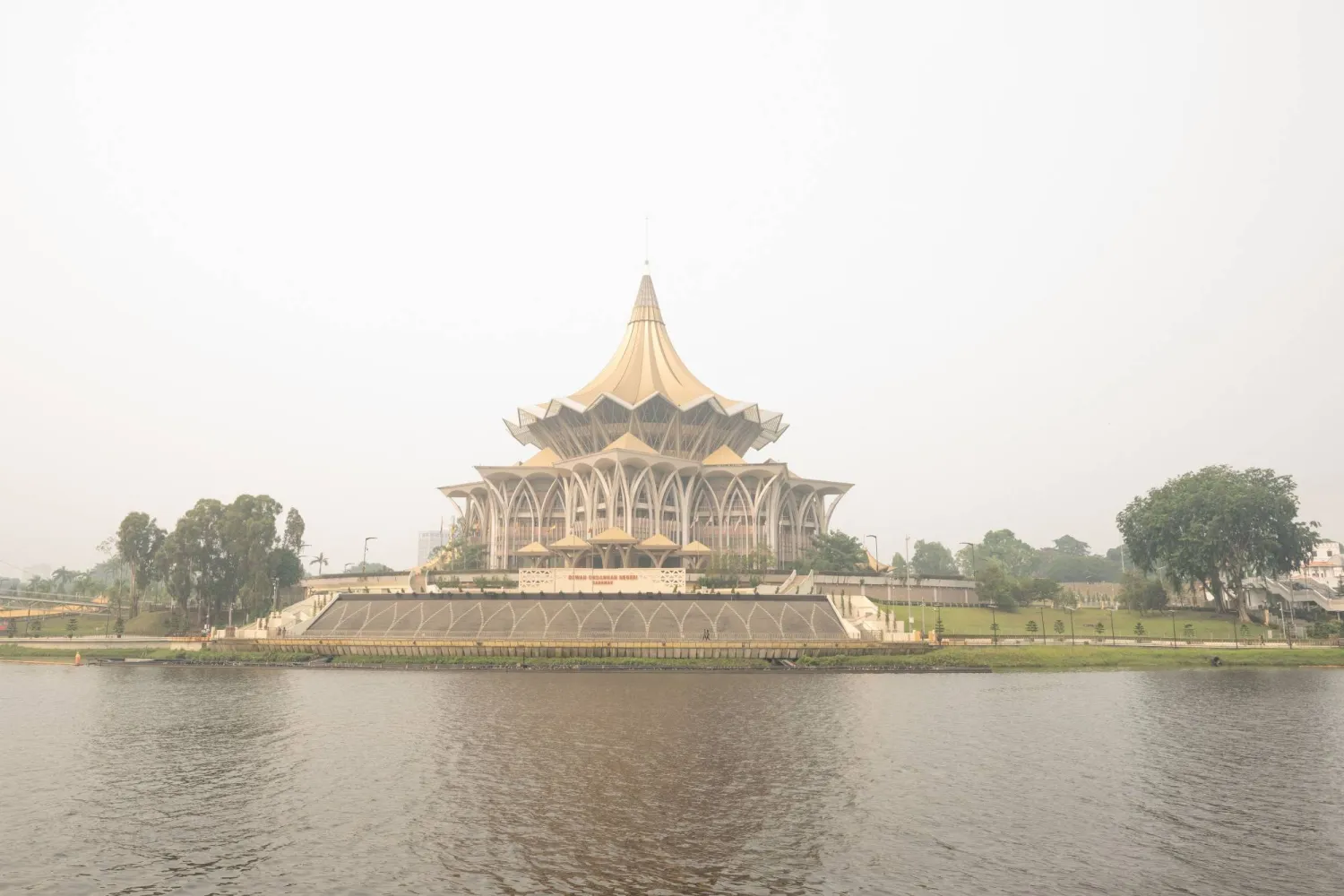
Malaysia Cancels Haze Emergency, but Warns Problems Remain

Haze shrouds the Sarawak Legislative Assembly building in Kuching, capital of the Malaysian state of Sarawak on the island of Borneo, on September 5, 2026. (AFP)
TT

Malaysia Cancels Haze Emergency, but Warns Problems Remain

Haze shrouds the Sarawak Legislative Assembly building in Kuching, capital of the Malaysian state of Sarawak on the island of Borneo, on September 5, 2026. (AFP)

Malaysia called off a haze emergency in Sarawak state on Borneo island on Monday but said very unhealthy levels of air pollution remain as a result of forest fires in neighboring Indonesia.

Kuala Lumpur on Friday activated the emergency after obtaining royal consent when pollution levels reached critical levels in Serian, about 65 kilometers (40 miles) south of the Sarawak capital, Kuching.

King Sultan Ibrahim "today approved the termination of the declaration of emergency", the prime minister's office said Monday.

"The haze situation in Sarawak has not yet fully recovered, and the API (Air Pollution Index) reading in several areas... is still at very unhealthy levels," it said in a statement.

API figures in Serian passed the critical threshold of 500 on Friday, peaking at 519 with the town cloaked in a thick cloud of smoke.

Under Malaysian guidelines, API levels above 300 are classified as hazardous, while readings beyond 500 constitute the threshold for declaring a local emergency.

Rain in Serian on Friday night and Saturday morning -- believed to have been the result of cloud seeding -- brought some respite, with API levels dropping to the low 200s on Monday, according to Sarawak's Natural Resources and Environment Board.

Toxic haze has shrouded parts of Indonesia and Malaysia for weeks as Jakarta struggles to contain fires that have scorched large tracts of Borneo and Sumatra, with the smoke drifting into neighboring Malaysia, Singapore, and Brunei.


Can Dogs Sniff Cancer? AI Joins the Hunt in India

A growing body of global research suggests dogs can be trained to detect cancer and other human illnesses. Idrees MOHAMMED / AFP
TT

Can Dogs Sniff Cancer? AI Joins the Hunt in India

A growing body of global research suggests dogs can be trained to detect cancer and other human illnesses. Idrees MOHAMMED / AFP

When rescue dog Chloe is not tumbling across the grass on a farm outside India's tech capital Bengaluru, she is learning to sniff human breath for cancer with a little help from AI.

Fitted with a 3D-printed helmet and harness packed with sensors, Chloe is part of experimental efforts to use dogs' extraordinary sense of smell to develop a non-invasive test for the disease.

A growing body of global research suggests dogs can be trained to detect cancer and other human illnesses, from Parkinson's to Covid-19.

The Bengaluru-based startup Dognosis is using AI to analyze dogs' brain activity, respiration and body language -- turning their reaction to scent into data.

"In an hour, they can do thousands of sniffs," co-founder Akash Kulgod, 26, told AFP. "Each sniff can evaluate a sample."

Dognosis hopes to launch commercially next year, which it says would make it the third company of its kind, after firms from Germany and Israel.

Early detection can make a crucial difference to cancer survival rates, but in India many patients are diagnosed only after the disease has advanced.

Dog sniffs could provide an easy and affordable first layer of screening to be deployed at scale, finding potential cases for further testing.

As it chases commercial approval, Dognosis -- backed by venture-capital firms including Accel India -- is collaborating with government medical institutions for its research.

Chloe, a Labrador mix, is one of 15 dogs being coached by the startup, clad in customized data-gathering helmets.

"It's like a doggy 'Iron Man' suit," said Kulgod, who comes from a family of doctors and studied cognitive science at the University of California, Berkeley.

- 'Promising' study -

Research suggests diseases can alter the chemicals released by the body, creating distinctive odors.

Dogs have around 300 million scent receptors, compared to about five million in humans.

The testing method is simple: a patient breathes into a cotton mask for about 10 minutes, and the mask is then sealed in a bag and taken to the lab. Patients do not meet the dogs.

A recent Dognosis study of more than 1,500 participants, involving six hospitals in Karnataka state, was published in the Journal of Clinical Oncology.

The company said it achieved an accuracy rate of more than 90 percent across seven major types of cancer, and now plans to test in real-world programs.

Cancer specialists in Bengaluru independent of the project voiced cautious optimism.

"The study is promising, as an early signal," said Santhosh Kumar Devadas, head of oncology at Ramaiah Memorial Hospital.

"But they need to do the study with a much larger group before we make any definitive conclusions."

Neelesh Reddy, a senior consultant oncologist at Manipal Hospitals, told AFP that "only time will tell how this technology will be useful to the actual patients".

- Dog 'work-life balance' -

India has described cancer as a major public health concern, saying one in nine of its 1.4 billion people are likely to develop the disease.

Dognosis says it aims to improve "proactive and preventative medicine" while boosting "human-canine communication".

Most of the dogs are beagles, along with some Malinois and Shepherd mixes, brought on board through adoption or legal breeders.

But only the best are selected, said Kulgod. The dog team individually lists each animal on the company website as an official "sniffer", alongside their photographs.

All have a great "work-life balance", with work time limited to around 30-45 minutes a day, he added.

At a center called "Sniffspace", dogs test human samples on platforms equipped with automatic feeders dispensing dog treats.

Kulgod's co-founder Itamar Bitan, 28, who spent four years in an Israeli special-forces canine unit, said the dogs were trained using "positive reinforcement" to detect a "specific funky smell" for a reward.

"Some of the dogs run directly to the feeder expecting rewards, some dogs freeze, some dogs will scratch the sample with excitement," Bitan said.

"But, as long as the machine that learns how the dogs react to the sample is very consistent... we don't really mind."


Wildfires, Heatwaves Threaten to Undermine Air Quality, UN Weather Agency Says

This photograph shows a plume of smoke engulfing trees during a wildfire near Etsaut, southwestern France, on September 6, 2026. (AFP)
TT

Wildfires, Heatwaves Threaten to Undermine Air Quality, UN Weather Agency Says

This photograph shows a plume of smoke engulfing trees during a wildfire near Etsaut, southwestern France, on September 6, 2026. (AFP)

Pollution from increasingly intense wildfires and heatwaves could undermine global efforts to improve air quality and protect human health, the United Nations' weather agency said on Monday, warning that climate change is making it harder to meet international air quality goals.

In its annual report on air quality and the climate, the World Meteorological Organization said air pollution and climate change are closely linked and should be ‌tackled through coordinated policies ‌rather than in isolation. It warned that meeting ‌the ⁠World Health Organization's ⁠air quality guidelines will become more difficult because extreme wildfires are more likely to occur in the future.

Wildfires are becoming a growing source of harmful air pollution even as regulations have reduced emissions from industry and transport in many developed countries, the WMO said in its report.

"No matter how clean your city or your region is ... if you have ⁠a lot of pollution brought about by wildfires, ‌that has the potential to negatively ‌impact air quality in those regions as well," Lorenzo Labrador, scientific officer at ‌the WMO, told Reuters.

The report highlights the growing impact of fine ‌particulate matter, known as PM2.5, and ground-level ozone, pollutants linked to respiratory and cardiovascular disease.

It also calls for improved monitoring of pollutants and aerosols including black carbon and microplastics, which it said remain poorly tracked despite their widespread ‌presence in the atmosphere.

This year has been marked by extreme heat and destructive wildfires across parts of ⁠Europe, including ⁠Spain, France and Greece. The WMO has said extreme heat is becoming more frequent, intense and longer-lasting as the planet warms.

The new report said PM2.5 concentrations in 2025 were above long-term averages in northern Canada, parts of Russia and western-central Africa due to heightened fire activity, while northwestern Spain was a hot spot following exceptional late-summer fires.

A study cited in the report found extreme fire-smoke events have tripled globally since the 1990s and may have contributed to nearly 100,000 additional deaths annually between 2010 and 2018.

Particulate matter from wildfires is particularly harmful because it comes with a host of toxic chemicals, Labrador said, adding that inhalation causes body-wide inflammation that can lead to pulmonary disease.


Tokyo's Shinjuku to Ban More than Half of Vacation Rentals

Tokyo tourist hotspot Shinjuku as a large residential population, who have become increasingly exasperated with tourists who fail to properly dispose of rubbish, smoke where they're not supposed to, and make too much noise. Ludovic MARIN / AFP/File
TT

Tokyo's Shinjuku to Ban More than Half of Vacation Rentals

Tokyo tourist hotspot Shinjuku as a large residential population, who have become increasingly exasperated with tourists who fail to properly dispose of rubbish, smoke where they're not supposed to, and make too much noise. Ludovic MARIN / AFP/File

Tokyo tourist hotspot Shinjuku will impose a ban on more than half of its holiday rentals including homes on Airbnb, an official said Monday, after a surge in complaints about visitors.

Known for its buzzing commercial and entertainment district, the ward hosts nearly 10 percent of Japan's 42,000 short-term rentals.

But it also has a large residential population, who have become increasingly exasperated with tourists who fail to properly dispose of rubbish, smoke where they're not supposed to, and make too much noise.

A Shinjuku official supervising holiday rentals told AFP that the district was "planning to revise the current ordinance... to ban private lodging" in residential zones and areas near schools.

"As the number of private lodging businesses has risen, complaints and troubles around them have increased," the official said on customary condition of anonymity.

More than 50 percent of short-term rentals in Shinjuku face a ban under the new rules, he said, adding that the plan would formally be announced by the Shinjuku mayor on Tuesday.

Shinjuku's policy will apply to existing properties, he added.

The move comes as other cities around the world attempt to crack down on private lodgings available on Airbnb and other platforms, including New York City and Barcelona.

Like elsewhere, overtourism has emerged as a major issue in Japan.

Residents of Kyoto and other hotspots have expressed annoyance at selfie-taking crowds as well as traffic congestion and soaring land prices.

In Shinjuku, the number of complaints over vacation rentals increased by around 40 percent in the fiscal year to March, the official said.

"Many complaints are about the violation of trash disposal rules while others include smoking and trespassing," he said.

Shinjuku's ban comes after the Japan Tourism Agency in July gave municipalities the right to regulate short-term lodgings if "a tranquil living and educational environment" is under threat or if they "hinder the maintenance of a permanent population and local community".

Japan's ancient capital of Kyoto is also considering a ban on short-term lodging, but only for new rentals within residential and industrial areas.

Several Airbnb hosts contacted by AFP declined to comment.