

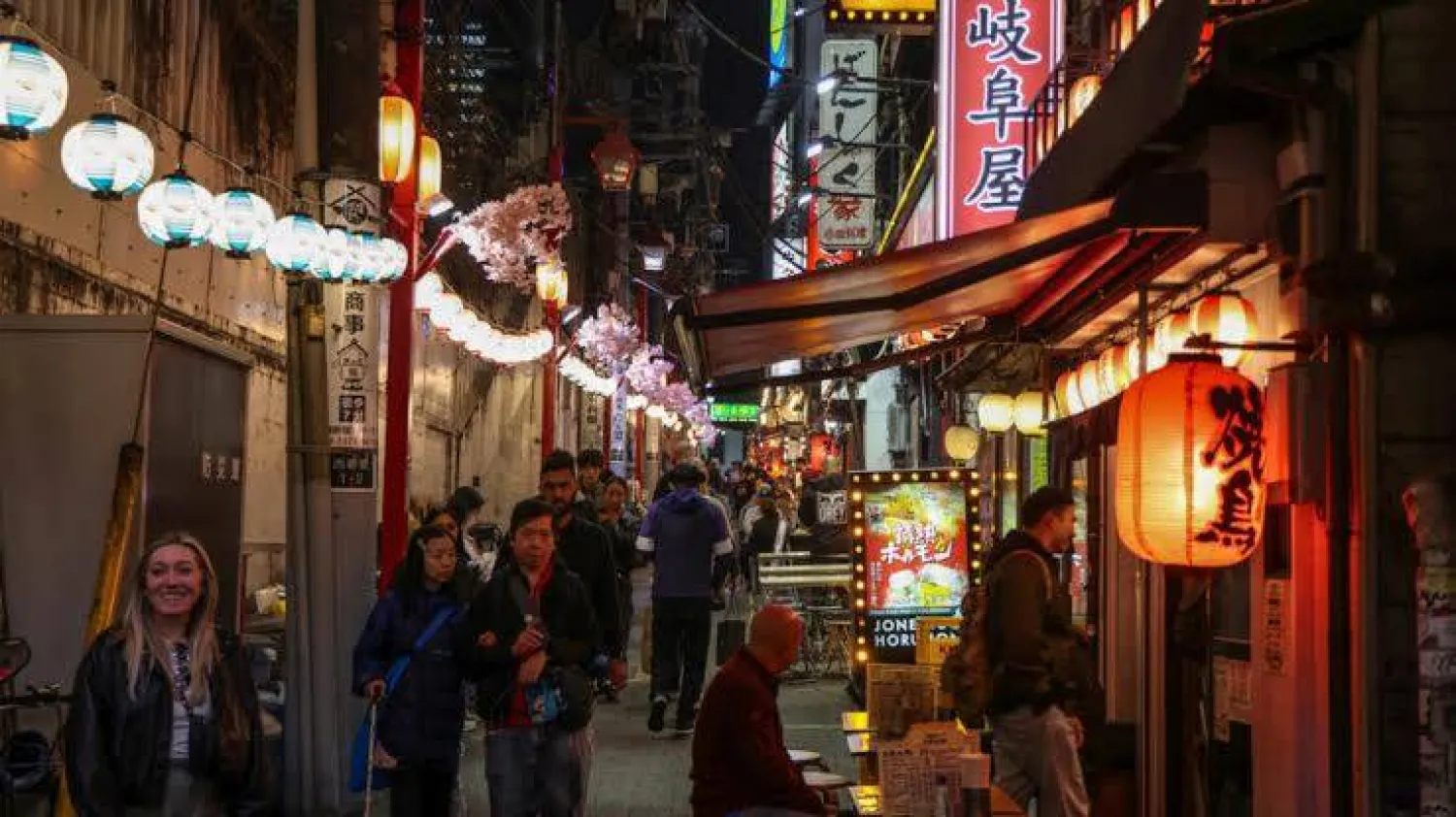

Tokyo's Shinjuku to Ban More than Half of Vacation Rentals

Tokyo tourist hotspot Shinjuku as a large residential population, who have become increasingly exasperated with tourists who fail to properly dispose of rubbish, smoke where they're not supposed to, and make too much noise. Ludovic MARIN / AFP/File
TT

Tokyo's Shinjuku to Ban More than Half of Vacation Rentals

Tokyo tourist hotspot Shinjuku as a large residential population, who have become increasingly exasperated with tourists who fail to properly dispose of rubbish, smoke where they're not supposed to, and make too much noise. Ludovic MARIN / AFP/File

Tokyo tourist hotspot Shinjuku will impose a ban on more than half of its holiday rentals including homes on Airbnb, an official said Monday, after a surge in complaints about visitors.

Known for its buzzing commercial and entertainment district, the ward hosts nearly 10 percent of Japan's 42,000 short-term rentals.

But it also has a large residential population, who have become increasingly exasperated with tourists who fail to properly dispose of rubbish, smoke where they're not supposed to, and make too much noise.

A Shinjuku official supervising holiday rentals told AFP that the district was "planning to revise the current ordinance... to ban private lodging" in residential zones and areas near schools.

"As the number of private lodging businesses has risen, complaints and troubles around them have increased," the official said on customary condition of anonymity.

More than 50 percent of short-term rentals in Shinjuku face a ban under the new rules, he said, adding that the plan would formally be announced by the Shinjuku mayor on Tuesday.

Shinjuku's policy will apply to existing properties, he added.

The move comes as other cities around the world attempt to crack down on private lodgings available on Airbnb and other platforms, including New York City and Barcelona.

Like elsewhere, overtourism has emerged as a major issue in Japan.

Residents of Kyoto and other hotspots have expressed annoyance at selfie-taking crowds as well as traffic congestion and soaring land prices.

In Shinjuku, the number of complaints over vacation rentals increased by around 40 percent in the fiscal year to March, the official said.

"Many complaints are about the violation of trash disposal rules while others include smoking and trespassing," he said.

Shinjuku's ban comes after the Japan Tourism Agency in July gave municipalities the right to regulate short-term lodgings if "a tranquil living and educational environment" is under threat or if they "hinder the maintenance of a permanent population and local community".

Japan's ancient capital of Kyoto is also considering a ban on short-term lodging, but only for new rentals within residential and industrial areas.

Several Airbnb hosts contacted by AFP declined to comment.


Italy's Catania Airport Reopens as Etna Threat Downgraded

Visitors climb Mount Etna as smoke rises from its volcano in Catania, on the Mediterranean island of Sicily, on September 28, 2026. (Photo by Roman PILIPEY / AFP)
TT

Italy's Catania Airport Reopens as Etna Threat Downgraded

Visitors climb Mount Etna as smoke rises from its volcano in Catania, on the Mediterranean island of Sicily, on September 28, 2026. (Photo by Roman PILIPEY / AFP)

Italy's Catania airport resumed flights on Tuesday after briefly halting operations due to renewed volcanic activity from nearby Mount Etna and adverse weather conditions, in the latest stop-and-go disruption to air traffic.

According to Reuters, Operator SAC said ⁠flights to and ⁠from the airport had resumed with immediate effect after the volcanic alert level was lowered from red to ⁠orange.

The hub had previously suspended operations until 1300 GMT on Tuesday, only hours after ending a three-day shutdown on Monday evening.

The Sicilian airport, Italy's fifth-busiest by passenger traffic, is often disrupted by volcanic ⁠ash ⁠interference from Mount Etna, Europe's highest and most active volcano.

The latest shutdown affected thousands of passengers and placed significant pressure on other Sicilian airports, as airlines diverted flights away from Catania.


Scientists: Rising Seas Threaten Spread of Marine Invaders

An aerial view of fishermen returning from sea at the traditional fishing port in Banda Aceh, Indonesia, 29 September 2026. EPA/HOTLI SIMANJUNTAK
TT

Scientists: Rising Seas Threaten Spread of Marine Invaders

An aerial view of fishermen returning from sea at the traditional fishing port in Banda Aceh, Indonesia, 29 September 2026. EPA/HOTLI SIMANJUNTAK

Sea-level rise driven by climate change could help invasive marine species spread into newly flooded coastal areas, threatening biodiversity and some economic activities, researchers warned in a study published Monday.

The findings in Nature Ecology & Evolution highlight the links between the climate and biodiversity crises, with global warming altering ecosystems and creating new opportunities for non-native species to thrive.

That could "potentially expose ecosystems and human activities that have not previously been affected by these species," said study co-author Xuan Liu of Beijing Normal University.

The researchers modelled the potential future spread of 122 established non-native marine animals, including fish, crustaceans, molluscs and sea stars, under different climate and sea-level scenarios.

Climate change causes sea levels to rise through thermal expansion -- ocean water increases in volume as it warms -- and the melting of glaciers and ice sheets.

Global sea levels are projected to rise by about 20 centimeters (eight inches) by 2050 and 56 cm by 2100 under a scenario of moderate growth in greenhouse gas emissions.

That would see around 360,000 square kilometers (139,000 square miles) of coastal land flooded by mid-century, rising to 550,000 square kilometers by the end of the century.

More than two-thirds of the newly flooded coastal land -- roughly 290,000 to 470,000 square kilometers -- could become suitable for the marine non-native animals studied, particularly around estuaries at mid-latitudes, AFP quoted the authors as saying.

The risk is concentrated in regions including the eastern United States, Gulf of Mexico, North Sea, Gulf of Guinea, Arabian Gulf, northern Bay of Bengal, southeastern China and northern Australia.

Several species examined are already established in Europe, including the Pacific oyster, Atlantic blue crab and the veined rapa whelk, a predatory sea snail.

"Estuaries are particularly at risk because they are directly connected to the ocean and are also major hubs of human activity," Liu said.

Such areas could provide stepping stones for marine invaders moving further inland as the sea advances, the study said.

The findings come as governments prepare for two UN-backed international summits on the twin biodiversity and climate crises: COP17 in October and COP31 in November.

A global assessment by the UN's expert scientific panel on biodiversity, IPBES, estimated that economic costs from biological invasions exceeded $423 billion in 2019.


Cape Town Divided Over Plan to Remove its Monkeys

The baboons’ presence has affected house prices on the Cape Peninsula, as they raid bins and kitchens and poo on properties. (Nic Bothma/Reuters)
TT

Cape Town Divided Over Plan to Remove its Monkeys

The baboons’ presence has affected house prices on the Cape Peninsula, as they raid bins and kitchens and poo on properties. (Nic Bothma/Reuters)

At the edge of Da Gama Park, where suburb meets the mountain, Cape Town’s baboons have caused conflict, with a furious debate raging over whether the monkeys can coexist with humans or whether they should be kept away.

On Monday, Cape Town’s city council has said it will “imminently” round up two baboon troops coming into repeated conflict with residents. The animals will be sterilized and permanently moved to a newly constructed sanctuary.

The plan has been fiercely criticized by animal rights activists, who say the monkeys should remain roaming freely, and that less destructive options have not been properly considered, according to The Guardian.

Cape Town’s baboon problem has been brewing since the 2000s, after the city stopped culling troops in the late 1990s after pressure from the public. But in the past two years it has reached boiling point.

A 2025 census found that the population had grown by a third since 2000, from 360 baboons to 493, now living in 12 managed troops.

As a result of the population boom, troops of chacma baboons on the city’s peninsula regularly rip off roof sheeting, sneak into unlocked cars and raid food pantries.

Some monkeys are now staying up late into the night to break into homes in Simon’s Town and nab snacks from convenience stores. Residents can no longer barbecue or host garden parties for fear of the marauding baboons.

“It’s depreciated property values because it’s hard to sell a house when it’s covered in baboon feces and paw prints, and you know they’re coming every day,” said Justin O’Riain, a behavioral ecologist at the University of Cape Town who has long studied the local baboons.

Cape Town’s geography is partially to blame. Much of the problem is confined to the Cape Peninsula, a narrow sliver of land stretching from the city center to Cape Point.

Here, baboons are boxed in between the steep, protected area of Table Mountain national park and the sprawling urban development that stretches to the Atlantic Ocean.

“The underlying issue is that baboons will seek low-lying land. That is their natural drive – it’s better access to water and more productive vegetation,” said Joselyn Mormile, who leads the Cape Baboon Partnership (CBP), a nonprofit organization that works with the city and local conservation authorities to manage the baboons.

“But throughout the peninsula, we’ve developed most of those places. It’s a constant battle between the two,” she noted.
