Indonesian Wildfire Emissions Surge to World’s Highest, Data Shows

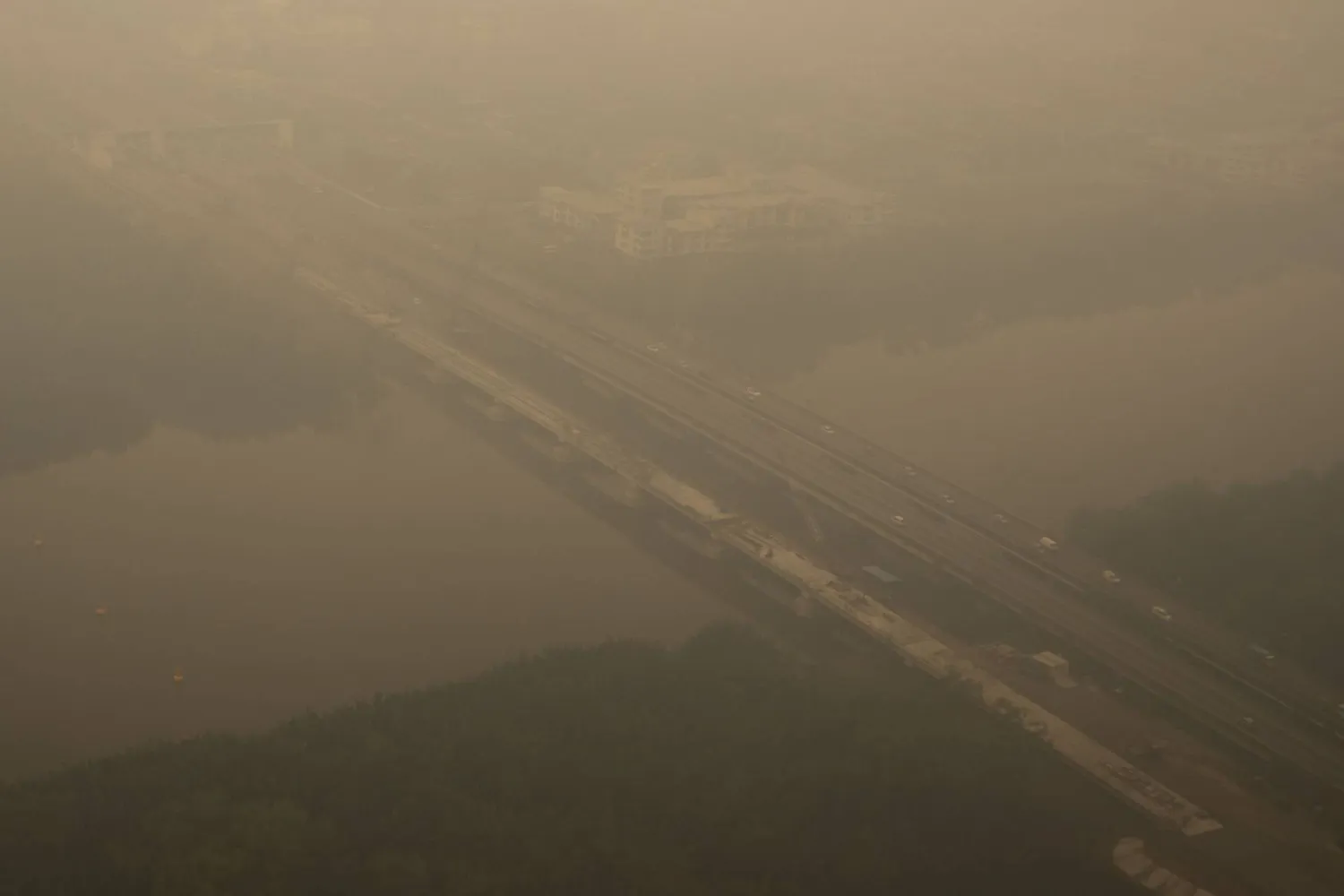
This aerial photo taken from a commercial aircraft shows haze from Indonesian forest fires blanketing a bridge in Kuching, the capital city of Malaysia's Sarawak state on the island of Borneo on September 5, 2026. (AFP)
TT

Indonesian Wildfire Emissions Surge to World’s Highest, Data Shows

This aerial photo taken from a commercial aircraft shows haze from Indonesian forest fires blanketing a bridge in Kuching, the capital city of Malaysia's Sarawak state on the island of Borneo on September 5, 2026. (AFP)

Indonesia is facing a surge in emissions from wildfires burning through parched stretches of forest and peatland on the islands of Borneo and Sumatra, with carbon dioxide readings currently the highest in the world, data showed on Wednesday.

Fire emissions from Indonesia from September 1 to September 7 reached 19.7 million metric tons, overtaking Russia this week and making up more than a third of the global total, according to Fire Emissions Watch, a portal developed by the European Union's Copernicus climate monitoring service.

Indonesia is one of the world's most fire-prone countries, but as "super-El Nino" weather conditions drive up temperatures and cause punishing droughts, the country is battling what authorities say is its most intense wildfire season in 11 years.

"We do expect to see some fires across the region at this time of year, but with El Nino, it clearly ‌just gives a ‌big enhancement to them," said Mark Parrington, senior scientist at the Copernicus Atmosphere Monitoring Service ‌in ⁠Bonn.

"It's much drier, ⁠it's hotter, and when there's ignition, these fires burn in a far more extreme way."

From September 1 to September 7, fire emission intensity exceeded 1,500 kg/sq km, more than 10 times the Russian level, with the highest concentrations in Kalimantan in Indonesia's part of Borneo and eastern parts of Sumatra, Copernicus data showed on Wednesday.

Emissions were 273% higher than the seasonal average, though still lower than the 21.7 million tons emitted in the same week of 2015, when Indonesia was battling similarly intense El Nino conditions.

Among the hardest hit areas has been the city of Pontianak in West Kalimantan, where the air quality index was ⁠394 on Wednesday, according to Swiss air quality monitoring firm IQAir. A reading of 300 ‌is considered hazardous.

Indonesia's environment ministry told Reuters in a statement that it ‌viewed the hazardous air quality readings in Kalimantan and elsewhere "with concern".

It said it was monitoring Copernicus's data, but added it "does not ‌directly reflect air quality conditions in a specific area", and other factors needed to be taken into account.

'BELOW THE ‌DETECTION LIMIT'

From January to July this year, fires burned around 202,000 hectares (780 square miles) of Indonesian land, about a third the amount over the same period in 2015, said Nisa Novita of the environmental group YKAN, which helps communities tackle fires.

"However, August data are estimated to show a significant increase of around 600,000 hectares, particularly in Kalimantan, Sumatra and South Papua," she said.

Indonesia lost a total ‌of 2.6 million hectares to fire in the whole of 2015, an area bigger than Wales.

The number of recorded hotspots from August 1 to September 8 reached ⁠13,443, compared to 9,454 over ⁠the same period of 2015, according to Indonesian forest ministry monitoring platform Sipongi, based on data from NASA's Terra and Aqua satellites.

A record monthly high for hotspots was recorded in October 2015, Sipongi data showed.

Fire Emissions Watch uses satellite observations to estimate concentrations of particulate matter, volatile organic compounds, greenhouse gases and other fire-fuelled pollutants, but Parrington said it could actually be underestimating the extent of the problem.

"One of the aspects with peat fires is if they're burning at low temperatures or underground, they'd be below the detection limit of the sensors, which means we're not actually seeing them," he said.

Studies have shown that fires in Indonesia in 2015 produced more emissions per day than the whole of the EU, and caused more than 100,000 excess deaths throughout Indonesia, Malaysia and Singapore.

"We have to remember that this is still the beginning of the season, and we expect the fires to continue and the emissions to keep increasing, potentially through to the end of October, which is what we saw in 2015," said Parrington.

"In two months we'll know how extreme this year has been, but the early indications are that it is at pace, if not slightly above those previous El Nino years."


Champion-chip: Best Fries Contest Heats Up Belgium

Fries are a national passion in Belgium. Nicolas TUCAT / AFP
TT

Champion-chip: Best Fries Contest Heats Up Belgium

Fries are a national passion in Belgium. Nicolas TUCAT / AFP

Thick or thin, greasy or crispy, with samurai sauce or a more traditional mayo dip? A TV show has been on a quest to find the best fries in potato-mad Belgium.

For four years running "La meilleure friterie" (the best chip shop), a lighthearted culinary competition aired by broadcaster RTL-TVI, has been seeking out perfection among fry peddlers in the country's French-speaking region.

Watching it is a "sacred Thursday night ritual", said David Antoine, the host.

Crowning a winner among a dozen contestants is no picnic.

"There's sometimes friction among the judges, but we always find that famous Belgian compromise" over a portion of fries, Antoine told AFP in a joking reference to the country's penchant for lengthy political negotiations.

Fried potatoes are a national dish and symbol of pride in Belgium, home to about 4,600 diners specializing in the dish known as "friteries" in French or "frituren" in Flemish.

That number "has remained stable for many years," said Bernard Lefevre of the National Chip Shop Union, an industry group, noting the "market is doing well".

Each has its own flair.

To Lefevre, a good chip is preferably cut from a Belgian potato of the Bintje variety and double fried in beef fat. And size is paramount.

"Anything under nine millimeters is too thin and anything over fourteen is too thick," he explained.

- Hand-peeled 'gold' -

At Hill's Burger, a diner in Brussels, chef Massimo Sefa has gone for a "size twelve" -- that is "a two-millimeter crust and ten millimeters of creamy flesh", he said.

The 23-year-old smiled nervously when the TV show's judges entered his joint and the cameras started rolling.

But the stress is worth it, he explained. The broadcast will shine a spotlight on his friterie and a win would likely send sales skyrocketing.

Sefa opened up shop with his two younger brothers, Lorenzo and Marco. For them chips are a family matter: their grandfather ran about 10 chip shops in Brussels.

"Wow, delicious, crispy, and peeled by hand," Fabienne De Corte, one of the judges, raved upon tasting the goods.

"Fries in Belgium are our gold," added her husband Patrick De Corte, who is also on the judging panel.

"Every little detail makes a difference."

The show has a devout following, including some who tag along for filming sometimes dressed as fry cones and chanting "We've got the fries, we've got the potatoes!".

It has also had its share of controversies, particularly on the hot topic of sauces.

A technical glitch caused trouble during public voting in the first season and some grumbled the winner had bamboozled jurors with dazzling sauces, while the fries were not to everyone's taste.

Still the show has established itself in the French-speaking Belgian media landscape at a time where fries are sometimes changing along with Belgian society.

"There are halal, vegetarian, and vegan fry shops -- that's perfectly normal; society is evolving. We're not a museum of bygone folklore," Lefevre insists.


Aging Japanese Village Turns to Peru in Search of New Residents

A general view of Nanmoku village, Gunma prefecture is seen on September 26, 2026. (Photo by Rie KIKUCHI / AFP)
TT

Aging Japanese Village Turns to Peru in Search of New Residents

A general view of Nanmoku village, Gunma prefecture is seen on September 26, 2026. (Photo by Rie KIKUCHI / AFP)

In a misty mountain village in Japan, residents recently welcomed unlikely guests from a Peruvian district along the Amazon River, seeing a chance to revive an aging community facing extinction.

The mayor of Belen and two young women visited a care home on their trip to Nanmoku, a village of just 1,300 people in Gunma Prefecture, greeting the elderly with broad smiles as some looked on slightly puzzled.

"From the moment I arrived, I began to admire everything about this place," 19-year-old student Wendy Sangama told AFP during a week-long tour of Japan that followed the signing of a sister-city agreement between her hometown and the village last year.

"And yes, it's a town where I could see myself living and settling down," she said.

The village is the oldest municipality in Japan, with 70 percent of its residents aged 65 or above. A 2014 think tank report described it as "most at risk of disappearing."

The main street along the Nanmoku River is lined with houses and shops, some abandoned, and appeared largely deserted on the rainy weekend AFP visited.

Village officials hope the sister-city agreement, which promotes cultural and people-to-people ties, will ultimately attract young people from Belen to live in Nanmoku, although how they might obtain residency remains unclear.

While Peru has the world's third-largest population of Nikkei -- Japanese immigrants and their descendants -- Nanmoku Mayor Saijo Hasegawa told AFP the pact was down less to strategy than to a chance meeting with a Japanese-Peruvian businessman.

The village needed "to broaden its horizons and attract more residents, including foreigners,” no matter where they came from, he said.

"Without them, we could reach a point where even public transportation stops operating."

Despite its rapidly aging population and labor shortages, opposition to immigration is growing within Japan, prompting a push by Prime Minister Sanae Takaichi for tighter regulations on foreign nationals.

Nanmoku has tried various initiatives to attract young people from elsewhere in the country, but employment opportunities remain scarce, and farmland is limited in the mountainous area.

"Around 60 people die each year here, and just two or three babies are born," Hasegawa said.

Belen, meanwhile, is young. The impoverished district of Iquitos, a remote Amazonian city in northeastern Peru, has a median age of about 27 years old.

Home to more than 60,000 residents, the "Venice of Latin America" -- accessible only by plane or boat -- is filled with wooden houses built on stilts to withstand seasonal flooding.

"I think the young people would be more enthusiastic about wanting to settle in other cities because of the economic situation we have," Mayor Lina Arista Lopez told AFP.

The district's residents rely largely on informal trade and agriculture, growing crops such as yuca, rice and corn.

"We have a harsh reality in Belen," Lopez said. "There is no work."

Ketsi Yahuarcani, a 23-year-old student, called the visit to Nanmoku "incredible,” citing the sense of warmth she felt.

"If I had the opportunity to settle here, I would," she said.

Sangama, the other student, said moving to the Japanese village could be "a better option" if it allowed them to build a brighter future and support their families back home.

Not being able to see her family regularly, however, would "certainly be a challenge", she conceded.

While municipalities near Nanmoku have accepted foreign workers, particularly caregivers, it has typically been via short-term programs for skilled workers and technical interns.

Mayor Hasegawa said his vision was different.

Rather than attracting people who stay only a few years for work, he hopes to welcome residents of Belen as fellow villagers ready to build long-term lives in Nanmoku.

"The approach of simply bringing in workers from an agency just because we're short-staffed isn't right for our village," he said.

Yuki Wanibuchi, 34, who moved to Nanmoku several years ago from the Kyoto area, said potential newcomers would face hurdles, including the language barrier.

"You cannot live here without a car, and getting a driver's license will require Japanese skills," Wanibuchi said.

"But personally, I think it's more interesting when people from different backgrounds come here to live."

Hiroshi Ihara, an 87-year-old villager, told AFP he had watched his community grow greyer and greyer, with young people, including his three children, moving to bigger cities to make a living.

"I want more younger people to come and live in the village," he said.

"The Japanese population is shrinking. I think it would be best if people from overseas could come here and do what they can to support us."


India Capital Steps Up Air Pollution Controls Ahead of Winter

Effigies of Ravana are transported on a truck ahead of the Hindu festival of Dussehra in New Delhi, India, Sunday, Oct. 18, 2026. (AP Photo/Channi Anand)
TT

India Capital Steps Up Air Pollution Controls Ahead of Winter

Effigies of Ravana are transported on a truck ahead of the Hindu festival of Dussehra in New Delhi, India, Sunday, Oct. 18, 2026. (AP Photo/Channi Anand)

India began annual measures on Thursday to tackle toxic air pollution in New Delhi, a megacity of 30 million people regularly ranked among the world's most polluted capitals.

Delhi's air quality deteriorates in winter, when cooler air traps pollutants close to the ground.

Major sources include coal-fired power plants, traffic, construction and farm stubble burning in neighboring areas.

The Delhi government on Wednesday announced a ban on open rubbish burning and ordered food stalls to stop using coal or firewood.

In previous years, such measures have failed to curb pollution, which peaks from November to January, when levels of cancer-causing PM 2.5 microparticles often hit more than 300 micrograms per cubic meter, 20 times the World Health Organization's recommended daily maximum.

Monitors recorded 233 micrograms per cubic meter early Thursday, about 15 times the limit.
The government's Commission for Air Quality Management has predicted air quality to remain "poor" the coming days.

A study in The Lancet Planetary Health in 2024 estimated that 3.8 million deaths in India between 2009 and 2019 were linked to pollution that exceeded India's own air quality guidelines.

Last year, pollution levels peaked at 846 micrograms per cubic meter, 56 times the WHO limit.
The UN children's agency warns that polluted air puts children at heightened risk of acute respiratory infections.

Further restrictions take effect on November 1, including doubled parking fees and work-from-home arrangements for government office staff, aimed at reducing traffic emissions.

Tighter construction rules will also begin then, followed by a complete ban on construction and demolition from December 10 to January 20.