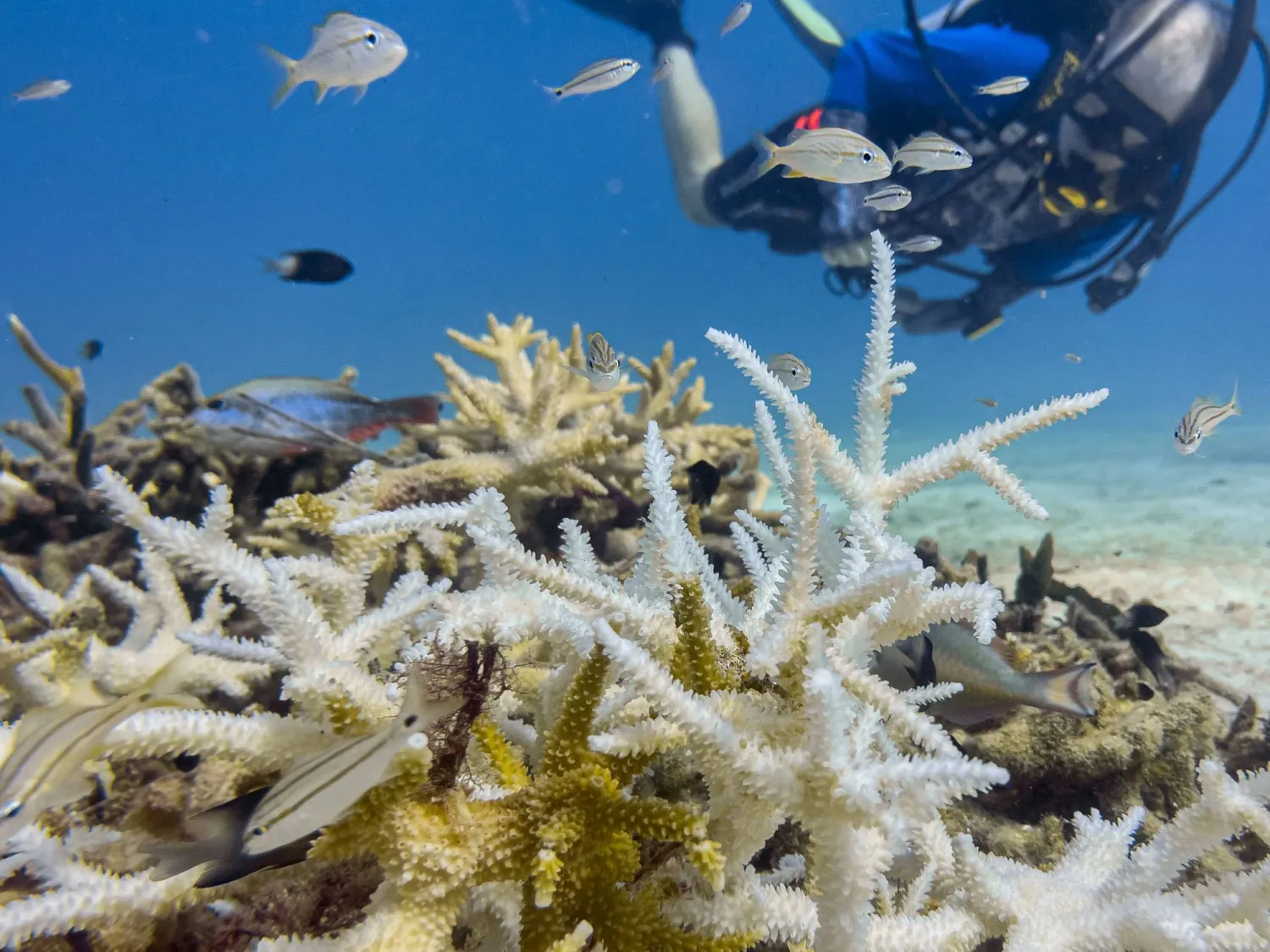
As Oceans Warm, Florida Scientists Hunt for Heat-resistant Coral

A mass of bleached staghorn coral, its pale and white branches a sign of stress after prolonged exposure to abnormally warm ocean waters, is seen off the coast of Florida on August 28, 2026. (Photo by Jesus Olarte / AFP)
TT

As Oceans Warm, Florida Scientists Hunt for Heat-resistant Coral

A mass of bleached staghorn coral, its pale and white branches a sign of stress after prolonged exposure to abnormally warm ocean waters, is seen off the coast of Florida on August 28, 2026. (Photo by Jesus Olarte / AFP)

Off Florida's coast, a team of scientists and trained volunteers in scuba gear descends to the ocean floor and begins planting young coral onto a reef and examining how others are faring in the increasingly warm waters.

It is part of a long-running "Rescue a Reef" program run by the University of Miami that aims to advance conservation efforts and raise public awareness.

Part of that work involves researching which coral species are able to better withstand rapidly warming oceans as a result of human-caused climate change.

"Certain species may be more resilient, where they're able to better survive and recover from thermal stress events," program manager Devon Ledbetter explained to AFP during a recent dive to Rainbow Reef about three miles offshore from Key Biscayne.

Coral reefs support vibrant marine ecosystems, but also act as breakwaters, protecting coastlines from storm-driven erosion and flooding.

The situation, however, is increasingly dire.

A record-breaking marine heat wave that began in 2023 left two ecologically vital coral species, elkhorn and staghorn, "functionally extinct" in Florida's Coral Reef, highlighting the growing dangers a warming climate poses for the world's oceans.

The National Oceanic and Atmospheric Administration believes that this fourth global coral bleaching event likely concluded in mid-2025. But the arrival of a very strong El Nino could bring a return to more widespread bleaching -- including in Florida's waters.

During the expedition, the participants go about their tasks diligently. Some coral species with fast-growing branches are planted onto "coral trees" that look like old television antennas and are suspended in the water column, with floats to keep them upright.

Others are placed onto table frames fixed to the ocean floor, and yet others are mounted onto plugs, screwed into a three-hole "cookie" and planted onto the reef.

These are given predation umbrellas to protect them from the hungry fish having a nibble.

Researchers place color reference charts around newly planted coral to record the pigmentation, a method used to monitor its health and detect early signs of heat stress.

Coral is made up of tiny individual animals called polyps, which maintain a symbiotic relationship with microscopic algae that live within their tissues.

When the algae are stressed by heat or pollution, however, they leave, causing the coral to "bleach" and become vulnerable to disease and death.

"Anecdotally, we've seen that Mountainous Star Coral tends to be the most resilient to bleaching and thermal stress," Ledbetter explained. So far, this summer the program has planted 615 coral, with 228 of those part of the thermal bleaching study. Their results are then given to state environmental and wildlife authorities.

The program began in 2015 and Ledbetter explained it exists both to serve science and educate the public -- but also to rebuild the ecosystem "one coral at a time."

The risks have never been higher. Even with the end of the fourth global bleaching event, sea surface temperatures are still higher than 25 to 30 years ago, when the first global coral bleaching event occurred, according to recent research published by NOAA in the journal Coral Reefs.


India Vows Action after 1st Cheetah Shot Dead

A cheetah cub stands at the Lunaret Zoo in Montpellier, southern France, on October 22, 2026. (Photo by Sylvain THOMAS / AFP)
TT

India Vows Action after 1st Cheetah Shot Dead

A cheetah cub stands at the Lunaret Zoo in Montpellier, southern France, on October 22, 2026. (Photo by Sylvain THOMAS / AFP)

India has vowed "swift action" after a cheetah was shot dead, the first such killing since the country began reintroducing the animals in 2022, the government said Wednesday.

The environment ministry said it had ordered a "high-level team for an on-ground investigation" into the shooting of the 19-month-old male, treating the incident with "utmost gravity”

The India-born cheetah -- whose mother was among those introduced to India from Botswana, Namibia and South Africa as part of efforts to restore the planet's fastest land animal -- was shot as it prowled in forests outside a protected national park.

Asiatic cheetahs were declared extinct in India in 1952. The critically endangered subspecies, once found across the Middle East, Central Asia and India, now survives in very small numbers in Iran.

Their African cousins were first reintroduced in September 2022 to India, to the Kuno National Park, 300 kilometers south of New Delhi.

The wounded cheetah was picked up on Sunday in forests in Madhya Pradesh state, outside Kuno's boundaries, and taken for veterinary care.

"During the surgery, five firearm pellets were recovered from its body," the environment ministry said.

Despite efforts, the cheetah died on Tuesday, AFP reported.

"Medical examinations corroborated multiple internal injuries associated with the recovered firearm pellets," it added.

The high-profile project, championed by Prime Minister Narendra Modi, has been dogged by criticism over the deaths of several of the cats.

But experts in animal reintroductions say they often result in more than 50 percent mortality, especially in the initial phases.

The National Tiger Conservation Authority, which oversees the cheetah project, said that survival rates and hunting successes are "comparable to other international cheetah reintroduction efforts, with recorded wild prey kills confirming successful adaptation to the Indian landscape.”

The total cheetah population in the wild in India is around 60, including some 40 Indian-born cheetahs.


Philippine Island Fights Rising Seas with Nature, Not Concrete

Workers lay coconut-fibre bags next to oyster shells on a breakwater at Pamarawan Island in Malolos City, in the Philippines Bulacan province. Ted ALJIBE / AFP
TT

Philippine Island Fights Rising Seas with Nature, Not Concrete

Workers lay coconut-fibre bags next to oyster shells on a breakwater at Pamarawan Island in Malolos City, in the Philippines Bulacan province. Ted ALJIBE / AFP

For years, residents of a flood-prone Philippine island north of Manila have elevated their homes atop layer upon layer of concrete, only to see floodwaters threaten them again.

Burdened by strong storm surges, land subsidence and rising seas exacerbated by climate change, the 3,000 residents of tiny Pamarawan Island have turned to bamboo poles and discarded oyster shells to build a barrier aimed at weakening waves and managing floods.

The unusual approach offers a nature-based alternative for a country still grappling with a multibillion-dollar scandal that drove public fury over substandard -- and at times non-existent -- concrete flood-control projects.

"We were terrified whenever there were typhoons. We couldn't sleep at night," fisherman Edgar Javier told AFP on a recent visit, recalling how strong waves once brought down one of his home's concrete walls.

"Whenever the waves hit, the wall shakes."

The project began when the city government of Malolos, home to the island, launched a study with a Dutch engineering consultancy.

"(Concrete infrastructure) projects won't suffice," Mayor Christian Natividad told AFP.

While the project, the first of its kind in the country, initially faced resistance from officials and residents working without a blueprint, Natividad said they had "nothing to lose".

"It's like you accept daily flooding or you do something else with risk," he said.

"I chose risk."

- Slowing the waves -

By May last year, workers, many of them residents, had begun installing bamboo poles packed with brushwood along the coast. They are designed to slow water flow and trap sediment, with the goal of gradually raising the seabed and supporting mangrove growth.

When AFP journalists visited the site, workers were building an oyster-shell breakwater about 100 meters (330 feet) offshore.

Under the searing heat, men in caps pounded wooden stakes used to secure coconut-fiber bags filled with shells on an artificial shore first created with sea sand.

"This breakwater's main purpose is to lessen the impact of the wave before it can reach the community," project manager Lyana Galang told AFP, adding that the oyster-shell barriers work in concert with bamboo sediment traps.

Filipino scientist Antonio Contreras said the Philippines had long relied heavily on concrete dykes and seawalls, many undertaken without adequate study.

"We have altered the environment so much that we tend to work against nature when in fact we should work with it," Contreras told AFP, noting that some design flaws linked to corruption had cost lives.

But nature-based solutions were not a universal answer, he warned, particularly during catastrophic floods, and should complement conventional infrastructure.

Contreras said the approach in Pamarawan could be replicated elsewhere, provided local environmental conditions were carefully taken into account.

Bamboo and oyster shells also need to be sourced sustainably, he warned, as bamboo deteriorates over time and releases carbon as it decomposes.

The nature-based installations, which cover about 14 hectares along Manila Bay, cost 70 million pesos ($1.1 million), including maintenance, compared with around 90 million pesos for a concrete seawall, Mayor Natividad said.

He estimated bamboo will need to be replaced once every five years.

- 'Our feet are dry' -

With its first phase completed in late 2025, the installation has already brought some comfort to residents.

Fisherman Edgar Javier said the breakwaters had softened waves and helped keep floodwaters at bay during typhoons and monsoon rains this year.

"This has made a huge difference for us. We can still feel the waves, but they have significantly weakened. (They're) almost nothing now," he said.

Arsenia Cabigao, 58, said flooding had previously disrupted her livelihood by submerging areas where she dried fish.

"Our feet are dry at last. They weren't before," she told AFP as she sliced small fish in a narrow Pamarawan alley.

The project's long-term effectiveness remains uncertain, with a scientific assessment due next year to determine if mangrove planting can begin, Natividad said.

Its success, he added, would become more tangible over the next decade as accumulated sediment stabilized the seabed and allowed for the growth of mangroves, which would provide another natural barrier.

Vince Dizon, head of the public works department before a recent reassignment, said he hoped the Pamarawan project could be replicated in other flood-prone areas.

"We need to study this, and learn from those who know and have already done this correctly, so we won't waste public funds again," Dizon told reporters on a visit to the island.

For residents who fear being driven from their longtime home, the ultimate test will be whether their houses remain upright when typhoons and monsoon rains strike.

"It's hard to fight water. Now we're trying to live with water," Natividad told AFP.

"We're building with nature."


Child Attacked by Wolf in German Wildlife Park

A woman cycles through the Tiergarten park in Berlin as trees sport their autumn foliage, on October 27, 2026. (Photo by John MACDOUGALL / AFP)
TT

Child Attacked by Wolf in German Wildlife Park

A woman cycles through the Tiergarten park in Berlin as trees sport their autumn foliage, on October 27, 2026. (Photo by John MACDOUGALL / AFP)

A young girl was attacked by a wolf and badly injured in a German wildlife park Wednesday, police said, adding that the eight-year-old was taken to hospital by rescue helicopter.

"The girl was attacked and seriously injured by at least one wolf within an animal enclosure while she was there with two other children and a staff member," AFP quoted police said.

They added in a statement that "the precise circumstances of the incident are the subject of an ongoing police investigation.”

The attack took place in the town of Baruth/Mark south of the capital Berlin, police said, adding that the staff member and other children were not injured.

The park keeps brown bears, lynx and grey and arctic wolves, according to its website, which said that the facility was temporarily closed without providing further details.