Man Hospitalized after Shark Attack in Western Australia

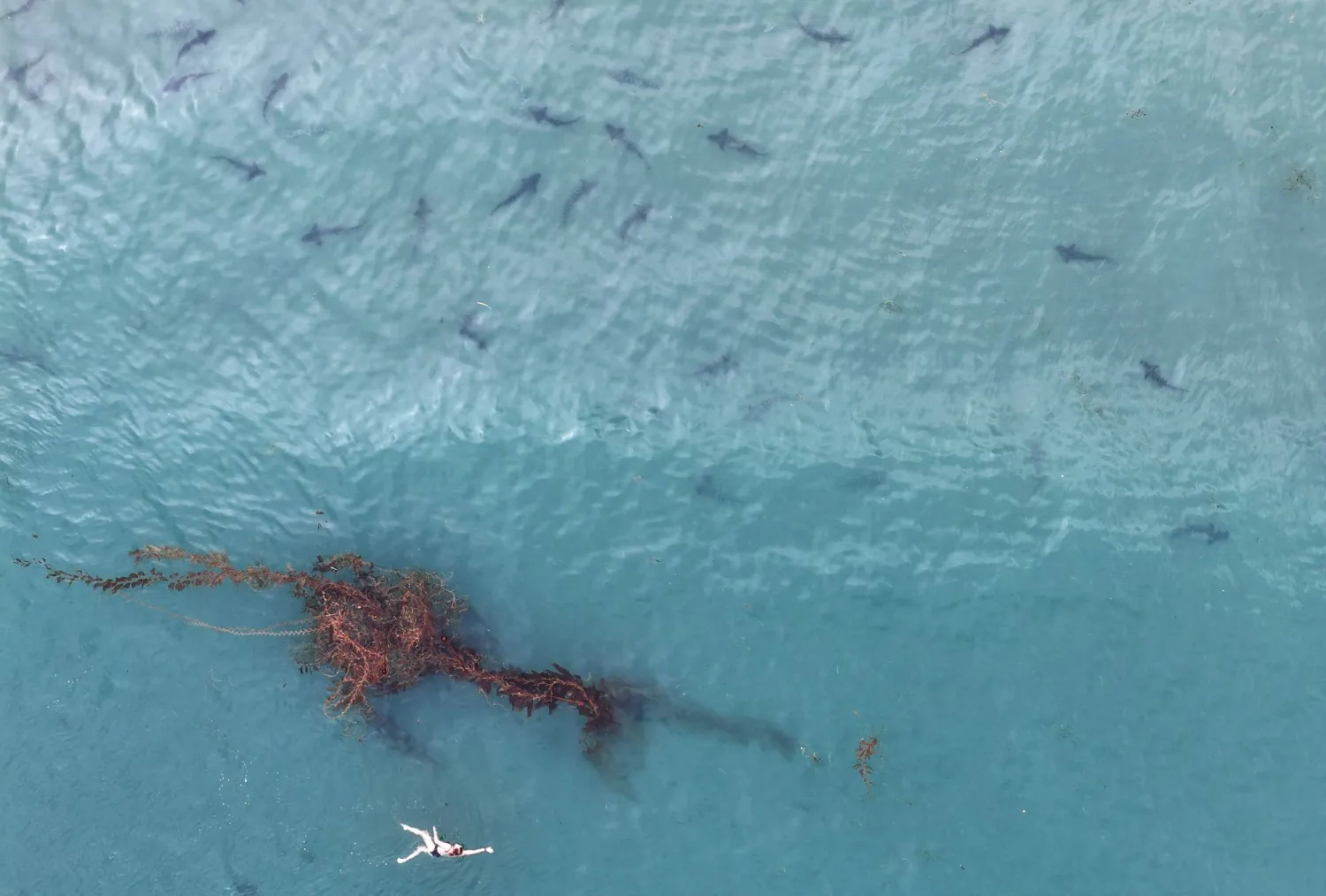
SAN DIEGO, CALIFORNIA - AUGUST 14: In an aerial view, a swimmer passes near kelp and leopard sharks, which are harmless to humans, in the Pacific Ocean in the La Jolla neighborhood on August 14, 2026 in San Diego, California. Mario Tama/Getty Images/AFP
TT

Man Hospitalized after Shark Attack in Western Australia

SAN DIEGO, CALIFORNIA - AUGUST 14: In an aerial view, a swimmer passes near kelp and leopard sharks, which are harmless to humans, in the Pacific Ocean in the La Jolla neighborhood on August 14, 2026 in San Diego, California. Mario Tama/Getty Images/AFP

A man in his fifties was rushed to hospital on Monday after being attacked by a shark in Western Australia, the state government and local ambulance service said.

Authorities said they had received a report of a "shark incident" around 9:45 am (0145 GMT) at Glenfield Beach, just over 400 kilometers (250 miles) north of Perth.

Locals were advised to "take additional caution" around the beach, AFP reported.

Australian scientists believe increasingly crowded waters and rising ocean temperatures are shifting sharks' migratory patterns, which may be contributing to a rise in attacks.

There have been nearly 1,300 shark incidents around Australia since 1791, of which more than 260 resulted in death, according to a database of shark encounters with humans.


Himalayas Approaching Tipping Point, Millions of Livelihoods at Stake, Says Report

Snow-covered peaks of the Himalayas are seen during a media tour, from Shigatse, Tibet autonomous region, China, Sunday, Sept. 6, 2026. (Tingshu Wang/Pool Photo via AP)
TT

Himalayas Approaching Tipping Point, Millions of Livelihoods at Stake, Says Report

Snow-covered peaks of the Himalayas are seen during a media tour, from Shigatse, Tibet autonomous region, China, Sunday, Sept. 6, 2026. (Tingshu Wang/Pool Photo via AP)

The Himalayas ‌are approaching a tipping point as glaciers melt faster than a decade ago, threatening water security as the region approaches "peak water" by mid-century, according to a study released this month.

The findings come after the collapse of a Himalayan glacier in late August along the Nepal-Tibet border, which caused cascading landslides and flash floods in the valleys below. At least 1,300 people have been confirmed dead and more ‌than 5,300 are ‌missing across Nepal and China's ‌Tibet ⁠region.

As glaciers retreat, ⁠they are leaving behind unstable glacial lakes held back by little more than loose rock and ice, above valleys where millions of people live, the study found.

The study was produced by Systemiq, a sustainability advisory firm, together with the Integrated Mountain ⁠Initiative, the International Centre for Integrated Mountain ‌Development, and India's G.B. Pant ‌National Institute of Himalayan Environment.

Himalayan glacier mass loss had ‌accelerated in recent decades, while only 21 glaciers were ‌currently monitored on the ground out of an estimated 40,000 glaciers across the Hindu Kush-Himalaya region, a vast mountain system spanning eight countries from Afghanistan to Myanmar, the ‌study found.

Close to 200 glacial lakes in India had been identified as high ⁠risk, ⁠with 56 classified as "very high risk", leaving millions exposed downstream.

As the region neared "peak water", the point when river flows stop rising and start declining, it would have profound implications for water security. As the Himalayas underpinned more than 20% of India's GDP, the region made up a key piece of the country's national economic infrastructure, upon which hundreds of millions of people depended.

Though making up around 18% of India's land, the Himalayan region accounted for roughly 35% of the country's natural disasters.



France Submits New Proposal to Ban Social Media for Under-15s

(FILES) A photo taken on October 21, 2020 shows the logo of the multinational American Internet technology and services company, Google (center), the American online social media and social networking service, Facebook (Top R), Snapchat (Bottom R), Twitter (top L) and Instragram (bottom L) on a computer screen in Lille. (Photo by DENIS CHARLET / AFP)
TT

France Submits New Proposal to Ban Social Media for Under-15s

(FILES) A photo taken on October 21, 2020 shows the logo of the multinational American Internet technology and services company, Google (center), the American online social media and social networking service, Facebook (Top R), Snapchat (Bottom R), Twitter (top L) and Instragram (bottom L) on a computer screen in Lille. (Photo by DENIS CHARLET / AFP)

The French government submitted a reworked proposal to ban social media for children, after its previous ban was struck down by the country's top constitutional authority, President Emmanuel Macron said on Monday.

France's Constitutional Council struck down the previous legislation in mid-August, finding that part of it constituted an unnecessary infringement on the freedom of expression of those affected.

"After rigorous technical work the government today is notifying" the European Commission of the new draft, Macron wrote on X.

The notification is a key step, as it ensures that the legislation is in line with European Union laws, AFP reported.

Macron has made banning social media use for children and teens one of his top priorities and hopes to see a working ban in force by the time he leaves office next year.

He has called for similar legislation to be adopted throughout the European Union.

EU chief Ursula von der Leyen is due to address a possible bloc-wide social media ban for children in a speech in Brussels this week.

A growing number of countries are taking steps to restrict social media access amid multiplying warnings over its harmful effects on children.


Prince William to Announce Electric Tuk Tuks as Finalists for his Earthshot Prize

A Mahindra electric tuk tuk (Saltash Town Council)
TT

Prince William to Announce Electric Tuk Tuks as Finalists for his Earthshot Prize

A Mahindra electric tuk tuk (Saltash Town Council)

Prince William is set to announce the manufacturers of electric tuk tuks as the first finalists for his Earthshot prize.

Mahindra, India’s largest makers of electric autorickshaws, are one of 15 finalists shortlisted for the Prince of Wales' Earthshot prize with the rest set to be announced next Friday, according to The Daily Mail.

The five winners are set to be announced in Mumbai in November and will each receive £1 million.

Tuk tuks are a familiar sight across Asia, with an estimated ten million on the streets of India alone, due to their cheap running costs and nippy ability to navigate crowded cities.

They are also notoriously bad for air quality in densely populated areas due to the high level of smog the tiny vehicles produce.

However, that could all be about to change with the rollout of new electric tuk tuks, which are powered by a battery under the seat. They are taking India by storm with 68% of new three-wheelers sold in the country being electric.

And Prince William wants to recognize the work of Mahindra by announcing them as the first finalist for his Earthshot prize whose mission is to “find, celebrate and scale solutions to repair the planet.”

Wills, who himself drives an electric Audi, went as far as to say the manufacturers are a “great example” of everything that Earthshot is about.

He told The Times, “[Mahindra] offered a great example of what the Earthshot prize is all about, a practical solution that is already working at scale and changing the way people move around their cities. Seeing solutions like this growing in India gives me real optimism.”

Mahindra has already put 400,000 vehicles on the road but has set the ambitious target of putting one million vehicles on the road by 2031 while also expanding globally.

The company has already exported EVs to Sri Lanka, Nepal and the Philippines and is already eyeing up expansion into Indonesia and as far afield as Brazil and Africa.