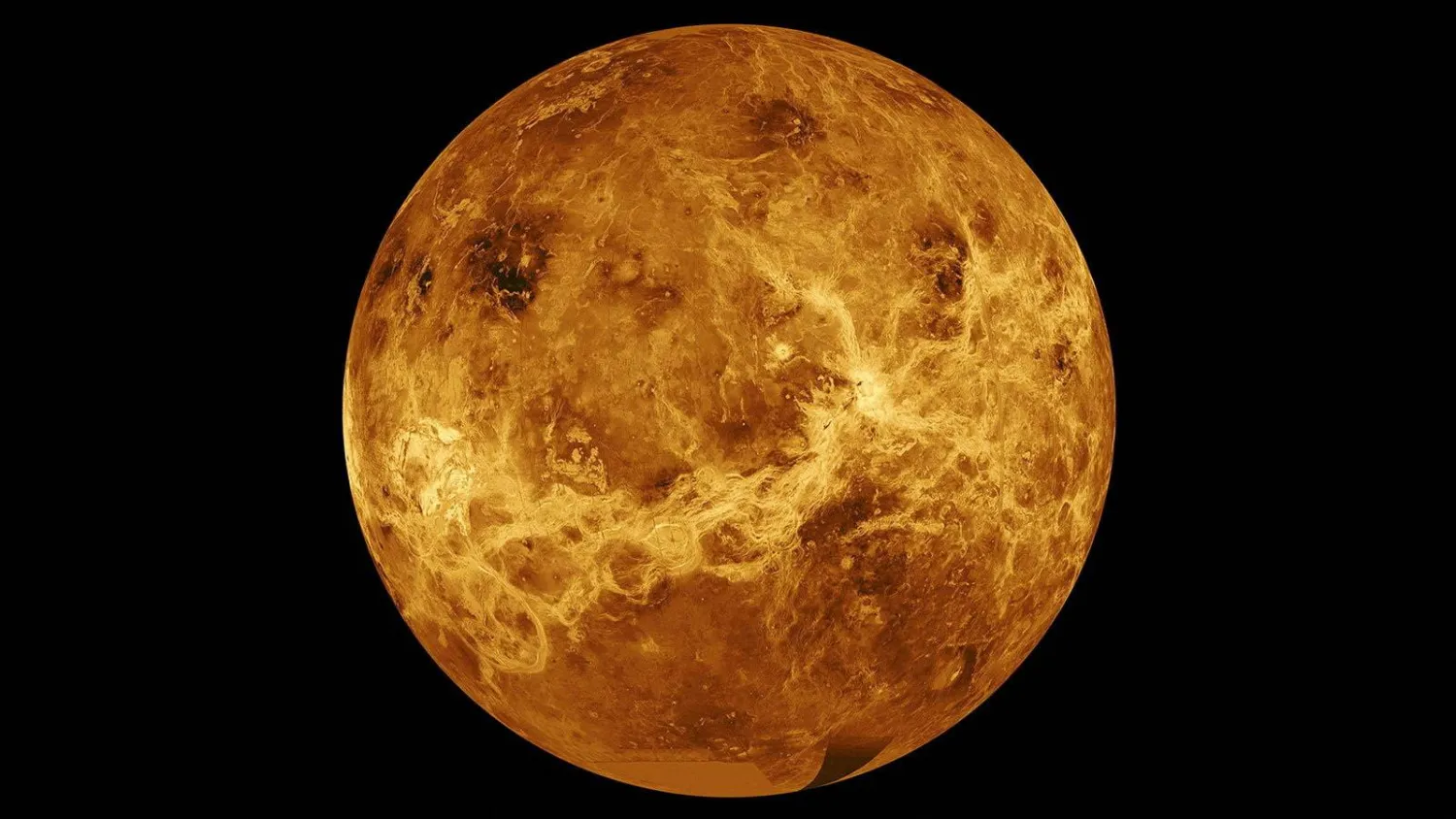
Astrophysics Study Suggests Venus May Have Swallowed Its Moon

Data from NASA's Magellan spacecraft and Pioneer Venus Orbiter is used in an undated composite image of the planet Venus. (NASA/JPL-Caltech/Handout via Reuters)
TT

Astrophysics Study Suggests Venus May Have Swallowed Its Moon

Data from NASA's Magellan spacecraft and Pioneer Venus Orbiter is used in an undated composite image of the planet Venus. (NASA/JPL-Caltech/Handout via Reuters)

A California-based astrophysicist presented a new theory on Monday to explain why Venus, the planet most like Earth in size, mass and structure, lacks its own moon. Call it a case of celestial cannibalism.

The extremely slow speed at which Venus rotates on its axis would have doomed any natural satellite that may once have orbited that planet to gradually spiral closer to its parent and ultimately be consumed in a cataclysmic smash-up.

So goes the theory offered by scientists at the University of California, Riverside, and published on Monday in The Astrophysical Journal, marking a departure from past explanations for why Venus, the second planet from the sun, is without a lunar companion.

"If it had a moon, and it ‌likely did at ‌some point, it could not have kept it," astrophysicist Stephen Krane, lead ‌author ⁠of the study, told ⁠Reuters on Monday. "That moon would have crashed down on the planet in a relatively short time scale."

Krane said data from computer models based on planetary physics and simulating the gravitational mechanics of hypothetical Venusian moons of various sizes showed them all meeting the same fate - sooner or later collapsing into their mother planet.

Such a presumed moon-gobbling event likely occurred within the first billion years in the history of Venus, Krane said.

Scientists previously theorized that Venus, ⁠known as Earth's "twin," either never acquired its own moon to begin ‌with, or possibly had a moon that was obliterated in ‌the massive impact from another celestial object.

EARTH SPINS MORE SWIFTLY THAN VENUS

The UC Riverside study, focusing on Earth-moon ‌dynamics, found that planetary rotational speed was the key factor.

In contrast to Venus, which takes 243 ‌Earth days to complete a single rotation - slightly longer than its orbit around the sun - Earth spins on its axis every 24 hours, more than 200 times more rapidly than Venus, Krane said.

The transfer of energy from Earth's faster rotation is gradually pushing our moon farther away, causing it to recede from Earth at the rate of ‌4 centimeters (1.6 inches) a year - precisely measured by mirrors left on the lunar surface in 1969 by Apollo 11's astronauts.

Venus, the third brightest object ⁠in the night sky ⁠after the sun and moon, looms large as point of study for scientists seeking to learn more about Earth's history, and its future.

Similar in its rocky structure but slightly smaller than Earth, Venus is enveloped in a thick, toxic atmosphere that has created a runaway greenhouse effect, scorching its surface at temperatures as high as 880 degrees Fahrenheit (471 degrees Celsius), hot enough to melt lead.

While there is no proof a Venusian moon ever existed, it is unlikely that Venus, in its infancy, somehow avoided the kind of world-shattering collision with another proto-planet that is widely believed to have formed Earth's moon, according to Krane.

The dawn of the inner solar system was crowded with large rocky objects hurtling through space and smashing into one another, with Venus probably taking more celestial hits than Earth because Venus was closer to the sun.

Scientists hope to unlock more secrets of Venus with two forthcoming NASA missions set for launch in the late 2020s or early 2030 dubbed DAVINCI+ and VERITAS to study the planet's atmosphere and geologic features.


Possible New Dwarf Planet Identified Orbiting Beyond Pluto

This image shows the orbital pathway of the newly discovered dwarf planet candidate 2026 ED138, as observed by the US National Science Foundation/Department of Energy Vera C. Rubin Observatory. This image is a composite of multiple images captured by Rubin between March 4 and July 11, 2026, at intervals indicated by the teal-colored circles. ED138 is visible at the center of each circle. (NSF–DOE Vera C. Rubin Observatory/NOIRLab/SLAC/AURA/Handout via Reuters)
TT

Possible New Dwarf Planet Identified Orbiting Beyond Pluto

This image shows the orbital pathway of the newly discovered dwarf planet candidate 2026 ED138, as observed by the US National Science Foundation/Department of Energy Vera C. Rubin Observatory. This image is a composite of multiple images captured by Rubin between March 4 and July 11, 2026, at intervals indicated by the teal-colored circles. ED138 is visible at the center of each circle. (NSF–DOE Vera C. Rubin Observatory/NOIRLab/SLAC/AURA/Handout via Reuters)

Scientists using a Chile-based telescope have identified an icy object orbiting beyond Pluto that may join our solar system's small roster of dwarf planets.

Researchers said the candidate, named 2026 ED138, has a diameter estimated at between roughly 370 and 930 miles (600 and 1,500 km) and is orbiting about 46 times farther from the sun than Earth. By way of comparison, Pluto orbits at an average of about 40 times farther from the sun than Earth.

The object was spotted using the new Vera C. Rubin Observatory, ‌on the summit ‌of the Cerro Pachón mountain in central Chile. The ‌telescope ⁠is a joint initiative ⁠of the US National Science Foundation and US Department of Energy.

Further observations are needed to confirm that the object is a dwarf planet.

If confirmed, 2026 ED138 would join five other dwarf planets recognized by the International Astronomical Union, the global authority on classifying celestial bodies. Those are Pluto, Eris, Haumea and Makemake, all of which orbit beyond the outermost planet Neptune, and Ceres, located in the main asteroid belt between Mars and ⁠Jupiter.

Based on the current data, 2026 ED138 would be among ‌the largest of the dwarf planets.

"For me, what ‌this demonstrates is that many exciting discoveries remain to be made with the Rubin Observatory ‌and other telescopes," said astrophysicist Matt Holman of the Center for Astrophysics, Harvard & Smithsonian, ‌who first spotted 2026 ED138.

Pluto long was considered the solar system's ninth and outermost planet, but was reclassified by the International Astronomical Union as a dwarf planet in 2006 because it did not meet the organization's formal definition of a planet.

Pluto and the new dwarf planet ‌candidate reside in a frigid region of the solar system populated by various icy bodies.

There are still questions about the ⁠size and composition ⁠of 2026 ED138. To be considered a dwarf planet, an object must possess sufficient mass for its own gravity to pull it into a round shape. 2026 ED138 appears to have sufficient mass for that, but more observations are needed.

"The main thing we need to do is to establish the physical size of 2026 ED138," Holman said.

"When we observe with Rubin, we are seeing the sun's light reflected from the object," Holman said. "A smaller, more reflective object would show the same amount of light as a larger, less reflective object. Fortunately, by looking at longer wavelengths, with an observatory like ALMA, we can detect the light emitted by the object itself," which is helpful in measuring an object's size.

ALMA, or the Atacama Large Millimeter/submillimeter Array, is a powerful telescope also based in Chile.


Lancet Study: Climate Change Must Be Declared 'Global Health Emergency'

(FILES) Emissions spew from a large stack at the coal fired Brandon Shores Power Plant, on March 9, 2018 in Baltimore, Maryland. (Photo by MARK WILSON / GETTY IMAGES NORTH AMERICA / AFP)
TT

Lancet Study: Climate Change Must Be Declared 'Global Health Emergency'

(FILES) Emissions spew from a large stack at the coal fired Brandon Shores Power Plant, on March 9, 2018 in Baltimore, Maryland. (Photo by MARK WILSON / GETTY IMAGES NORTH AMERICA / AFP)

Climate change must be declared a "global health emergency" to shape governments' policies after heat caused three million deaths between 2016 and 2023, a report in The Lancet said Wednesday.

Published by the British medical journal ahead of the COP 31 climate summit in November, the 10th edition of the report brought together 146 researchers from 30 countries to assess the impact of climate change on the health of the world's population.

It said there were a record 710,000 heat-related deaths in 2023 with more than 70 percent of that toll linked to human-caused climate change.

Marina Romanello, the executive director of the health and climate research project Lancet Countdown, said there were "three million heat-related deaths globally in an eight-year span since the Paris Agreement" of 2015.

"That's roughly equivalent to the entire population of Wales being wiped out in the space of eight years due to heat," she told a news conference, according to AFP.

And "68 percent of those deaths are directly attributable to climate change."

The legally binding international climate treaty adopted in the French capital aimed to limit global warming to well below 2C and pursue efforts to keep it to 1.5C compared to pre-industrial levels.

Romanello said the global health emergency due to climate change should have "an integrated approach so that we're not responding to emergency after emergency.”

Instead she called for "a cohesive long-term response that builds resilience, builds capacities, and builds the possibilities of countries to avoid further emergencies moving forward.”

To determine the share of deaths attributable to warming caused by human activity, the researchers compiled the number of heat-related deaths recorded by states, then subtracted those that would have occurred in the absence of climate change, said Professor Ollie Jay of the University of Sydney.

Jay said the intensity and frequency of periods of intense heat were amplified by climate change, pointing out that last year an extreme drought affected more than half of the world's land surface for at least one month.

By reducing worker productivity, warming has cost the global economy more than one trillion dollars per year over the past three years, the researchers said.

Southeast Asia and Africa, the hardest-hit regions, are estimated to have lost the equivalent of 3.9 percent and 3.2 percent of their GDP, compared with 0.2 percent for Europe and 1.5 percent for the Americas.

However, there has been concrete progress in some areas.

Since 2016, 56 of the WHO's 194 member states have adapted their health and early-warning systems to anticipate extreme events.

Investment in clean energy reached $2.1 trillion in 2025 -- double that of the amount invested in fossil fuels, which cause climate change.

However fossil fuels still account for 80 percent of global energy, causing air pollution that results in 2.73 million deaths per year, the study said.

Meanwhile, roughly 323,000 deaths have been avoided in "at least" 77 countries where air pollution from fossil fuels has fallen since 2016, according to the report.

Although funding for climate-related medical research has increased sevenfold to reach $316 million in 2024, 84 percent of these funds go to researchers in wealthy countries, even though the least developed nations are the most affected by the growing climate-related health threats.

Romanello said this year for the first time the researchers' work was complicated by the disappearance of certain data sources, particularly from the United States, such as fossil fuel subsidies, which have not been made public by the US authorities.

And for the past two years, global geopolitical instability has pushed global warming and its health impact into the background, she said, stressing that inaction was exacerbating the situation.


Australia's ABC Tells Far-Right Party to Stop Using ‘Bluey’ Character

Bluey balloon flies during the 97th Macy's Thanksgiving Day Parade in Manhattan, New York City, US, November 23, 2023. (Reuters)
TT

Australia's ABC Tells Far-Right Party to Stop Using ‘Bluey’ Character

Bluey balloon flies during the 97th Macy's Thanksgiving Day Parade in Manhattan, New York City, US, November 23, 2023. (Reuters)

Australia's national broadcaster ABC called on the far-right One Nation party on Wednesday to stop using children's TV character "Bluey" in its political cartoons.

"Bluey" is the popular star of an Australian cartoon series featuring canines navigating childhood and parenting in the suburbs.

Pauline Hanson's One Nation party has come under fire for a 2024 political cartoon depicting "Bluey" driving a car over an Australian politician.

That cartoon in particular has come into the spotlight since a man allegedly drove deliberately into Australian independent lawmaker Helen Haines on October 19.

Surgeons had to amputate both of her legs and she remains in hospital.

The ABC said it did not own the intellectual property for "Bluey", which it shows under license, but was concerned by its unauthorized use for One Nation.

"The ABC is considering available options," a spokesperson for the broadcaster said in a statement provided to AFP.

"In the meantime, the ABC considers the relevant cartoons should be immediately removed from One Nation's platforms and no further use should occur."

ABC managing director Hugh Marks told a Senate committee on Tuesday that he had only recently become aware of the One Nation cartoon.

"It is an infringement of the intellectual property, number one, but it's also a shocking use of Australia's most loved character," he said.

One Nation hit back at the ABC director in a social media post, saying it was not the first time he had taken aim at the party: "This time, over Bluey!"

"He cannot hide his contempt for One Nation and its voters. He exists in a parallel universe from most everyday Australians."

A 43-year-old man, Brendan Nugent, was charged last week over the alleged attack on Haines.

He is accused of dangerous driving causing serious injury and intentionally causing serious injury, as well as the federal crime of harming a public official.