Indonesia Cash-for-photos Scheme Turns Animal Hunters Into Protectors

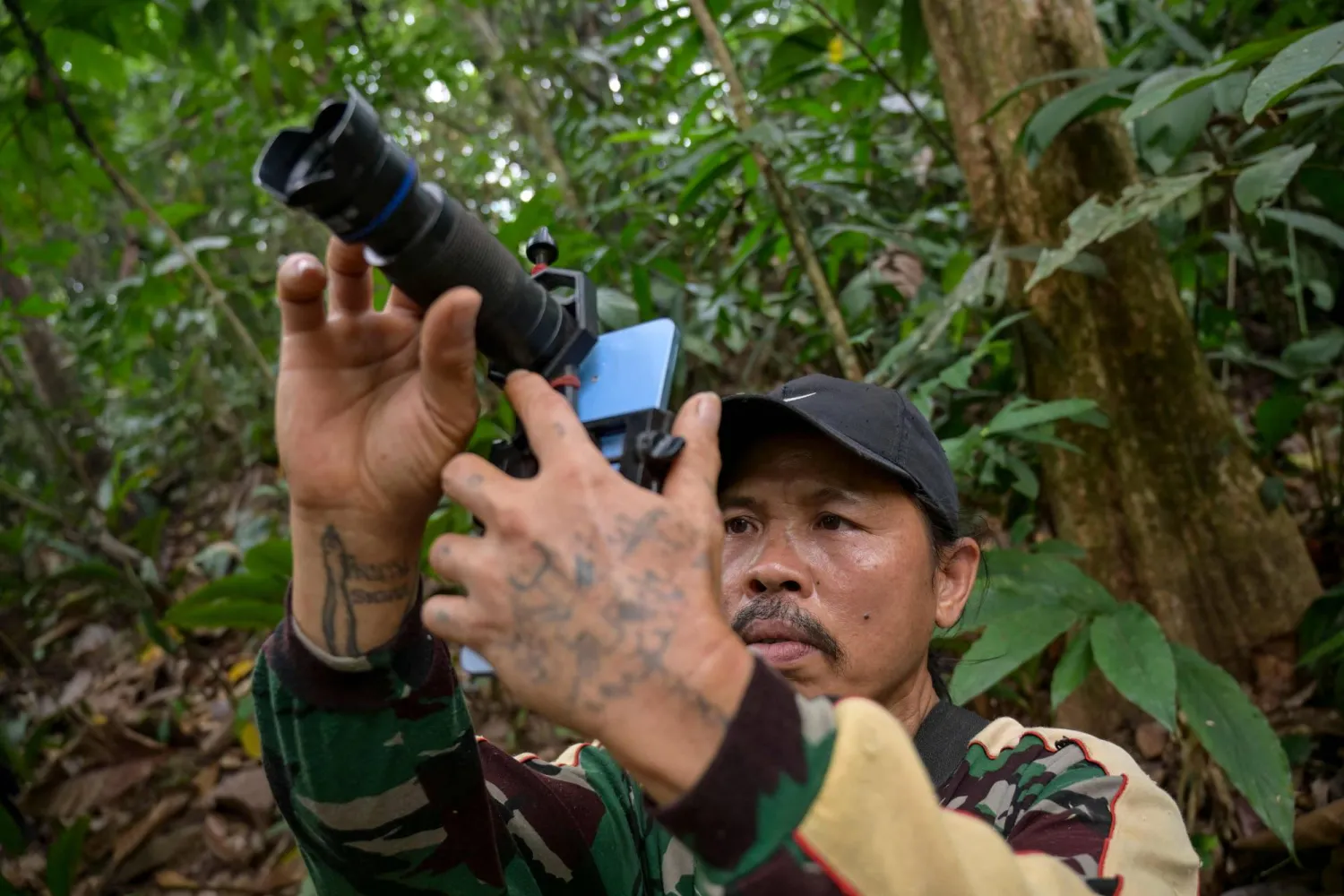
This picture taken on September 2, 2026 shows wildlife observer and former poacher Octavius using a mobile phone equipped with a telephoto lens to take pictures of wildlife in a forest near Labian village in Kapuas Hulu, West Kalimantan. (Photo by BAY ISMOYO / AFP)
TT

Indonesia Cash-for-photos Scheme Turns Animal Hunters Into Protectors

This picture taken on September 2, 2026 shows wildlife observer and former poacher Octavius using a mobile phone equipped with a telephoto lens to take pictures of wildlife in a forest near Labian village in Kapuas Hulu, West Kalimantan. (Photo by BAY ISMOYO / AFP)

Indonesian villager Octavius wades through the forest in rubber boots and tattered joggers, ears pricked, eyes peeled, a telephoto lens on his phone primed to capture orangutans, monkeys or birds.

The daily photo hunt earns Octavius and hundreds of others in Borneo cash as part of a conservation program seeking to make animals worth more alive than dead.

Locals on the island have long made money from hunting wild songbirds and selling them, mainly to domestic customers.

The KehatiKu project aims to break that cycle by paying individuals in nine participating villages in West Kalimantan province for photos or recordings of animals instead.

Payments range from 5,000 rupiah (about $0.30) for observing a common bird, to 130,000 rupiah for an endangered orangutan -- the top prize.

The most successful observers earn up to 10 million rupiah a month -- equivalent to about $570, several times an average farmworker's income.

The extra cash "really helps, especially to pay for my children's college", said 50-year-old Octavius, who like many Indonesians uses a single name.

The program, run by environmental consultancy Borneo Futures, began two years ago and produces data on wildlife distribution and population changes.

Most participants are small-scale farmers of rice, cacao, durian and the stimulant kratom.
Early signs suggest the scheme is working.

"People have started to realize that where previously they caught one bird and it was worth 50,000 rupiah, now they just need to take a photo, send it to us, and they can receive a payment of 5,000 to 10,000 rupiah," Borneo Futures Indonesia director Nardiyono told AFP.

"If they take just five photos, they (may) earn 50,000 rupiah, and the bird is still in their environment, still observable, and still able to reproduce, so the potential income from observing birds is far greater than from hunting birds."

That shifting logic has prompted two participating villages to voluntarily introduce hunting bans since the project started, added Nardiyono.

The program is funded by philanthropic foundations and has received about $300,000 to date, according to Borneo Futures.

Half has gone towards development, including a mobile app for uploading animal sightings and an AI system that helps humans verify observations.

So far, users have submitted over 350,000 observations, about half of which have been validated and paid for.

Invalid entries might include multiple observations of the same animal, or a species that is not on the program's list.

In September, Octavius and dozens of others gathered at the tiny office in Labian village -- population 683 -- for their monthly payments.

His share was four million rupiah, or nearly $230.

"This is a side-job; it doesn't interfere" with farming, he told AFP as he showed off a patch where he grows kratom and cacao.

"Sometimes when we're working, when everyone is gathered to collect kratom leaves, we hear birds calling, so we go over, observe them -- if we can take a photo, we take a photo; if not, we just make a sound recording."

The program's model is "likely better for both environmental and social impacts than an unincentivized, top-down conservation project design," said researcher Paul Ferraro of the US-based Johns Hopkins University.

The main challenge will be maintaining funding, he added.

"People may revert to their prior behavioral patterns because the incentive payments are insufficient when the enthusiasm has waned," said Ferraro, an expert in human behavior and public policy.

For now, Borneo Futures has funding secured through 2028, and two more villages will join next month.

It pays for observations of 73 species, including birds, monkeys, wild cats and deer.

Antonia Uneng says she never has to venture too far from her home in Sungai Ajung, a village of fewer than 400 people, for observations.

She bought her first fridge with her earnings, as well as a karaoke machine, complete with flashing lights and two microphones, that occupies pride of place in her living room.

The project has given women in the village a sense of independence, said the 36-year-old part-time nursing assistant, whose husband works abroad.

"I have my own income... so I am not dependent on my husband."

Imelda, a farmer in Labian, goes into the forest daily with friends to record bird sounds and, if they are lucky, orangutans.

"It makes us healthier, walking in the forest," said the 72-year-old.

In the past, some in the community considered wild boar and deer pests for damaging their gardens and crops, she said.

But now, "we really, really want to protect them".


From Italy to Croatia, a Warming Climate Threatens Prized White Truffles

Truffles hunter Tino Marolo checks truffle found with his dog Stella in the woods in Vezza d'Alba, near Alba, northern Italy, Thursday, Oct. 1, 2026. (AP Photo/Antonio Calanni)
TT

From Italy to Croatia, a Warming Climate Threatens Prized White Truffles

Truffles hunter Tino Marolo checks truffle found with his dog Stella in the woods in Vezza d'Alba, near Alba, northern Italy, Thursday, Oct. 1, 2026. (AP Photo/Antonio Calanni)

Guided by the beam of a flashlight, Tino Marolo follows his dog Stella through the darkness of a Piedmont woodland, searching for one of Italy’s most prized culinary treasures hidden beneath the soil.

In the hills around Alba, home to the world’s most famous white truffles, hunters known as “trifolau” traditionally begin their season on Oct. 1. But increasingly, they are confronting a challenge above ground: climate change.

Months of heat and drought have raised concerns about the future of the prized white truffle, a fungus that depends on cool, moist soils and a delicate relationship with tree roots.

“The entire month of October was affected by the lack of rain in July and August and the high temperatures, so it was characterized by poor production and poor truffle shelf life,” said Antonio Degiacomi, president of Italy’s National Centre for Truffle Studies.

According to Degiacomi, dry and compacted soils have also produced smaller truffles this season.

The difficult harvest comes as Alba and the surrounding Langhe hills welcome visitors for the International White Truffle Fair, one of Italy’s best-known food events, which opened on Oct. 10 and runs until Dec. 6.

A changing climate, a changing harvest For Axel Iberti, president of the fair, the season began slowly, with smaller truffles emerging after a hot, dry summer. More recent rains have improved conditions, helping larger specimens appear.

Despite tighter supplies, demand remains strong. Prices at Alba’s truffle market are running about 20% to 30% higher than last year, Iberti said, while hotels and other accommodations have largely sold out during the fair period.

The concerns extend beyond this year’s crop.

“This year certainly stands out from a trend we all know has been going on for five or six years now,” Degiacomi said, citing hotter summers and increasingly erratic rainfall patterns.

Back in the woods, Marolo says uncertainty has always been part of the hunt.

“You certainly come home empty-handed more often than you do with a truffle,” The Associated Press quoted him as saying. “It’s really the thrill of saying: I don’t know what I’m going to find.”

Similar concerns are emerging elsewhere in Europe’s truffle-producing regions, suggesting a challenge extending beyond any single forest or region.

Across the Adriatic in Croatia, truffle hunters and scientists describe many of the same challenges, from shrinking harvests to declining habitat suitability.

In oak forests outside Zagreb, truffle hunter Petar Alebic says years of drought have made the prized fungi harder to find.

“Each year for the past seven or eight years has been worse than the last,” Alebic said. “Due to the drought, unfortunately, truffles are becoming smaller and scarcer.”

Alebic estimates this year’s harvest is about 30% below normal and increasingly supplements his income with truffle-hunting tours for tourists.

Scientists studying truffles in Croatia report similar findings. Croatia is home to about a dozen truffle species, according to mycologist Armin Mesic of the Rudjer Boskovic Institute. The most prized, the white truffle, can fetch as much as 4,000 euros ($4,500) per kilogram.

“Drought, a lack of rainfall and high temperatures have a significant impact on both the quantity and quality of truffles,” Mesic said.

“Quantities are declining, as is the geographical area where white truffles grow,” he added.

Forests are part of the solution Yet experts in Piedmont reject the idea that the white truffle is doomed.

“I don’t think we’re facing extinction; we’re facing a challenge,” Degiacomi said.

Researchers are studying ways to help truffle habitats adapt, including improved forest management and experimental irrigation during prolonged droughts.

“We’re trying to do what nature does, and do it artificially,” Degiacomi said.

In Alba, the response increasingly centers on restoring and protecting forests.

Iberti has expanded the fair’s focus beyond tourism to include environmental education and conservation efforts.

“The truffle is the sum, but it’s also the vector,” Iberti said. “People come to Alba and the Langhe to discover everything the territory has to offer.”

Working with municipalities, truffle hunters and landowners, communities have begun creating new public truffle grounds and planting trees that could eventually support truffle growth.

“The forest is an act of love and faith for the next two or three generations,” Iberti said.

Advocates say reforestation can help lower soil temperatures, retain moisture and reduce erosion, although it can take more than a decade before newly planted trees become suitable hosts for truffles.

Science looks underground Researchers are also investigating the role of soil microorganisms and looking for tree varieties better suited to hotter and drier conditions.

Attempts to cultivate the prized white truffle continue, but reliable commercial production remains elusive.

Unlike black truffles, which can be cultivated, white truffles have largely resisted large-scale production.

As autumn progresses, the size of this year’s harvest will become clearer, along with its effect on prices and supplies reaching restaurants and markets.

For now, however, the ancient partnership between hunters, dogs and forests endures.

One evening in the woods, Stella eventually stops and begins to dig.

The dog has found a truffle.

Whether future generations will continue to enjoy such moments may depend on a mix of science, conservation and adaptation to a warmer climate.


'Air-con Nation' Singapore Eyes Alternatives to Cool Down

This photo taken on August 26, 2026, shows rows of the air conditioning compressors installed on the rear of buildings at Boat Quay in Singapore. (Photo by Roslan RAHMAN / AFP)
TT

'Air-con Nation' Singapore Eyes Alternatives to Cool Down

This photo taken on August 26, 2026, shows rows of the air conditioning compressors installed on the rear of buildings at Boat Quay in Singapore. (Photo by Roslan RAHMAN / AFP)

Long dubbed an "air-conditioned nation", Singapore is experimenting with cooling alternatives from chilled beams to "passive displacement" to curb its thirst for energy-guzzling air conditioning.

The city-state has the highest per-capita air conditioner ownership rate in Southeast Asia, with about 99 percent of private residences equipped with cooling units.

Singapore's local building sector accounts for one-fifth of its emissions, while cooling itself accounts for 40 to 60 percent of a building's energy consumption, according to studies.

A stroll down renowned thoroughfare Orchard Road highlights that dependence. Shoppers are greeted by blasts of cool air that waft into the street as doors swing open -- a major draw given daytime highs hover between 31C and 33C year-round.

But air conditioning can make the heat problem worse. Compressor units belch hot air back out into the environment, and the electricity that powers the systems can contribute to climate change if generated from fossil fuels.

Some buildings in Singapore are looking at other options, including active chilled beams, which are perforated panels equipped with cooling coils that are mounted on ceilings.

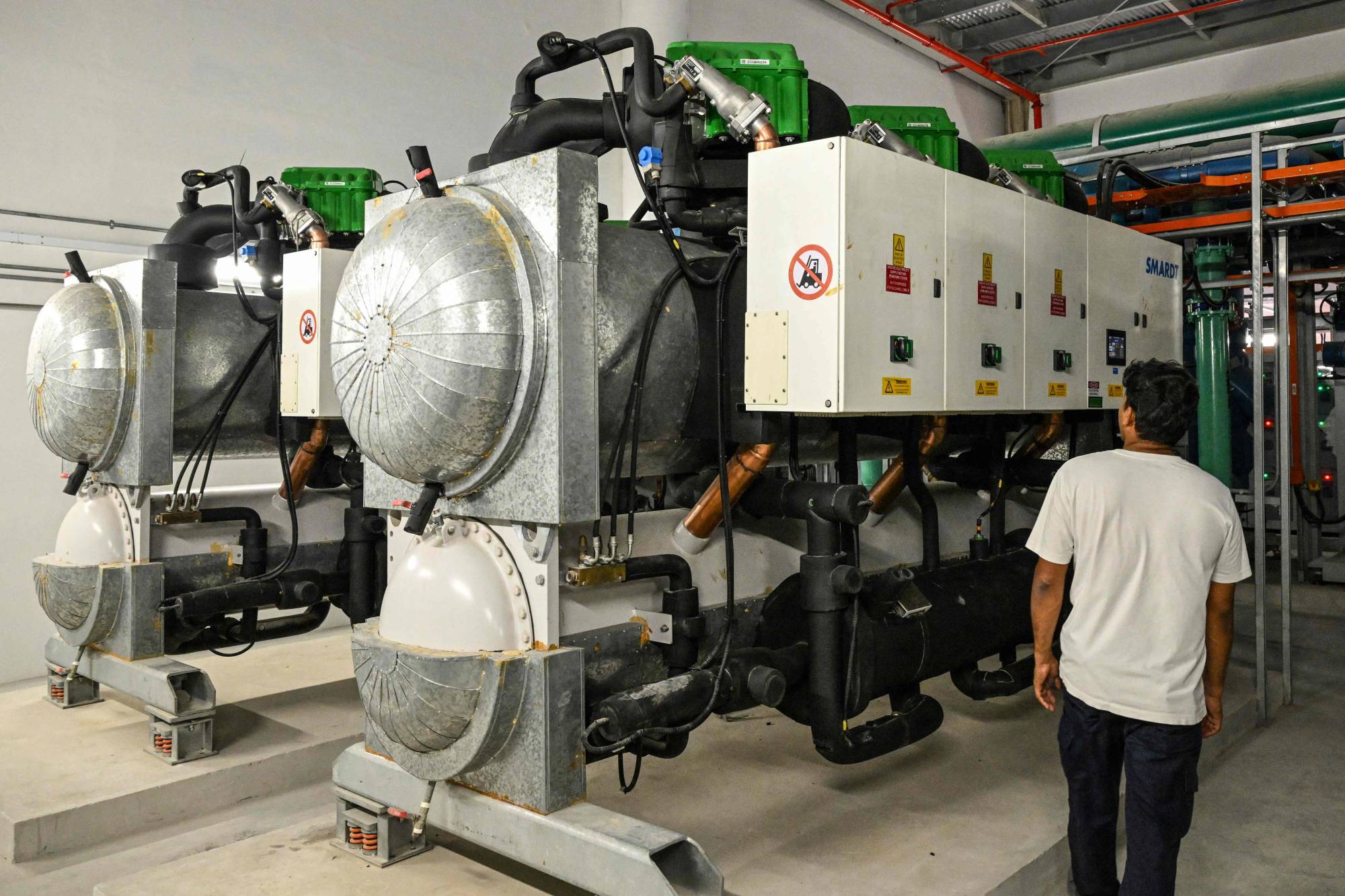
A chiller plant on the building's top floor cools water down to 9C, then pumps it into the coils. Simultaneously, air is blasted through small nozzles inside the beams.

The jets of air create a low-pressure zone that sucks up warmer air from the room below so it passes over the coils and is cooled before recirculating.

The technology keeps the offices at the eight-story Paya Lebar Green building in eastern Singapore at a comfortable 24C.

This photo taken on August 21, 2026, shows a technician checking the chillers that produce a hybrid cooling method at an office building in Singapore. (Photo by Roslan RAHMAN / AFP)

A visiting AFP team felt noticeably cooler air flowing from the sleek white panels on the ceiling of the building, described as one of Singapore's "greenest".

The system is also quiet, without the constant hum of air conditioning units.

When HR professional Renuga Shekar first moved into an office space at Paya Lebar Green last November, the 30-year-old and her colleagues just thought the exposed pipes and panels on the ceiling was a "warehouse kind of look".

"We didn't really think much about it. No one really commented about it," she told AFP.

It was only months later, after noticing how quiet the office was and hearing technicians mention "ACB" during maintenance, that they realized it was cooled by active chilled beams.

"We didn't even realize how different the air cooling system is because it was very seamless, and in terms of the temperature, ideal for everybody in the office," she said.

Together, the system cut energy use by more than 30 percent compared with conventional air conditioning, according to the building's designers, DP Architects.

A similar system is in use at Singapore's ports authority maintenance building at western Tuas harbor.
The building uses passive displacement cooling, which taps natural airflow to reduce reliance on mechanical fans.

Ceiling cooling coils chill the air, which sinks before naturally rising back to the coils as it warms. This continuous cycle reduces the need for fans, cutting energy use and noise.

Another alternative is radiant cooling, where water chilled to between 14C and 18C flows through pipes or panels and absorbs heat radiating from people or objects to reduce ambient temperatures.

The push to find new cooling solutions has government backing.

A 2024 government study identified alternative cooling technologies (ACTs) as a key strategy which found they could save the city up to 48 percent in energy.

By mid-2026, at least 33 public and 14 private buildings had adopted ACTs, Singapore's building authorities said. The city-state has an ambitious goal to achieve net-zero carbon emissions by 2050.

The figures are still relatively small, and it can be challenging to find an ACT that is acceptable to users familiar with tried-and-tested air conditioners.

Supporters of alternative systems acknowledge that they cost more to install than conventional air-conditioning, but say they more than make up for it over time with much lower running costs thanks to big energy savings.

This photo taken on August 21, 2026, shows a technician monitoring remotely the chillers operation that produce a hybrid cooling method at an office building in Singapore. (Photo by Roslan RAHMAN / AFP)

The most popular alternative method remains hybrid cooling -- simply turning up air conditioning to a higher temperature of 25.5C to 27C, and pairing it with fans.

"Everybody's more used to having air-conditioned office spaces, so for them to suddenly accept 26 degrees, I think the mindset shift has not reached a threshold where it's generally accepted yet," said Chua Zi Jun, director at DP Architects.

Demand for cooling is only increasing as climate change raises temperatures and humidity in Singapore and beyond.

Traditional air-conditioning systems rely on vapor compression, using refrigerants to move heat from one place to another.

ACTs use the same basic principle, but either spend less energy moving cool air or reduce run-time by leaning on people's ability to adapt to slightly higher temperatures.

"The technologies are a step in the right direction and should eventually incorporate more sophisticated controls, including predictive systems that adjust temperatures before rooms become too hot or cold," said Wan Man Pun, a cooling tech expert at Nanyang Technological University.

But "we still haven't found any alternative cooling methods that have a higher coefficient of performance, or efficiency, than vapor compression", Wan said.


How to Choose a Cat Who Will Actually Be Your Friend

A cat breeder attends with their animals during the FIFe World Cat Show in Vijfhuizen, the Netherlands, 24 October 2026. EPA/DINGENA MOL
TT

How to Choose a Cat Who Will Actually Be Your Friend

A cat breeder attends with their animals during the FIFe World Cat Show in Vijfhuizen, the Netherlands, 24 October 2026. EPA/DINGENA MOL

Cats have a reputation for being mysterious and aloof, but some are more so than others.

Just like dogs, cats’ personalities differ depending on their breed, naturally making some of them far friendlier, elusive or even more “dog-like” than others, according to report published by the Daily Mail.

While some breeds might see you as their housemate or best friend, for others humans as nothing more than their personal wait staff.

Of course, every cat is different, and opting for particular breed doesn’t necessarily guarantee a specific set of personality traits but it’s always worth learning more before you commit.

Some are better suited than others to family life or co-existing with other pets, while certain types prefer a more solitary and independent life.

Oxford-educated chemist and founder of Tribal Pet Foods Fatima Maktari said: “When choosing a cat, it’s important to understand the natural instincts and characteristics of different breeds and ultimately choose a cat that suits your lifestyle and your home – for instance, the cat will need to feel comfortable with a dog if you have one, and vice versa.”

From the couch potato to cat in need of constant stimulation, here are the most elusive cat breeds according to the experts, as well as those to pick if you’re looking for a friendly companion.

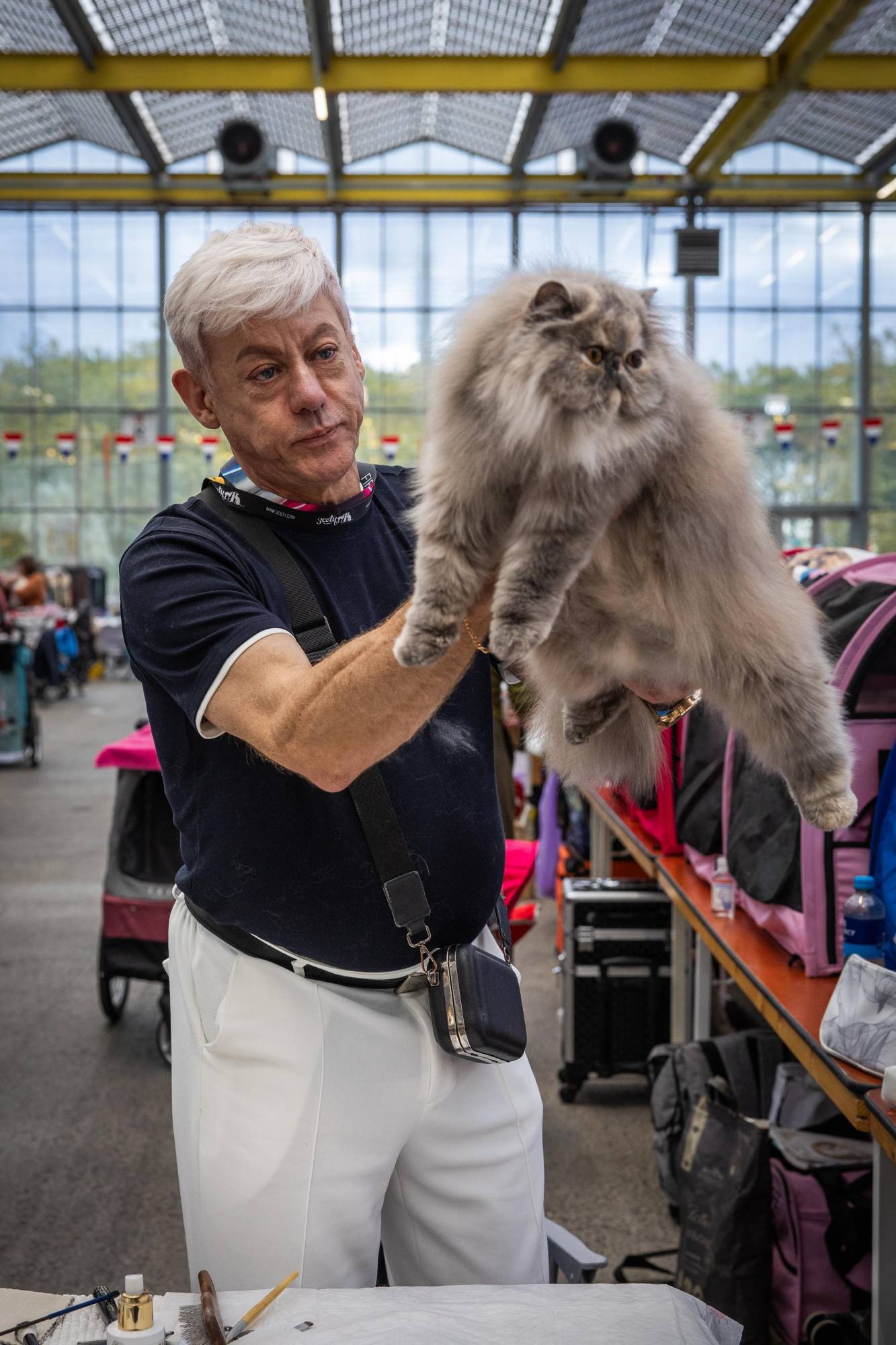
A cat is being judged during the FIFe World Cat Show, to select the best cats for each participating breed, in Vijfhuizen, The Netherlands, on October 24, 2026. (Photo by Dingena Mol / ANP / AFP)

Sokoke

“A Sokoke can be tricky to pin down because they love exploring – you might even think from time to them that they’ve left home,” said Milbourne.

He added: “If you’re set on this rare breed, you can tap into their natural hunting instincts through feeding activities, such as puzzle feeders or hiding small portions of their food around the home. This encourages them to explore and keeps their minds stimulated.”

Bengal

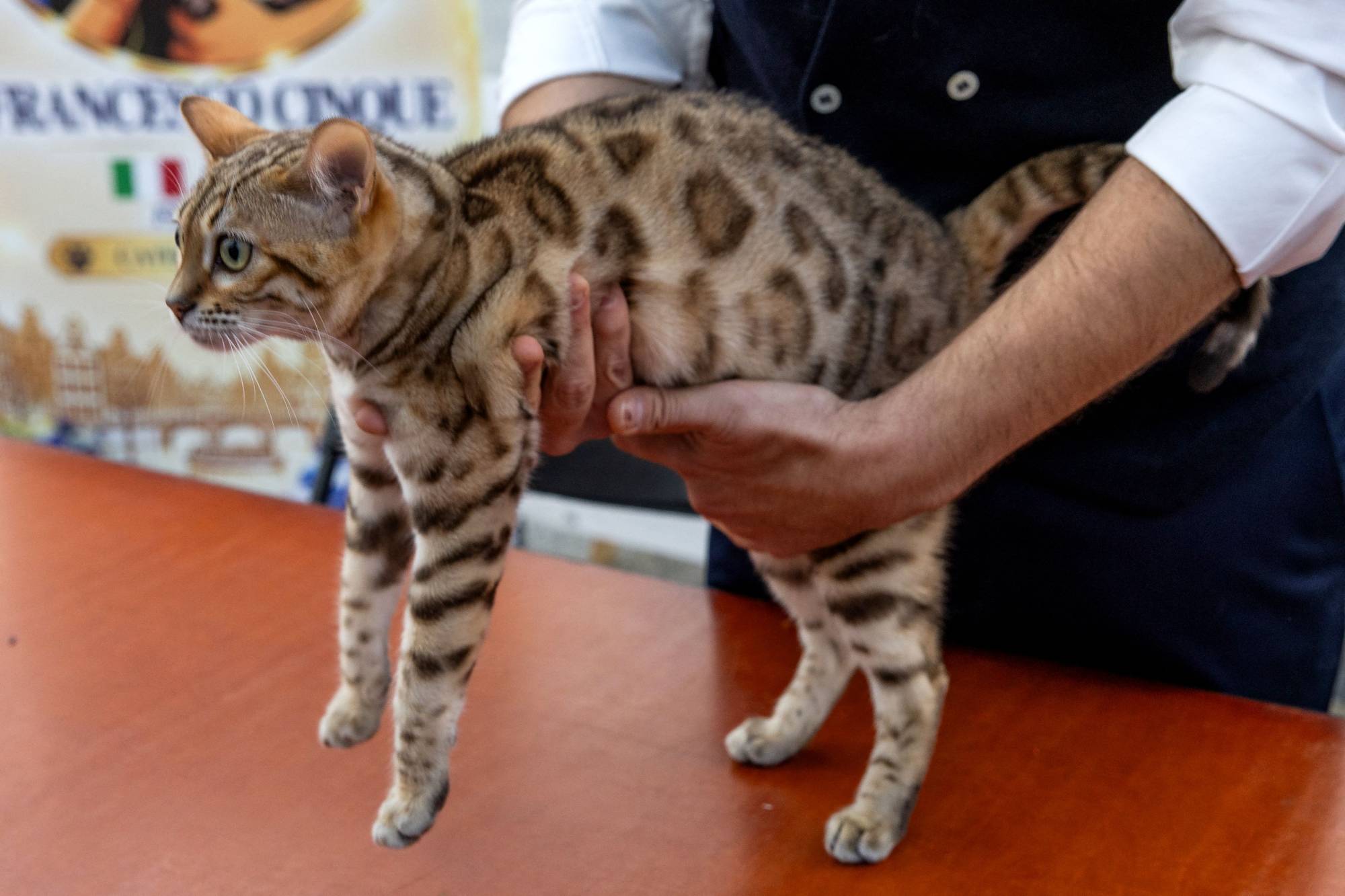
Like miniature leopards, Bengal cats are not built for an indoors lifestyle.

Dr. Brynden said: “They are wild-derived, fiercely independent, very vocal and can be remarkably challenging to handle. Without endless mental stimulation, puzzle toys and vertical territory, they will create their own entertainment – usually by tearing up your home.”

Unlike some of the other cat breeds on this list, the Bengal cat is not a beginner-friendly breed.

According to Brynden: “They are high-octane cats that require an experienced owner.”

British Blue

According to Milbourne: “This breed is one of the most registered pedigree cat breeds in the UK, yet they can be quite elusive.”

He said a British Shorthair will love to find the tightest and darkest of spaces and nestle up. “They will happily sleep undisturbed for hours on end. Owners will wonder where they are and find them in the oddest of spaces, such as behind a wardrobe or inside the laundry basket,” he said.

“If you aren’t clued up on your cat’s secret hiding spaces, you may frantically be searching for them!”

But despite their Houdini-like instincts, these cats are people-centered and are generally quite low-maintenance.

Brynden said: “If you want an affectionate, low-fuss pet around the house, British Shorthairs are practically like small dogs in feline form.”

British shorthairs are a great fit for families or first-time owners, just beware that this couch potato breed is prone to obesity.

A cat breeder attends with their animals during the FIFe World Cat Show in Vijfhuizen, the Netherlands, 24 October 2026. EPA/DINGENA MOL

Chartreux

The breed is famous for having a nearly silent meow but that doesn’t make them low-maintenance.
“Chartreux cats have a strong need to hunt and may bring unwanted guests to your door,” said Milbourne.

Ragdolls

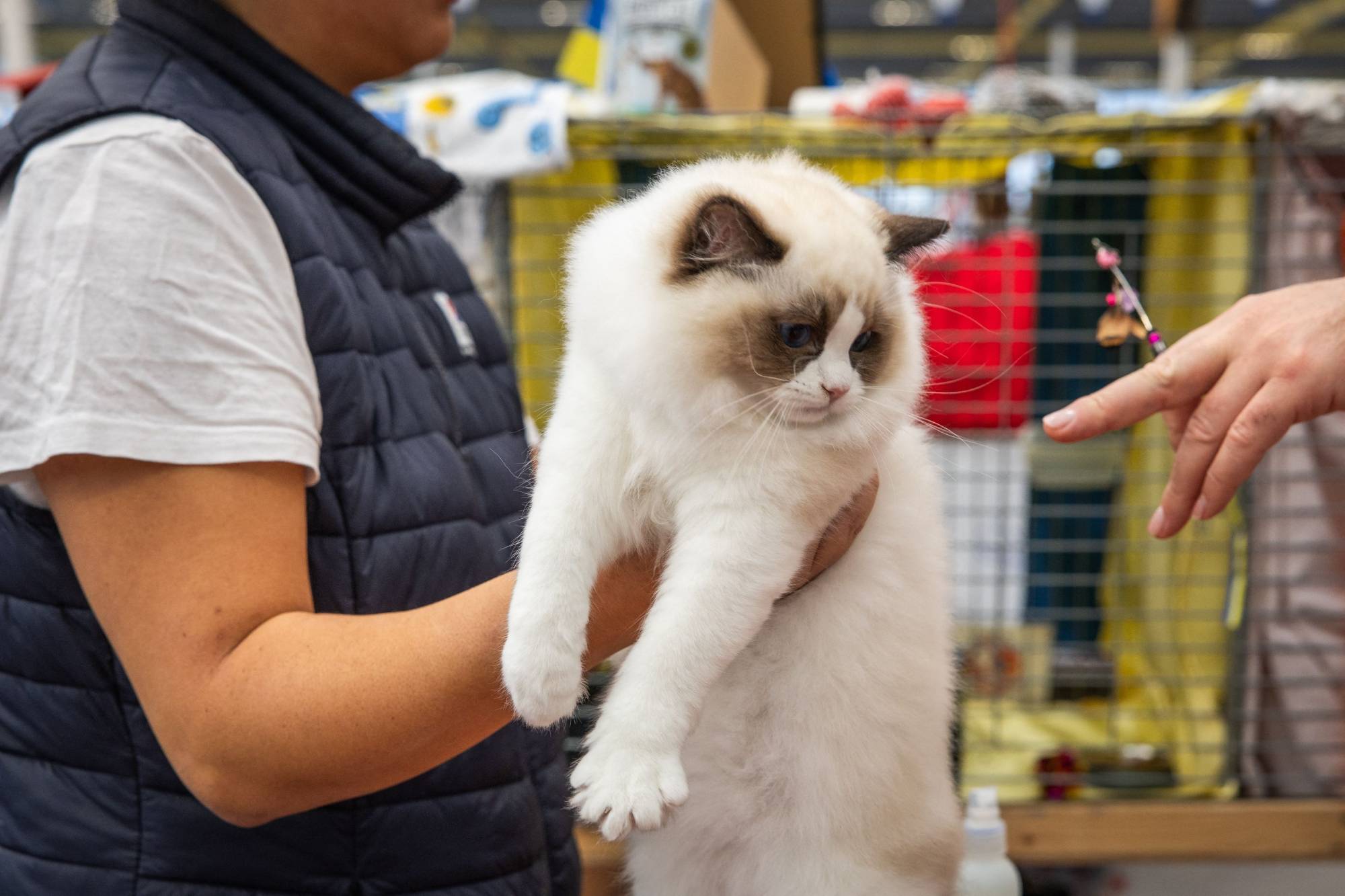
Ragdolls are fairly dog-like in their demeanor; they’re exceptionally sociable and love to play with people and other animals.

Brynden said: “They’re famously placid, docile and will famously flop into your arms like a rag doll (as the name suggests).

She added: “Big cats come with big responsibilities. Don’t underestimate that coat, without daily, dedicated grooming, their long fur will mat very quickly, which is both painful for the cat and difficult to treat.”

Maktari said: “They definitely have a dog-like devotion when it comes to their owners.”

A cat breeder holds a cat during the FIFe World Cat Show, to select the best cats for each participating breed, in Vijfhuizen, The Netherlands, on October 24, 2026. (Photo by Dingena Mol / ANP / AFP)

Maine Coons

Maine Coons are huge gentle giants. In fact, a male Maine Coon can weigh up to 11 kilos; that’s about three times heavier than a small dog.

Maine Coons are the ideal breed if you’re looking for a furry companion (or shadow) given their dog-like demeanor and socialness.

According to Brynden: “Maine Coons are big, goofy extroverts who want to be involved in whatever you’re doing.”

Norwegian Forest Cat

The Norwegian Forest cat is friendly and gentle without being too needy and demanding. They’re not lap cats, but according to Brynden “their calm temperament makes them a good choice for families with children and other pets.”

She also said: “Hardy, intelligent and muscular, the Norwegian Forest Cat is one of the more active breeds of the Felines. These cats love to climb and hunt, so outdoor space is recommended.”