


Mongolian Herders Enlist New Tech Against Harsher, Drier Climate

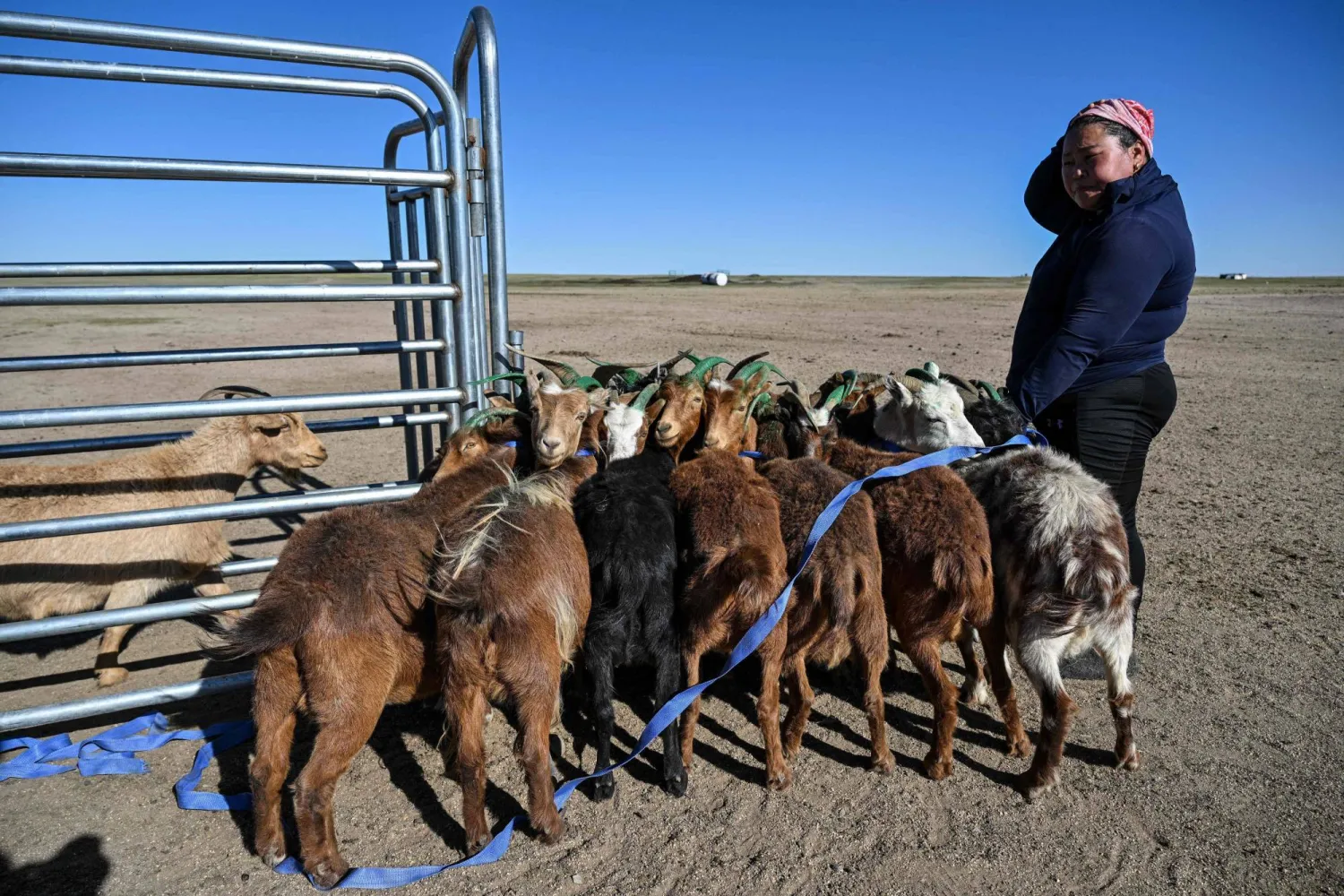
In this photo taken on August 25, 2026 sheep herder Ganchimeg stands with goats she rounded up in Bayantal, Mongolia's Govisumber province.  (Photo by Hector RETAMAL / AFP)
In this photo taken on August 25, 2026 sheep herder Ganchimeg stands with goats she rounded up in Bayantal, Mongolia's Govisumber province. (Photo by Hector RETAMAL / AFP)
TT

Mongolian Herders Enlist New Tech Against Harsher, Drier Climate

In this photo taken on August 25, 2026 sheep herder Ganchimeg stands with goats she rounded up in Bayantal, Mongolia's Govisumber province.  (Photo by Hector RETAMAL / AFP)
In this photo taken on August 25, 2026 sheep herder Ganchimeg stands with goats she rounded up in Bayantal, Mongolia's Govisumber province. (Photo by Hector RETAMAL / AFP)

When Mongolian herder Ganchimeg's sheep strayed dangerously near a salty lake this summer, driven by hunger as nearby vegetation was poor, she was in a "total panic".

"If they drank or stepped into it, the whole flock would be destroyed," she told AFP outside her traditional ger, the tent's shape silhouetted on the vast horizon of the Gobi Desert.

But thanks to an app helping herders navigate the risks that climate change is bringing to Mongolia, her husband was able to reach the sheep before they drank the brackish water.

"He immediately rushed over at top speed and intercepted them," said Ganchimeg, a mother of four who, like many Mongolians, goes by just one name.

"If we hadn't used that GPS tracker, we might have lost our entire flock."

Herders are on the frontline of both climate change and desertification impacts -- climate change is bringing extreme weather, including deadly cold snaps and droughts, which compound desertification caused by overgrazing.

Huge and sparsely populated, Mongolia is disproportionately affected by human-driven climate change, threatening the country's nomadic population and livestock.

Bilgudei Gankhulug, the 26-year-old founder of the Hunu app used by Ganchimeg, told AFP he was inspired to help herders after a 2024 "dzud" -- an extreme weather event that brought temperatures as low as minus 45C.

"Over eight million livestock died. I saw a lot of herders losing their income, losing their livelihoods in just the span of a few months," said Bilgudei.

Meaning "strong nomad", the name Hunu "embodies our mission of empowering nomadic herders with the help of technology," he said.

The app allows nomads to track their livestock with a solar-charging GPS device attached to one animal per group -- sufficient for herds that tend to stick together on the spacious steppe.

It has an artificial intelligence-powered weather feature with updates on the deadly dust storms and blizzards made more common in recent years by climate change, which scientists say is intensifying globally.

The app also compiles useful information on maps showing snow depth, wind direction, soil moisture and drought, assisting nomads in crucial decisions on where to move next.

Mongolia hosted talks on a global desertification treaty, known as COP17, last month.

Countries agreed financing for land restoration and tackling drought resilience, but concerns remain over a massive funding shortfall to the growing problem.

Bilgudei told AFP he hopes to expand Hunu to central Asian countries, and met with pastoralists from Tanzania and Uruguay at COP17 interested too.

"Our problems are pretty similar," he said.

About 80 percent of Mongolia is rangelands, large tracts of unfarmed land covered by native grasses and shrubs, according to Chimeddorj Buyanaa, Mongolia conservation director at the World Wildlife Fund.

"Rangelands are critically important for the local communities and also for the livelihoods of all of the Mongolian people," he told AFP.

Compounding the issue of climate change is rampant overgrazing that also endangers the region's wildlife, including snow leopards and saiga antelope, Chimeddorj said.

Around one in four Mongolians are nomadic herders.

Nearly 82 percent of the country's territory is affected by desertification and land degradation, authorities said in August.

Many herder families have simply decided to pack up and seek new lives in the city.

"Dundgovi Province's population has been declining continuously in recent years," the southern region's governor, Munkhchuluun Samdannyam, told AFP at COP17.

The worsening climate is a major problem for the province -- three-fifths of its economy depends on livestock husbandry, Munkhchuluun said -- but consequences are felt further afield.

"Dust storms can begin here and travel south to China, Korea, Japan and even as far as the United States," Munkhchuluun said.

"(It) is not only Mongolia's problem.

"It is also a global problem."

Speaking to AFP before heading to milk several camels tethered nearby, 49-year-old herder Bolormaa Erdenee said she was skeptical of forums like COP17.

"I often question whether the true voice of our herders is actually reaching decision-makers or not," she said.

Bolormaa and her husband raise about 400 livestock.

In their usual summer grazing area, she said roads for heavy mining trucks now criss-cross the steppe, kicking up dust and disrupting her animals.

Several nomadic households nearby have already relocated nearly 200 kilometers (125 miles) away in search of greener pastures.

Hunu app founder Bilgudei -- whose ancestors were nomadic herders -- said traditional migration itself is a form of environmental protection.

Bilgudei told AFP it's important to "learn from the traditions... and combine it with the science and technology".



Bats Originated and Took First Flight in Europe 65 Million Years Ago

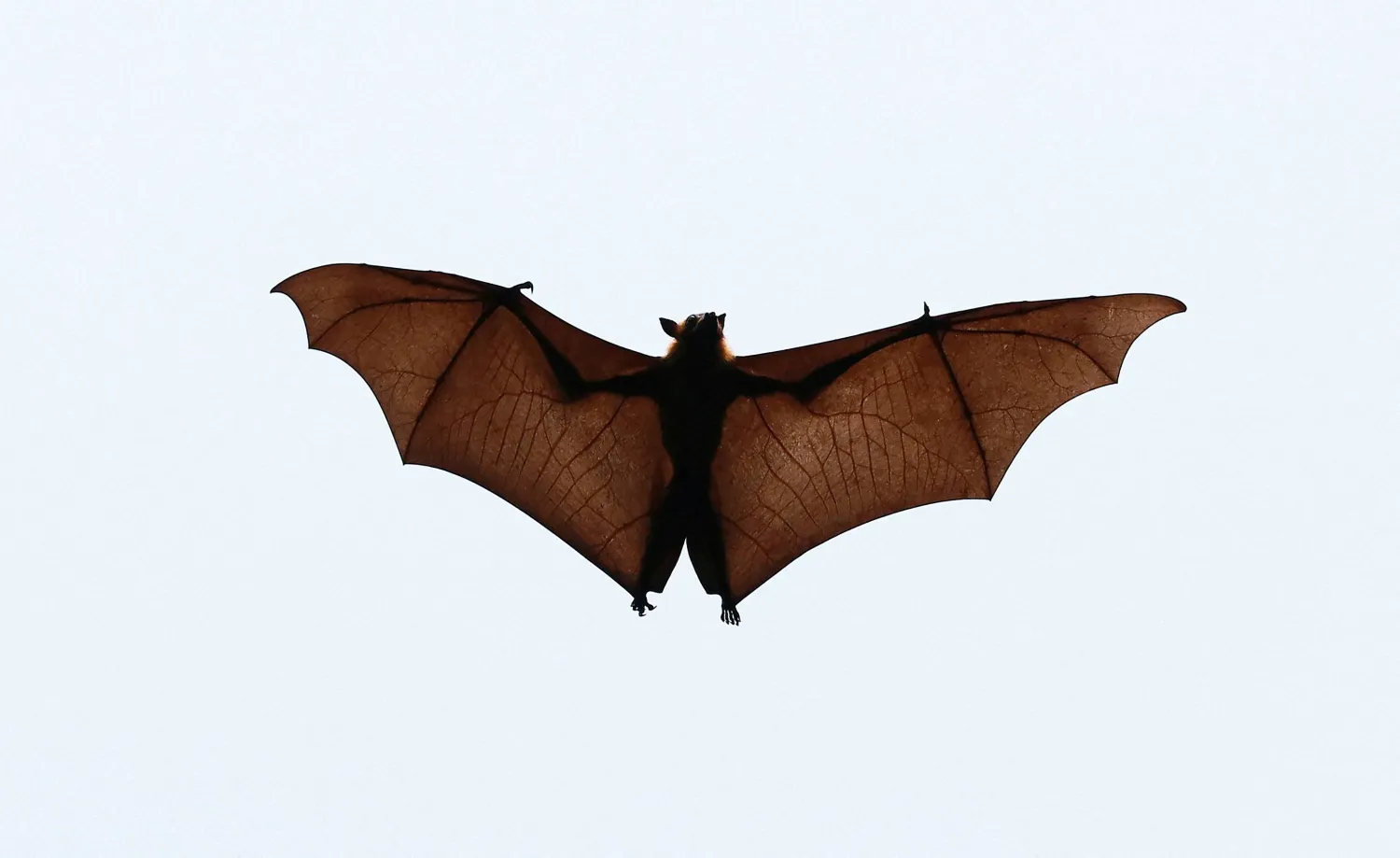
FILE PHOTO: An Indian flying fox or fruit bat flies over trees at Kodiyathur village in Kozhikode district in the southern state of Kerala, India, February 2, 2022.REUTERS/Sivaram V/File Photo
TT

Bats Originated and Took First Flight in Europe 65 Million Years Ago

FILE PHOTO: An Indian flying fox or fruit bat flies over trees at Kodiyathur village in Kozhikode district in the southern state of Kerala, India, February 2, 2022.REUTERS/Sivaram V/File Photo

Scientists have long struggled to establish where bats first originated, with previous hypotheses proposing Africa, Asia and North America.

A new research has rewritten the evolutionary history of bats, providing evidence the winged mammals most likely originated in Europe during the late Palaeocene, some 65-60 million years ago.

By combining genomic data from all living bat families with ancient fossil records, an international team of 137 researchers from 64 countries working as part of the Bat1K consortium, a global initiative dedicated to sequencing the genomes of all living bat species have reconstructed the evolutionary history of the world's only mammals capable of true powered flight.

The landmark study published in Nature magazine analyzed 103 bat genomes, including 42 newly generated chromosome-level assemblies, representing all 21 recognized bat families.

This was combined with evidence from 44 fossil bats. The results provide a clearer picture of where and how this remarkable lineage emerged.

The researchers found that bats most likely first evolved in Europe during the late Palaeocene. And from there, their descendants spread into Africa.

As bats diversified, different groups then expanded independently into the Americas, Asia and Australia, eventually giving rise to the major bat groups found around the world today.

“The approach we used to model the evolution of fossil and living species together can do what other methods cannot - identify the oldest group of fossil bats while taking the genomic data into account, and uncover when and where bats originated,” said senior author Professor Liliana M Davalos from Stony Brook University.

Computationally reconstructing the genome of the ancient ancestor from which all living bats descended, researchers are able to offer a glimpse into the genetic make-up of one of the earliest flying mammals.

This new genomic resource will allow scientists to investigate the genetic changes behind bats' extraordinary diversity and adaptations, including flight, echolocation, longevity and resistance to disease, as well as their remarkable resistance to disease and exceptionally long lives, for their size.

Bats are among the most extraordinary mammals on Earth. They are the only mammals capable of true powered flight. Most bats orient and hunt in complete darkness using sound alone, and they account for one fifth of all living mammals, playing a vital role in maintaining healthy ecosystems across the globe.

Many bat species show remarkable resistance to disease and live exceptionally long lives for their size.

Yet despite their unique biology and ecological importance, scientists have struggled for decades to answer some of the most fundamental questions about their evolution.

“It is extraordinary, after decades of research and conflicting findings, we finally have a robust phylogenetic tree that we can now use to properly understand how and where bats’ unique traits evolved,” said leading senior author and co-founding Director of Bat1K Professor Emma Teeling, from the UCD School of Biology and Environmental Science.

“We also have the genomes to uncover the molecular basis of these spectacular mammalian adaptations and know where the fossil bats fall in this tree.”

This new study represents the largest combined bat genome and fossil study ever undertaken, drawing on samples collected over decades from bats around the world, including some of the rarest and unusual species found only in the most remote locations.


Xi: 2 Giant Pandas from China Will Arrive in Coming Days at Atlanta's Zoo

Jin Xi, one of the only two giant pandas in Spain, eats on its sixth birthday at Madrid Zoo Aquarium in Madrid, Spain, September 19, 2026. REUTERS/Juan Barbosa


Jin Xi, one of the only two giant pandas in Spain, eats on its sixth birthday at Madrid Zoo Aquarium in Madrid, Spain, September 19, 2026. REUTERS/Juan Barbosa


TT

Xi: 2 Giant Pandas from China Will Arrive in Coming Days at Atlanta's Zoo

Jin Xi, one of the only two giant pandas in Spain, eats on its sixth birthday at Madrid Zoo Aquarium in Madrid, Spain, September 19, 2026. REUTERS/Juan Barbosa


Jin Xi, one of the only two giant pandas in Spain, eats on its sixth birthday at Madrid Zoo Aquarium in Madrid, Spain, September 19, 2026. REUTERS/Juan Barbosa


Chinese President Xi Jinping said Thursday that two giant pandas from China will arrive at Zoo Atlanta in the coming days, bolstering a loan program that at one time had lapsed as part of tensions between Beijing and Washington.

China and the zoo had said in April that Ping Ping, a male, and Fu Shuang, a female, would go to the United States. But Xi’s announcement at the White House, in opening remarks before talks with President Donald Trump, marked the first public confirmation of the timing, The Associated Press reported.

Beijing had reclaimed four pandas from Atlanta in 2024, the last of the animals on loan from China to the US at the time.

Xi said Ping Ping and Fu Shuang, “will come to their new home in Zoo Atlanta and meet with the American people” in “a few days.” He called it “a piece of good news” and hailed the panda loan program as an example of “friendship between the Chinese and Americans.”

The pandas are part of a conservation agreement between the zoo and the China Wildlife Conservation Association. Both pandas were born at the Chengdu Research Base of Giant Panda Breeding in China.

In 2024, Lun Lun, Yang Yang, Ya Lun, and Xi Lun returned from Zoo Atlanta to China, ending a 25-year partnership and leaving the US without any of the animals for several months.

The National Zoo in Washington returned three pandas to China in 2023 before accepting new arrivals Bao Li and Qing Bao, in October 2024 after Atlanta lost its pandas. Other American zoos sent pandas back to China before that as loan agreements lapsed.

When the pandas' Atlanta return was officially promised in the spring, Zoo Atlanta CEO Raymond B. King celebrated “the wonder and joy of giant pandas" and said his facility was “delighted and honored to yet again be trusted as stewards of this treasured species.”


UN Approves Resolution on Dealing with Rising Sea Levels

This picture taken on September 4, 2026, shows an aerial view of the small islands off the coast of Koror, the capital of Palau, scattered across the turquoise waters of the Pacific Ocean. (AFP)
TT

UN Approves Resolution on Dealing with Rising Sea Levels

This picture taken on September 4, 2026, shows an aerial view of the small islands off the coast of Koror, the capital of Palau, scattered across the turquoise waters of the Pacific Ocean. (AFP)

The United Nations on Thursday passed a unanimous resolution demanding stronger action on rising sea levels, an existential threat for low-lying island nations driven by ocean warming and melting ice sheets and glaciers.

In 2024, global sea levels rose by almost six millimeters, the largest annual increase ever recorded, and they are set to rise by a meter or more by the end of the century without drastic action.

"Sea-level rise is measured in millimeters, but its toll is measured in millions of shattered lives, uprooted communities, and stolen futures," Secretary-General Antonio Guterres said.

"We cannot allow countries and cultures to vanish beneath the waves -- or leave the aspirations of billions dead in the water."

The declaration is aimed at bringing new momentum to efforts to tackle the problem -- reducing greenhouse gas emissions and providing funding to vulnerable countries to strengthen their resilience plans.

Concretely, it resolves legal issues around what happens to nations when they start to vanish under the waves.

It affirms that maritime zones remain in place even if coastlines recede, and that "once a State is established, the disappearance of one of its constituent elements would not necessarily entail the loss of its statehood."

"For States that are literally defined by the ocean around us, the impact of sea level rise will be life-altering," said Palau President Surangel Whipps Jr., speaking on behalf of the Alliance of Small Island States.

Small island states have been sounding the alarm since the 1989 Male Declaration on Global Warming and Sea Level Rise and helped develop international law on the issue, he continued, welcoming the declaration as "a genuine achievement."

Even small increments of sea-level rise pose grave risks, explained Tom Mortlock, a senior catastrophe research analyst at Aon.

One centimeter of sea-level rise translates to a meter of coastline retreat.

Projections show that flooding that might occur once every 50 years with sea levels as they are today could happen every three or four years if sea levels rise by half a meter.

Nature-based solutions like mangroves "can reduce coastal risk, but it can also get to the core problem we have for climate change which is carbon sequestration and carbon mitigation," said Mortlock.