
In Vietnam… A Piano Concert to 150 Rescued Moon Bears

Fingers play what cages cannot (EPA)
TT

In Vietnam… A Piano Concert to 150 Rescued Moon Bears

Fingers play what cages cannot (EPA)

Rick Wakeman has played to all kinds of people around the globe, but he has now performed to an audience he had never encountered before – an enclosure of 150 bears.

The former Yes musician, who has gone on to have a prolific solo career, played the piano at a Vietnamese bear sanctuary.

“Before you ask, I won’t be playing the teddy bear’s picnic,” he joked ahead of the performance. Wakeman, who is a supporter of animal welfare causes and has rescue dogs and cats of his own, is conducting the concert to raise awareness of moon bears kept in cruel conditions for the extraction of their bile, according to The Guardian.

He said he was a bit worried about how hot it is going to be. “You know the heatwave we had in England? It’s double that,” he said. “They offered to rig up a fan for me, but I figured that will just blow more hot air around.”

His concert was performed live on a Yamaha grand piano positioned in Animals Asia’s bear sanctuary in the Tam Dao national park, and Wakeman had written some new compositions especially for rescued bears.

Asked whether the bears would enjoy the music, he said: “They’ve not got much choice, really. It’s a well-known fact that all animals react to music, especially gentle melodic music. So what I am going to do is piano music that is melodic, and I can only hope that they will come up to the perimeter of the sanctuary and have a listen.”

Wakeman has been sponsoring rescue bears since 2016 and recently adopted a new one: “He’s only 20 months old, a big fella, I went to see him today. He came out right to the edge and stood on his back legs and just stared at me, it was brilliant.”

Bile is extracted from bears for traditional Chinese medicine by putting a needle into their gall bladder and drawing it out.

The bears are kept in poor conditions in countries including China and in Vietnam, where it has just been banned, but where some bears are still in captivity in cramped enclosures.

It is the fourth-biggest market in the illegal wildlife trade in east Asia, resulting in a dramatic decline in the Asiatic black bear populations in Vietnam, with nearly a third of their numbers lost around the world in just 30 years.

Of the sanctuary, which he has been visiting this week, Wakeman said: “To see the bears be rehabilitated, having a life they never had before, some have never put their feet on grass before.”

He added: “They are so wonderful, that we can do such horrendous things to animals is beyond belief. Before this, they were chained in cages sometimes for 10 or 20 years in conditions where they couldn’t even turn around.”

He is playing to raise awareness for the bears still stuck in cages in Vietnam and to urge the government to get them released: “We have 150 bears at the sanctuary, but there are 125 bears left in cages in the old bear bile farms, and there are four dying a month. We have to get them out quick and into the sanctuary.”

Wakeman treats his rescue dogs and cats to music back at home in Suffolk. He said: “I had one cat who used to jump on the grand piano, and if I stopped playing he would put his paw in the strings and rattle them until I played again. I know if my dogs don’t like it, they will get up and walk out, and my cats don’t like metal, grunge or rap. They want a melody.”

Wakeman spends hours watching the bears. “If you see these bears it is hard to put into words, they are almost human the way they look at you,” he said.

“If you see them, you can’t help but be moved. They aren’t tame but they are very safe, very happy, they play, they romp. I witnessed two today jumping in a bubble bath and playing. They’ve got a life back,” he noted.

Dr. Jill Robinson, the founder and CEO of Animals Asia, said: “We are beyond blessed to have Rick’s support for Animals Asia and the bears.”

Robinson noted that “his love for them is immeasurable and can be heard in the beautifully haunting music he has written for them. We’re all so excited to hear his performance in the open air at our sanctuary in the stunning setting of Tam Dao national park. I can’t wait to see how the bears respond.”

Wakeman added: “I hope they lay down and have a listen, that would make my day. I would have a big grin on my face.”


Pakistani Astronaut to Join China's Next Space-station Mission

FILE - The Shenzhou-23 manned mission launches from the Jiuquan Satellite Launch Center in Jiuquan, northwestern China on Sunday, May 24, 2026. (AP Photo/Ng Han Guan,File)
TT

Pakistani Astronaut to Join China's Next Space-station Mission

FILE - The Shenzhou-23 manned mission launches from the Jiuquan Satellite Launch Center in Jiuquan, northwestern China on Sunday, May 24, 2026. (AP Photo/Ng Han Guan,File)

A Pakistani astronaut will become the first foreigner to visit China's space station when they join the country's next mission into orbit, Beijing's manned space agency said on Saturday.

Pakistan and China are close diplomatic and strategic partners, and signed a deal in February 2025 setting up a Chinese government training program for Pakistani astronauts.

The Pakistani astronaut will take off with the Shenzhou-24 crew, the China Manned Space Agency (CMSA) said on social media.

According to AFP, the statement did not give a date of departure, but the mission is expected to take place by the end of the year.

The Pakistani astronaut, a payload specialist, will join a short orbital flight before returning with the Shenzhou-23 spaceship, which docked at the Tiangong space station in May, according to the CMSA.

The agency did not name the Pakistani crew member, but said in April that astronauts Muhammad Zeeshan Ali and Khurram Daud had been chosen to start training in China.

Beijing has invested heavily in its space program in recent years -- catching up with its main rival the United States -- and aims to land astronauts on the Moon by 2030.

Pakistan is a natural partner, given the countries often tout their decades-long, "all-weather" friendship. China is Pakistan's largest trading partner and a major foreign investor.

Under the 2025 deal, following training in China, the Pakistani astronauts will carry out short-term missions with Chinese counterparts over the "next few years,” Beijing's state news agency Xinhua reported at the time.


China's Giant Pandas Make Public Debut at US Zoo

Ping Ping, a giant panda on loan from China, is seen in his new habitat at the Arthur M. Blank Panda Grove, at Zoo Atlanta in Atlanta, Georgia on November 6, 2026. (Photo by Elijah Nouvelage / AFP)
TT

China's Giant Pandas Make Public Debut at US Zoo

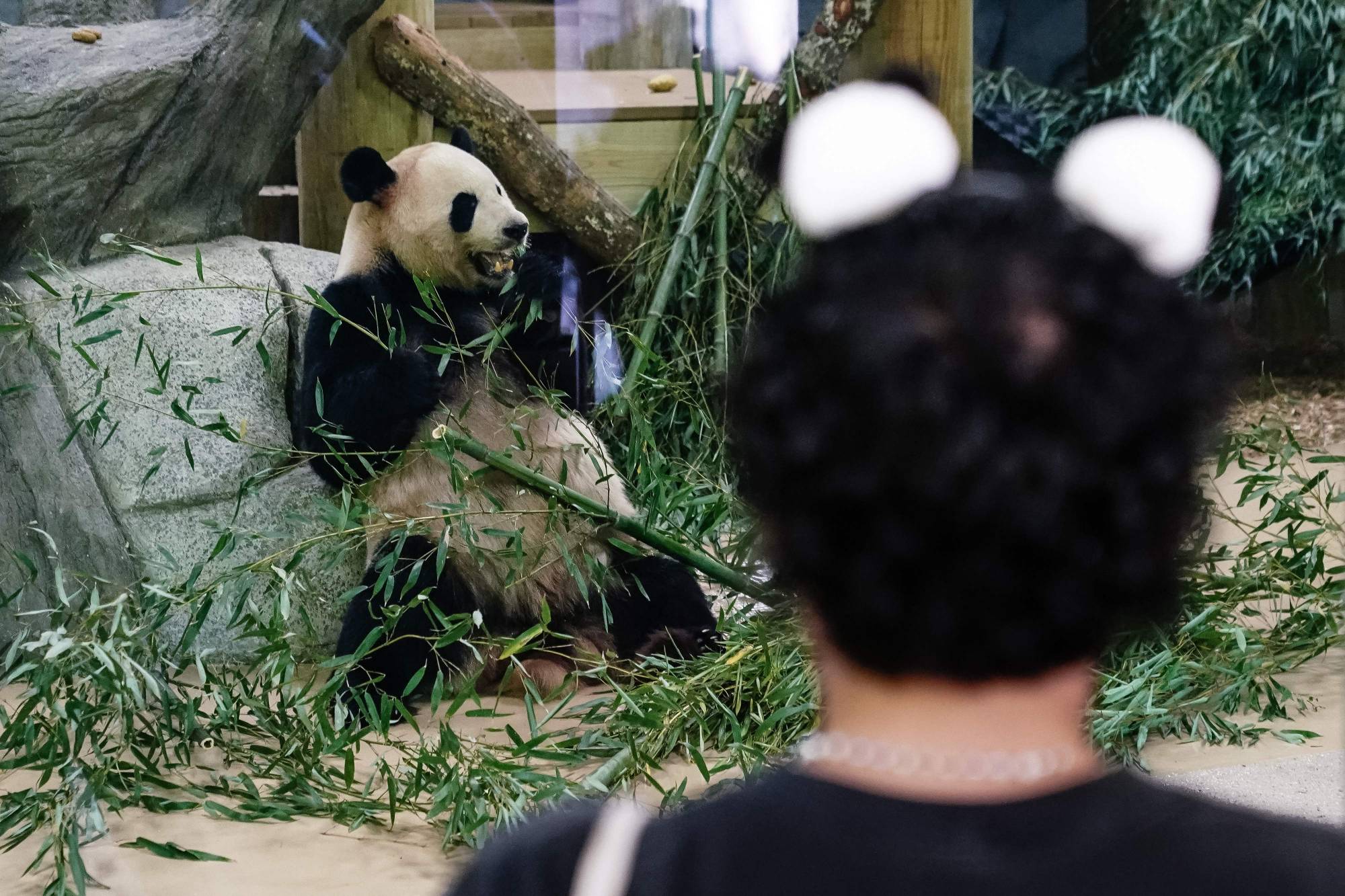
Ping Ping, a giant panda on loan from China, is seen in his new habitat at the Arthur M. Blank Panda Grove, at Zoo Atlanta in Atlanta, Georgia on November 6, 2026. (Photo by Elijah Nouvelage / AFP)

Giant pandas Ping Ping and Fu Shuang delighted visitors to Zoo Atlanta during their public debut Friday, chewing bamboo and lounging in their new US habitat while on loan from China.

A male named Ping Ping and female Fu Shuang arrived from Chengdu in September via a FedEx flight dubbed the "Panda Express," and are to be hosted in the southern US facility for the next 10 years.

Pandas are "animals that have got a unique ability to inspire curiosity, instill passion, evoke joy, and unite people around the globe," CEO Raymond King told onlookers at Zoo Atlanta.

"This extraordinary spirit of partnership helps create a future for a species that is truly beloved the world over."

In preparation for their arrival, Zoo Atlanta has renovated its panda facilities and assembled a team of animal caretakers.

It has also ensured a stable and long-term supply of bamboo, grown locally in Atlanta, which has a climate that is very similar to Chengdu.

"I think they inspire happiness," zoo visitor Rachel Totts told AFP on Friday. "They make people smile. I've never seen someone not say 'Oh, it's so cute!' when they're looking at a panda."

A zoo-goer watches Ping Ping, a giant panda on loan from China, in his new habitat at the Arthur M. Blank Panda Grove, at Zoo Atlanta in Atlanta, Georgia on November 6, 2026. (Photo by Elijah Nouvelage / AFP)

Native to temperate forest habitats in East Asia, the lumbering black-and-white mammals do not typically travel long distances in the wild.

But many have been shipped to zoos around the world as apart of Beijing's decades-long "panda diplomacy" program to foster foreign ties.

The furry show of "soft power" came as top US officials on Friday called on China to uphold the trade agreement made in an October 2025 meeting between US President Donald Trump and his Chinese counterpart Xi Jinping.

The accord calmed tensions after a whirlwind of tariff hikes, and required China to buy US soybeans while suspending export controls on rare earths.

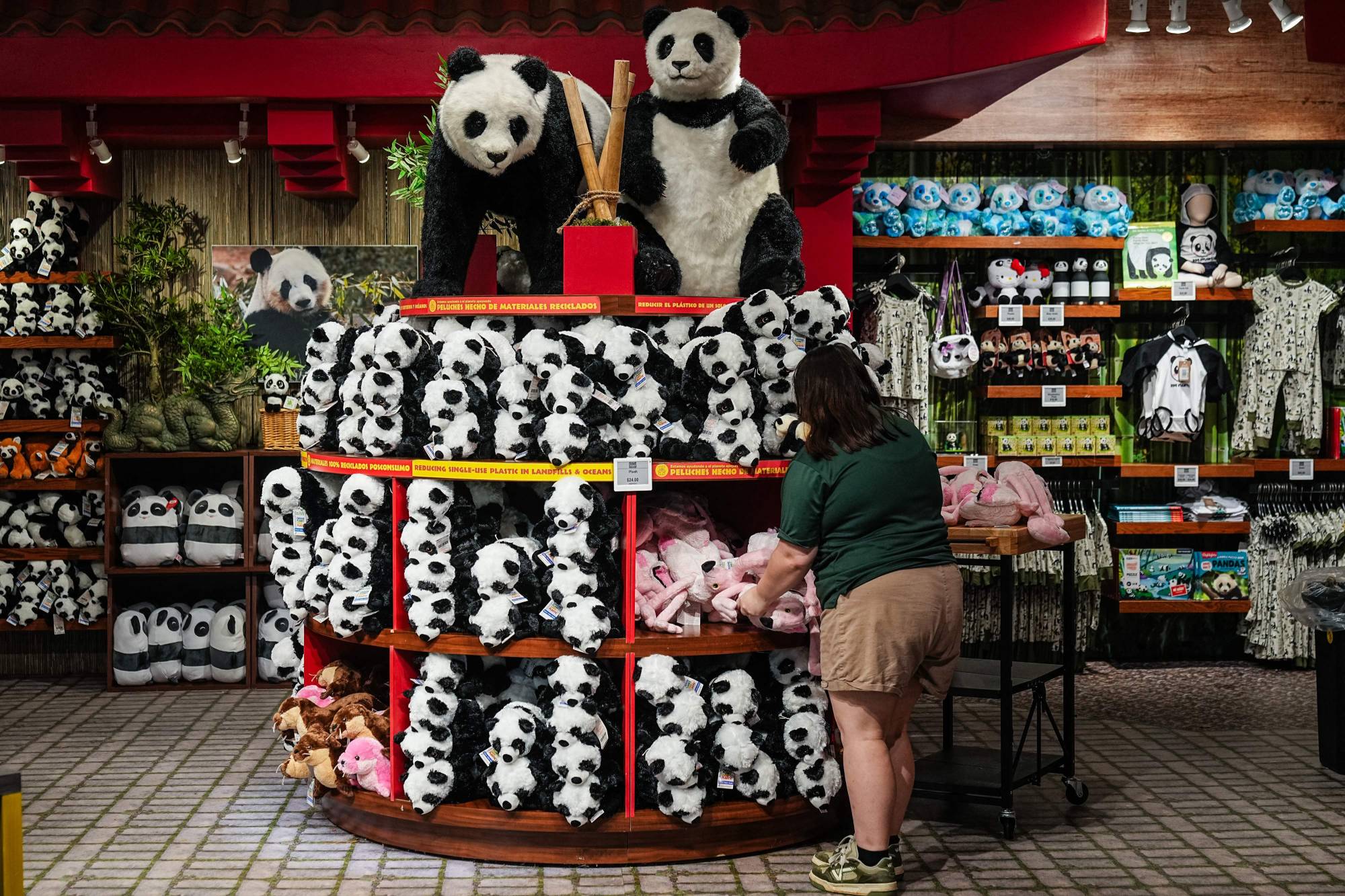
A Zoo Atlanta employee adjusts stuffed animals on a display featuring giand pandas in the gift shop, in Atlanta, Georgia on November 6, 2026. (Photo by Elijah Nouvelage / AFP)

Before 2016 pandas were considered endangered but are now listed as "vulnerable" by wildlife advocates, and an estimated 1,800 pandas live in the wild.

The Chinese government has established more than 50 panda reserves for conservation, but in the wild the bears continue to face threats of habitat loss and poaching.

Atlanta previously hosted pandas on loan from China starting in 1999, and seven panda cubs have been born at the zoo. All are now back in Chengdu, and Zoo Atlanta has not had any pandas since 2024.

Atlanta native John Perez celebrated his 28th birthday at Zoo Atlanta on Friday, telling AFP the pandas drew him to visit for the first time because "it felt perfect, you know?"

Both of the new arrivals were born in 2020, and it's hoped they will be suitable mates. Pandas in captivity typically live for around 30 years.

In 1972, China gifted a pair of pandas to Washington, following US president Richard Nixon's historic visit to the Communist nation.

Beijing recalled two of its pandas from Japan early this year, following a diplomatic spat that began when Japan's prime minister hinted that Tokyo could intervene militarily in the event of any attack on Taiwan.


Scientists Discover Unknown Baby Right Whale Off Canada

This photo provided by the Mingan Island Cetacean Study shows a North Atlantic Right whales mother, Silt (#1817) swims with her calf (no identification number yet) in the Jacques-Cartier Passage, Gulf of St. Lawrence in Canada on Sept. 25, 2026. (Mathilde Laverdière /Mingan Island Cetacean Study via AP)
TT

Scientists Discover Unknown Baby Right Whale Off Canada

This photo provided by the Mingan Island Cetacean Study shows a North Atlantic Right whales mother, Silt (#1817) swims with her calf (no identification number yet) in the Jacques-Cartier Passage, Gulf of St. Lawrence in Canada on Sept. 25, 2026. (Mathilde Laverdière /Mingan Island Cetacean Study via AP)

It would seem difficult to miss a 15,000-pound (6,804-kilogram) baby, but for months scientists who study rare whales did just that, and now they couldn't be happier.

Researchers in Canada captured images of an unidentified baby North Atlantic right whale, one of the rarest sea mammals in the world, off Anticosti Island in Quebec in September. Scientists with the New England Aquarium in Boston said this week that after analyzing photos and data about right whales, they have determined it was a calf likely born months ago that went unseen during winter surveys for the giant animals.

The discovery puts the number of baby right whales discovered from the most recent birthing season at 24, the most productive year for the whales since 2009 and the fourth-highest count on record, the aquarium said. The whales number only about 380 in the world, and their population has fallen since 2010, The Associated Press reported.

The whale was seen with its mother, a 38-year-old whale known to researchers as Silt, scientists said. Right whales give birth off the southeastern US in winter before venturing north to New England and Canada to feed.

The whales are extensively cataloged with photography by researchers because they are so rare. It's also rare for the researchers who study the whales to miss a baby, but the discovery was a welcome surprise, said Amy Warren, a scientist at the New England Aquarium's Anderson Cabot Center.

“Silt was briefly seen in the southeastern US calving grounds in February 2026, so it’s possible she had the calf there but snuck away before they were documented together. This is an exciting discovery for us so late in the year,” Warren said.

Baby right whale births are closely tracked by scientists because the tiny population needs successful calving years to remain viable. There are only about 70 reproductive-age females left in the population, and scientists have said the whales have reached 20 calves in a season only a few times since 2010.

That was when their numbers started falling, as they lost about 25% between 2010 and 2020. The whales are vulnerable to collisions with large ships and entanglement in commercial fishing gear, and the warming of the ocean has heightened those threats because they have strayed from protected areas, scientists have said. They also suffered a disastrous year in 2018 when no babies were born.

Recent years have been slightly more encouraging, as the whales have gained back some of their population since 2020.

But conservationists have decried recent moves by the US government to delay new protections for the whales for a decade in favor of commercial fishing interests.

The baby whale sighted off Quebec was spotted by researchers with Mingan Island Cetacean Study, a nonprofit research organization in the province's coastal Côte-Nord region. The whale wasn't seen by researchers despite boat-based and aerial surveys along the US East Coast all spring and summer, the New England Aquarium said.

Scientists are celebrating the animal's addition to a successful breeding season for the rare whales, said Richard Sears, founder and director of Mingan Island Cetacean Study.

“It just goes to show you how big the ocean is, and how those animals can get lost out there,” he said.