

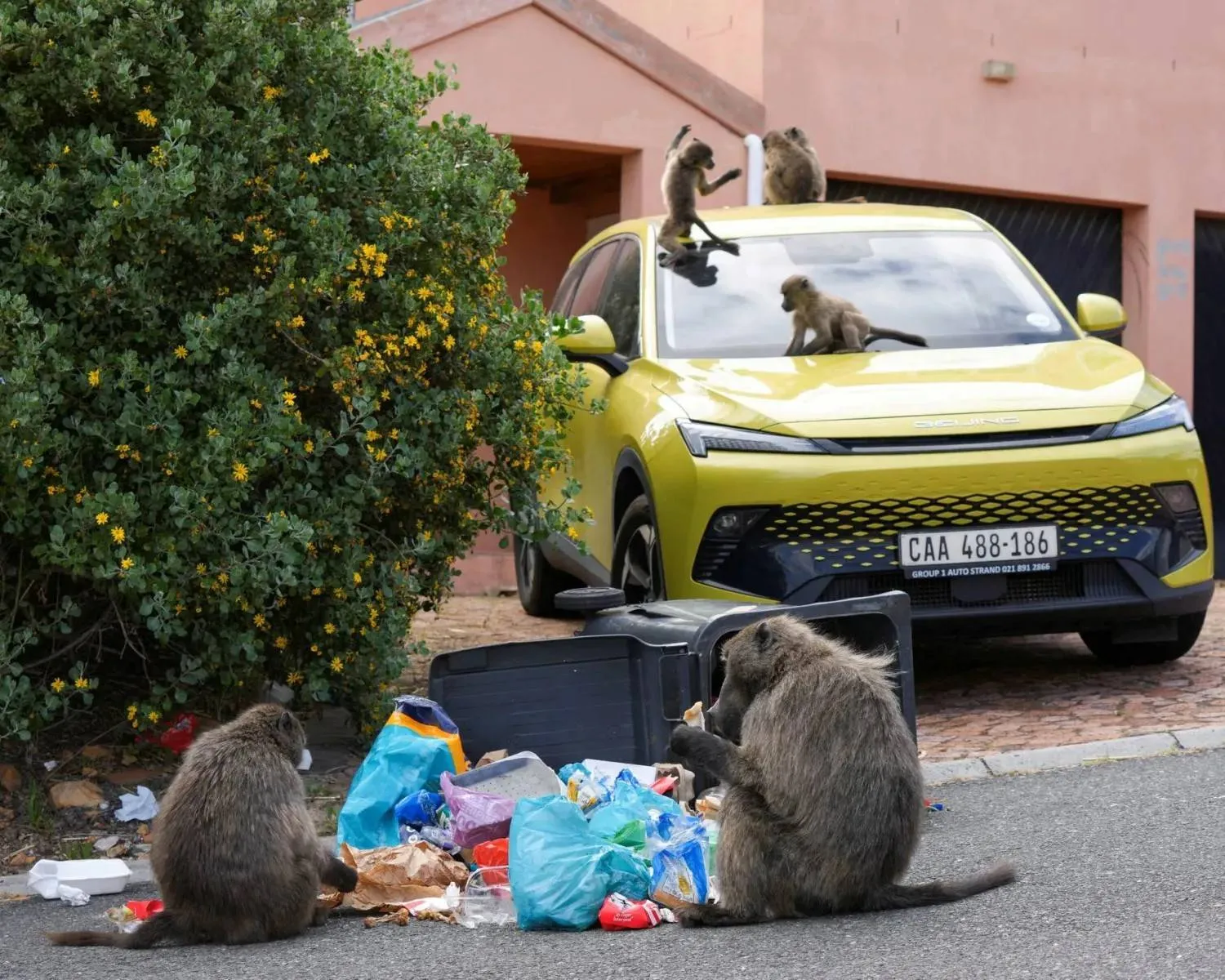

Cape Town Divided Over Plan to Remove its Monkeys

The baboons’ presence has affected house prices on the Cape Peninsula, as they raid bins and kitchens and poo on properties. (Nic Bothma/Reuters)
TT

Cape Town Divided Over Plan to Remove its Monkeys

The baboons’ presence has affected house prices on the Cape Peninsula, as they raid bins and kitchens and poo on properties. (Nic Bothma/Reuters)

At the edge of Da Gama Park, where suburb meets the mountain, Cape Town’s baboons have caused conflict, with a furious debate raging over whether the monkeys can coexist with humans or whether they should be kept away.

On Monday, Cape Town’s city council has said it will “imminently” round up two baboon troops coming into repeated conflict with residents. The animals will be sterilized and permanently moved to a newly constructed sanctuary.

The plan has been fiercely criticized by animal rights activists, who say the monkeys should remain roaming freely, and that less destructive options have not been properly considered, according to The Guardian.

Cape Town’s baboon problem has been brewing since the 2000s, after the city stopped culling troops in the late 1990s after pressure from the public. But in the past two years it has reached boiling point.

A 2025 census found that the population had grown by a third since 2000, from 360 baboons to 493, now living in 12 managed troops.

As a result of the population boom, troops of chacma baboons on the city’s peninsula regularly rip off roof sheeting, sneak into unlocked cars and raid food pantries.

Some monkeys are now staying up late into the night to break into homes in Simon’s Town and nab snacks from convenience stores. Residents can no longer barbecue or host garden parties for fear of the marauding baboons.

“It’s depreciated property values because it’s hard to sell a house when it’s covered in baboon feces and paw prints, and you know they’re coming every day,” said Justin O’Riain, a behavioral ecologist at the University of Cape Town who has long studied the local baboons.

Cape Town’s geography is partially to blame. Much of the problem is confined to the Cape Peninsula, a narrow sliver of land stretching from the city center to Cape Point.

Here, baboons are boxed in between the steep, protected area of Table Mountain national park and the sprawling urban development that stretches to the Atlantic Ocean.

“The underlying issue is that baboons will seek low-lying land. That is their natural drive – it’s better access to water and more productive vegetation,” said Joselyn Mormile, who leads the Cape Baboon Partnership (CBP), a nonprofit organization that works with the city and local conservation authorities to manage the baboons.

“But throughout the peninsula, we’ve developed most of those places. It’s a constant battle between the two,” she noted.



Scientists: Rising Seas Threaten Spread of Marine Invaders

An aerial view of fishermen returning from sea at the traditional fishing port in Banda Aceh, Indonesia, 29 September 2026. EPA/HOTLI SIMANJUNTAK
TT

Scientists: Rising Seas Threaten Spread of Marine Invaders

An aerial view of fishermen returning from sea at the traditional fishing port in Banda Aceh, Indonesia, 29 September 2026. EPA/HOTLI SIMANJUNTAK

Sea-level rise driven by climate change could help invasive marine species spread into newly flooded coastal areas, threatening biodiversity and some economic activities, researchers warned in a study published Monday.

The findings in Nature Ecology & Evolution highlight the links between the climate and biodiversity crises, with global warming altering ecosystems and creating new opportunities for non-native species to thrive.

That could "potentially expose ecosystems and human activities that have not previously been affected by these species," said study co-author Xuan Liu of Beijing Normal University.

The researchers modelled the potential future spread of 122 established non-native marine animals, including fish, crustaceans, molluscs and sea stars, under different climate and sea-level scenarios.

Climate change causes sea levels to rise through thermal expansion -- ocean water increases in volume as it warms -- and the melting of glaciers and ice sheets.

Global sea levels are projected to rise by about 20 centimeters (eight inches) by 2050 and 56 cm by 2100 under a scenario of moderate growth in greenhouse gas emissions.

That would see around 360,000 square kilometers (139,000 square miles) of coastal land flooded by mid-century, rising to 550,000 square kilometers by the end of the century.

More than two-thirds of the newly flooded coastal land -- roughly 290,000 to 470,000 square kilometers -- could become suitable for the marine non-native animals studied, particularly around estuaries at mid-latitudes, AFP quoted the authors as saying.

The risk is concentrated in regions including the eastern United States, Gulf of Mexico, North Sea, Gulf of Guinea, Arabian Gulf, northern Bay of Bengal, southeastern China and northern Australia.

Several species examined are already established in Europe, including the Pacific oyster, Atlantic blue crab and the veined rapa whelk, a predatory sea snail.

"Estuaries are particularly at risk because they are directly connected to the ocean and are also major hubs of human activity," Liu said.

Such areas could provide stepping stones for marine invaders moving further inland as the sea advances, the study said.

The findings come as governments prepare for two UN-backed international summits on the twin biodiversity and climate crises: COP17 in October and COP31 in November.

A global assessment by the UN's expert scientific panel on biodiversity, IPBES, estimated that economic costs from biological invasions exceeded $423 billion in 2019.


Exhibition in Sweden Highlights Lives of Sami People

The ladjogahpir, a traditional hat historically worn by Sami women. (Johan Ylitalo/Kin Museum)
TT

Exhibition in Sweden Highlights Lives of Sami People

The ladjogahpir, a traditional hat historically worn by Sami women. (Johan Ylitalo/Kin Museum)

More than a century after they were first documented, the stories of the Sami people return to the spotlight in an art exhibition in Kiruna, northern Sweden.

The exhibition revisits the work of artist Johan Turi, who wanted his 1910 book Muitalus samiid birra (An Account of the Sami) to set the record straight about the lives of Europe’s only recognized Indigenous people, according to The Guardian.

Turi is widely regarded as the first Sami author to write about Sami life in his own language, but until now his pioneering works had not been on display for almost 100 years.

To mark the handover to the Swedish government this week of a long-awaited report by the Truth Commission for the Sami People on abuses committed by the state against the Sami, his writings, drawings, paintings and Duodji (traditional Sami handicraft) now form the center of an exhibition at the Kin Museum of Contemporary Art in Kiruna, the area in which he used to live.

The title of the exhibition, On the Ugly and the Beautiful, draws from a quote by Turi, who died in 1936, about his belief that everything, positive and negative, has a place to be shown.

The museum’s director, Maria Lind, said an Account of the Sami, which was published in Sami and Danish before being translated into Swedish seven years later, is “about Sami life, small and big – external and inner life.”

Turi was born in Guovdageainnu (Kautokeino), the Norwegian part of Sapmi, in 1854 but as the imposition of formal national borders began to have a bigger impact on the lives of the Sami, his family, who were reindeer herders, moved to Kiruna.

“He had dreamed about writing a book about the Sami with the purpose of making the population in Sweden understand how difficult it was for the Sami because those were difficult years,” Lind said, citing the arrival of settlers, industry, including mining, and the railway.

“He wanted the king to read his book because he felt if the king knew then things would change. Most likely the king did not read his book, but it became a success,” she added.

The problems facing Sami people today are not dissimilar to those Turi would recognize.

Industry – especially the search for rare earth minerals and wind energy – is an ever-increasing threat to reindeer herding and nature.

Anti-Sami rhetoric is on the rise, including from political leaders, despite the seeming progress symbolized by the truth commission and its report, which will be presented on Wednesday. Similar commissions have also been held in Norway and Finland.

But unlike in Turi’s time, there is now the escalating impact of the climate crisis, particularly visible in the Arctic and northern regions.

As the report, which is intended to form the basis for reparation and reconciliation discussions, is handed over at Mid Sweden University in Staare, the Kin Museum will put on a special tour of the works, after which there will be a reading of testimonies at the culture house next door.


GEA Chairman Unveils New Promotional Video for Riyadh Season 2026

The seventh edition of Riyadh Season kicks off on October 21. (SPA)
TT

GEA Chairman Unveils New Promotional Video for Riyadh Season 2026

The seventh edition of Riyadh Season kicks off on October 21. (SPA)

Chairman of the General Entertainment Authority (GEA) Turki Alalshikh unveiled a new promotional video for the seventh edition of Riyadh Season, creatively showcasing some of the experiences and events awaiting visitors from Saudi Arabia and around the world.

The video takes viewers on a journey through a number of Riyadh Season zones and events, featuring the atmosphere of Boulevard World alongside major international sporting events, including tennis and boxing, through visual storytelling that highlights the variety of experiences brought together in the Saudi capital.

The video focuses on the emotions that accompany the Riyadh Season visitor experience, capturing the excitement, enjoyment, and joy of the journey from the moment of arrival, through exploring its different zones, events, and experiences, to the lasting memories visitors take away with them.

The seventh edition of Riyadh Season, which kicks off on October 21, features a diverse lineup of entertainment and sporting events and experiences, including boxing, wrestling, UFC events, and the Six Kings Slam tennis tournament, alongside concerts, comedy shows, and experiences for children and families.

It also features a number of zones and destinations, including Boulevard World, Boulevard City, The Groves, Via Riyadh, Al Suwaidi Park, Wonder Garden, Dirah Winter, and Farm Market.