

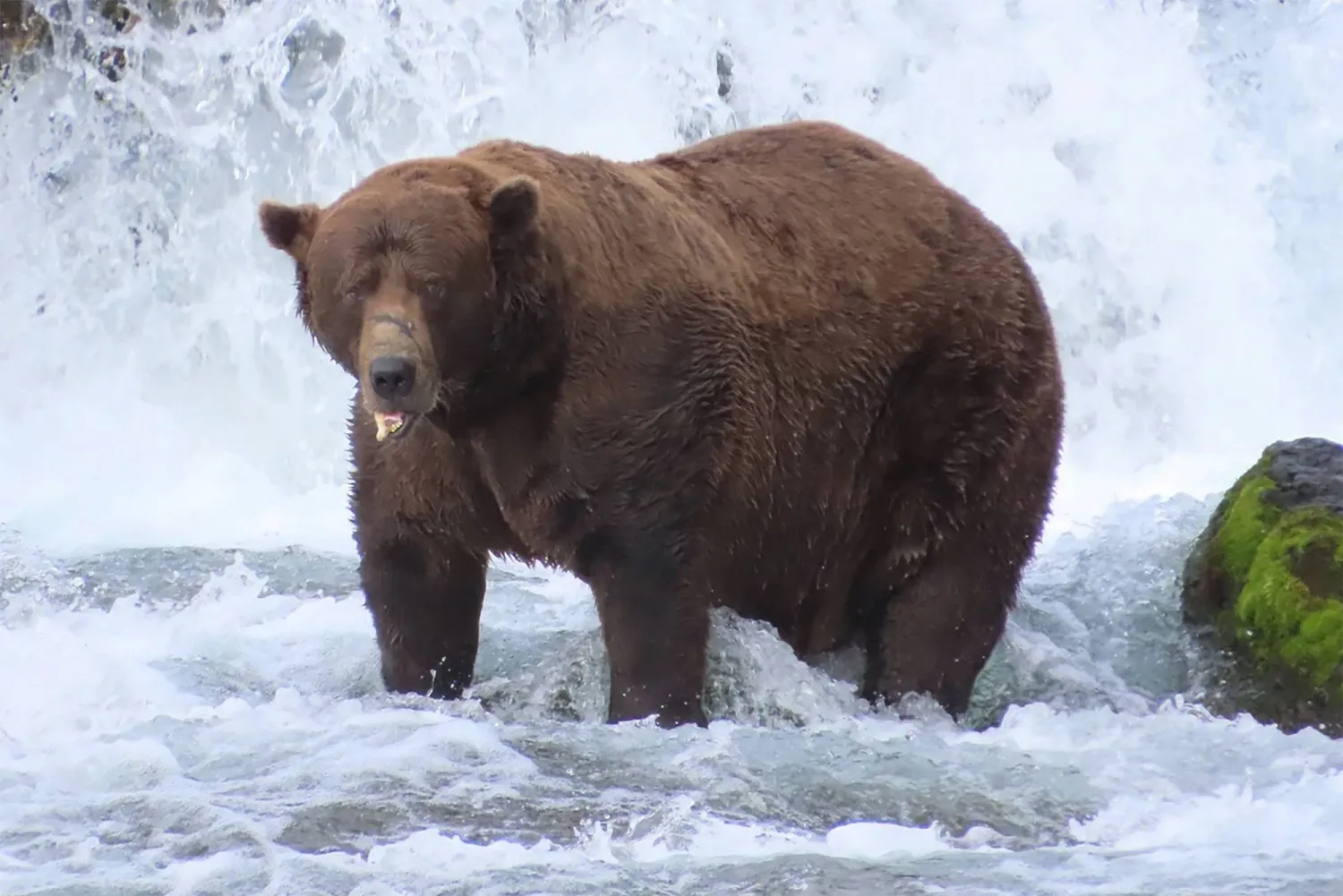

Fat Bear Week: Nepobaby Wins Alaska Contest

This handout photo from the National Park Service shows Chunk (Bear 32), the 2025 Fat Bear Week champion, a wild brown bear in Katmai National Park and Preserve in southwest Alaska. (Photo by T. CARMACK / NATIONAL PARK SERVICE / AFP)
TT

Fat Bear Week: Nepobaby Wins Alaska Contest

This handout photo from the National Park Service shows Chunk (Bear 32), the 2025 Fat Bear Week champion, a wild brown bear in Katmai National Park and Preserve in southwest Alaska. (Photo by T. CARMACK / NATIONAL PARK SERVICE / AFP)

The winner of this year's Fat Bear Week has been crowned after a nail-biting final -- and it's the son of a former champion.

Backpack, a 20-year-old male beloved by rangers in Alaska for his quiet determination, edged out female fellow finalist Dancing Queen in the annual ursine eating competition at Katmai National Park.

More than 2.3 million people voted in the week-long competition that sees bears unwittingly jostle in a series of head-to-head contests to decide which one of them has most impressively piled on the pounds ahead of hibernation.

Viewers watch a livestream of the enormous animals as they scoop salmon from the Brooks River, while visitors to a dedicated website can browse biographies of some of the top contenders, including before-and-after pictures showing how much weight the bears have gained over a summer of feasting.

Backpack's victory -- by a razor-thin margin of just 5,000 votes out of 200,000 cast for the final alone -- continues something of a family tradition: his mother Holly is a previous winner.

The animal, known officially by the more prosaic name Bear 89, was nicknamed Backpack by rangers who noted his habit of climbing on his mother's back when she swam across the river, AFP reported.

He previously suffered a leg injury that left him with a limp and has apparently adapted his lifestyle, preferring to spend his time lazing on a rock, rather than fighting with fellow bears.

"Unlike many large adult male bears, Backpack hasn't shown much aggression toward his competitors," his contestant profile says.

Sarah Bruce, a Katmai park ranger, told Alaska Public Media that Backpack now weighs around 1,200 pounds (544 kilograms) and is a clear fan favorite.

"He's one of the bears that we've been able to watch on the live cams since the live cams were put in in 2012," she said.

The bears of Katmai spend summer and early autumn gorging themselves on salmon as they look to bulk up ahead of a long winter of hibernation.

For five months, the creatures will not eat or drink, slowing all bodily functions as they shelter away from the harsh Alaskan weather.

While the increasingly popular annual competition is largely for fun, organizers say it is helpful in raising awareness of brown bears and their Alaskan habitats, as well as the risks they face from human activity.



Butterfly Wing Patterns May Trick Predators with Motion Illusions

A green-veined white butterfly perches on a cluster of purple lilac flowers, taken in Mareil-Marly, France, on April 22, 2019, in this photograph released on September 30, 2026. Helen Briolat/Handout via REUTERS
TT

Butterfly Wing Patterns May Trick Predators with Motion Illusions

A green-veined white butterfly perches on a cluster of purple lilac flowers, taken in Mareil-Marly, France, on April 22, 2019, in this photograph released on September 30, 2026. Helen Briolat/Handout via REUTERS

When a bird lunges at a butterfly in mid-flight, it may see something that is not there — the insect's wings flashing beneath may not be moving where they appear to be moving. By the time the predator realizes the illusion, the butterfly already may have escaped.

Researchers studying this natural defense have found that contrasting wing patterns can work together with wing movements to create misleading motion signals, making it harder for predators to judge a butterfly's speed and direction during flight.

"The patterns on butterfly wings combine with their wingbeats to create optical illusions, making it look like the butterfly is moving in a different direction to its actual course," said Jolyon Troscianko, a professor at the University of Exeter in England and a leader of the study published in the journal Nature. "This is likely enough to save a butterfly from the split-second moment when a bird would try to catch it."

The idea that stripes and other bold markings can create "motion dazzle" has long been ⁠proposed by scientists. ⁠But experiments involving animals including zebras, snakes and lizards have produced mixed evidence, and many studies did not account for the movements of wings or limbs.

A fritillary butterfly perches on red clover flowers, taken in Le Planay, Areches-Beaufort, France, on July 25, 2026, in this photograph released on September 30, 2026. Emmanuelle Briolat/Handout via REUTERS

"Butterfly wings are flexible surfaces that clap together and fling apart, and also pivot forwards and backwards in a figure-of-eight as they fly. This movement means that a stripe across the forewings can be visibly and slowly moving down on the down-stroke," Reuters quoted Troscianko as saying.

"But on the up-stroke, this stripe is rapidly folded away and twisted in line with upwards flight direction. Together these make the downwards motion of the butterfly much more visible than its upwards motion, even though it ⁠is flying up," Troscianko added.

To investigate the idea, the researchers combined high-speed filming of real butterflies, computer modelling, simulated evolution and touchscreen experiments.

"Stripes are particularly good at interfering with the circuits that detect motion," Troscianko said. "The barber pole illusion is a good example — stripes moving sideways can look like they're moving up or down instead."

The patterns also appear to increase uncertainty about a butterfly's position during an attack.

"This increased 'confusion' effect would be almost impossible to overcome without evolving a fundamentally different visual system," Troscianko said, suggesting it may have been pivotal to the success of the butterflies as a group.

Not all butterflies appear to use this strategy, however.

"The least motion-confusing butterflies are typically brown or red," Troscianko said, suggesting that some species may rely more on camouflage or on warning colors that may signal to predators that the insect is toxic, poisonous or has a bad taste.

To test whether the effects could influence attacks, the researchers recruited 100 human volunteers and ⁠carried out 3,000 virtual butterfly-catching ⁠experiments. Participants watched videos and attempted to catch butterflies by tapping a screen. Butterflies that were predicted to produce stronger visual confusion caused people to aim farther behind them.

"Predation experiments with live birds and butterflies would have been ideal in many ways, but likely impossible and unethical in practice," Troscianko said.

A European swallowtail butterfly rests on purple lilac in Mareil-Marly, France April 20, 2019, in this handout image released on September 30, 2026. Helen Briolat/Handout via REUTERS

Because the neural circuits involved in motion vision are quite fundamental in vertebrates, Troscianko said, the researchers hope the findings can translate between different species.

Butterflies face multiple predators, and motion confusion may not fool them all equally.

"For now, we've only looked at bird vision," Troscianko said. "In principle, similar effects could happen in predatory insects like dragonflies and robber flies. However, they have much faster vision than birds, so the illusions might not work for them. Indeed, dragonflies and robber flies do successfully hunt butterflies quite often."

Beyond biology, the team's motion-vision tools could have practical applications, from improving how movement is displayed in flight or combat simulators to developing patterning that protects personnel, vehicles, drones or robots in motion when being targeted visually.

"I'm most excited to explore how useful our models could be for improving road safety and reducing discomfort and stress in the built environment, where flashing, moving and striped objects can cause harm or danger," Troscianko said.


Japan Tightens Rules for Foreigners Wanting Permanent Residency

Foreign residents wishing to stay in Japan permanently will have to prove their annual income is above average. Andrew CABALLERO-REYNOLDS / AFP
TT

Japan Tightens Rules for Foreigners Wanting Permanent Residency

Foreign residents wishing to stay in Japan permanently will have to prove their annual income is above average. Andrew CABALLERO-REYNOLDS / AFP

Japan toughened on Thursday requirements for foreigners wanting to obtain permanent residency, as part of Prime Minister Sanae Takaichi's push to tighten immigration controls.

Under new rules that will come into effect in stages, foreign residents wishing to stay in Japan permanently will have to prove their annual income is above average and they can carry casual conversations in Japanese.

Application fees will also rise 20-fold from Thursday and at one immigration office in central Tokyo visited by AFP this week hundreds of people queued, hoping to wrap up procedures before the price spike.

"I understand that over-accepting foreigners... might dilute Japan's unique culture. But at the same time, given its low birth rate and aging population, Japan has to accept foreigners," said American-born university student Yujie Chono, who was among those waiting.

The 22-year-old told AFP, in fluent Japanese, that he had been waiting for five hours to file his paperwork.

Previous guidelines did not lay out specific thresholds for income, pension or language skills.

Even though Japan has a rapidly ageing population and is suffering labor shortages in many sectors, opposition to immigration is growing, prompting a push by Takaichi for tighter regulations on foreign nationals.

"As the number of foreign residents in Japan increases, the government is facing the fact that some citizens feel anxiety and a sense of unfairness," Takaichi said in an extended post on X on Sunday, adding that she was pushing for "orderly coexistence" with foreign nationals.

Programs to attract international workers have fueled public worry.

Anti-immigration sentiment has spread across social media and false claims have circulated widely, including that a significant portion of welfare payments in Japan go to foreigners and that they are making Japanese streets less safe.

Experts and many business leaders warn however that Japan must welcome more foreign workers to sustain itself.

Japan needs to open its doors to more foreigners, the Nikkei business daily said in a recent editorial.

"Japan should stop viewing foreigners merely as a temporary labor force and instead promote their long-term settlement by expanding Japanese-language education and improving their treatment," it said.

- Anti-immigration sentiment -

Foreigners were a major issue in last year's upper house election which saw the sharp rise of the "Japanese-first" Sanseito party, which describes immigration as a "silent invasion".

The new rules for permanent residency come after the ruling Liberal Democratic Party last year pushed to tighten regulations for business manager visas, meaning entrepreneurs will be forced to leave Japan if they don't meet the new conditions.

Some foreign residents seek permanent residency to secure long-term stability, employment freedom and to earn trust within Japanese society. Those without permanent residency often have a difficult time seeking mortgages, for example.

Thursday's changes may prevent some people from applying for permanent residency but should not immediately push anyone out of the country.

Under the regulations, the application fee for permanent residency will soar to 200,000 yen ($1,275) from the current 10,000 yen.

Candidates must also show "understanding" of social rules and demonstrate expected pension benefits equivalent to someone who has paid pension insurance for 30 years.

Having lived in Japan for a decade, permanent residency applicant Chono said he saw both sides of the debate but that the country needed young people "to support its future".

"In recent years, I believe there had been a strong push to promote cultural diversity. The momentum has stalled, perhaps, and maybe it may never fully return," he said.


Shark Stranded in South Korean Canal Draws 600,000 Visitors as Rescue Bid Fails

People take pictures of a shark that has been trapped in a canal since September 18 in Busan, South Korea, September 20, 2026. Yonhap via REUTERS 
TT

Shark Stranded in South Korean Canal Draws 600,000 Visitors as Rescue Bid Fails

People take pictures of a shark that has been trapped in a canal since September 18 in Busan, South Korea, September 20, 2026. Yonhap via REUTERS 

A shark stranded in a canal in the South Korean port of Busan has become the country's latest wildlife sensation, with the city saying about 600,000 ‌people have flocked to see it over the past two weeks.

The 3.5-meter shark was first spotted in a narrow waterway in North Port on September 18, according to Reuters.

As the days passed without the shark finding its way back to the ocean, authorities launched a rescue operation on Tuesday to guide it out, ⁠but the effort failed.

The Coast Guard and other agencies deployed vessels to spray jets of water behind the shark to gently propel it toward the open ocean, but it swam away from the streams, according to videos published by Yonhap News Television.

Officials now plan to use a net to try to guide the shark out of the canal on Friday, the Chosun Daily reported.

The shark, reported to be a bronze whaler, has become something of a celebrity in South ‌Korea ⁠and has been dubbed “Bukangi,” a nickname derived from “Buk Hang,” the Korean name for Busan’s North Port, and the Korean suffix “-i.”

During the four-day Chuseok holiday last weekend, about 480,000 people visited the waterfront park where the shark was stranded, compared with the park's usual daily average ⁠of around 2,000 visitors on weekends, according to a Busan city statement and media reports.

On Tuesday, Busan declared the shark an honorary public relations ambassador for the city after ⁠a poll on the city’s official Instagram account received 91% approval from about 8,000 participants.

Other animal escapades have gripped South Korea in the past.

Earlier this year, ⁠a wolf that escaped from its enclosure at a South Korean zoo spawned a cryptocurrency meme coin and even prompted a message of concern from the country's president.