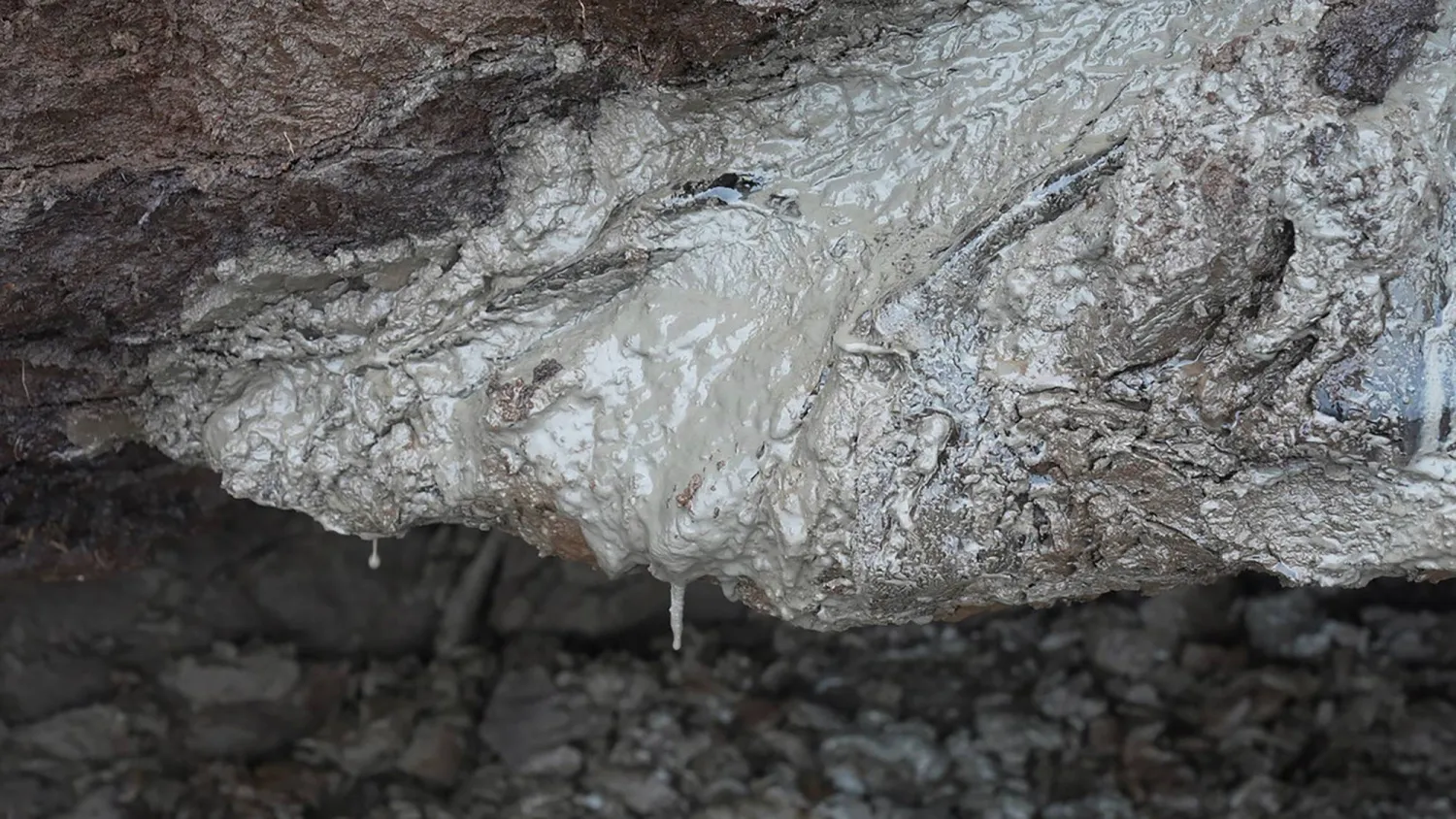
Heat-trapping Gas Once Frozen in Arctic Ground is Slowly Leaking, Warming the Planet

FILE - Permafrost melts on the coast in Newtok, Alaska, Aug. 16, 2024. (AP Photo/Rick Bowmer, File)
TT

Heat-trapping Gas Once Frozen in Arctic Ground is Slowly Leaking, Warming the Planet

FILE - Permafrost melts on the coast in Newtok, Alaska, Aug. 16, 2024. (AP Photo/Rick Bowmer, File)

As Ted Schuur stepped along the edges of Smith Lake, a bubble surfaced from the muck underfoot. And then another.

They're bubbles of methane, a potent heat-trapping gas made from decomposing plants and animals that had once been stuck in Alaska's frigid permafrost. But that frozen ground is thawing because the Arctic is warming four times faster than the rest of the globe. For thousands of years that frozen ground stored dead plants and animals, but the accelerating thaw is allowing them to decay into methane and carbon dioxide.

“Once you start leaking this carbon out, there’s so much in the ground that it’s not going to shut off,” said Schuur, an ecologist at Northern Arizona University, calling it one of climate change's scary tipping points. “Essentially every year is setting a permafrost record.”

There’s three times as much carbon still frozen in permafrost than what’s now in the air, but all over the Arctic those heat-trapping gases are escaping into the atmosphere. Their release adds to what's already in the air from humanity's burning coal, oil and natural gas, changing the delicate balance of how a warming world deals with the buildup of heat-trapping carbon, Schuur said.

Permafrost is ground that stays frozen — below 32 degrees Fahrenheit (zero degrees Celsius) — for at least two years and often for centuries and even millennia. That frozen ground — found in Alaska, Canada, Siberia, Antarctica and high mountain elevations elsewhere — has special advantages, trapping decaying matter, keeping it from turning into greenhouse gases and just being firm enough for communities and industries to build their lives upon.

But warming is undercutting that, The Associated Press reported.

Two different studies project that by the end of this century, those previously trapped gases in permafrost will add nearly half a degree of warming (about a quarter degree Celsius) in addition to warming from the burning of fossil fuels. Over that time period, that'll warm the Earth about as much as a major industrialized country like the United States or the whole of Europe, scientists said.

A sleeping giant awakens “The permafrost system is really like a sleeping giant,” said Gustaf Hugelius, a permafrost expert at Stockholm University.

For thousands of years, when the climate was somewhat stable, the Arctic helped Earth's delicate carbon cycle by acting as a sink. That means plants in the cold areas used to pull some heat-trapping gas out of the air and capture it in the frozen ground, with the Arctic essentially withdrawing more carbon from the air than it added, benefiting the entire globe.

A few years ago, warming caused that balance to shift so that once-frozen ground is venting more heat-trapping gases than it takes in. Instead of reducing climate change, the Arctic is now adding to the problem, said Columbia University ecologist Duncan Menge.

Permafrost thaw, along with other “warming-induced emissions” from fires and changes to wetlands and lakes, are likely to increase warming by 20% by the end of the century, according to a September study co-authored by Arctic ecologist Sue Natali of the Woodwell Climate Research Center.

It may be a small amount, not worthy of scenarios of doom, but it’s something “that we’re going to have to deal with” on top of everything else, said University of Victoria climate scientist Andrew Weaver, who first calculated the half-a-degree of expected permafrost warming in a 2012 study.

What’s troublesome is that when politicians and scientists talk about future warming, they’re usually not accounting for the extra greenhouse gases from permafrost thawing, said Natali and Hugelius. So while the UN says without policy changes the world will warm 2.6 degrees C (4.7 degrees F) above pre-industrial times by the end of the century, it leaves out a few tenths of a degree from thawing permafrost, they said.

Thawing permafrost is not just messing with the planet's carbon balance, it's destabilizing the very land underfoot, making once-rigid ground collapse and sink, Natali said.

Frozen ground that's no longer firm became deadly this summer. Flooding in Nepal killed more than 1,000 people after part of a glacier collapsed, which happened after a heat wave that set records for the location and time of year, according to Berkeley Earth climate scientist Robert Rohde.

Ground that’s solidly frozen holds up mountains and skyscrapers, but once the permafrost thaws, it’s no longer strong enough. That was likely one of several still-to-be-determined factors in the Nepal disaster, said George Washington University permafrost scientist Dmitry Streletskiy, lead author of an August study that found significant permafrost thawing in most of the Northern Hemisphere.

Permafrost in Alaska and other Arctic areas has long supported homes, roads and pipelines, but it’s no longer so reliable. For example, in Galbraith on Alaska’s North Slope, a recently formed 10-foot (3-meter) deep, craterlike hole was visible during a recent foray by scientists.

These holes, known as slumps, occur when ice melts and the land collapses, releasing methane, Natali said. A Woodwell team has identified more than 40,000 of these slumps across the Arctic using satellites, according to scientist Kyle Arndt.

University of Alaska Fairbanks geophysicist Vladimir Romanovsky said when he first started studying permafrost in the 1970s, “everybody believed permafrost was very stable. People thought it was forever.”

Not anymore, he said.

“It took some thousands and tens of thousands of years to sequester this carbon into permafrost,” Romanovsky said. “You need a new ice age to put back this ice into the ground.”

A time capsule to the last ice age is visible under a Fairbanks hill where the US Army drilled a massive permafrost research tunnel. Artificially cooled and used for training, the tunnel's icy walls are dotted with bones of bison and mammoths, producing a sewage-like odor that vividly illustrates where the Arctic methane comes from.

“Every time I go there, I'm reminded of the magnitude of the problem. You smell it. You see it. You feel it all around you,” Natali said. “You see how deep the ice is and just how the carbon is buried and then when you go on top and you see these large thaw features. ... This isn't a problem of 100 years from now. This is a problem of right now.”


Egypt Plans Archaeological Exhibitions in Several Chinese Cities

A view of the previous Egyptian antiquities exhibition in Hong Kong (Ministry of Tourism and Antiquities)
TT

Egypt Plans Archaeological Exhibitions in Several Chinese Cities

A view of the previous Egyptian antiquities exhibition in Hong Kong (Ministry of Tourism and Antiquities)

Egypt is seeking to organize temporary archaeological exhibitions in several Chinese cities as part of efforts to strengthen cooperation with China in antiquities protection and heritage preservation. The discussions also included a proposed twinning agreement between the Giza Pyramids and the Great Wall of China, two of the world's most prominent historic landmarks.

The plans were discussed during the 11th Chinese Exposition of Museums and Relevant Products and Technologies, attended by Egyptian Minister of Tourism and Antiquities Sherif Fathy.

Fathy held a series of meetings with officials from Chinese museums and cultural and heritage institutions, including Dr. Louis Ng, director of the Hong Kong Palace Museum, representatives of the Great Wall administration in Yanqing, Beijing's Capital Museum and the director of a cultural heritage bureau.

According to a ministry statement issued Monday, the meetings focused on expanding cooperation in archaeology and museum management, organizing temporary exhibitions, exchanging expertise in managing heritage sites and improving museum display techniques.

The discussions explored ways to strengthen cooperation between Egypt's Ministry of Tourism and Antiquities, represented by the Supreme Council of Antiquities, and Chinese museums and cultural institutions through temporary exhibitions of Egyptian antiquities in various Chinese cities.

The proposed exhibitions would build on the success of "Ancient Egypt Unveiled: Treasures from Egyptian Museums," hosted by the Hong Kong Palace Museum from November 2025 to August 2026. The exhibition attracted significant public interest and helped promote cultural exchange and awareness of ancient Egyptian civilization.

Fathy emphasized the importance of such exhibitions as effective tools for promoting Egypt's tourism and cultural heritage, particularly in China, which he described as a promising tourism market given the growing interest in cultural tourism among Chinese travelers, especially younger generations.

He said archaeological exhibitions offer visitors an opportunity to explore the richness and history of Egyptian civilization while providing a glimpse of the archaeological treasures they could discover during a visit to Egypt, helping attract more tourists to the country.

In the field of cultural heritage protection, the meetings also addressed a proposal to sign a twinning agreement between the Giza Pyramids and the Great Wall of China, both UNESCO World Heritage Sites.

The proposed agreement would open new opportunities to exchange expertise and best practices in protecting and managing the sites while preserving their historical and cultural significance for future generations.

Both sides also stressed the importance of strengthening cooperation in underwater archaeology. Fathy reviewed several recent discoveries in the field and referred to an agreement signed with China last year that provides opportunities for scientific and technical cooperation and the exchange of expertise.

The "Ancient Egypt Unveiled: Treasures from Egyptian Museums" exhibition at the Hong Kong Palace Museum attracted more than 600,000 visitors between November 18, 2025, and August 31, 2026.

The exhibition featured 250 artifacts from Egyptian museums and archaeological sites, taking visitors on a journey through the history of ancient Egyptian civilization.

Dr. Dina Soliman, a specialist in Egyptian and ancient Near Eastern archaeology at the Faculty of Archaeology and Tourist Guidance at Misr University for Science and Technology, said organizing exhibitions of Egyptian antiquities in Chinese cities represents an important step toward strengthening Egypt's cultural and civilizational presence internationally, particularly in a country with growing interest in history and human civilizations.

She told Asharq Al-Awsat that archaeological exhibitions are no longer simply a means of displaying artifacts outside their country of origin. They have become an important instrument of cultural diplomacy, helping build bridges between peoples.

Soliman said the initiative takes on particular significance following the success of the Egyptian antiquities exhibition in Hong Kong, which demonstrated strong Chinese interest in Egyptian civilization and created opportunities to expand the experience to other cities and reach new audiences.

She explained that displaying Egyptian artifacts in different museum settings allows visitors to explore various aspects of religious, social, artistic and political life in ancient Egypt while deepening their appreciation of the artifacts' historical and cultural value.

Soliman stressed that the cooperation should be viewed as a comprehensive cultural and scientific initiative extending beyond exhibitions to include the exchange of expertise in restoration, documentation, museum management and exhibition design, as well as the use of modern technologies and artificial intelligence to present heritage in more interactive and engaging ways.

She said museums today are no longer merely institutions that preserve collections but have become centers of knowledge and education that help introduce history to younger generations through contemporary approaches.

Soliman also emphasized the significance of the proposed twinning agreement between the Giza Pyramids and the Great Wall of China, describing the two sites as among humanity's most important historical landmarks, both recognized on UNESCO's World Heritage List.

She said the initiative's real value lies in its potential to establish a practical framework for exchanging expertise and addressing the challenges facing major archaeological sites.


Egypt Celebrates Scientist Behind 12 Drugs for Cancer, Depression and Other Diseases

Egyptian scientist Dr. Magid Abou-Gharbia (Temple University)
TT

Egypt Celebrates Scientist Behind 12 Drugs for Cancer, Depression and Other Diseases

Egyptian scientist Dr. Magid Abou-Gharbia (Temple University)

The Egyptian Cabinet has celebrated Egyptian scientist Dr. Magid Abou-Gharbia for winning the 2026 John Scott Award in the United States, recognizing his significant contributions to drug discovery and development, particularly treatments for cancer, depression and chronic pain.

In a statement posted on its Facebook page, the Cabinet said Abou-Gharbia holds more than 145 US patents and has helped develop nearly a dozen new drugs marketed to treat various conditions, including cancer, infectious diseases, neurological disorders, women's health conditions, bone diseases and chronic pain. He has also led multidisciplinary research teams at international scientific and pharmaceutical institutions.

The Cabinet said the John Scott Award is one of the oldest scientific honors in the United States, recognizing discoveries and innovations that benefit humanity. Abou-Gharbia was among three scientists selected for the 2026 award and received the honor at a ceremony on October 27, along with a $10,000 cash prize, in recognition of his decades of pharmaceutical research.

In a statement published on November 3, 2026, Temple University said Abou-Gharbia, Laura H. Carnell Professor and founding director of the Moulder Center for Drug Discovery Research at its School of Pharmacy, received the award for his pioneering innovations in drug discovery and development.

The university said his research has contributed to the development of nearly a dozen new medicines for a range of conditions, including cancer, infectious diseases, neurological disorders, women's health conditions, bone diseases and chronic pain.

According to the university, Abou-Gharbia was preparing to travel to Egypt to deliver a lecture when he received an unexpected email from the chair of the award's selection committee informing him that he had won. He expressed surprise, happiness and pride at the recognition.

Abou-Gharbia said he had been passionate about chemistry since childhood and viewed the award as recognition not only of his own achievements but also of the talented research teams and collaborators he had worked with over the years.

The university said Abou-Gharbia is the fifth Temple faculty member to receive the award, following Michael Klein in 2020, Masatoshi Nei in 2017, John Perdew in 2015 and Franklin Davis in 2006.

Abou-Gharbia began his career as a research scientist at Wyeth Pharmaceuticals, which was later acquired by Pfizer. He rose through the ranks to become senior vice president of drug discovery, leading research teams comprising more than 500 scientists.

Among the notable drugs he helped develop are Effexor and Pristiq, both used to treat depression; Dezocine, a painkiller; and Torisel, a treatment for kidney cancer.

Research teams under his leadership also helped develop Mylotarg, a drug introduced in 2000 that targets cancer cells while limiting the exposure of other cells to toxic substances. The treatment remains in use in chemotherapy.

The university said Abou-Gharbia returned to academia in 2008 and played a leading role in establishing the Moulder Center for Drug Discovery Research, serving as its founding director until 2020. The center was established to bring together education, scientific research and the pharmaceutical industry, helping translate laboratory discoveries into treatments for patients.

During his tenure, the center secured more than $30 million in research grants and external funding. Its research resulted in 15 US patents and the establishment of four spin-off companies.

Abou-Gharbia also served as associate dean for research at Temple University's School of Pharmacy from 2008 to 2019. He received the university's Outstanding Service Award in 2022 and was inducted into the American Chemical Society Medicinal Chemistry Hall of Fame and the New Jersey Inventors Hall of Fame.

After more than 55 years in medicinal chemistry, Abou-Gharbia continues to research and design drugs targeting alcohol and opioid addiction. He has also expressed enthusiasm for working with younger generations of researchers and students, whom he regards as the future leaders of the field.

In a report published on November 5, 2026, the American Chemical Society's Chemical & Engineering News magazine said the Board of Directors of City Trusts of Philadelphia honored the three award recipients for their contributions to the comfort, welfare and happiness of humanity.

The other recipients were Nina Jablonski of Pennsylvania State University, recognized for research that transformed the understanding of race, and Daniel Skovronsky of Eli Lilly and Company, who pioneered a first-of-its-kind diagnostic tool for Alzheimer's disease.

The magazine said the three scientists join a distinguished list of previous recipients, including Marie Curie, Thomas Edison, Irving Langmuir, who served as president of the American Chemical Society in 1929, and Glenn T. Seaborg, who led the society in 1976.


Handwritten Draft of MLK’s ‘I Have a Dream’ Speech to Go on Display Before It’s Sold at Auction

The Rev. Dr. Martin Luther King Jr., head of the Southern Christian Leadership Conference, speaks to thousands during his "I Have a Dream" speech in front of the Lincoln Memorial for the March on Washington for Jobs and Freedom, Aug. 28, 1963, in Washington. (AP)
TT

Handwritten Draft of MLK’s ‘I Have a Dream’ Speech to Go on Display Before It’s Sold at Auction

The Rev. Dr. Martin Luther King Jr., head of the Southern Christian Leadership Conference, speaks to thousands during his "I Have a Dream" speech in front of the Lincoln Memorial for the March on Washington for Jobs and Freedom, Aug. 28, 1963, in Washington. (AP)

Words scrawled in blue pen — and others scratched out — give an intimate peek into the writing of what would become the Rev. Martin Luther King Jr.'s most famous speech.

Delivered Aug. 28, 1963, from the steps of the Lincoln Memorial, the “I Have a Dream” speech reflects on the shameful legacy of slavery, segregation and discrimination and looks forward with hope to future equality for the country's Black citizens. A handwritten draft of that speech goes on display in King's hometown Monday before it is sold to the highest bidder at auction in January.

The words that became most famous do not appear in the seven pages from a pad of yellow, lined paper. The “I have a dream” refrain was added by King on the spot as he stood before a crowd of tens of thousands of people gathered on the National Mall for the March on Washington.

But other key parts of the speech are there in the civil rights icon's own handwriting, including the opening lines and the powerful finish invoking an African American spiritual.

King completed the handwritten draft in his hotel room in the wee hours of the morning, less than 12 hours before it was delivered, according to Christie's, which will handle the sale of the manuscript. It was then given to assistants to be typed and sent to the media, the auction house said in a news release.

Speechwriter Edward Clayton was among the multiple advisers who helped King hash out the content of the speech. His wife, Xernona Clayton, who worked alongside him in the civil rights movement, discovered the draft in the late 1990s, three decades after her husband's death. It was in a drawer of his desk, tucked inside an envelope labeled “speech.”

“The two of them gelled with writing and words,” Xernona Clayton said in the Christie's news release. “They would go back and forth and there was such respect. Dr. King, who was a great thinker, said Ed was so good at getting his words on paper and putting them in the right place at the right time.”

Clayton knew the document was important but didn't realize it was the only remaining handwritten draft and stuck it back in the drawer, finding it there again just two years ago.

Clayton, who established the Still Marching Irrevocable Charitable Unitrust to advance causes important to her, decided after consultation with trusted advisers to sell the draft to support charities that advance her own legacy and that of King. Christie's expects the draft to fetch more than $10 million. The organizations that will benefit include the Xernona Clayton Foundation and the King Center in Atlanta.

“I am so grateful for the opportunity to give this amazing speech new life, and to give new life to people who are in need,” Clayton said. “And we cannot wait to give that first gift.”

King's two remaining living children, the Rev. Bernice King and Martin Luther King III, said in the Christie's release that they are grateful the sale will support the legacy of the movement their father helped build.

“It is poetic that the past will protect the future,” Martin Luther King III said. “We are grateful that this treasure was preserved over decades by the Clayton family. It is a remarkable piece of history that shines a light on our father’s process as he prepared to make a speech that so profoundly affected the course of the Civil Rights movement and our nation. Now, for the first time, the public will have the opportunity to be inspired by this document.”

The draft will be publicly displayed for the first time at the National Center for Civil and Human Rights in Atlanta from Monday through Sunday. It will be on view in Chicago at a date to be determined and will be shown at Christie's in New York from Jan. 15, King's birthday, through Jan. 21 before being offered for auction on Jan. 22.