Return of Swarming Moth Spectacle Has Australia in a Flutter

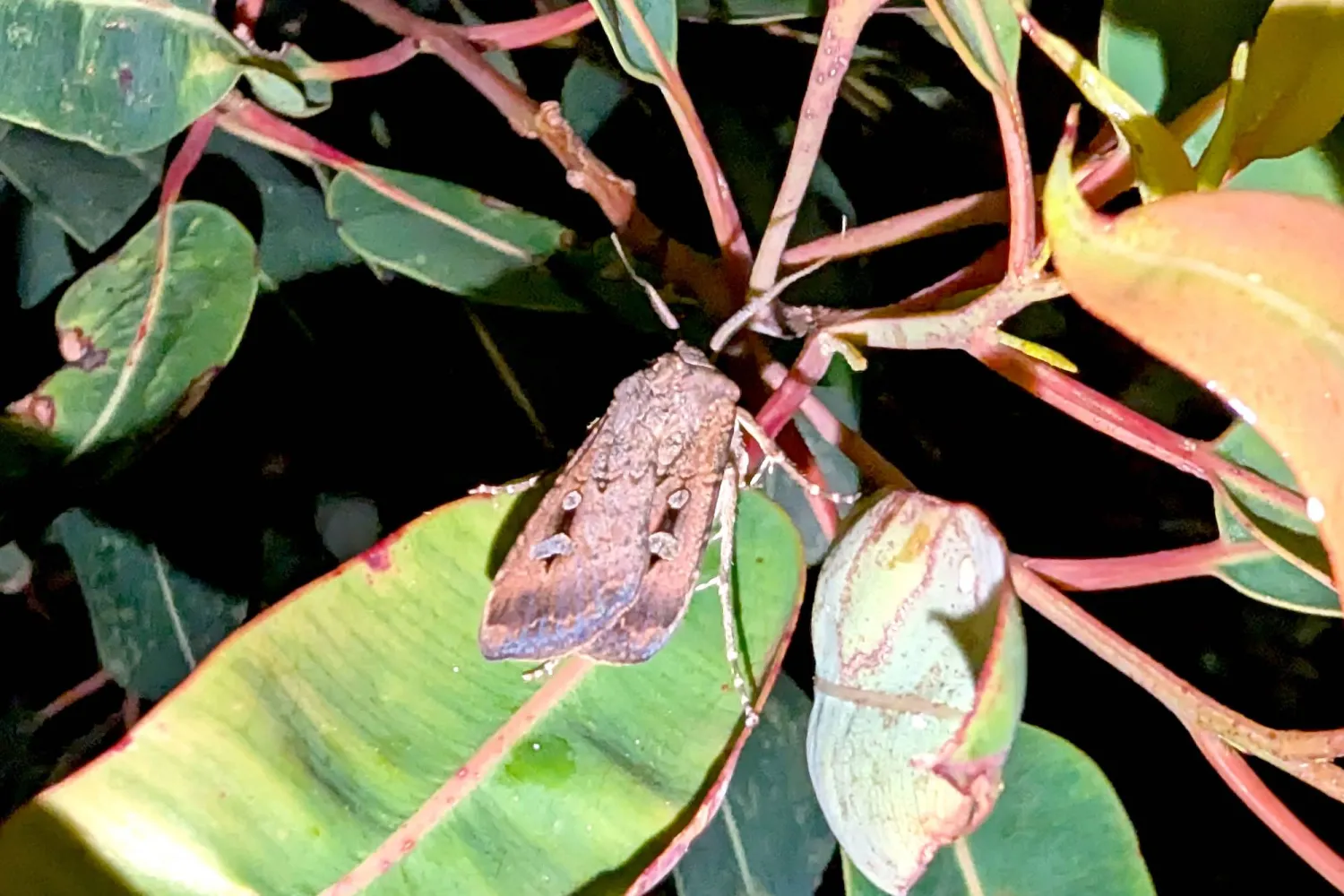
This picture taken on October 1, 2026 shows a Bogong moth among the leaves of a tree in Sydney. (Photo by David WILLIAMS / AFP)
TT

Return of Swarming Moth Spectacle Has Australia in a Flutter

This picture taken on October 1, 2026 shows a Bogong moth among the leaves of a tree in Sydney. (Photo by David WILLIAMS / AFP)

Moth swarms so thick they can blot out the stars are fluttering across Australia, heralding a migratory spectacle unseen since the creature's brush with extinction nearly 10 years ago.

The great migration of the Bogong moth was once a yearly feature of the Australian spring, the insects humming down the nation's east coast in their billions as they searched for cooler climes.

But drought, pesticides and habitat destruction triggered an unprecedented collapse that began in 2017, eventually wiping out an estimated 99.5 percent of the Bogong moth population.

While vast clouds of flying bugs might not be everyone's cup of tea, scientists have been delighted to find that the Bogongs are back.

"There have been happy tears in my office because this is what nature should be," said conservation biologist Marissa Parrott.

"People are noticing those big swarms again. They can celebrate what I think is one of nature's great spectacles."

In a good year, four billion moths or more would escape the inland heat to seek shelter in the alpine caves of eastern Australia.

"So many Bogong moths would come through that they could block out the stars and the moon as they went overhead," said Parrott, from Zoos Victoria.

Photos showed how the endangered moths clustered together so densely inside their caves, it was impossible to see the rock beneath.

"They get up into the mountains and into these caves, where they make this beautiful tiling pattern," said Western Sydney University insect researcher Eleanor Drinkwater.

"They cover the walls in this very dense mat of moths.

"They hang out there until the weather starts getting cooler, and they come back down to their breeding grounds."

Their migration has long fascinated scientists, who have puzzled over how they found their way on a journey they only ever make once.

By placing a tether around captive moths and projecting stars on the wall, researchers last year showed how Bogongs used the Milky Way.

They were the first invertebrates -- a broad group of animals including spiders, snails and worms -- shown to use celestial navigation for such long trips.

Bogong moths are thought to help plants spread pollen and are also a key food source for the mountain pygmy possum, a critically endangered cave-dwelling marsupial.

"They are very, very important to Australian ecosystems," Drinkwater said.

Drawn towards the blazing stadium floodlights, Bogong swarms caused havoc at the 2000 Olympic Games in Sydney.

Forecasters warned that heavy rain was about to drench the event's closing ceremony -- only to realize the radar had picked up a cloud of Bogongs, AFP reported.

While the Bogong migration continued in the years following the population crash, scientists were aghast at how few moths were making the journey.

"People described going into the caves and finding barely any moths, and just kind of being in shock," Drinkwater said.

Researchers are still working to better understand what contributed to the Bogong bounce-back, but believe a spate of wetter weather has helped.

With a severe El Nino forecast to send temperatures soaring over summer, scientists hope the rebound is not short lived.

"It's great they're back, and we're really excited they're back," said Drinkwater.


UK Endures Second Big Storm of the Weekend, with the North Bearing the Brunt This Time

People walk through heavy rain in Liverpool, Britain, 24 October 2026. (EPA)
TT

UK Endures Second Big Storm of the Weekend, with the North Bearing the Brunt This Time

People walk through heavy rain in Liverpool, Britain, 24 October 2026. (EPA)

The second of two storms to hit the UK this weekend brought widespread travel disruptions and power outages to Scotland, Northern Ireland and northern England on Sunday.

The Met Office, the UK's national forecaster, said Storm Boelo will bring a danger to life from flying debris and crashing waves and people should stay indoors as much as possible.

Gusts above 80 mph (128 kph) have already been recorded in Scotland, including on the island of Tiree in the Inner Hebrides. Energy company SSEN had reported a total of 93 unplanned power cuts in Scotland by 10 a.m.

An amber wind warning, the Met Office’s second most severe, is active across Scotland and the north of England until late Sunday. Flood warnings are also in place, while airports, ferries, railways and roads have seen disruptions.

Boelo, pronounced “Boo-Loh”, has followed hard on the heels of Storm Austen, which battered southern England on Friday. The National Grid, which distributes electricity around the UK, said power had been restored to more than 130,000 properties impacted by Austen by 7 p.m. on Saturday.

The Met Office began naming major storms in 2015 as a way to keep the public informed about severe weather. Storms are named in alphabetical order throughout the season, from September to August.


Ensnared Female Orangutan and Her Baby Rescued in Indonesia

A 20-year-old orangutan tries to escape as members of the BKSDA (Natural Resources Conservation Agency), the Borneo Orangutan Survival Foundation (BOSF) and the World Wide Fund for Nature (WWF) Indonesia evacuate it due to forest and land fire, in Hampangen Village, Katingan Regency, Central Kalimantan, on October 17, 2026. (AFP)
TT

Ensnared Female Orangutan and Her Baby Rescued in Indonesia

A 20-year-old orangutan tries to escape as members of the BKSDA (Natural Resources Conservation Agency), the Borneo Orangutan Survival Foundation (BOSF) and the World Wide Fund for Nature (WWF) Indonesia evacuate it due to forest and land fire, in Hampangen Village, Katingan Regency, Central Kalimantan, on October 17, 2026. (AFP)

Indonesian conservation workers rescued an orangutan ensnared in rope and her baby on the island of Borneo where the critically endangered animals are at risk from boar traps and wildfires, an official said Sunday.

The female orangutan named Gadis, about 25 years old, and her son Garis, 10 months, were found snared in a suspected trap early Friday near a village in Central Kalimantan province on the Indonesian part of Borneo.

"Gadis was found with the ropes tied to her upper right arm and lower left arms, and the wounds were bad because the ropes had torn deep into her flesh," local conservation official Muriansyah told AFP by telephone on Sunday.

"It looked like the ropes were set up as a wild boar snare trap," added Muriansyah, who like many Indonesians has one name.

Both were receiving treatment at the Orangutan Foundation International clinic near the village of Pangkalan Bun.

Wild boar hunting using rope snares is legal and common in parts of Indonesia as a pest control measure to protect crops, but illegal inside protected forests or national parks.

Officials have repeatedly cautioned that careless placement of snares near wildlife areas could instead trap endangered sun bears or orangutans.

Dozens of orangutans have also been rescued in recent weeks from rampant wildfires burning across Indonesia that have cloaked the Southeast Asian region in a toxic haze.

Two more were released in Ketapang, West Kalimantan on Saturday after being rescued from an oil palm plantation.

Orangutans are critically endangered and only about 120,000 remain in the wild in Borneo and Sumatra -- about half the number from a century ago, according to conservation group WWF.

Last month, the International Union for Conservation of Nature said fires were burning in habitats containing 52 percent of Borneo's orangutan population.


Cracking a Smile Regularly May be Good Not Just for Your Mood but for Your Health

FILE - A fan attends the performance by American singer Jon Batiste at the Rock in Rio music festival in Rio de Janeiro, Sept. 7, 2026. (AP Photo/Bruna Prado, File)
TT

Cracking a Smile Regularly May be Good Not Just for Your Mood but for Your Health

FILE - A fan attends the performance by American singer Jon Batiste at the Rock in Rio music festival in Rio de Janeiro, Sept. 7, 2026. (AP Photo/Bruna Prado, File)

Reminding yourself to smile often cannot only make more friendships but it can also make you feel better.

And rather than wait for a reason to smile, just making the physical change of literally turning that frown upside down could impact emotions, according to experts.

Research backs up the fact that smiling goes a long way.

Some older research has focused on this “facial feedback hypothesis,” according to Jeanne Tsai, a longtime psychology professor at Stanford University who runs the Culture and Emotion Lab. In one classic study in the late 1980s, researchers would have subjects put a pencil between their lips and adopt a smile or a frown while viewing a positive movie clip like a cartoon. Some subjects who smiled would feel the sensation of the smile more and be more amused.

“When we’ve done that demonstration in classes, it works,” Tsai said. “When you’re doing it in a room by yourself, you’re not doing it in a social interaction, maybe it’s making you remember, or it’s an effect of remembering some good thing that happened and that would put you in a better mood.”

At the Orange County Academy of Sciences and Arts in Southern California, the power of a smile is taken very seriously. An entire section on the charter school group’s website is dedicated to its philosophy that a smile can make a difference.

“Smiling creates a supportive classroom culture that makes students relaxed, active, and motivated,” according to the website. “It increases emotional well-being, lowers stress, and gives students confidence.”

How smiling can benefit health Dr. Judy Ho, a Los Angeles clinical and forensic neuropsychologist who also teaches at Pepperdine University, discusses smiling as a coping strategy with some patients suffering depression or anxiety.

“I'm not suggesting that that's the only way they can fix things,” Ho said. “It's just like another thing that you can add to your toolbox.”

Smiling can affect one's level of cortisol, a hormone the body releases partly to help regulate stress and mood, according to Ho. Smiling can affect brain chemicals that are associated with positive feelings including endorphins, dopamine and serotonin.

“People who smile during stressful tasks generally demonstrated lower heart rates during recovery than those maintaining neutral expressions,” Ho said. “Smiling also reduced aspects of the body's physiological stress response.”

The hope is if you smile enough, you will start feeling it emotionally.

“In some ways it's like a mediating effect,” she added.

The value of a smile varies culture to culture How smiling and even the openness of a smile are perceived are not universal. Tsai, the Stanford professor, has conducted research on how emotion in American culture puts value on trying to always feel positive and minimizing negativity and sadness. In East Asian cultures, emotion is more about balance.

“It’s like the positive and the negative emotions are braided together, and so you don’t want to feel too positive or too negative,” Tsai said. “You want more of a balance between the two.”

Her past studies also examined how European Americans and East Asians — including Taiwanese, South Koreans, Japanese and Hong Kong Chinese — look at a “neutral or a calm” smile versus a full-on grin. Subjects rated the differing facial expressions on warmth and trustworthiness. While some Americans saw the excited smiles as friendlier, some East Asians characterized those facial expressions as “emotionally unstable” or “unreliable."

“What kind of smile matters — whether it’s a calm, closed mouth smile more like the Dalai Lama or a big toothy excited smile like Julia Roberts,” Tsai said. “We’ve done some series of studies in Taiwan and other East Asian contexts. They don’t like the big, toothy, excited smile unless it’s really situationally appropriate.”

In Thailand — known as “The Land of Smiles” — smiling is embedded in the culture. There are nearly 30 Thai words for “smile.” Many teach-abroad programs where people can teach English as a foreign language in Thailand cite that smiling often with children and colleagues is key to showing respect, good manners and calmness.

At the OCASA charter schools, smiling is part of an effort to make children feel seen.

“I’ve always believed in wanting school to be a happy place for kids,” said RaNae Posey, principal of OCASA Capistrano Elementary School. “To actually help them form habits of looking at the bright side of things.”

Mandating smiles may lead to more frowns Women in recent years have smacked down the idea that they have to smile in the workplace while men do not. Smiling can feel like a Catch-22 for some women and sometimes for people of color who may be stereotyped as unapproachable or cold if they don’t smile enough.

Last year, retailer Target was ridiculed across social media for instituting a smiling policy. Workers had to smile and make eye contact if a customer was within 10 feet (3 meters) and personally greet them if they were within 4 feet (1.2 meters).

People do not like feeling like they have no “emotional autonomy,” according to Nicholas Coles, an assistant professor who runs the Social Science Collaboratory at the University of Florida in Gainesville.

“In those scenarios, what we find is that it’s more that you’re smiling your way to misery,” Coles said. “It’s only when it feels authentic and voluntary that I think it’ll have any real effect.”

With the holidays approaching, more people may have to muster smiles with family if sensitive topics like politics and religion come up. Those could be good times to see if smiling helps.

“If we were able to just smile and be like ’Look, this is somebody that historically cares about you and loves you,' maybe that would change the way that we respond to them even in a moment of tough conversation,” Ho said.