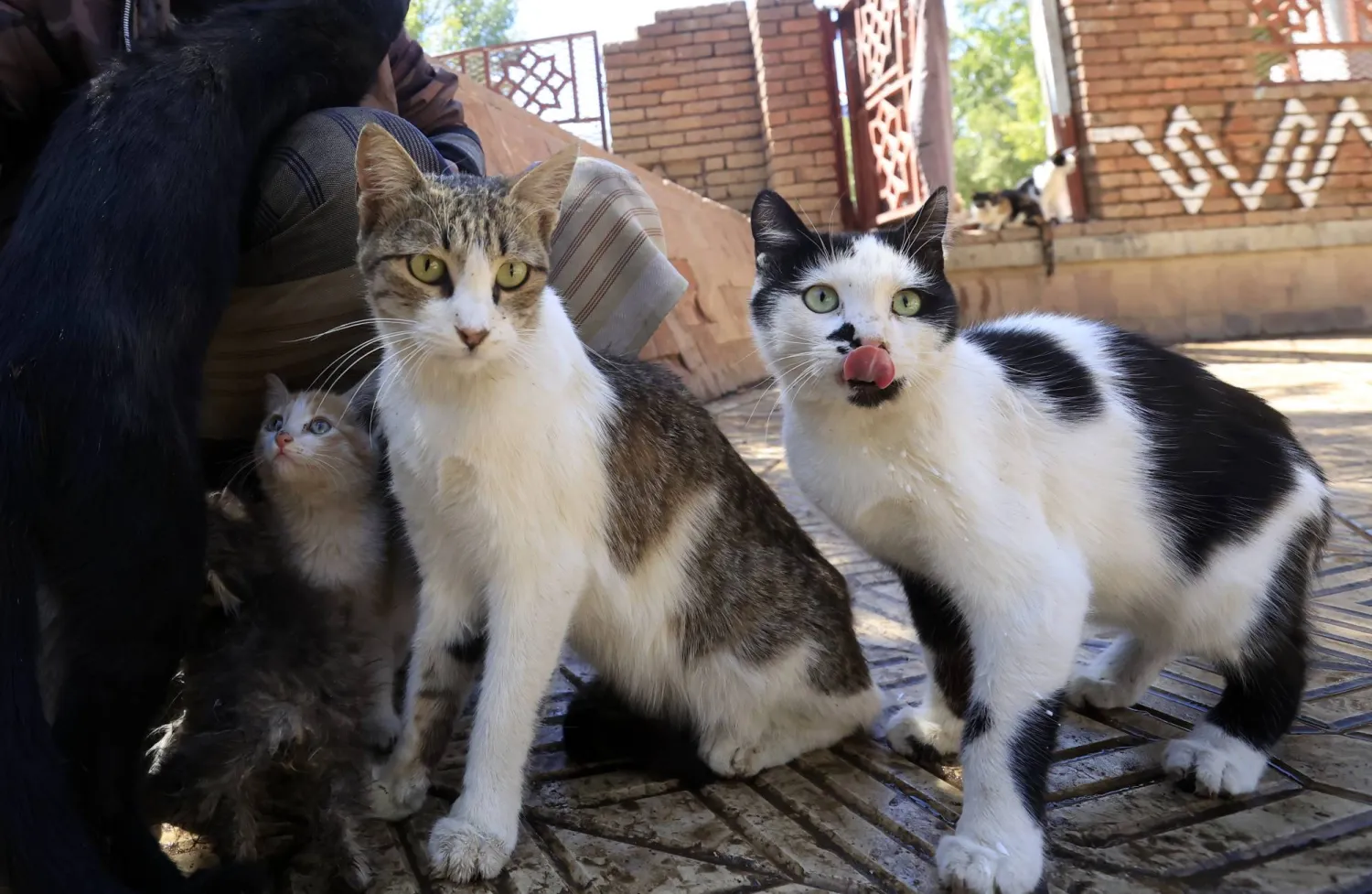
Vietnam Busts Cat-stealing Ring that Took 2,700 Pets for Food

Stray cats. AFP
Stray cats. AFP
TT

Vietnam Busts Cat-stealing Ring that Took 2,700 Pets for Food

Stray cats. AFP
Stray cats. AFP

Vietnamese police have arrested 12 men accused of stealing nearly 2,700 cats during night raids into residential neighborhoods, taking the pets to be slaughtered for food, police and state media said on Monday.

Fur removal machines, cat traps and measuring scales were among items confiscated during investigations into the alleged cat-stealing ring in Ho Chi Minh City.

Consumption of dogs and cats is legal in Vietnam, where many restaurants openly advertise the meat, but vendors are required to obtain certificates showing the origin of the animals.

Media reports have said that stolen cats can be sold at restaurants for at least 70,000 dong ($2.70) per kilogram.

The 12 men were arrested on allegations of property theft and admitted "to stealing and trafficking approximately 2,700 cats of various types", police said in a statement.

Criminal proceedings began on Sunday, but it was not clear when the men were detained.

The suspects pounced between 11:00 pm and 04:00 am, roaming residential areas on motorbikes in small groups to steal local cats, state media said.

The network was first discovered in July, with police seizing 50 live cats alongside 55 cat traps, two scales and two fur removal machines.

Each team was estimated to have stolen between four and 10 cats per night.

Police in Ho Chi Minh City arrested 18 people earlier this year accused of being part of two separate cat-stealing rings.


Indonesia Says Will Halt Forest Destruction for Rice Paddies

A man attempts to extinguish flames with a bucket amid thick smoke and fires burning through peatland in Palangkaraya, Central Kalimantan, on October 3, 2026. (Photo by REINA / AFP)
TT

Indonesia Says Will Halt Forest Destruction for Rice Paddies

A man attempts to extinguish flames with a bucket amid thick smoke and fires burning through peatland in Palangkaraya, Central Kalimantan, on October 3, 2026. (Photo by REINA / AFP)

Indonesia said on Tuesday it will halt a project to raze several million hectares of forest to clear land for rice production, saying it had reached self-sufficiency levels of the staple grain.

The government launched a program in 2024 to stop relying on rice imports within five years by clearing three million hectares of land for paddies.

Indonesia is one of the world's most forested countries, and as such a major absorber of planet-warming carbon emissions from mankind's burning of fossil fuel.

It aims to become a net carbon sink by 2030, with forests and other land use absorbing more carbon than they emit.

However, observers have said continuing forest destruction for agriculture and logging, as well as rampant wildfires, could put Indonesia's plans at risk.

President Prabowo Subianto hailed an "important victory" this year after data showed countrywide rice demand had been met with domestic production in one of the world's top consumers of the commodity.

Climate envoy Hashim Djojohadikusumo said on Tuesday the government's strategic reserve rice stock had reached about 5.3 million tonnes.

"The government sees no further need for expanding rice cultivation areas in the so-called forest areas," said Hashim, who is Prabowo's brother.

He added that the government will focus instead on "intensification measures" using superior seeds, for example, to increase rice yields.

It was not known how much forest had already been replaced by rice paddies before the project was halted.

According to the National Food Agency, a government body that seeks to advance food security, Indonesia produced 34.71 million tons of rice in 2025 -- exceeding annual demand of 31.19 million tons.

Haze from wildfires consuming forests and peatlands in Indonesia has blanketed neighboring Malaysia and Singapore for weeks.

Hot, dry conditions associated with the El Nino weather phenomenon have fueled the fires, which are also linked to land clearing.

The Mighty Earth advocacy group welcomed Hashim's announcement, AFP reported.

"This decision renews Indonesia's leadership in showing how to expand agriculture while protecting nature," the NGO's founder, Glenn Hurowitz, said in a statement.

"This decision creates an opportunity for large-scale investments in achieving President Prabowo's goal of restoring 12 million hectares of forest, peat, and other ecosystems," he added.


Ready, Set, Snooze: Sleep-deprived Japanese Compete for Best-rested

© Selim CHTAYTI / AFP
TT

Ready, Set, Snooze: Sleep-deprived Japanese Compete for Best-rested

© Selim CHTAYTI / AFP

In diligent, exhausted Japan, self-described elite "competitive sleepers" vied to lie down, relax and nap the fastest and deepest in a contest organized by a mattress company.

The Tokyo competition, dubbed "Matt Race", saw dozens of participants fitted with sleep tracking devices sprawl on comfy mattresses to slumber for up to 90 minutes Monday, competing for the top prize of over two million yen ($14,000).

"Japan is often described as a country suffering from sleep deprivation, and people here are very diligent," Riichiro Nakama, creative director at organizer Koala Sleep Japan, the mattress company.

Inside a dimly lit room, participants slept with monitors attached to their heads, some cradling stuffed toys in their beds, reported AFP.

"By turning it into an event like this, I think we can get people to sleep together, raise interest in sleep," Nakama said.

OECD data showed in 2021 that Japanese people slept an average seven hours 24 minutes a day -- the least of all OECD nations within the group -- with experts citing long working and commuting hours and a busy nightlife economy as among contributing factors.

"It was over in an instant. I almost wish I could have slept a little longer," participant Chisato Honda, 32, told AFP.

"It was a happy competition," he added.

The winner was chosen based on how quickly and soundly they slept.

"I want to live on my own, so I think I'll use the money for the moving costs," said Suimii, the contest winner who only gave her nickname.

"I also want a bed like a princess's, so I think I'll buy that bed."


Purple Reign: Philippines Seeks to Keep Grip on Ube Throne

Purple yam sprout at a farm in Padre Garcia, Batangas province. Jam STA ROSA / AFP
TT

Purple Reign: Philippines Seeks to Keep Grip on Ube Throne

Purple yam sprout at a farm in Padre Garcia, Batangas province. Jam STA ROSA / AFP

The Philippine ube has become a trend-setting sensation from Los Angeles to London to Seoul, with the humble yam's bright purple hue drawing lines outside coffee shops and bakeries and millions of views on social media.

But keeping pace with the international boom has proven tricky for the archipelago nation's overwhelmingly smallholder farmers, with yields declining and some unable to commit to the plant's nine-month growing time.

Fears that biopiracy might take a chunk out of the blossoming market, meanwhile, have prompted the government to announce a ban on the export of the raw form of the yam.

Standing in his ube field south of Manila, farmer-exporter Al Bonifacio told AFP he was in favor of doing whatever it took to protect the crop from any growers overseas trying to cash in on the craze.

"Purple is so royal and is very pleasing to the eye," the 59-year-old said with a smile during a visit to his one-hectare (2.5-acre) ube farm.

"Our greatest fear is, if we are not able to supply ube to the world, someone (else) will step in."

Sold as powder, extract, paste, or frozen puree, ube is easily mixed into coffee, pastries, ice cream, spreads and even make-up.

At a Tokyo gelato shop, ube importer JP Mercado told AFP the Japanese market was expanding rapidly after the craze first hit neighboring South Korea.

"It's really taken off like wildfire," he said as a batch of powder was slowly stirred into gelato, turning it a bright purple.

"I think social media has been hugely impactful," he said, adding his client list ranged from small cafes to luxury hotels.

- Rooted in history -

Ube was a staple of Philippine gardens as long as 5,000 years ago, boiled and eaten by families as a substitute to rice when their provisions ran out.

Beloved for its mildly sweet, nutty flavor and velvety texture, it later evolved into a party food, consumed as a jam or stewed with sticky rice balls in coconut milk.

Demand exploded locally this decade, most memorably during a purple bread mania that swept the archipelago in the darkest days of the Covid-19 pandemic.

"I'm super-obsessed with ube," university student Kym Trivino told AFP as she sipped an ube-matcha concoction at one of Manila's largest shopping malls.

Baker Diane Bustos said her company now sells seven types of ube cookies.

"It took over matcha. That's really something that we Filipinos should be really proud of," she said, referring to the bright green tea powder popularized by Gwyneth Paltrow and other celebrities.

But as ube mania grows globally, clouds loom at home.

Bonifacio told AFP the country's small farmers widely lacked the facilities for post-harvest storage and processing, while access to marketing and financing lagged.

Planting to harvest takes at least nine months, too long for most Filipino farmers who preferred the shorter growing period for beans, squash or bittergourd to feed their families, the farmer added.

Bonifacio said he had been forced to scour the rest of the country for raw ube to meet his growing export commitments, a process that can double his costs.

"We have the land, but quality planting materials are not always available," Leonilyn Ladao, a local agriculturist, told AFP.

- A battle for the future -

"Last year's production was just 12,483 tons," Jose Zalde Samson, from the country's plant industry bureau, told AFP of the five-year low.

Industry officials blamed typhoons, which hit key ube farming regions. For the first half of 2026, production was up around 17 percent.

"The government has only started promoting ube in the past two to three years as demand spiked," Samson explained.

"Before the ube craze, it was a niche market," he said, adding it had lagged behind high-value crops like bananas, mangoes and coffee.

With the pressure on, the government is now working on how it can boost supply.

"We are looking at how (the growing season) can be shortened to six months," Samson said.

With neighbors like Thailand and Vietnam now getting into the game, the Philippines is acting to protect its crown.

"We don't want to export it to countries that could use Philippine ube varieties to compete with us," Agriculture Secretary Francisco Tiu Laurel said last month while revealing the ban on raw ube exports.

"We've had data that tubers were being (surreptitiously) exported," Samson said, declining to provide further details.

In Tokyo, ube importer Mercado said he backed the Philippine government's move, which he believed would protect the country's cultural heritage.

"Ube really is, I would say, very interlocked with the Filipino identity," he said.

Bonifacio the farmer agreed.

"(We) are stewards of the ube industry," he said, looking out over his crop.

"We have a stake in this. We have to protect it."