


Nobel Prize in Chemistry Awarded to Kagan, Soai for Untangling Mirror Images in Molecules

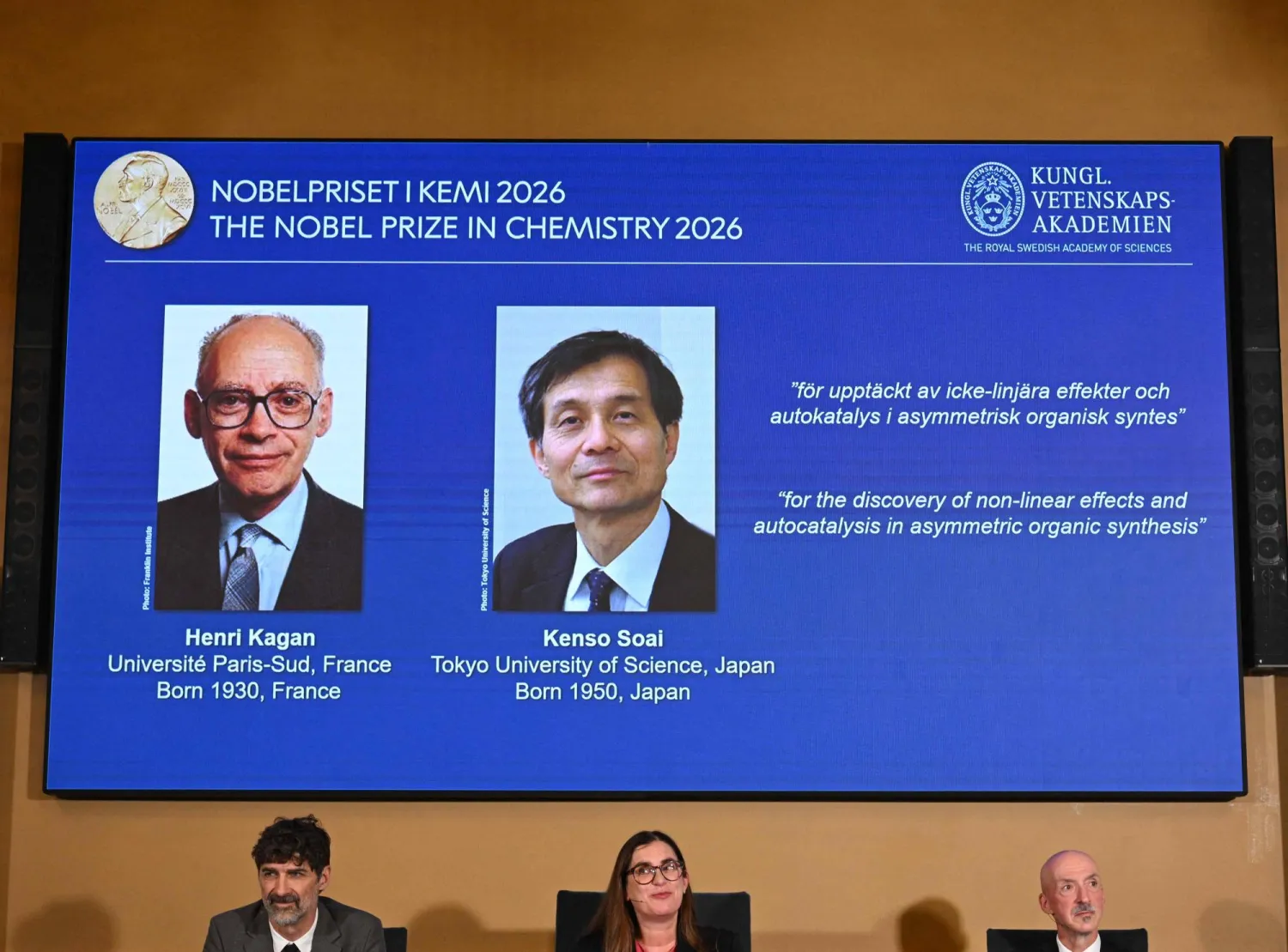
(Bottom L-R) Heiner Linke, Chair of the Nobel Committee for Chemistry; Ellen Moons, Secretary General of the Royal Swedish Academy of Sciences; and Peter Somfai, Member of the Nobel Committee for Vhemistry, react in front of a screen displaying this year's laureates Henri Kagan of France and Kenso Soai from Japan during the announcement of the winners of the 2026 Nobel Prize in Chemistry at the Royal Swedish Academy of Sciences in Stockholm, Sweden, on October 7, 2026.  (Photo by Jonathan Nackstrand / AFP)
(Bottom L-R) Heiner Linke, Chair of the Nobel Committee for Chemistry; Ellen Moons, Secretary General of the Royal Swedish Academy of Sciences; and Peter Somfai, Member of the Nobel Committee for Vhemistry, react in front of a screen displaying this year's laureates Henri Kagan of France and Kenso Soai from Japan during the announcement of the winners of the 2026 Nobel Prize in Chemistry at the Royal Swedish Academy of Sciences in Stockholm, Sweden, on October 7, 2026. (Photo by Jonathan Nackstrand / AFP)
TT

Nobel Prize in Chemistry Awarded to Kagan, Soai for Untangling Mirror Images in Molecules

(Bottom L-R) Heiner Linke, Chair of the Nobel Committee for Chemistry; Ellen Moons, Secretary General of the Royal Swedish Academy of Sciences; and Peter Somfai, Member of the Nobel Committee for Vhemistry, react in front of a screen displaying this year's laureates Henri Kagan of France and Kenso Soai from Japan during the announcement of the winners of the 2026 Nobel Prize in Chemistry at the Royal Swedish Academy of Sciences in Stockholm, Sweden, on October 7, 2026.  (Photo by Jonathan Nackstrand / AFP)
(Bottom L-R) Heiner Linke, Chair of the Nobel Committee for Chemistry; Ellen Moons, Secretary General of the Royal Swedish Academy of Sciences; and Peter Somfai, Member of the Nobel Committee for Vhemistry, react in front of a screen displaying this year's laureates Henri Kagan of France and Kenso Soai from Japan during the announcement of the winners of the 2026 Nobel Prize in Chemistry at the Royal Swedish Academy of Sciences in Stockholm, Sweden, on October 7, 2026. (Photo by Jonathan Nackstrand / AFP)

Scientists Henri B. Kagan and Kenso Soai won the Nobel Prize in chemistry Wednesday for untangling mysterious mirror images in molecules, a discovery that has been used to develop countless drugs and transformed modern medicine.

Many molecules come in versions that look alike but are not exactly identical, like right and left hands. One mirror image of the chemical carvone smells like mint, for example, while the other has a whiff of caraway, a spice often used in rye bread.

Even life itself prefers one mirror image over the other. DNA twists to the right, and the proteins in human bodies are made of mostly left-handed building blocks, The AP news reported.

Versions of the same molecule can behave differently when interacting with other chemicals. When designing drugs to treat diseases, scientists want to be choosy about which mirror image they get. They want the version of a molecule to treat a cold, not one that will make the sniffles worse.

Kagan, who is from France, and Soai, from Japan, found ways to make chemistry pick a side, designing and manipulating reactions to produce the desired mirror image.

“This is probably the coolest experiment in organic chemistry,” said Peter Somfai, a member of the Nobel Committee for Chemistry. “Taken together, the groundbreaking discoveries by Henri Kagan and Kenso Soai have reshaped our understanding of molecular chirality,” a term that comes from the Greek word for “hand.”

The discovery enabled most modern medicines Scientists paid tribute to Kagan and Soai's work, which the Nobel committee described as a feat never previously achieved by anyone “other than life itself.”

“It might be difficult to say that this drug, or that drug, was developed using this,” Somfai said. “I would say all of them, because we use this as a tool, we use this as an understanding, how to develop catalysts, how they function.”

In the 1980s, Kagan’s work showed there might be a way to design reactions to produce one form of a molecule over the other. Years later, Soai perfected the process. He created the first-ever chemical reaction to efficiently produce only one of a molecule’s mirror images, in what’s now known as the Soai reaction.

“The medicines we have today would not be possible without this chemistry,” said Rigoberto Hernandez, president of the American Chemical Society.

Kagan, 95, is affiliated with the Université Paris-Sud in Orsay, France. Soai, 76, is affiliated with the Tokyo University of Science.

The French Academy of Sciences, of which Kagan is a member, congratulated the two scientists and expressed its pride in the prize.

Neither the Université Paris-Sud nor the Tokyo University of Science immediately responded to requests for comment from The Associated Press.

“I’m very excited to receive the very nice news,” Soai told the committee and journalists by phone. “Of course this is one of the most exciting days in my life.”

He said he was shopping near his home when he was reached by the Nobel committee.

More Nobel prizes will be awarded over the next week The Royal Swedish Academy of Sciences announced the winner in Stockholm.

Last year, three scientists won the chemistry Nobel for their development of new molecular structures that can trap vast quantities of gas inside, laying the groundwork to potentially suck greenhouse gases out of the atmosphere or harvest moisture from desert environments.

This year's prizes began with the Nobel for medicine, awarded Monday to three scientists whose work led to a tool that uses light to help unravel how the brain works. The physics award Tuesday recognized a scientist's efforts to demystify a rare group of neutrinos.

The literature prize is set to be awarded Thursday. After Friday’s peace prize is awarded, the Nobel Memorial Prize in Economic Sciences will be announced Monday.

The prize money this year is 12 million Swedish kronor (about $1.2 million), whether for an individual, a small group of laureates or an organization.



Hoor Al Qasimi Becomes 1st Arab Woman to Lead Venice Biennale Art Show

Emirati curator Hoor Al Qasimi (Venice Biennale)
TT

Hoor Al Qasimi Becomes 1st Arab Woman to Lead Venice Biennale Art Show

Emirati curator Hoor Al Qasimi (Venice Biennale)

Emirati curator Hoor Al Qasimi has been named as the first Arab and the seventh woman to lead the Venice Biennale contemporary art exhibition, scheduled for 2028.

Al Qasimi leads the Sharjah Art Foundation, which she founded in 2009 to promote contemporary art and foster cultural exchange in the emirate, and has run the Sharjah Biennial since 2003. She curated the UAE’s pavilion at Venice in 2015.

The influential contemporary art magazine ArtReview ranked her No. 1 on its 2024 Power 100 list of the contemporary art world’s most influential figures, highlighting her support for artists beyond the Western mainstream.

The curator’s role is to present an organizing theme for the 62nd International Art Exhibition and choose artists for the main curated show, which runs alongside national pavilions that often take cues from the curator’s vision.

“The International Art Exhibition of La Biennale di Venezia has been an important platform for many of us around the world,’’ said Al Qasimi, who visited her first Venice Biennale in 2005.

“For me, La Biennale continues to be a critical space to engage with the work of influential artists and curators,” she added on Thursday.

Biennale President Pietrangelo Buttafuoco, who recommended Al Qasimi’s appointment, said her work combines “a profound attentiveness to deep-rooted memory and its legacies, an open perspective on the intricate complexities of the present, and a rare ability to listen to places and their people.”

The 61st Biennale contemporary art show curated by the late Koyo Kouoh closed on Sunday.


‘American Doctor’ Documentary Puts Spotlight on Gaza Health Workers

Doctors Feroze Sidhwa and Thaer Ahmad and filmmaker Poh Si Teng of the documentary film ‘American Doctor’ pose for a portrait in London, Britain, November 20, 2026. REUTERS/Kevin Coombs
TT

‘American Doctor’ Documentary Puts Spotlight on Gaza Health Workers

Doctors Feroze Sidhwa and Thaer Ahmad and filmmaker Poh Si Teng of the documentary film ‘American Doctor’ pose for a portrait in London, Britain, November 20, 2026. REUTERS/Kevin Coombs

Filmmaker Poh Si Teng went “all chips in” to reveal the harsh realities of Gaza’s hospitals in her feature debut “American Doctor.”

A former New York Times journalist and Al Jazeera documentary commissioner, Malaysian American Teng left her role at a major studio, used up her savings and fundraised to direct her first feature-length documentary.

The film follows three US doctors, Jewish American orthopedic surgeon Dr. Mark Perlmutter, Zoroastrian trauma surgeon Dr. Feroze Sidhwa and Palestinian American emergency physician Dr. Thaer Ahmad, who volunteer to provide care for Palestinians in Gaza.

Shot by local filmmakers and medics on the ground, it takes viewers inside the overwhelmed operating rooms and hospitals hit by Israeli strikes, depicting the extreme conditions, shortages and difficult decisions the trio and their Palestinian colleagues face.

“A lot of my well-meaning friends told me, ‘if you make this film, know that you’re sabotaging your own commercial film career’,” Teng told Reuters.

“And I thought to myself, ‘look, as a taxpayer, I’m paying for what is happening in Palestine, so if I’m going to be sabotaging my career, then, okay, all ⁠chips in, let’s go. Maybe this is the last feature, so be it’.”

Teng’s team agreed early on to make the film – shot between Christmas 2024 and Christmas 2025 – at record speed to release it before the US midterm elections.

Looking for an entry point that would resonate with audiences and allow her to examine America’s role in the Gaza war, Teng reasoned that “everybody’s got a doctor and has been to OR and ER at some point in their lives.”

“The title was always meant to be like a decoy. It was always meant to be a Trojan horse, especially in the United States, where people were so afraid to talk about Palestine and Gaza. I was, like, ‘let’s give it the most non-controversial title’,” she said.

“People came to watch ‘American Doctor’, quite a substantial chunk of the audience didn’t know what it was, and then when they watched it, they were exposed to what’s happening in Palestine.”

From Khan Younis to Washington

The film shows Sidhwa and Perlmutter working in the surgery department of Nasser Hospital in ⁠Khan Younis, which serves half of Gaza’s 2 million people, and follows Ahmad’s efforts to gain permission to re-enter Gaza.

They also engage in advocacy work, talking to journalists, addressing conventions and travelling to Washington, DC, to meet politicians.

Trying to convince lawmakers to support medical humanitarian aid was not a role they had been eager to take on, said Ahmad, but they felt it was necessary.

“They are casting votes that directly lead to bombs being dropped on our colleagues in Palestine, so it’s essential that they understand how deeply involved they are and that ⁠they need to be held accountable,” he said.

Israel’s campaign in Gaza has strained the decades-long bipartisan support for the country in the US.

Israel’s military has struck the Nasser Hospital complex at least seven times since the start of the Gaza war, according to hospital officials.

Surgeon Rezik Abushira, who is featured in “American Doctor,” was killed in an Israeli airstrike on Nasser Hospital two weeks ⁠ago.

Israel’s military said it targeted a senior Hamas commander and accused the militants of using the hospital complex to plan attacks, which the group denied.

Hospitals are protected sites under international law. Both attacking hospitals and their use for military purposes are typically considered breaches of the law.

Israel’s assault on Gaza has killed more than 74,000 ⁠Palestinians since 2023, caused a hunger crisis, internally displaced Gaza’s entire population and led to assessments of genocide from scholars and United Nations inquiries.

Israel has said its actions were in self-defense after Hamas-led militants killed 1,200 people and took more than 250 hostages in an attack on Israel in October 2023.

The Academy announced earlier this week that “American Doctor,” currently showing in cinemas in Britain and Ireland, was eligible for Oscar consideration.


Tourists Enjoy Brilliant Autumn Colors in Kyoto

Tourists dressed in kimonos pose for photos near autumn leaves next to the Nanzen-ji Buddhist temple in Kyoto on November 25, 2026. (Photo by Andrew CABALLERO-REYNOLDS / AFP)
TT

Tourists Enjoy Brilliant Autumn Colors in Kyoto

Tourists dressed in kimonos pose for photos near autumn leaves next to the Nanzen-ji Buddhist temple in Kyoto on November 25, 2026. (Photo by Andrew CABALLERO-REYNOLDS / AFP)

Visitors from Japan and overseas marveled at the brilliant reds and yellows of Kyoto's autumn foliage season, as it transformed the city's temples, gardens and mountains with a blaze of color.

The ancient Japanese capital is known for its cherry blossoms in spring, but autumn is another peak tourism season, particularly for local visitors keen to enjoy the centuries-old tradition of viewing vibrant fall foliage.

"The autumn leaves themselves are beautiful," Rie Segawa, 34-year-old visitor from Osaka, told AFP, adding that the colors make her "feel calm".

"Seeing them turn red makes me happy to see the seasons changing," she said.

Anthony Piglioni from France said he'd heard so much about the famous cherry blossom season but "the colors are just as beautiful as in the spring".

"It's incredible... the colors, the landscapes... very zen, very relaxing," the 37-year-old told AFP.

Kyoto has a long-standing tradition of appreciating autumn foliage.

During the Heian period between the late eighth century and the late 12th century, when the city was Japan's capital, looking at autumn leaves was an important seasonal pastime among the aristocracy, much like cherry blossom viewing in spring.

The aristocracy would visit the mountains and compose poems celebrating the beauty of the autumn colors.

Over time, trees such as Japanese maples were planted in aristocratic residences, temples and gardens across Kyoto.

Scientists say climate change is delaying famed autumn foliage season in Japan, pushing back the peak display of red and yellow leaves, although this year was within the normal range for Kyoto.