


A 194-year-old Tortoise, World's Oldest Land Animal, May Hold Clues to Longer Life

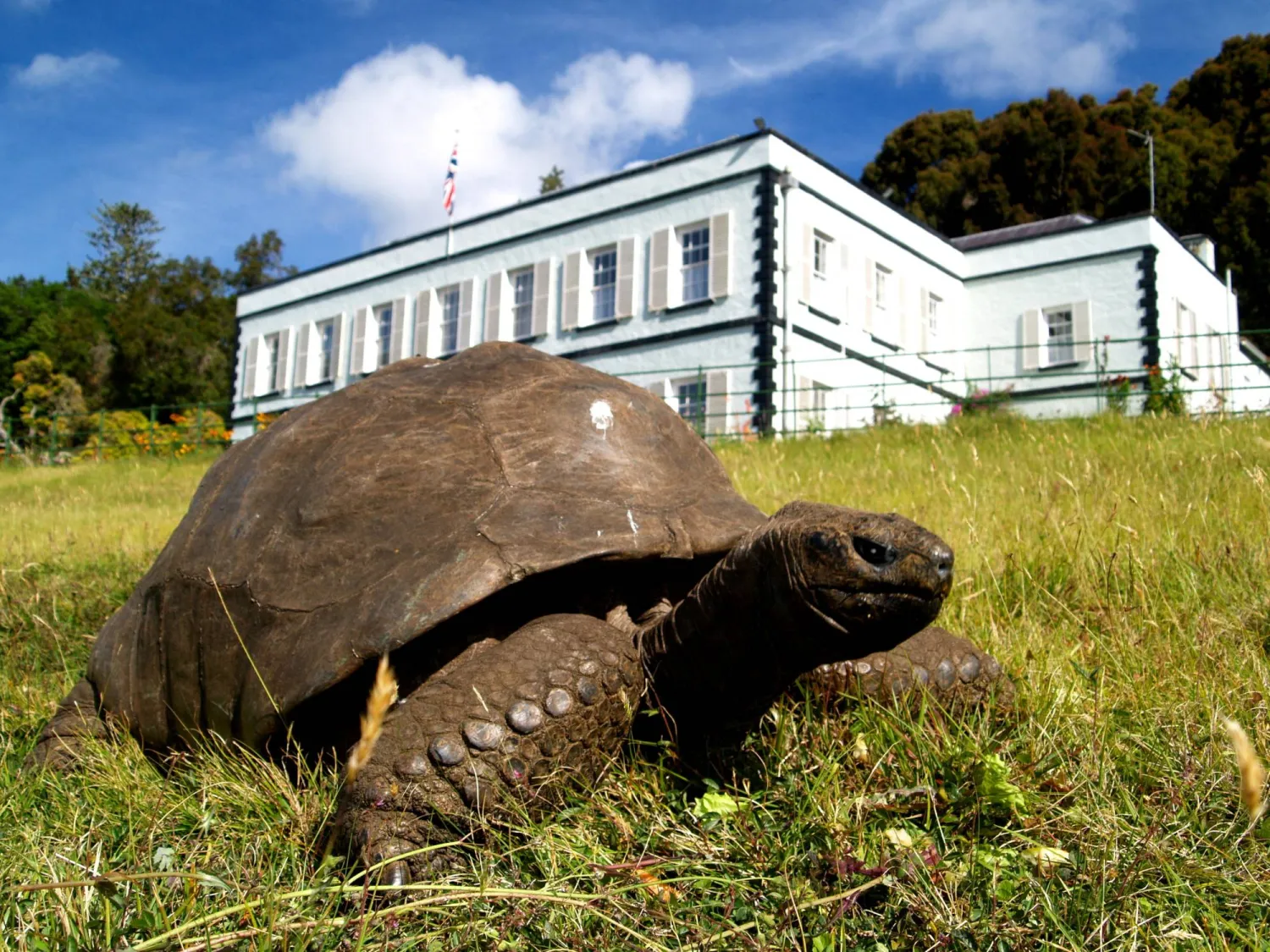
Tortoise named Jonathan, a giant tortoise believed to be the world's oldest known living land animal, stands in front of Plantation House, in St Paul on the South Atlantic island of St Helena, January 6, 2013.  Joe Hollins/Handout via REUTERS
Tortoise named Jonathan, a giant tortoise believed to be the world's oldest known living land animal, stands in front of Plantation House, in St Paul on the South Atlantic island of St Helena, January 6, 2013. Joe Hollins/Handout via REUTERS
TT

A 194-year-old Tortoise, World's Oldest Land Animal, May Hold Clues to Longer Life

Tortoise named Jonathan, a giant tortoise believed to be the world's oldest known living land animal, stands in front of Plantation House, in St Paul on the South Atlantic island of St Helena, January 6, 2013.  Joe Hollins/Handout via REUTERS
Tortoise named Jonathan, a giant tortoise believed to be the world's oldest known living land animal, stands in front of Plantation House, in St Paul on the South Atlantic island of St Helena, January 6, 2013. Joe Hollins/Handout via REUTERS

The world's oldest-known terrestrial animal, an Aldabra giant tortoise named Jonathan and estimated to be about 194 years old, may owe his extraordinary longevity to a combination of genetic traits and an ability to keep key cellular systems functioning in a more youthful way, according to scientists.

Members of this species are known to live more than 100 years, but Jonathan has far exceeded that. Brought to the remote South Atlantic island of St Helena as a fully grown animal in 1882, likely from the Aldabra Atoll or the Granitic Seychelles, the tortoise now resides in a paddock at Plantation House, the governor's residence.

"Other Aldabra tortoises have been claimed to have lived as long as Jonathan, but he has the most documentary evidence supporting his age," said Benjamin Vaisvil, a researcher affiliated with the organization Kallel and co-lead author of the study published on Wednesday in the journal Science Advances.

Scientists have studied Jonathan to explore the secrets of the animal's amazing longevity, sequencing his genome and analyzing his epigenome — the chemical markers that control which genes switch on and off.

"We found changes in Jonathan's genome in pathways associated with longevity, like DNA repair, mitochondrial function, insulin regulation and telomere function," ⁠Reuters quoted Vaisvil as saying.

Mitochondria are structures ⁠considered the powerhouse of a cell. Insulin is a hormone that helps regulate levels of blood sugar by letting it enter the body's cells for energy. Telomeres are protective caps at the ends of chromosomes, structures that carry genetic information inside cell nuclei.

Researchers compared Jonathan's epigenome with four other Aldabra tortoises, ranging from juveniles to older adults. While pretending to feed Jonathan, they waited until he began biting the air, then wedged his mouth open with a gloved hand and scraped under his tongue with a specialized kit. St Helena officials restrict blood draws to prevent infection risks.

To explain the finding, Vaisvil compared the genome to a cookbook and the epigenome to handwritten notes in the margins.

"As the cookbook ages, those notes become ⁠more difficult to read clearly. We can think of that as methylation entropy," Vaisvil said, referring to a metric for disorder in a certain biochemical process.

Most of the notes in Jonathan's "cookbook" look very old. But in certain regions, stretches of DNA that act as switches controlling whether genes are turned on or off, Jonathan's methylation entropy was lower than that of every tortoise studied except a 5-year-old juvenile. These regions controlled genes that influence longevity.

The researchers identified 287 genes with variants unique to Jonathan, including some linked to tumor suppression and DNA repair. The tortoise also carries extra copies of a gene that encodes a protein that hunts down ageing and cancerous cells.

When younger, Jonathan was known for mischievous antics including overturning chairs and lying on croquet balls, according to the tortoise's longtime veterinarian and study co-author Joe Hollins. Cataracts have since left him mostly blind. Hollins describes Jonathan today as "a gentle giant."

Determining how long giant tortoises can live is challenging because reliable historical records are scarce and many outlive researchers. Record-keeping before the 20th century also was problematic. While a young tortoise's age can be estimated from growth ⁠rings on the plates that form ⁠the animal's shell, ascertaining the age of adults is more difficult.

The new study involved only one exceptionally old tortoise, making it hard to determine whether the traits identified are unique to Jonathan or common among long-lived tortoises.

"We cannot say for certain that what we found is the reason for his longevity," Vaisvil said.

Environmental factors also may have contributed. Jonathan lives on a tropical island, with an optimal diet carefully managed by trained veterinarians.

The research findings broadly match patterns documented in studies of exceptionally long-lived people, suggesting that some mechanisms of aging may be shared across species.

Vaisvil noted that a recent study of a 117-year-old woman found unusually efficient mitochondrial function, echoing findings in some of Jonathan's regions.

Despite his age, Jonathan retains a voracious appetite, Hollins said, lifting his head and stretching out his long neck when the veterinarian calls out his name.

"I know he knows me, knows my voice and my handling, and I also know it isn't love on his part but a recognition of the arrival of a feast," Hollins said. "And yet I, of course, don't mind. I have a huge affection for him."

"He is a remarkable symbol. Icon, I know, is an overused word, but Guinness World Records has just given him 'icon' status this year," Hollins said.

Beloved by island residents, Jonathan has lived through world wars and the rise and fall of empires.

"He is symbolic of resilience, longevity, endurance, a persistent presence throughout huge historic events," Hollins said.



Japan Space Probe Changes Target Over Engine Trouble

This undated image provided by the European Space Agency on Nov. 5, 2026 and taken by the Hera spacecraft, shows asteroid Didymos. (European Space Agency via AP)
TT

Japan Space Probe Changes Target Over Engine Trouble

This undated image provided by the European Space Agency on Nov. 5, 2026 and taken by the Hera spacecraft, shows asteroid Didymos. (European Space Agency via AP)

A Japanese probe that returned precious asteroid dust to Earth six years ago has changed course in its extended mission, officials said Tuesday, citing issues in its aging engines.

The unmanned Hayabusa-2 probe brought back pristine materials from the asteroid Ryugu in 2020, supporting discoveries linked to clues on the origin of life.

In July, the probe flew 400 meters (1,312 feet) from a near-Earth asteroid, making the closest approach ever recorded in such a mission, Japan Aerospace Exploration Agency (JAXA) has said.

It was then headed for its main target, an asteroid called 1998 KY26 that will be some 300 million kilometers away from Earth when the probe would have reached it in 2031.

However, 12 years since its launch, "the deterioration of the onboard equipment... is becoming increasingly evident", Yuya Mimasu, team leader of the extended mission, told reporters.

With the main engines suffering repeated malfunctions, "we decided to revise the plan to one that could be safely implemented", AFP quoted him as saying.

The probe will now head towards an asteroid called 2015 BM510, aiming for a flyby -- passing close to it at high speed -- in April 2028, according to the team leader.

"Because it is a dark, small asteroid... it will be one of the world's most difficult flyby missions," Mimasu said.

The new target is between 17 meters and 74 meters in diameter, completing a rotation every 49 minutes.

The revised operation can help "future planetary defense" missions aimed at deflecting asteroids that might otherwise collide with Earth, Mimasu said.


Wildlife Whereabouts Lost as Russian Researchers Cut Off from Satellite Tracking

Freshwater seal Kroshik carries a satellite-tracking transmitter on the shore of Lake Ladoga in the Leningrad region, in this still image from video released November 10, 2026. Fund of Friends of the Baltic Seal/Handout via REUTERS
TT

Wildlife Whereabouts Lost as Russian Researchers Cut Off from Satellite Tracking

Freshwater seal Kroshik carries a satellite-tracking transmitter on the shore of Lake Ladoga in the Leningrad region, in this still image from video released November 10, 2026. Fund of Friends of the Baltic Seal/Handout via REUTERS

You could follow Kroshik the rescue seal with little dots on a map. There he was: hunting for fish on the dangerous southern shore of Lake Ladoga, then swimming back to safer waters. Then suddenly, he was gone.

"We will know nothing more of Kroshik’s adventures," conservationist Vyacheslav Alexeyev wrote last week on the social media feed where he had been sharing the seal's whereabouts with thousands of fans. Hundreds of commenters responded with crying emojis and broken hearts.

This month, Russian researchers were cut off from the main satellite system they have used for years to track wildlife across some of the world's largest wildernesses, in the latest example of Moscow's scientific isolation due to sanctions and war.

The Argos system, run by French firm CLS, has been used to track rare migratory birds across Russia's Far East, wild reindeer in northern forests, bearded seals in the White Sea and Atlantic walruses around ⁠Franz Josef Land.

A ⁠CLS spokeswoman confirmed the suspension of services to Russian clients, due to "the evolving international context and the arising constraints".

Fans of Kroshik, or Little Crumb, had been following the playful freshwater ringed seal's movements across Lake Ladoga in northern Russia, thanks to updates pinged via satellite from a transmitter glued to his fur. He had gained fame for repeatedly returning to his carers after failed releases, before making it back to the wild in September.

"All of that will now have to be stopped, so our feelings about it are extremely negative," Alexeyev, who runs a shelter near St ⁠Petersburg that rescued Kroshik as a pup, cared for him for a decade and released him this year, told Reuters.

The satellite cut-off adds to an unravelling of decades of scientific cooperation between Russia and the West since Moscow's launch of its full-scale war in Ukraine in 2022.

Since then, partnerships with institutions such as the European Space Agency and the European Organization for Nuclear Research (CERN) have ended, while joint Arctic research has been curtailed.

Losing access to Argos for Russian researchers "is really going to lead to lacking information on priority species and conservation and management actions," said Philipp Maleko, a PhD candidate at the University of Wisconsin-Madison, who has used it to study endangered shorebirds that fly between Russia's Far East and Southeast Asia, such as the spotted greenshank.

"So many birds depend on Russia's Arctic boreal ecosystems for reproducing, for really sustaining viable populations," he told Reuters.

Russia's Lake Baikal ⁠Foundation, a conservation group dedicated ⁠to the huge Siberian lake that holds nearly a quarter of the world's unfrozen fresh surface water, warned in October that losing the data threatened wildlife research across Russia.

The suspension would disrupt programs monitoring Baikal’s endemic seal and a tiny population of endangered forest reindeer, its head was quoted as saying by news agency TASS.

Researchers say no other available system is quite as useful as Argos at tracking how animals move across Russia's far-flung regions, away from cellphone towers and human settlements.

CLS did not say how many users it had in Russia, but its website says it was nearly the only system used by Russian scientists to study marine and terrestrial wildlife migration in northern regions.

In October, Russia's state-run Agency for Strategic Initiatives said it was in talks to develop a Russian alternative.

At the St Petersburg shelter a plump, velvety seal glided past Alexeyev by the outdoor pool. Alexeyev said he did not think Argos could be replicated: "It is the only satellite constellation of its kind."

He was grateful the company had worked with Russia as long as it did, "despite all the difficulties and the generally hostile attitude towards us in Europe."


South Korea Tightens Exam Security After AI Cheating Scandal

AI glasses are placed at an optical shop in Seoul, South Korea, Monday, Nov. 16, 2026. (AP)
TT

South Korea Tightens Exam Security After AI Cheating Scandal

AI glasses are placed at an optical shop in Seoul, South Korea, Monday, Nov. 16, 2026. (AP)

South Korea will deploy thousands of extra personnel to prevent cheating on its college entrance exam sites this week and may introduce tougher penalties, Prime Minister Han Seong-sook said Tuesday.

The announcement comes after an individual confessed on Sunday to cheating on the national tax accountant exam using artificial intelligence tools, an admission that brought panic ahead of the college test.

Known as the Suneung, the intense once-a-year exam -- widely seen as a ticket to well-paid jobs and even better marriage prospects -- will bring much of South Korea to a standstill on Thursday to minimize distractions.

As a measure to detect phones that have not been handed over, an emergency alert will be sent before the exam begins, Han said at a press conference.

Students will also be ordered to place their glasses on their desks so supervisors can verify they are not smart devices.

"We also strongly urge students to avoid wearing clothing with buttons wherever possible," Han said.

Students "will be asked to roll up both sleeves, and collars, buttons and other areas will also be checked to determine whether electronic devices, including miniature cameras, are concealed", she added.

Those caught cheating could be banned from taking the Suneung for 10 years, up from the current one-year restriction, Han said.

The government will also file criminal complaints over serious cases of cheating, including those involving smart devices.

In addition to the 75,000 supervisors deployed to 1,312 test centers nationwide, an additional 8,400 personnel will be deployed this year.

"You may feel nervous and intimidated by the unfamiliar atmosphere inside and outside examination centers and the stricter inspection procedures," said Han, addressing the 550,000 students who will take the Suneung.

The extra staff "are minimum safeguards designed to protect the value of the hard work you have put in over the years and to guarantee a fair competition in which everyone can hold their head high", she added.

At a meeting held Sunday, officials decided to investigate all suspected cases of cheating involving AI across national qualification examinations.

The individual who confessed to cheating said he had photographed the exam questions with a miniature camera before using AI and checking the answers on his smartphone.

Han said the government "will define such cheating as a 'social evil'".