Housing Crisis Set to Dominate Spain's Snap Election

The main tenants' unions have spearheaded pressure on politicians to reform Spain's housing market. JAVIER SORIANO / AFP
TT

Housing Crisis Set to Dominate Spain's Snap Election

The main tenants' unions have spearheaded pressure on politicians to reform Spain's housing market. JAVIER SORIANO / AFP

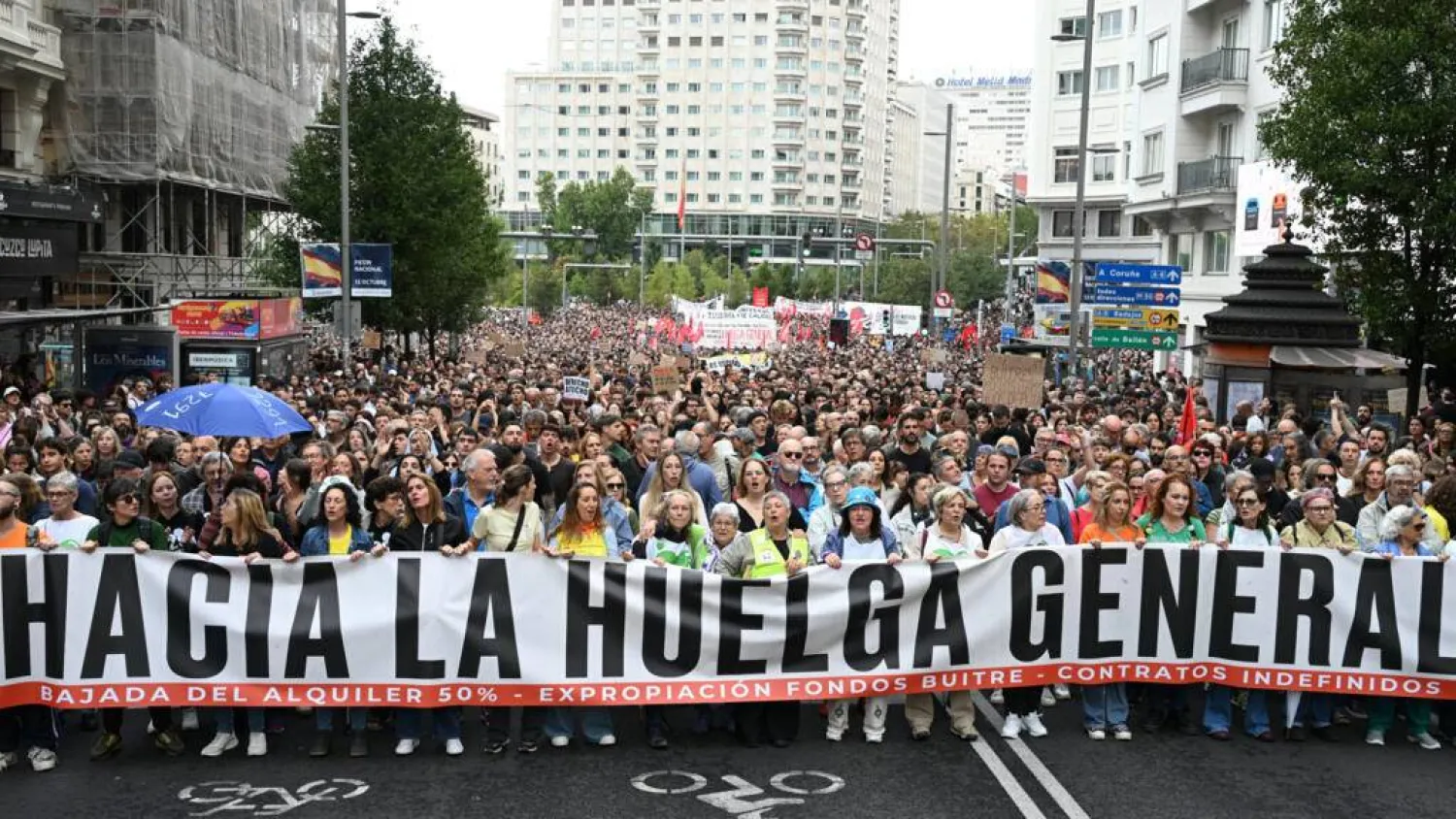
After simmering below the surface for years, anger at unaffordable housing in Spain has bubbled over and precipitated a general election that will be dominated by the crisis.

The spark was ignited on September 23 when 87-year-old Maricarmen Abascal was evicted from her lifelong Madrid home on a stretcher after the real estate firm that owned the apartment drastically hiked the rent, AFP said.

Abascal, who died on Wednesday, became the symbol of a crisis that cuts across Spanish society: young and old, renters and buyers, workers and pensioners.

The uproar at her eviction triggered national demonstrations, with hundreds of people camping in central Madrid's Puerta del Sol square in the most symbolic protest.

As in other European countries, housing has long been a top public concern, particularly for young adults who are priced out of the market and stay with their parents into their 30s and beyond.

Growth in housing prices has far outstripped wages in recent years, eating up far more than the upper limit of 30 percent of income recommended by public bodies and housing professionals.

According to the latest figures by the National Statistics Institute (INE), the average gross monthly salary in Spain is around 2,460 euros ($2,750).

Renting a 50-square-meter (538-square-foot) apartment in Madrid cost on average 1,170 euros per month in September, according to real estate portal Idealista -- around half of a normal income.

- 'Society of inheritors' -

Many residents in popular destinations like Barcelona complain that short-term tourist accommodation is limiting supply and driving up prices.

Investment funds with large housing portfolios are another much-maligned group, accused of being "vulture funds" that acquire properties and hike rents for maximum profits.

A tiny public housing supply is another major factor, with Madrid representing an extreme example of the phenomenon.

A paradise for luxury real estate, the capital only has around 10,000 social housing units for its 3.5 million inhabitants.

Such is the demand for them that some public apartments are allocated by lottery.

A history of home ownership partly explains the small public housing stock. Under the dictatorship of General Francisco Franco (1939-1975), a housing minister said he wanted "a country of owners and not proletarians".

But the model is breaking down, especially for the young. While almost three in four households own their main residence, more than half of under-30s rented in 2025, according to the INE.

Jorge Galindo, director of the Centre for Economic Policy at Esade business school, said the 2008 global financial crash was a turning point for the Spanish housing market.

The bursting of a real estate bubble sparked the "collapse" of construction and "the destruction of a million jobs" in the sector, Galindo told AFP.

Since then, "supply has not kept up", falling from around 260,000 new builds per year in the 1990s to 92,000 in 2025, he said.

The expert warned that the country of around 50 million people risked becoming "a society of inheritors" in which home ownership depends on parents passing property to their children.

- Political upheaval -

How to solve a puzzle that has bedeviled successive governments will be a central debate of the snap election that Socialist Prime Minister Pedro Sanchez called for November 29.

Last week, Sanchez's leftist coalition proposed a series of measures including more restrictions on evictions, a ban on the "speculative" purchase of homes and the automatic renewal of tenant contracts.

But the minority government failed to pass them in parliament, leading Sanchez to call an early vote originally scheduled for 2027.

Spain's main unions have called a general strike for November 11 in large part due to the political paralysis over housing.

In 2023, Sanchez's government passed a law that provided for more social housing, the regulation of rents in areas under the greatest stress, and punishments for owners who left their properties empty.

But the law has not stopped the spiraling prices and popular discontent.

The main opposition right-wing Popular Party advocates a building boom to make up the deficit between supply and demand.

For Galindo, the debate contains a "paradox".

"Those who suffer most from the housing crisis are those with the least weight at the ballot box: young people, who vote less, and immigrants."


France Blames Iran for a Cyberattack that Heated Supermarket Refrigerators

TOPSHOT - A woman walks past empty fresh-food refrigerators at an Intermarché supermarket in Névez, western France, on October 12, 2026, following a cyberattack affecting the French supermarket chains Intermarché and Cooperative U that caused their refrigerators to defrost. (Photo by Fred TANNEAU / AFP)
TT

France Blames Iran for a Cyberattack that Heated Supermarket Refrigerators

TOPSHOT - A woman walks past empty fresh-food refrigerators at an Intermarché supermarket in Névez, western France, on October 12, 2026, following a cyberattack affecting the French supermarket chains Intermarché and Cooperative U that caused their refrigerators to defrost. (Photo by Fred TANNEAU / AFP)

France on Monday blamed Iran for last month's cyberattack on supermarket refrigerators, summoned the Iranian ambassador and said it would seek European sanctions against those responsible for the attack.

The Oct. 12 attack sent refrigerator temperatures soaring, affecting about 700 of the country’s 10,000 supermarkets. In a statement Monday, prosecutors in Paris said they found that Iran’s paramilitary Revolutionary Guard was behind the large-scale cyberattack, The Associated Press said.

The French Foreign Ministry condemned the attack “in the strongest possible terms,” and French Foreign Minister Jean-Noël Barrot, speaking on the sidelines of G7 talks in Paris, said the Iranian ambassador was being summoned to “strongly protest against this extremely serious act.”

“This is an attack of unprecedented scale and aggressiveness,” Barrot said. “It is the first large-scale cyberattack aimed at sabotage on French soil, and it represents a major threat to our national interests and the security of the French people. That is why it will not go unanswered.”

“We will impose sanctions at the European level against all those responsible for this attack,” he added, vowing to take “any other measures needed” to respond to it and deter future attacks.

Paris prosecutor Laure Beccuau said in a statement that a formal judicial investigation was opened Monday into suspected organized cybercrime with the aggravating circumstance of “having been committed to serve the interests of a foreign power — in this case, Iran."

France’s national cybersecurity agency, ANSSI, attributed the attack to the Shahid Kaveh group, described as a “cyber unit” affiliated with Iran’s Revolutionary Guard Corps. The investigation targets the leader of the group as well as his two deputies and any other individuals who might be identified in connection with the case, Beccuau said.

Investigators found that the attackers had used Farsi and IP addresses linked to devices located in Iran, Beccuau said. The Paris prosecutor’s office is seeking international arrest warrants, she said.

In the early hours of Oct. 12, attackers remotely took control of refrigeration systems in hundreds of supermarkets and independent stores across France. Temperatures reached 50 Celsius (122 Fahrenheit) for about six hours, forcing stores to discard fresh and frozen goods. The Intermarché supermarket chain reported losses of “tens of millions of euros” in a single day.

Last week, another cyberattack in France on several blood banks tried to raise temperatures to extremely high levels but was thwarted before it could do any damage to blood products or samples. France’s national cybersecurity agency and Paris prosecutors are investigating the incident.

Also last week, supermarkets in Sweden, Belgium, Luxembourg, Ireland and Estonia were hit by problems with freezers and fridges that apparently were caused by cyberattacks, forcing some to dispose of ruined food.

The ANSSI cybersecurity agency said it was able to attribute some other cyber attacks carried out against France since 2020 to another group named Shahid Shoostari, also affiliated with Iran’s Revolutionary Guard Corps. They include attacks targeting satirical newspaper Charlie Hebdo in 2023 and the organization of the Paris Olympic Games in 2024.


US Aircraft Evacuated from Second UK Base Due to Iran Threat

A B-1 bomber takes off from RAF Fairford airbase, as the US removes its B-1 bombers one week after several men were arrested on suspicion of offences under the Explosives Act, in this screengrab obtained from a social media video in Fairford, Gloucestershire, Britain on Oct 4, 2026. — X/CraigYoungMedia via Reuters
TT

US Aircraft Evacuated from Second UK Base Due to Iran Threat

A B-1 bomber takes off from RAF Fairford airbase, as the US removes its B-1 bombers one week after several men were arrested on suspicion of offences under the Explosives Act, in this screengrab obtained from a social media video in Fairford, Gloucestershire, Britain on Oct 4, 2026. — X/CraigYoungMedia via Reuters

The US military evacuated aircraft from a second airbase in Britain on Monday after a threat from Iran, the Wall Street Journal reported, citing people familiar with the matter, weeks after the US withdrew its bombers from RAF Fairford airbase over a suspected Iran-linked security incident.

Two US refueling tankers that were using the RAF Mildenhall military base diverted to Germany earlier on Monday, while several other ‌tankers at ‌the base were moved to ‌Germany ⁠and other locations later ⁠in the day, the WSJ report said.

According to the Journal, the precise nature of the threat to RAF Mildenhall remains under discussion among US officials.

“We do not routinely comment on the activity of other nations. Aircraft and other assets move ⁠regularly according to operational requirements,” a British ‌ministry of defense spokesperson said.

The ‌Pentagon and the US European Command did not ‌immediately respond to a Reuters request for comment sent ‌outside regular business hours.

Five men were arrested outside RAF Fairford airbase in southwest England in September over a security incident with two others arrested later on suspicion of ‌assisting Iranian intelligence.

The circumstances of the incident, which remain largely unexplained, attracted huge international ⁠attention, ⁠coming at a time of heightened concern about the security implications for Western states of the war between the United States and Iran, and prompted the US to remove its B-1 bombers from the Fairford airbase on security grounds.

RAF Fairford had been used by US bombers to carry out strikes on Iran.

British Prime Minister Andy Burnham said last month that the activity at RAF Fairford was likely to have been coordinated in Iran, which Tehran's ambassador to Britain has denied.


US-mediated Talks with Russia and Ukraine to Start in Abu Dhabi

US-led talks on ending the war in Ukraine will resume in Abu Dhabi. IRYNA RYBAKOVA / The 93rd Kholodnyi Yar Separate/AFP
TT

US-mediated Talks with Russia and Ukraine to Start in Abu Dhabi

US-led talks on ending the war in Ukraine will resume in Abu Dhabi. IRYNA RYBAKOVA / The 93rd Kholodnyi Yar Separate/AFP

Negotiators from Ukraine, Russia and the United States will hold talks in Abu Dhabi Tuesday on ending Europe's worst conflict since World War II, in the first such meeting in more than nine months.

Europe -- alarmed by US President Donald Trump floating a deal with Moscow on European security ahead of the talks -- will also send representatives to Abu Dhabi, as another winter of war approaches.

Trump has pushed for an end to the Russia-Ukraine war since returning to power, but previous talks produced no breakthroughs and the process became sidelined by the US-Israeli war against Iran.

Europe and Ukraine fear the United States will force a deal on Kyiv that would amount to a de-facto capitulation, with Trump appearing to pivot towards Moscow this year, said AFP.

Moscow's invasion of Ukraine has killed hundreds of thousands, displaced millions and has dragged on for 56 months, with the Kremlin showing no sign of backing down.

Trump hinted ahead of the talks that Ukraine may have to give up land, saying: "They're going to end up with a little bit different shape, Ukraine."

Russia occupies large swathes of Ukraine but, while its troops have grinded westwards, they have not been able to seize the whole of the Donetsk region.

Moscow demands Kyiv surrender the parts of the region it still controls, vowing it will otherwise press on with its offensive.

Ukraine -- which for more than four and a half years has resisted a far larger invading army at a huge human cost -- has ruled out such a withdrawal.

Russia pummeled Ukraine in the run-up to the talks and carried out one of its deadliest strikes yet -- with Kyiv saying 55 people were killed in a frontline village as they queued for humanitarian aid.

- No 'particular expectations' -

Ukrainian President Volodymyr Zelensky said the intensified strikes were part of Moscow's strategy of "putting pressure on Ukraine's position" at the negotiations.

The Ukrainian military said on Tuesday that Russia had fired 162 drones and one ballistic missile overnight.

Russia's Vladimir Putin, who launched the war in February 2022, has repeatedly refused broader ceasefire offers and face-to-face talks with Zelensky.

Trump's son-in-law Jared Kushner and special envoy Steve Witkoff will gather the enemy sides in Abu Dhabi for the first time since February, when negotiations took place in Geneva.

The meetings would begin at 11:50 am in Abu Dhabi (0750 GMT), Russia's state-owned TASS and RIA Novosti news agencies reported.

Russia and Ukraine have held several rounds of failed talks during almost five years of war and hopes for peace are low.

"We don't have any particular expectations," a senior Ukrainian official in Kyiv told AFP.

Trump last week floated a "very big agreement" on the war that will "involve all of Europe", stoking fears Washington would collaborate with Moscow on creating a new European security architecture.

- 'We don't want Yalta 2.0' -

Shortly before launching its 2022 invasion, Moscow had issued an ultimatum to the West for NATO to roll back troops from Eastern Europe.

The diplomat who issued the demand, Sergei Ryabkov, will for the first time be part of Moscow's delegation, which is headed by Putin's nationalistic aide Vladimir Medinsky.

US envoy Kushner said Monday that a peace settlement will require direct Russia-Europe talks "on the broader security arrangements that affect them" and said Washington "recognizes difficult decisions ahead".

These announcements have stoked fears in European capitals.

"For Europe, it is clear: we do not need to establish a new security architecture for Europe," German Foreign Minister Johann Wadephul said Monday.

He urged Moscow to "give up maximalist demands" and warned against any "negotiation show" in the UAE capital.

Zelensky has warned of a "Yalta 2.0" referring to Western leaders dividing Europe with the USSR in 1945.

According to Ukraine's chief negotiator Rustem Umerov, representatives from Britain, France, Germany and Italy, as well as NATO and EU officials, will hold separate talks with Kyiv's representatives in Abu Dhabi.

The Kremlin -- which has sought to keep Europe out of the talks -- said negotiations will remain "trilateral".

A recent ceasefire in the Kherson region was "a very positive precedent", Ukrainian political expert Volodymyr Fesenko told AFP, predicting Kyiv will look for "de-escalation of the war through such local truces".

Kushner and Witkoff have been accused by critics of being soft on Russia and US media have reported that the Americans are pushing large back-door business deals with Moscow.