


Study: Global Deforestation Slowed in 2025 but Surged in Congo Basin

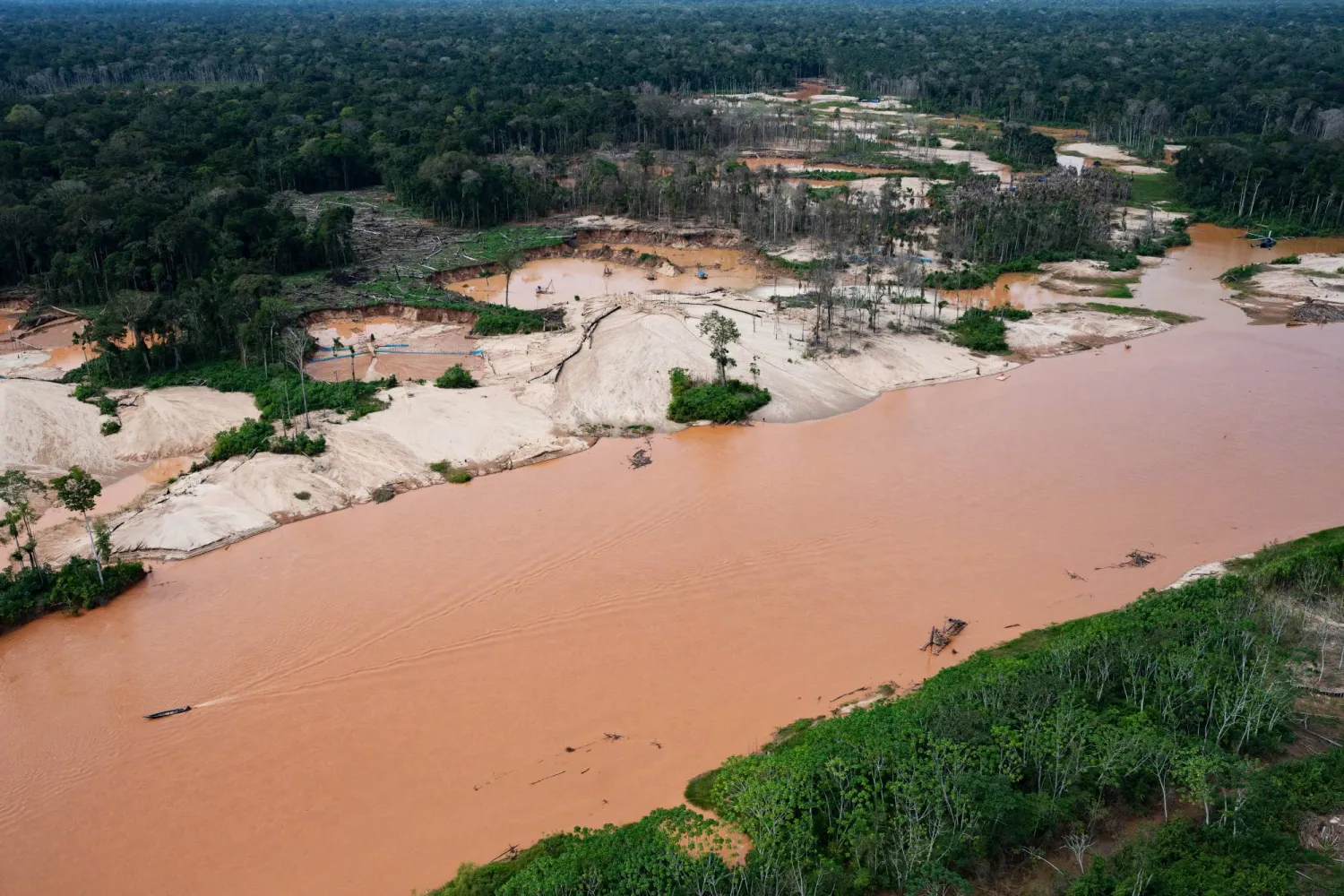
Deforestation from illegal mining borders the Malinowski River in the Tambopata National Reserve in Puerto Maldonado, Peru, Tuesday, Aug. 11, 2026. (AP Photo/Guadalupe Pardo)
TT

Study: Global Deforestation Slowed in 2025 but Surged in Congo Basin

Deforestation from illegal mining borders the Malinowski River in the Tambopata National Reserve in Puerto Maldonado, Peru, Tuesday, Aug. 11, 2026. (AP Photo/Guadalupe Pardo)

Deforestation slowed worldwide last year, but the improvement is unlikely to last as the situation deteriorates in Central Africa and an exceptionally strong El Nino weather pattern intensifies, a new study said on Wednesday.

Seven million hectares of forest -- roughly the size of the Republic of Ireland -- were permanently destroyed in 2025, a 15-percent drop from the previous year, according to the annual Forest Declaration Assessment.

The slowdown, however, is not enough to keep the world from missing a pledge to end deforestation by 2030, according to the report, which was drafted by a coalition of research groups and non-governmental organizations.

The 2025 figure is "encouraging but so far it's the exception, not a new trajectory", Erin Matson, the study's co-author and lead consultant at advisory group Climate Focus, said in a media briefing.

To meet the target, agreed at the United Nations' COP26 climate talks in 2021, deforestation would have to fall by around one million hectares per year.

Clearing forests for agriculture or mining operations remains the leading drivers of deforestation.

Last year's improvement was due in part to progress in Latin America, with a 33-percent drop in what has historically been the world's deforestation "hot spot", according to the study.

The authors pointed particularly to Brazil's deforestation action plan and increased enforcement in the country's Amazon, AFP reported.

Progress in the region, however, "rests heavily on the choices of a small number of governments and remains highly vulnerable" to recent and upcoming elections across the Amazon basin.

Brazil's left-wing leader, Luiz Inacio Lula da Silva -- who has vowed to end illegal deforestation by 2030 -- faces populist right Senator Flavio Bolsonaro in a runoff presidential election on October 25.

Deforestation had surged under the administration of Bolsonaro's father, far-right former president Jair Bolsonaro.
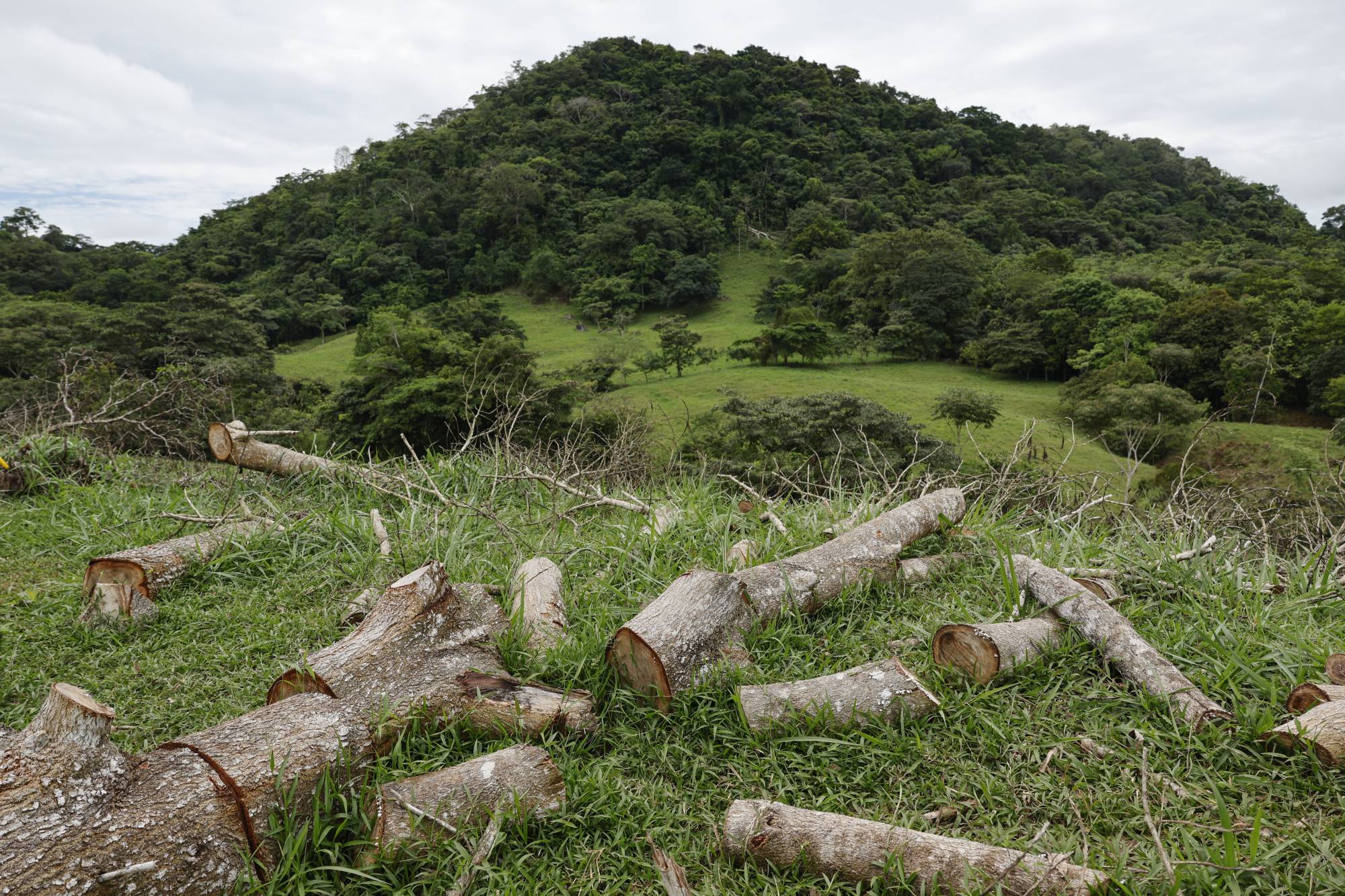
Trunks of a tree in Capira, Panama, 06 October 2026. EPA/Bienvenido Velasco

Progress could also be threatened in Colombia and Peru, where hard-right presidents were recently elected, according to the experts.

Across the Atlantic in Africa, the situation deteriorated in the Congo basin, where rainforest loss reached 2.4 million hectares -- near the same level of deforestation as the Amazon for the first time.

"Losing such a size of forest every year is a disaster," said Sam Nguiffo, a lawyer and founder of the Centre for Environment and Development in Cameroon.

"As humanity, we clearly cannot afford that because it will be totally irreversible," he said.

Logging for timber or felling trees for agriculture or mining appear to prevail in forest management in Central Africa, Nguiffo said.

Deforestation has a "massive impact on the cultural identity and on the livelihood of local and indigenous communities", he said.

"The erosion of the forest, both in size and in number of species, reduces the space available for communities and fuels conflicts," the lawyer added.

El Nino, the warming phase of a natural climate cycle, also threatens progress because its effects include droughts, creating conditions for wildfires.

The current El Nino event, which emerged in June, is expected to peak later this year but is already shaping up to be the strongest ever observed.

El Nino has been associated with strong drought in Indonesia, where tracts of forest and plantations have been burning in biodiverse Borneo and South Sumatra for months.

"If projections of the historically strong 2026-27 El Nino materialize, drought and fire risks will intensify further across tropical forest regions," the deforestation report said.

Matson, of Climate Focus, noted that there was a "huge spike" in tree cover loss during the last "super" El Nino event in 2015-2016.

"We can't fully predict the future but it's unlikely, I would say, that in 2026 we'll see the same kind of reductions (in deforestation) that we saw last year," she said.



Missing Teen Found Alive After 6 Days in Australian Woodlands

In this image made from video and provided by the Victoria State Police 17-year-old William, center right, is embraced by his mother Elizabeth, only first names were provided by police, while in a helicopter in Cowwarr, Australia, Thursday, Nov. 12, 2026, after William spent six days lost in eastern Australian woodlands. (Victoria Police via AP)
TT

Missing Teen Found Alive After 6 Days in Australian Woodlands

In this image made from video and provided by the Victoria State Police 17-year-old William, center right, is embraced by his mother Elizabeth, only first names were provided by police, while in a helicopter in Cowwarr, Australia, Thursday, Nov. 12, 2026, after William spent six days lost in eastern Australian woodlands. (Victoria Police via AP)

A 17-year-old boy with autism was found alive Thursday after six days lost in eastern Australian woodlands.

The boy, whom police identified only as William, had begun camping with a teenage friend when he disappeared last Friday near Walhalla, a former gold-mining town 185 kilometers (115 miles) east of Melbourne, police said.

A police helicopter crew found him surrounded by wilderness lying asleep on a flat rock beside a creek, and he was later reunited with his mother. William was in good spirits and mostly in good health, the police statement said.

Video shot from the rescue helicopter showed he was shirtless and sunburned. He was wearing shorts and boots and was using towels as blankets.

“I’m just over the moon that he’s alive,” his mother, Elizabeth, told reporters.

The AP has decided not to provide her family name to avoid identifying her son.

“And he’s never leaving the house again. He’s grounded for life. He’s not going anywhere ever again,” she joked.

William was later taken to a hospital for his health to be monitored, police said.

William's family have said he has Level 2 autism. That requires “substantial support,” according to the Australian advocacy group Autism360.

Such a person may have marked deficits in verbal and non-verbal social communication and rely heavily on routines and predictable activities.

Disruption can cause significant distress.

The Southern Hemisphere spring weather had been mild for the past week in the alpine region where William was lost and there had been little rain.

Elizabeth had dropped off her son and his friend last Friday for a weekend of camping. William walked a short distance from the campsite to the drop-off location to collect more camping equipment but never returned to his friend, police said.

After becoming lost, William trekked for days up and down “some very steep terrain,” Acting Police Inspector Jason Benbow said.

He spent the last two days where he was found at the creek, trapped by the steepness of his surrounds 2 kilometers (1.2 miles) from his camp site, Benbow said.

“He woke up to the sound of the helicopter, gave them a thumbs up and they winched him to safety,” Benbow told reporters.

The extensive police search for him involved more than 100 emergency services personnel and volunteers.


Europe’s Hera Spacecraft Begins Close Inspections of an Asteroid Rammed by NASA in a 2022 Test

This undated image provided by the European Space Agency on Nov. 5, 2026 and taken by the Hera spacecraft, shows asteroid Didymos. (European Space Agency via AP)
TT

Europe’s Hera Spacecraft Begins Close Inspections of an Asteroid Rammed by NASA in a 2022 Test

This undated image provided by the European Space Agency on Nov. 5, 2026 and taken by the Hera spacecraft, shows asteroid Didymos. (European Space Agency via AP)

A European spacecraft has begun close inspections of an asteroid rammed by NASA four years ago in a planetary defense test.

The European Space Agency announced Wednesday that the Hera spacecraft is now studying Didymos and its moonlet Dimorphos from just 15 miles to 18 miles (25 kilometers to 30 kilometers) away, The AP news reported.

NASA’s Dart spacecraft deliberately slammed into little Dimorphos in 2022 to see whether such a defensive move might help save Earth from a killer space rock one day.

The impact shortened the moonlet’s orbit around Didymos. More importantly, it nudged the moonlet into a slightly different path around the sun.

Next month, the small car-sized Hera, launched in 2024, will venture even closer — just 12 miles (20 kilometers) away.

ESA officials consider this a “crash site investigation” worthy of its finest robotic detective. Hera is carrying 25 science instruments as well as a pair of shoebox-sized Cubesats to survey Dimorphos even more closely and attempt to land on it.

The Dart spacecraft — short for Double Asteroid Redirection Test — sent rubble and even boulders flying off Dimorphos, providing an extra kick to the impact’s momentum. The debris trail extended thousands of miles (more than 10,000 kilometers) into space for months.

Some of that debris could still be in the vicinity, according to scientists.

Dimorphos is an estimated 500 feet (151 meters) in diameter. Didymos is roughly 2,560 feet (780 meters) in diameter.


Euclid Mission Data Release Spans More than 900 Million Galaxies

Looking across vast distances means peering into the past because of the time needed for light from distant objects to reach us (Reuters)
TT

Euclid Mission Data Release Spans More than 900 Million Galaxies

Looking across vast distances means peering into the past because of the time needed for light from distant objects to reach us (Reuters)

The European Space Agency has released its first big collection of data from the orbiting Euclid telescope's mission to map the universe's large-scale structure, including observations of more than 900 million galaxies, as scientists investigate the puzzling cosmic components dark matter and dark energy.

The data unveiled on Thursday covered a survey of the sky equal to about 9,500 times the size of the moon as viewed from Earth. The mission's goal is to complete the largest-ever three-dimensional atlas of the cosmos, spanning more than a third of the sky, in 2031.

Thursday's release encompassed around 13 months of Euclid observations, totaling an enormous 1.7 petabytes — 1.7 million gigabytes — of data, Reuters reported.

"It marks a major milestone for ESA's Euclid mission and for everyone involved," said astrophysicist Valeria Pettorino, ESA's Euclid project scientist.

Euclid, launched from Florida in 2023, is gathering data on how the universe has expanded and how its structure has formed over time while amassing information about the nature of dark energy and dark matter and the role of gravity on large scales.

"Euclid will not just take images of galaxies in the sky, in two dimensions, but will also measure their distance, the third dimension. This will tell us where galaxies are in space and time, across 10 billion years, and in all directions beyond our galactic plane," Pettorino said.

"Galaxies cluster along filaments, surrounded by empty space, and form a network that we call the cosmic web. Euclid will reconstruct the cosmic web and how it has grown over time. This is important because the exact configuration of the cosmic web, how many clusters or voids are there, how fast it changed, depend on the properties of dark energy and dark matter," Pettorino said.

The universe's contents include ordinary matter as well as dark matter and dark energy.

Ordinary matter — stars, planets, gas, dust and all the familiar stuff on Earth — represents about 5% of the contents. Dark matter, known from the gravitational effects it exerts on galactic scales, is invisible material that may make up about 27% of the cosmos. Dark energy, thought to be responsible for the accelerated expansion of the universe, may account for 68%.

Dark matter and dark energy do not emit or absorb light and cannot be directly observed.

Previous Euclid data releases covered only a few days of observations. The newly released dataset includes more than a year of data and still spans only 14% of the total sky area Euclid is due to survey in visible and near-infrared light over six years. This data release will be completed next year with the first results on dark energy and dark matter.

GRAVITATIONAL LENSING

Light traveling toward Earth from faraway galaxies can be bent and distorted by normal matter and dark matter in the foreground, an effect called gravitational lensing. Thus, the nearer galaxy's gravity warps the light coming from the one behind.

Gravitational lensing is one of the tools being used to study dark matter's distribution. The new Euclid data includes about 15,000 strong gravitational lens candidates, exceeding the total number discovered in the previous half century.

"Gravitational lenses are nature's own weighing scales," said Natalie Lines, a doctoral student in astrophysics at the University of Portsmouth in England and a member of the Euclid Consortium of scientists.

"How strongly the light is bent tells us how much matter a galaxy contains, including invisible components like dark matter. With thousands of lenses, we can study how dark matter is spread through galaxies and understand how galaxies form and evolve over cosmic time," Lines said.

Lines noted the sharpness of the Euclid images over a huge area of the cosmos.

"Telescopes on Earth can cover large areas of the night sky, but their view is blurred by the atmosphere. The Hubble and James Webb space telescopes take beautifully sharp images, but only of tiny patches of sky. Euclid does both at once, and that is crucial for finding things that are small and rare, like strong gravitational lenses," Lines said.

Looking across vast distances means peering into the past because of the time needed for light from distant objects to reach us. The most distant objects Euclid has viewed are quasars, the brilliant cores of galaxies powered by supermassive black holes. The telescope has pinpointed 60 million of them.

"Euclid has found some dating back to when the universe was just 5% of its current age, so their light set off around 13 billion years ago," Lines said.