


Isle of Wight Fossil Sheds Light on Enigmatic Meat-eating Dinosaurs

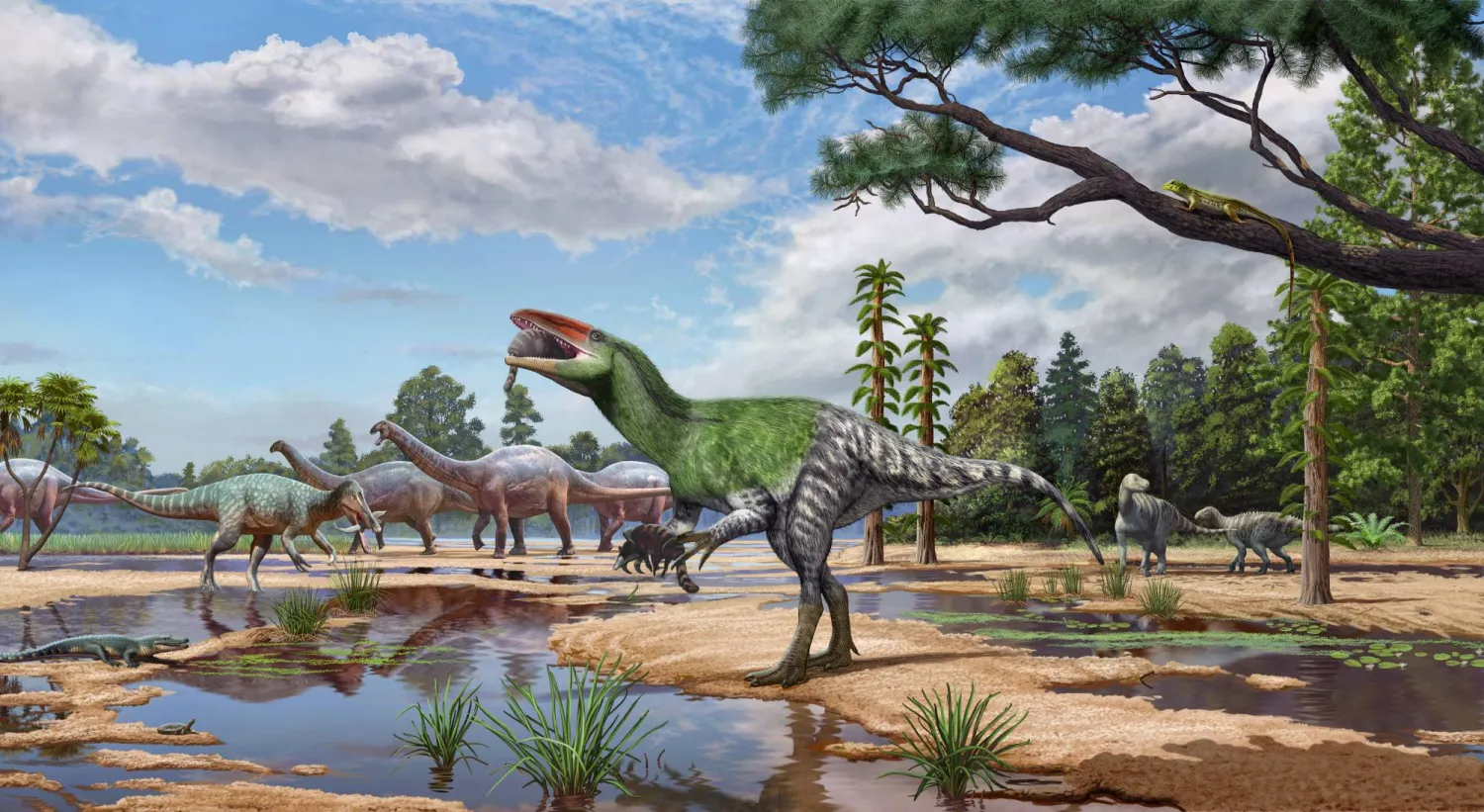
The meat-eating dinosaur Invictibellatrix amberina feeds on a mammal while grasping another in its ecosystem alongside other dinosaurs and other kinds of animals on the Isle of Wight, United Kingdom, in the Cretaceous Period around 120 million years ago, in this illustration released on October 13, 2026. Sergey Krasovskiy and Pedro Salas/Handout via REUTERS
TT

Isle of Wight Fossil Sheds Light on Enigmatic Meat-eating Dinosaurs

The meat-eating dinosaur Invictibellatrix amberina feeds on a mammal while grasping another in its ecosystem alongside other dinosaurs and other kinds of animals on the Isle of Wight, United Kingdom, in the Cretaceous Period around 120 million years ago, in this illustration released on October 13, 2026. Sergey Krasovskiy and Pedro Salas/Handout via REUTERS

The partial skull of a tiger-sized predator that prowled what is now the Isle of Wight off England's southern coast about 120 million years ago is giving scientists a better understanding of an enigmatic group of meat-eating dinosaurs known for running down prey and ripping them apart with massive hand claws.

Researchers said the fossil belongs to a species they have named Invictibellatrix amberina, an early member of the lineage of Cretaceous Period carnivorous dinosaurs called megaraptorans. Invictibellatrix adds to the knowledge of skull anatomy among early megaraptorans and, being the first one known from Europe, helps show how the group spread globally.

Invictibellatrix is one of the smallest megaraptorans. Based on fossils of closely related megaraptorans, the researchers estimated that Invictibellatrix was about 16 feet (5 meters) long, with the weight of a large tiger. Its body may have been covered in filament-like feathers, they said.

Megaraptorans were part of the group called theropods that spans all the meat-eating dinosaurs, Reuters reported.

"Megaraptorans are very unique among theropods because they have relatively small and slender heads but had long and strong arms with massive hand claws as well as very lightly built skeletons," ⁠said Cassius Morrison, ⁠a postdoctoral researcher at the University of Leeds in England and lead author of the study published in the journal Royal Society Open Science.

"These characteristics imply that megaraptorans were agile hunters capable of chasing down prey and using their large arms and claws to catch them and disembowel them using their hand claws," Morrison said.

The largest-known megaraptoran, named Maip, was about 33 feet (10 meters) long, inhabiting Patagonia during the twilight of the dinosaur age, about 50 million years after Invictibellatrix lived.

Littler megaraptorans like Invictibellatrix may have hunted smaller prey like mammals, smaller reptiles and baby dinosaurs. Larger megaraptorans may have targeted bigger plant-eating dinosaurs like duckbilled hadrosaurs and long-necked sauropods, though probably not the biggest ones.

Megaraptorans hunted in the ⁠opposite way from massive predators like Tyrannosaurus rex. Tyrannosaurus employed its large and stoutly built head, enormous teeth and incredible bite strength to kill prey, but had puny arms of little use in hunting.

Invictibellatrix was not the Isle of Wight's top predator, with larger theropods around, alongside various herbivorous dinosaurs, and may have filled a role similar to a hyena today.

There is a debate among dinosaur paleontologists as to where megaraptorans fit on the theropod family tree. Despite differences in how they were built and hunted, one hypothesis is that megaraptorans were closely related to tyrannosaurs, the group that included Tyrannosaurus and others that dominated the landscapes in North America and Asia later in the Cretaceous.

Invictibellatrix means "unconquered female warrior." Morrison noted that after humble beginnings megaraptorans developed into apex predators in South America, Australia and Antarctica, becoming "the ruling queens," while the tyrannosaurs became the "tyrant kings" in North America and Asia.

Scientists are trying to unravel the evolutionary history of megaraptorans. A leading hypothesis has megaraptorans originating in Asia before migrating through Europe into Africa and then on into South America, thriving until ⁠the dinosaurs were doomed by an ⁠asteroid strike 66 million years ago. This hypothesis was lacking fossil evidence because no megaraptorans had been known from Europe until now.

"These findings help to uncover the evolution of one of the most mysterious theropod groups," University College London doctoral student and study co-author Charlie Scherer said.

The Invictibellatrix fossil, a fragmented braincase, was discovered about a century ago and acquired by the Natural History Museum in London in 1924.

"It was left in one of the collection's drawers ever since, and no one noticed it until a couple of years ago," Scherer said.

While Tyrannosaurus may be more imposing than Invictibellatrix, the researchers noted that if a person were somehow transported back in time — like in the recent film "The End of Oak Street" — Invictibellatrix might present more of a danger.

"A smaller theropod like Invictibellatrix would likely have been a much bigger threat to a human than something like T. rex because we would likely be too small for T. rex to see as a worthwhile meal because of how massive it was and the amount of energy it would be required to catch us," Morrison said.

"But we would be the perfect size for something smaller like Invictibellatrix, as we are about a third to a quarter of its weight, making us a good hearty meal and more than just a snack.

Additionally, Invictibellatrix would have the agility and maneuverability to pursue and catch a human."

Egypt Recovers Remains of Napoleon's Sunken Fleet Off Alexandria

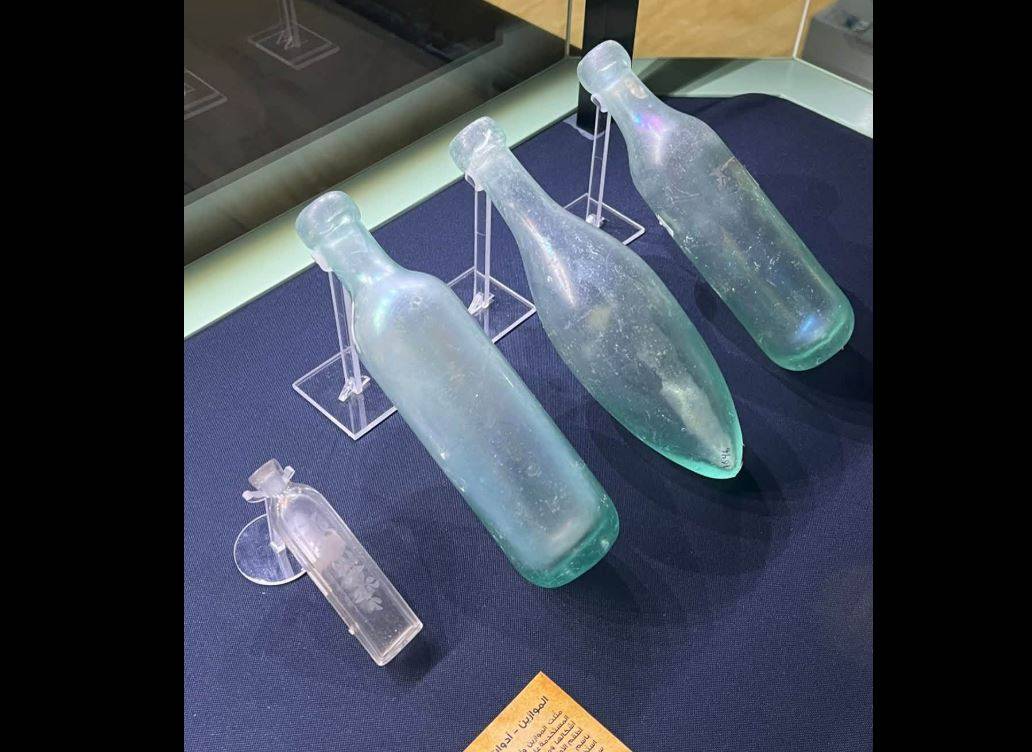
Tableware from Napoleon's sunken fleet (Egyptian Ministry of Tourism and Antiquities)
TT

Egypt Recovers Remains of Napoleon's Sunken Fleet Off Alexandria

Tableware from Napoleon's sunken fleet (Egyptian Ministry of Tourism and Antiquities)

Egypt marked World Underwater Cultural Heritage Day with an exhibition titled "Napoleon's Fleet: Tales Told by the Sea" at the National Museum of Egyptian Civilization (NMEC), highlighting one of the most significant historical events associated with the country's underwater archaeological heritage.

The exhibition tells the story of the French fleet that sank off the coast of Alexandria during Napoleon Bonaparte's campaign in Egypt. Through a collection of archaeological artifacts, it sheds light on the events surrounding the fleet's sinking while offering insights into the daily lives and activities of sailors aboard the ships.

The exhibition features approximately 235 artifacts displayed for the first time, including objects recovered from the wrecks of Napoleon's fleet and selected from the collections of the Department of Underwater Antiquities.

Some artifacts from the sunken fleet (Ministry of Tourism and Antiquities)

Other exhibits come from several museums, including the Maritime Museum, the Alexandria National Museum and the National Museum of Egyptian Civilization, according to a statement issued Monday by Egypt's Ministry of Tourism and Antiquities.

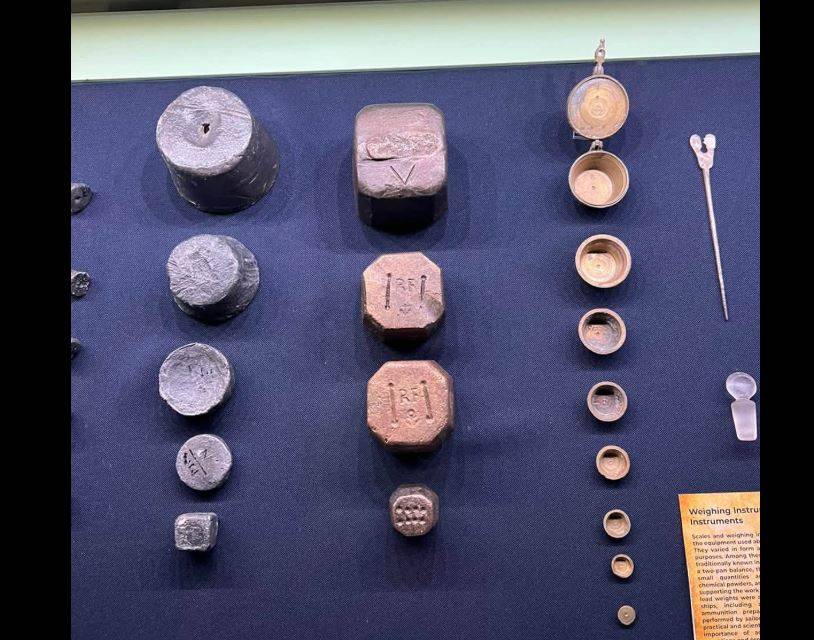
Among the exhibits are gold coins, navigation and writing instruments, cooking utensils used by crew members, and weapons recovered from the shipwreck sites. Together, the objects provide a comprehensive picture of maritime and military life during that period.

The exhibition will run for three months in the Egyptian Textile Hall at the National Museum of Egyptian Civilization.

It forms part of the ministry's efforts to highlight the importance of underwater cultural heritage as a rich source of physical evidence documenting historical events, figures and civilizations.

Such discoveries also contribute to archaeological research and scholarship, allowing historians to reexamine aspects of the past through evidence recovered from the sea.

The exhibition offers visitors an opportunity to explore a distinctive part of Egypt's heritage through original artifacts preserved underwater for centuries, each providing evidence of a significant historical period and revealing stories of maritime life at the time.

Archaeologist Dr. Hussein Abdel-Bassir, director of the Antiquities Museum at the Bibliotheca Alexandrina, said the exhibition's significance lies in its ability to bring back an entire world that disappeared beneath the water, leaving behind details waiting to be rediscovered and interpreted.

Some of the weighing scales used aboard the fleet (Ministry of Tourism and Antiquities)

"On August 1, 1798, Abu Qir Bay witnessed one of the most important naval battles in modern history," Abdel-Bassir explained.

"Napoleon's French expedition had arrived in Egypt just weeks earlier, pursuing an ambitious military, political and scientific project. But the French fleet suffered a devastating blow at the hands of the British fleet under Admiral Horatio Nelson in the Battle of the Nile."

He said the French ships were reduced to wreckage, shattering France's ambitions to dominate the Mediterranean, while the waters off Alexandria preserved the remains of that historic moment.

"What is fascinating is that the sea, which witnessed the struggle between empires, preserved not only the remains of ships and cannons but also details of the everyday lives of the men aboard them," he said.

"A small artifact can sometimes tell history more effectively than a grand monument. A coin, a personal belonging, a piece of tableware or part of a ship's equipment allows us to see history from a human perspective, rather than through the eyes of rulers and generals."

Abdel-Bassir said perhaps the most important lesson offered by Napoleon's sunken ships is that history never truly disappears.

"Sometimes history simply changes its location. It may leave the pages of books for the seabed, or transform from a written account into a silent artifact. But it remains there, waiting for someone to discover it, understand it and bring it to life for new generations," he said.

The archaeologist also described the celebration of World Underwater Cultural Heritage Day, coinciding with the 30th anniversary of Egypt's General Department of Underwater Antiquities, as an important opportunity to reconsider the future of the field.

Three decades of archaeological work, he said, provide an opportunity to assess what has been accomplished and develop an ambitious vision for what should be achieved in the decades ahead.


Denmark to Propose Mobile Phone Ban in Schools in 2027

22 October 2026, Schleswig-Holstein, Kiel: A man's hand reaches for a smartphone. (dpa)
TT

Denmark to Propose Mobile Phone Ban in Schools in 2027

22 October 2026, Schleswig-Holstein, Kiel: A man's hand reaches for a smartphone. (dpa)

Denmark will propose a ban on mobile phones in its primary and lower secondary school system as well as content filtering on the schools' network starting from the new academic year in 2027, the Danish education ministry said ‌on Monday.

Countries ‌including the Netherlands, ‌South ⁠Korea and Italy have ⁠banned smartphones in schools due to concerns over their impact on concentration and behavior, while Poland and the Czech Republic in June proposed ⁠a similar ban.

"Children ‌should be ‌able to go to school ‌without constantly being distracted by ‌things like social media, online shopping, and gaming," Education Minister Magnus Heunicke said in a statement.

The ‌ban also includes other private electronic devices with internet ⁠access.

⁠Content filters will be implemented to block websites that have no educational or pedagogical relevance, including social media, gaming and shopping sites, during lesson time.

It will be up to each municipality and school to decide which websites should be blocked.


Kuala Lumpur Otters Raise River Revival Hopes

This picture taken on October 19, 2026, shows a smooth-coated otter eating a fish along the bank of the Klang River in Kuala Lumpur. (AFP)
TT

Kuala Lumpur Otters Raise River Revival Hopes

This picture taken on October 19, 2026, shows a smooth-coated otter eating a fish along the bank of the Klang River in Kuala Lumpur. (AFP)

Beneath a tangle of highway in the Malaysian capital Kuala Lumpur, a family of otters rolls around in a patch of riverside sand, delighting the few passersby who notice them.

Small groups of otters are now being seen regularly in parts of the city, including along the once heavily polluted Klang River.

Theories vary on whether the smooth-coated otters, classed as vulnerable by the International Union for Conservation of Nature, have returned to the city or were hiding in plain sight all along.

But their presence has raised hopes that efforts to clean up the Klang may be bearing fruit, and could inspire further improvement.

The Klang was once one of the world's dirtiest waterways, designated a Class 5 severely polluted river under Malaysia's rankings.

Years of work improved it to Class 3, or moderately polluted, which seems to have encouraged the otters to move in, said Malaysian wildlife ecologist Woo Chee Yoong.

"Wherever there are otters, there are fish. Wherever there are fish it means the whole river system... (is) clean, it's healthy for all the communities around. So that's one of the importance of otters," he said.

In recent years, the animals have been filmed sunbathing on the river's concrete banks and swimming in front of elevated metro stations, winning viral fame.

Retired soldier Hasan Ujang, who lives in a riverside apartment, enjoys watching their antics.

"We feel really happy when we watch them playing and playing, like kids swimming," he said.

- 'They have to survive' -

But unlike otters in neighboring Singapore, which are closely monitored by a network of citizen scientists, little is known about Kuala Lumpur's otters.

Woo learned about them from local media reports on sightings in 2019 and the following year co-founded the Malaysian Otter Network (MON) conservation group.

"We don't know how many groups are there, we don't know how actually the otters are moving around," he said.

Even the question of whether the otters have returned to the capital or were simply in less visible city environments before remains a "mystery."

MON hopes to set up a citizen science system for people to report sightings.

Otters have been spotted elsewhere in the city, including at the Tropicana Golf & Country Resort, a high-end housing estate where they are less welcome visitors.

They are accused of raiding at least 12 houses in the past year. Their target: fish ponds.

Resident Yee Sze Mun, 89, said otters killed the beloved -- and expensive -- arowana fish he had nurtured for 15 years.

"They are a nuisance, but I can't blame them, because they are just like us, they have to survive," he said.

Residents say the incursions began last year after a company began clearing forest next door for a new development.

"We have an issue because they're losing their habitat," said residents' association president Joy Appukuttan, who called the otter attacks a "grave concern."

Tropicana's security team believes there are around 25 otters in the forest and the estate brought in Woo to teach residents how to deal with them.

The species is protected in Malaysia, so Woo urges residents to block entry points to their yards and install fences or netting over ponds.

- 'An asset' -

Maimunah Mohd Sharif, a former Kuala Lumpur mayor and now advisor to the city on sustainable urbanization, call the otters an "asset."

"Otters are one of the benchmarks for clean cities," she said.

Like others, she hopes a growing awareness of the Klang River otters can be harnessed to help improve the river further.

Hundreds of garbage traps were installed as part of the government's River of Life project, and solar-powered "interceptors" deployed by a Dutch NGO have collected tens of thousands of tons of waste.

Now Maimunah wants to see more done to stop waste entering the river in the first place, and efforts to make the Klang Class 2B status, clean enough for body contact.

"One day, I want to swim in the Klang River," she said.

Scarlett Koon Si Qi, a community architect and co-organizer of the annual Klang River Festival hopes the waterway can be restored to its natural banks without concrete lining.

"Some parts, maybe yes, you do need concrete to kind of protect and control for floods," she said.

"But I think wherever we can, we should leave it as natural as possible."

That would further benefit the otters, who need some vegetation and natural crevices to hide in, experts said.

The otters are already shifting views on the river, said Faith Foo, who runs the festival.

Growing up, "the teachers would always say that this is a very unsanitary place," he said.

But seeing the otters, "it's a reminder that that is a river."
