


Tiny Fiji Village Restores Dying Fishery with Coral Planting

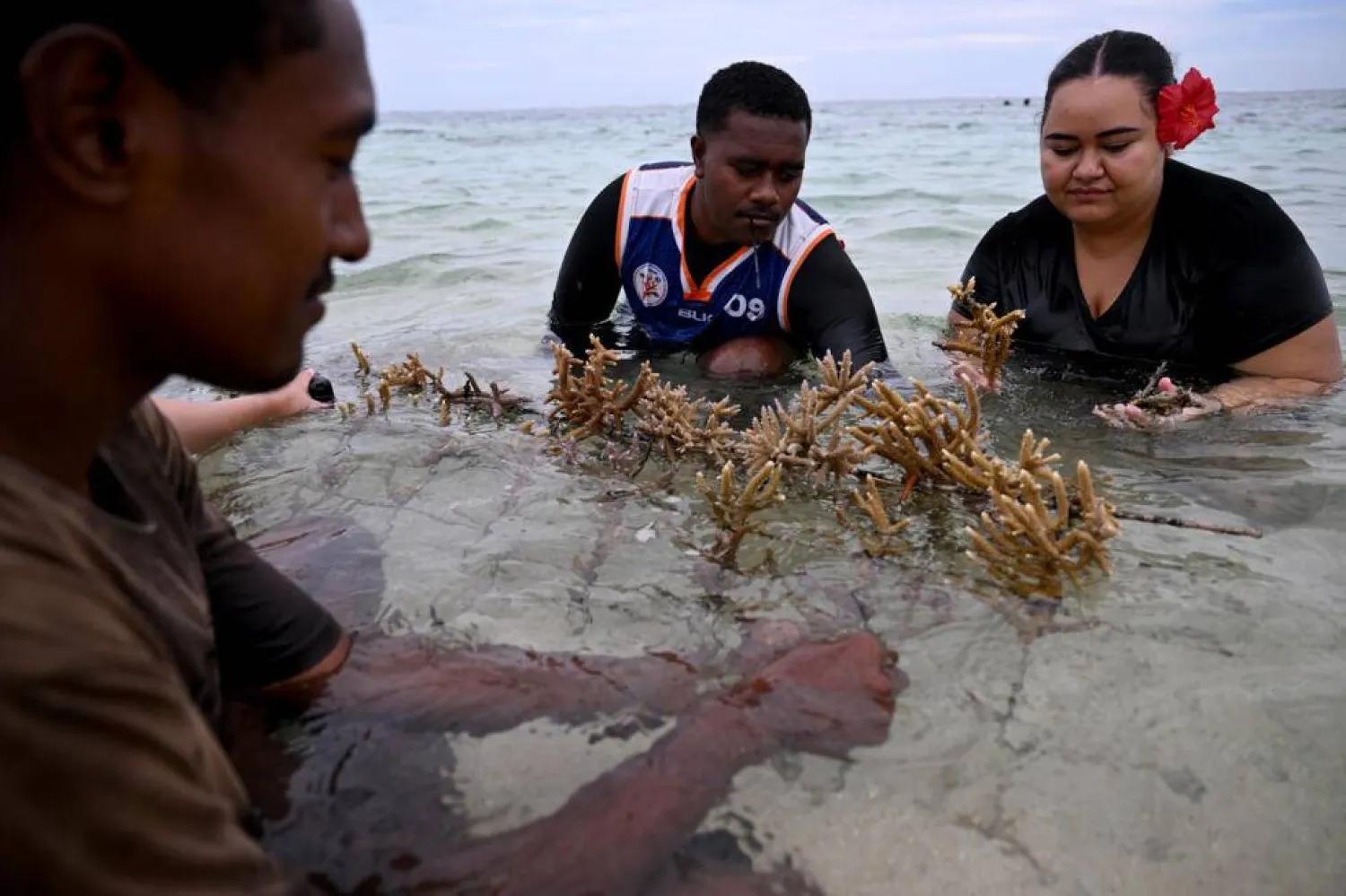
Villagers and environment advocates plant coral in the sea within the Naidiri Marine Biodiversity Park. Saeed KHAN / AFP
TT

Tiny Fiji Village Restores Dying Fishery with Coral Planting

Villagers and environment advocates plant coral in the sea within the Naidiri Marine Biodiversity Park. Saeed KHAN / AFP

It had been decades since sharks last patrolled the reef off the coast of Fiji's Naidiri Village, but they returned this year following a community-led effort to protect the fishery and plant thousands of corals.

Manoa Duwai convinced his village in 2009 to create a protected area within their customary fishing grounds on Fiji's Coral Coast after concerns over the small number and size of fish he was catching.

At the time, he was lucky to catch a fish as big as his palm.

"Man, imagine 10, 15, 20 years to come, what we going to have," Duwai said after a fishing trip one night yielded only tiny, juvenile fish.

"What type of species are we going to have left in our customary fishing ground? We have to do something," he said.

Duwai approached village elders with a proposal to protect part of their fishing grounds, originally a 30-by-40-metre area within the reef.

It didn't take long for the plan to bear fruit, with larger fish finding a home in the protected area and then spreading into the neighboring waters.

In time, the village increased the size of the protected area to 280 by 240 meters. It is now flanked by a similar-sized area they call "the fridge", which they temporarily closed as a way to build up fish stocks.

Duwai's vision for a plentiful marine habitat that would sustain his village of 147 people has now received global praise, with academics and charities seeking his insights.

- Youth ownership -

Joseva Kunagado, 21, leads the youth of Naidiri Village in preserving the health of their protected area.

The village formed a youth group in 2011 to manage what they call the "tabu area", and the group leads the effort to plant corals and encourage a healthy ecosystem.

In 2023 alone, the group planted 18,000 corals and 10,000 mangroves.

"When we started this we were small kids," Kunagado told AFP.

"We used to take some barrels, cut it in half, tie the rope on it, and we pull it. We have to walk for maybe 20 minutes to get corals, come back and plant.

"From that to today, we can say that we are very happy on the work that we have done because we've seen big changes."

The protected area Kunagado and his friends have cultivated is bursting with corals and is now home to hundreds of heat-resistant "super corals" that may protect the village from the impacts of rising sea temperatures.

Sharks have started returning to the area.

Far from being scared, Duwai said he shed a tear when they came back this year.

"When things started to come back, different types of fish species, invertebrates, all back, I'm like the most happiest person in the whole village," Duwai said.

Kunagado said he'd seen sharks the morning of AFP's visit. He smiled with pride at the state of the fishery.

"We didn't see this coming, like having tourists coming, having researchers, students from universities coming. So we're proud of the work."

- Super corals -

Researchers are interested in not only how Naidiri Village has protected their marine ecosystem, but also specific corals showing extraordinary heat resistance.

Duwai said water temperatures reached up to 39C during a heatwave earlier this year, and there was widespread bleaching of the thousands of planted corals.

At those temperatures, most of the coral should have died, but Duwai said 20 percent survived and are considered "super corals".

"The only corals we have here now are the ones who survived this 38, 39 degrees."

Duwai said Naidiri is now transplanting their heat-resistant corals to deeper, cooler waters close to the capital Suva to further protect from future heatwaves.



2026 ‘Most Likely’ to Be Second-Hottest Year on Record, Says EU Monitor

Vehicles drive over the Woodhead reservoir amid a drought near Manchester, England, Aug. 13, 2026. (AP)
TT

2026 ‘Most Likely’ to Be Second-Hottest Year on Record, Says EU Monitor

Vehicles drive over the Woodhead reservoir amid a drought near Manchester, England, Aug. 13, 2026. (AP)

The world is on track for 2026 to be the second-hottest year on record as an exceptionally strong El Nino weather pattern turbocharges human-driven global warming, the EU's climate monitor said Friday.

This year still has a "20 percent chance of tying or exceeding" 2024 as the warmest ever seen, the Copernicus Climate Change Service said in a monthly bulletin.

Global temperatures are now "virtually certain" to exceed 1.5C above pre-industrial levels in 2026, Copernicus said.

The four-year average from 2023 to 2026 is also expected to top 1.5C, the preferred limit set in the Paris Agreement to avert the worst impacts of climate change.

The world experienced its warmest October on record, with average global surface air temperatures 1.75C above pre-industrial times, an era defined as 1850-1900, Copernicus added.

It was the third straight month exceeding 1.5C.

"October has continued the pattern of remarkable global warmth, with record global and surface ocean temperatures," said Samantha Burgess, strategic lead for climate at the European Centre for Medium-Range Weather Forecasts (ECMWF), which operates Copernicus.

"An exceptionally strong El Nino is adding further heat to a climate already warmed by human activities," she said.

The latest bulletin comes as nations prepare to meet on Monday for the UN's two-week COP31 climate summit in Türkiye after a year marked by deadly floods in Nepal, searing heatwaves in Europe and major wildfires in Indonesia.

- El Nino has yet to peak -

Global forecasters have been warning for months that this El Nino, which is expected to peak later this year, would likely become the strongest ever observed.

The intensifying weather phenomenon set an all-time temperature record in a key Pacific zone last month, Copernicus said.

The warming phase of a natural climate cycle, El Nino temporarily raises sea temperatures in the tropical Pacific, triggering changes in weather that can increase the risk of drought and flooding, and exacerbate man-made global warming.

Forecasters say El Nino could help make 2027 the hottest year on record.

Nations agreed at the 2015 UN climate talks in Paris to keep global warming "well below" 2C above pre-industrial levels, while pursuing efforts to limit it to 1.5C.

But the United Nations declared in September that the long-term 1.5C target would be missed in a matter of years.

Scientists say it is crucial to reduce greenhouse gas emissions from fossil fuels to limit the period of "overshoot" above 1.5C and bring temperatures back down as quickly as possible.


China’s Marriage Rate in Third Quarter Tumbles to 18-Year Low

Women take a selfie with a cat statue displayed near autumn-colored ginkgo trees as visitors tour Zhongshan Park in Beijing, Wednesday, Nov. 4, 2026. (AP)
TT

China’s Marriage Rate in Third Quarter Tumbles to 18-Year Low

Women take a selfie with a cat statue displayed near autumn-colored ginkgo trees as visitors tour Zhongshan Park in Beijing, Wednesday, Nov. 4, 2026. (AP)

China's ‌marriage rate for the first nine months of this year plummeted to its lowest level in 18 years, fueling concerns about declining births and demographic strain.

A total of 4.65 million couples got married from January to end September, while 2.08 million couples divorced, according to ‌data from ‌the Ministry of Civil Affairs ‌published ⁠this week.

The ⁠number was the lowest in 18 years, local news outlet Yicai reported on Friday.

Chinese authorities have rolled out a range of measures in recent years to encourage marriage and childbearing, including family subsidies, ⁠childcare support, and reduced childbirth-related medical ‌costs.

They have ‌also pledged to integrate youth development into urban ‌planning, housing, healthcare, education and public services, ‌in a broader push to make urban life more supportive for young people, children and families.

Despite these efforts, China is now ‌supporting more elderly people than children, with the old-age dependency ratio surpassing that ⁠of ⁠children.

China's population fell for a fourth consecutive year in 2025, as its birth rate dropped to a record low, prompting demographers to warn of further declines.

The number of women in China of reproductive age, defined by the United Nations as 15-49, is set to drop by more than two-thirds to under 100 million by the end of the century.


Türkiye Outlines Plans for ‘Paradigm Shift’ in Energy Use Ahead of Climate Summit

Türkiye’s Energy Minister Alparslan Bayraktar attends the plenary session of the Russian Energy Week international forum in Moscow, Russia, October 16, 2026. (Reuters)
TT

Türkiye Outlines Plans for ‘Paradigm Shift’ in Energy Use Ahead of Climate Summit

Türkiye’s Energy Minister Alparslan Bayraktar attends the plenary session of the Russian Energy Week international forum in Moscow, Russia, October 16, 2026. (Reuters)

The Turkish energy minister has laid out plans for his country to wean itself away from coal and other fossil fuels as it prepares to host the COP31 climate change summit.

World leaders are due to arrive next week in the Mediterranean city of Antalya, and Türkiye’s hosting of the annual environmental conference has thrown a spotlight on its own coal, oil and gas usage.

Türkiye is Europe’s largest coal power generator, according to energy think tank Ember. The Turkish Energy Ministry says coal remained its largest source of power last year, accounting for 33% of generation. The share of solar and wind in electricity generation stood at nearly 23%.

Energy Minister Alparslan Bayraktar revealed the National Energy Plan 2040 to reporters in a presentation made public Friday, in which he said Türkiye would aim to transition from coal to cleaner energy sources — a process known as electrification. This would help it fulfill its pledge to reach net zero emissions by 2053.

“When we reach 2040 we are going to reduce our emissions by 40%. This big change in electrification will make this happen,” he said, adding that the use of solar and wind energy sources would more than quadruple over the next 13 years.

“Our aim is to reach 36% electrification by the year 2040,” he told a news conference in Istanbul. Using transport as an example, Bayraktar said the number of electric cars on Türkiye’s roads would increase from around 500,000 to 20 million in the next 13 years.

The aim of the plan is to produce a “paradigm shift” in how energy is used in Türkiye. “We have a huge project list ahead of us,” the minister added.

Huge level of investment needed

Such a shift, however, would require a huge level of investment — $500 billion in the next 13 years, some $210 billion of which would come from Turkish public sector companies with much of the rest from foreign investment.

“If the world is serious about carbon neutrality and if we would like to fund (fighting) climate change and global warming, we need to find the money,” Bayraktar said. “Everyone needs to take some responsibility and provide money for that.”

He also emphasized the importance of a transition from coal to clean energy that would not negatively impact communities reliant on mines and power stations for employment.

“We are looking for a just transition from coal to relatively cleaner sources of energy... but we need coal for security of supply,” he said.

“Equally important is that (coal mining) is providing at least 30,000 to 40,000 people with employment and labor opportunities. How are we going to make these miners into AI experts or high-tech experts? It’s not going to be easy. We need a just transition period.”

Despite aiming to break away from coal, Türkiye will remain tied to other fossil fuels, particularly natural gas, for the foreseeable future.

Türkiye recently started drilling gas reserves in the Black Sea and Bayraktar said production would double to 7.5 billion cubic meters annually in the coming years.

Growing nuclear power

Another key area would be nuclear power. The Akkuyu nuclear power plant on the Mediterranean coast is nearing operation and there are plans for another nuclear station by the Black Sea.

These would contribute towards the “very ambitious target” of Türkiye becoming energy independent by 2040, Bayraktar said.

Turning to the “turbulent times” facing energy markets, Bayraktar described how sanctions around the wars in Ukraine and Iran were impeding efforts to fight global warming.

“We are trying to become carbon neutral in less than three decades’ time and with all these difficulties it’s very difficult to achieve this,” he said.

According to the Climate Action Tracker, which measures countries’ progress against goals of the 2015 Paris Agreement, Türkiye’s climate targets and policies are “critically insufficient.”

The agreement set a target of limiting global temperature rise to 1.5 degrees Celsius (2.7 degrees Fahrenheit) compared with the early 1800s.

Looking ahead to COP31, Bayraktar said his key message would be for countries to adopt “responsive and realistic policies” to achieve carbon neutrality.