China’s Tourists Flock to Experience Pretend Typhoon as ‘Dark Tourism’ Flourishes

Participants brace for surging water in a flash flood simulator at the Lvxing center in Hangzhou (Reuters)
TT

China’s Tourists Flock to Experience Pretend Typhoon as ‘Dark Tourism’ Flourishes

Participants brace for surging water in a flash flood simulator at the Lvxing center in Hangzhou (Reuters)

When Leon Lv was looking for somewhere to travel last year, she turned to the Chinese social media app RedNote for ideas. The algorithm took her to videos of people struggling to survive typhoon-strength winds and flash floods.

“I never experienced a typhoon. I don’t know how it will feel and what will happen. I just have seen it on the news,” said the 28-year-old from Chongqing in southwest China. “So that’s why I want to go there to have a safe place to experience it and learn something.”

She travelled more than 1,300 kilometers to Hangzhou in the east, and joined a group of 20 to take part in a disaster simulation that featured a typhoon-fueled flooding scenario, according to The Guardian.

Standing in a simulated flood, her mind momentarily went blank as hundreds of tons of water swept people off their feet, and carried them towards a safety barrier.

As the surge hit, she forgot she was in a simulation. “One thing I learned is how to stay calm and protect myself during a flood. I learned how to use the right body position to stay safe,” she said. “No book and no school [can] teach me like that.”

Across Chinese social platforms phrases like “paying to suffer”, or “paying to buy fear” are trending online as part of a wave of interest in experiences known as “dark tourism.”

Lvxing Base, a company in Hangzhou offering simulated disaster experiences has gone viral. The founders spent 10 years making documentaries in some of the world’s most extreme environments.

At a 200,000 square meter facility, which opened in 2024, they simulate extreme weather conditions like typhoons and mudslides, giving participants the experience of what it would be like in a disaster.

“I don’t deny that many people come because they want excitement,” said general manager Wang Kuanghan. "They want to see what this place is like, what a real typhoon and torrential rain feel like, and whether they themselves can withstand it. Most of our individual customers are between 20 and 30 years old.”

It plans to open five more centers across China within the next three years. It also plans to create earthquake and fire simulations.

Extreme weather has become increasingly common in China. In 2025, China recorded its highest number of hot days since records began, and was hit by 10 typhoons, well above the long-term annual average.

China’s ministry of emergencies reported that 67 million people were affected by such disasters across the country.

The new generation of Chinese travelers want to experience a place rather than simply see famous attractions,” said Robert Li, director of the School of Hotel and Tourism Management at the Chinese University of Hong Kong.

But some travelers have found a way to blend the two approaches; rather than indulging in the white-knuckle ride of a simulated typhoon, they are travelling to real sites of death and destruction.

In May 2008 a magnitude 8.0 earthquake devastated towns in China’s Sichuan province, killing more than 70,000 people.

Alice, a 30-year-old writer from Sichuan walked around Beichuan, one of the affected towns, the ruins of which the government had preserved. Metal beams hold collapsed buildings in place for the public to visit. She saw the site where schools collapsed, crushing students inside.

“I felt scared because of the power of nature and how many children and students could not escape from it,” said Alice, who plans to start a Chinese language Substack account detailing her journeys into tragedy. “Everything was so broken. It became like a ghost town, because nobody lives in the old town anymore.”

Alice believes dark tourism helps a country reconcile with its past, even if the government decides what can be remembered.


"Lebanon in Every Shade": More Than 60 Paintings Capture the Land of the Cedars

Artist Jessy Tabet in front of a selection of her paintings (Rebirth Beirut)
TT

"Lebanon in Every Shade": More Than 60 Paintings Capture the Land of the Cedars

Artist Jessy Tabet in front of a selection of her paintings (Rebirth Beirut)

In acrylic paintings where bright colors intertwine to transport viewers into a dreamlike world, Lebanese artist Jessy Tabet presents her works in an exhibition titled "Lebanon in Every Shade" at Rebirth Beirut.

Clustered houses, clear skies and brilliant sunshine are recurring elements in her paintings, inviting viewers into a dreamlike journey across Lebanon, from one region to another. Traveling from north to south, Tabet photographed landscapes that caught her attention before reimagining them through her brush, highlighting details of a country she has always loved and never left.

Across canvases large and small, the artist explores Lebanon's defining symbols, from its enduring cedars to its blue sea and towering mountains.

She has devoted paintings to these subjects, giving them titles inspired by their themes. Some works form artistic series, including "The Cedar" and "Little Shadows of Lebanon," which brings together scenes from different Lebanese regions.

Individual paintings capture particular moments and landscapes, such as "Batroun and the Orange Sunset" and "Coastal Reflections," which explores the Lebanese coastline. The mountains also have a place of their own, with houses and hills depicted in "Mountain Harmony."

Speaking to Asharq Al-Awsat, Tabet said she had traveled through different parts of Lebanon, discovering scenes that inspired her.

"I would photograph them and then rush back to my studio to paint them in my own way. I don't simply copy what my camera captures. I interpret what I see and complete it through my own artistic vision," she said.

Tabet believes her choice of colors reflects the beautiful Lebanon she has always seen through her own eyes.

By choosing pink as the background and dominant color in some of her works, she sought to invite viewers into a world of imagination.

"When visitors contemplate a painting, they feel as though they have entered a moment of meditation and relaxation. They leave their worries and problems behind and embark on an artistic journey through Lebanon," she explained.

Asked why houses and Lebanese architecture feature so prominently in her paintings, Tabet said: "Homes are the soul of a person, their anchor in their homeland. They embrace people's emotions, exhaustion, moments of rest, family life and sense of togetherness."

"In my view, these houses clearly reflect the Lebanese way of life, filled with emotion and tranquility despite the tragedies people face. I also focused on details such as open windows, arched balconies and red-tiled roofs to revive scenes from a heritage dear to our hearts."

In her "Cedars" series, Tabet depicts Lebanon's national symbol in meticulous detail, crowned with rich green foliage and touched with gold and white, transforming the cedar tree into a visual narrative of history.

Its sturdy roots appear to clasp two enormous hands, while branches full of life extend outward, seemingly immune to withering.

In "La Vie en Rose," a cluster of closely packed houses welcomes visitors through open doors. A closer look reveals residents going about their daily activities or enjoying moments of relaxation.

Through these scenes, Tabet preserves a sense of constant movement, giving her paintings a feeling of life and serenity.

She said Lebanon's sea, stretching along the country's coastline, has profoundly influenced her because of the stillness and clarity it inspires.

She paints its waters shimmering in the light, reflecting a way of life where warmth, tranquility and harmony come together.

Tabet considers each painting a piece of Lebanon.

"Anyone who acquires one of my paintings takes home a memory of their homeland, something they can enjoy looking at at any moment. It is like a remedy that eases the longing for home among those living abroad and soothes the wounds of war and destruction for those who remain," she said.

Part of the proceeds from painting sales will support Rebirth Beirut's humanitarian and development initiatives, which aim to revitalize the capital and rehabilitate its infrastructure, including street lighting and traffic signals.

Reflecting on her artistic approach and the meanings carried by each painting, Tabet concluded:

"I love following the path of my brush and engaging in long conversations with it. When the words stop and silence takes their place, I know the painting is finished, and I move on to another."

"With every painting, I dream and rise into a more beautiful world, where imagination has room to expand and colors are freed from the boundaries of reality."


Pakistani Astronaut to Join China's Next Space-station Mission

FILE - The Shenzhou-23 manned mission launches from the Jiuquan Satellite Launch Center in Jiuquan, northwestern China on Sunday, May 24, 2026. (AP Photo/Ng Han Guan,File)
TT

Pakistani Astronaut to Join China's Next Space-station Mission

FILE - The Shenzhou-23 manned mission launches from the Jiuquan Satellite Launch Center in Jiuquan, northwestern China on Sunday, May 24, 2026. (AP Photo/Ng Han Guan,File)

A Pakistani astronaut will become the first foreigner to visit China's space station when they join the country's next mission into orbit, Beijing's manned space agency said on Saturday.

Pakistan and China are close diplomatic and strategic partners, and signed a deal in February 2025 setting up a Chinese government training program for Pakistani astronauts.

The Pakistani astronaut will take off with the Shenzhou-24 crew, the China Manned Space Agency (CMSA) said on social media.

According to AFP, the statement did not give a date of departure, but the mission is expected to take place by the end of the year.

The Pakistani astronaut, a payload specialist, will join a short orbital flight before returning with the Shenzhou-23 spaceship, which docked at the Tiangong space station in May, according to the CMSA.

The agency did not name the Pakistani crew member, but said in April that astronauts Muhammad Zeeshan Ali and Khurram Daud had been chosen to start training in China.

Beijing has invested heavily in its space program in recent years -- catching up with its main rival the United States -- and aims to land astronauts on the Moon by 2030.

Pakistan is a natural partner, given the countries often tout their decades-long, "all-weather" friendship. China is Pakistan's largest trading partner and a major foreign investor.

Under the 2025 deal, following training in China, the Pakistani astronauts will carry out short-term missions with Chinese counterparts over the "next few years,” Beijing's state news agency Xinhua reported at the time.


China's Giant Pandas Make Public Debut at US Zoo

Ping Ping, a giant panda on loan from China, is seen in his new habitat at the Arthur M. Blank Panda Grove, at Zoo Atlanta in Atlanta, Georgia on November 6, 2026. (Photo by Elijah Nouvelage / AFP)
TT

China's Giant Pandas Make Public Debut at US Zoo

Ping Ping, a giant panda on loan from China, is seen in his new habitat at the Arthur M. Blank Panda Grove, at Zoo Atlanta in Atlanta, Georgia on November 6, 2026. (Photo by Elijah Nouvelage / AFP)

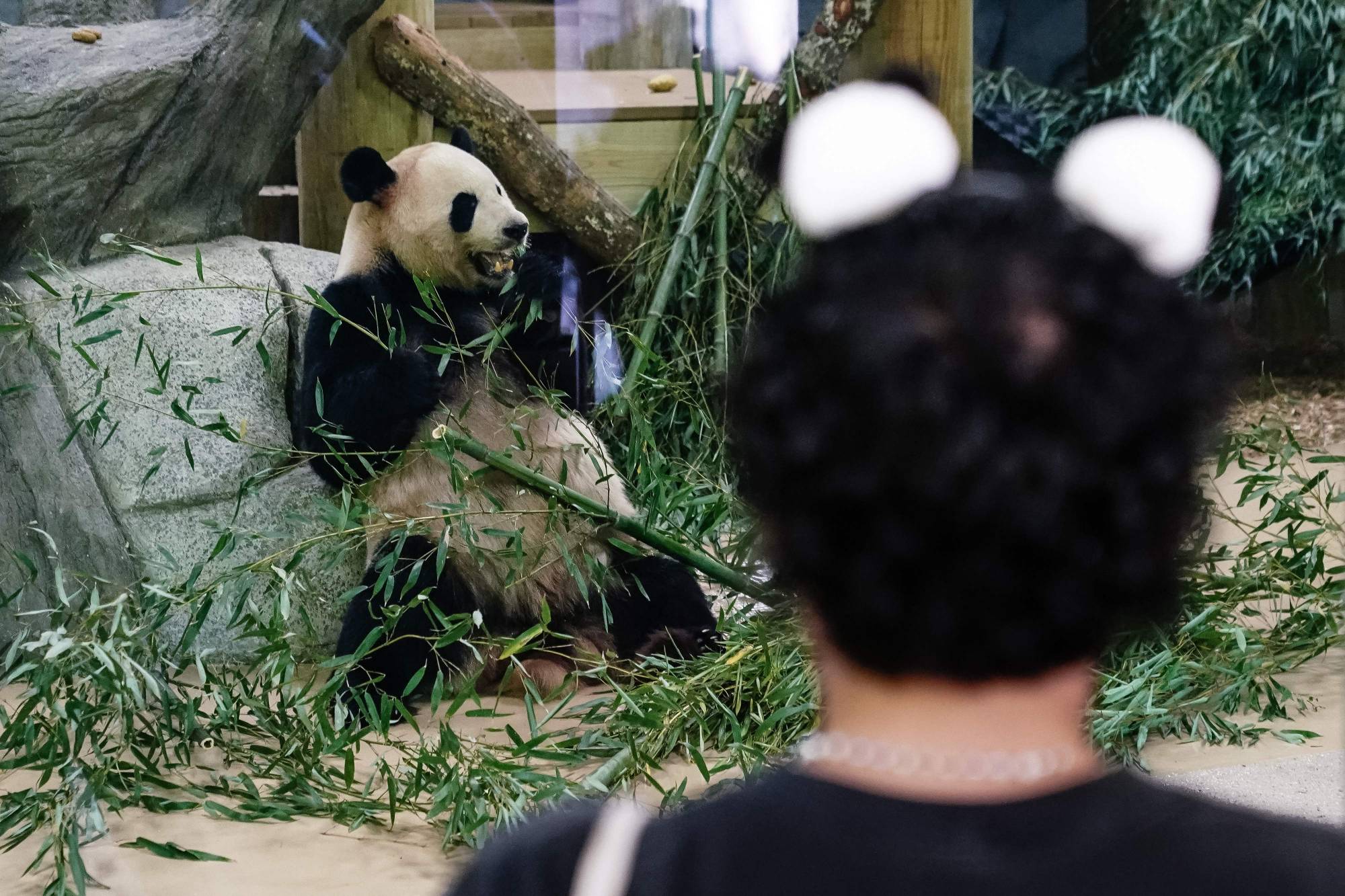
Giant pandas Ping Ping and Fu Shuang delighted visitors to Zoo Atlanta during their public debut Friday, chewing bamboo and lounging in their new US habitat while on loan from China.

A male named Ping Ping and female Fu Shuang arrived from Chengdu in September via a FedEx flight dubbed the "Panda Express," and are to be hosted in the southern US facility for the next 10 years.

Pandas are "animals that have got a unique ability to inspire curiosity, instill passion, evoke joy, and unite people around the globe," CEO Raymond King told onlookers at Zoo Atlanta.

"This extraordinary spirit of partnership helps create a future for a species that is truly beloved the world over."

In preparation for their arrival, Zoo Atlanta has renovated its panda facilities and assembled a team of animal caretakers.

It has also ensured a stable and long-term supply of bamboo, grown locally in Atlanta, which has a climate that is very similar to Chengdu.

"I think they inspire happiness," zoo visitor Rachel Totts told AFP on Friday. "They make people smile. I've never seen someone not say 'Oh, it's so cute!' when they're looking at a panda."

A zoo-goer watches Ping Ping, a giant panda on loan from China, in his new habitat at the Arthur M. Blank Panda Grove, at Zoo Atlanta in Atlanta, Georgia on November 6, 2026. (Photo by Elijah Nouvelage / AFP)

Native to temperate forest habitats in East Asia, the lumbering black-and-white mammals do not typically travel long distances in the wild.

But many have been shipped to zoos around the world as apart of Beijing's decades-long "panda diplomacy" program to foster foreign ties.

The furry show of "soft power" came as top US officials on Friday called on China to uphold the trade agreement made in an October 2025 meeting between US President Donald Trump and his Chinese counterpart Xi Jinping.

The accord calmed tensions after a whirlwind of tariff hikes, and required China to buy US soybeans while suspending export controls on rare earths.

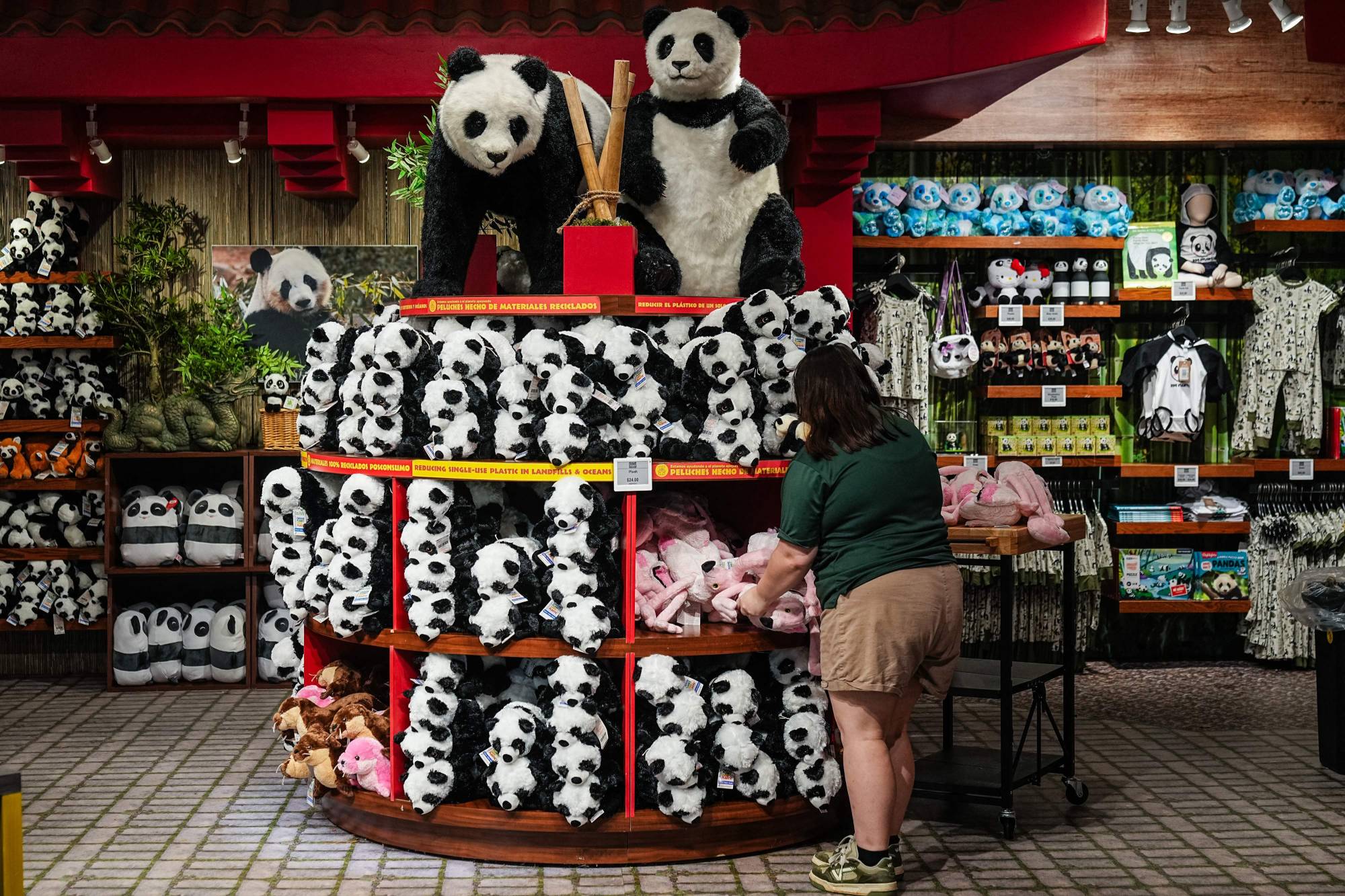
A Zoo Atlanta employee adjusts stuffed animals on a display featuring giand pandas in the gift shop, in Atlanta, Georgia on November 6, 2026. (Photo by Elijah Nouvelage / AFP)

Before 2016 pandas were considered endangered but are now listed as "vulnerable" by wildlife advocates, and an estimated 1,800 pandas live in the wild.

The Chinese government has established more than 50 panda reserves for conservation, but in the wild the bears continue to face threats of habitat loss and poaching.

Atlanta previously hosted pandas on loan from China starting in 1999, and seven panda cubs have been born at the zoo. All are now back in Chengdu, and Zoo Atlanta has not had any pandas since 2024.

Atlanta native John Perez celebrated his 28th birthday at Zoo Atlanta on Friday, telling AFP the pandas drew him to visit for the first time because "it felt perfect, you know?"

Both of the new arrivals were born in 2020, and it's hoped they will be suitable mates. Pandas in captivity typically live for around 30 years.

In 1972, China gifted a pair of pandas to Washington, following US president Richard Nixon's historic visit to the Communist nation.

Beijing recalled two of its pandas from Japan early this year, following a diplomatic spat that began when Japan's prime minister hinted that Tokyo could intervene militarily in the event of any attack on Taiwan.