Possible New Dwarf Planet Identified Orbiting Beyond Pluto

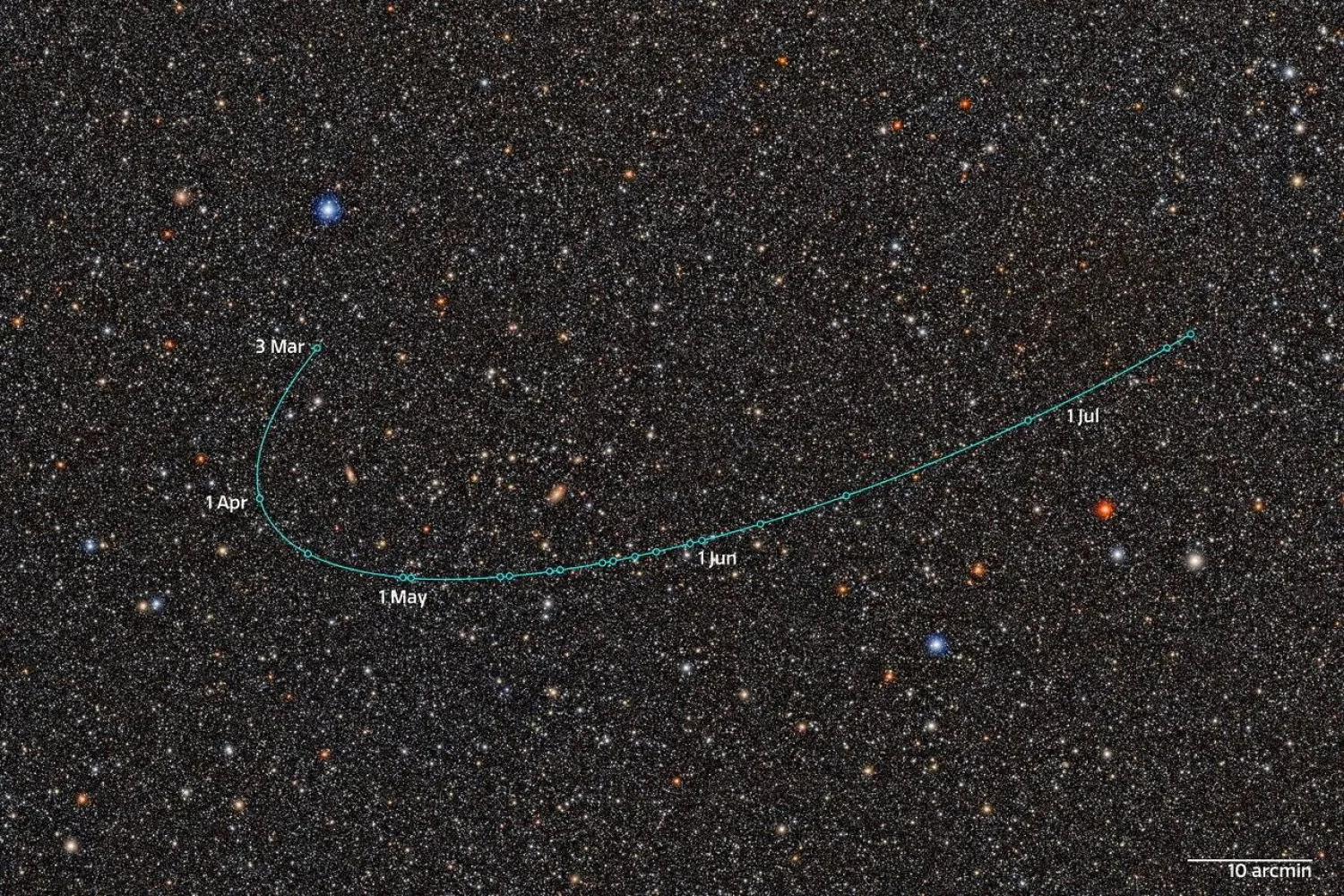
This image shows the orbital pathway of the newly discovered dwarf planet candidate 2026 ED138, as observed by the US National Science Foundation/Department of Energy Vera C. Rubin Observatory. This image is a composite of multiple images captured by Rubin between March 4 and July 11, 2026, at intervals indicated by the teal-colored circles. ED138 is visible at the center of each circle. (NSF–DOE Vera C. Rubin Observatory/NOIRLab/SLAC/AURA/Handout via Reuters)
TT

Possible New Dwarf Planet Identified Orbiting Beyond Pluto

This image shows the orbital pathway of the newly discovered dwarf planet candidate 2026 ED138, as observed by the US National Science Foundation/Department of Energy Vera C. Rubin Observatory. This image is a composite of multiple images captured by Rubin between March 4 and July 11, 2026, at intervals indicated by the teal-colored circles. ED138 is visible at the center of each circle. (NSF–DOE Vera C. Rubin Observatory/NOIRLab/SLAC/AURA/Handout via Reuters)

Scientists using a Chile-based telescope have identified an icy object orbiting beyond Pluto that may join our solar system's small roster of dwarf planets.

Researchers said the candidate, named 2026 ED138, has a diameter estimated at between roughly 370 and 930 miles (600 and 1,500 km) and is orbiting about 46 times farther from the sun than Earth. By way of comparison, Pluto orbits at an average of about 40 times farther from the sun than Earth.

The object was spotted using the new Vera C. Rubin Observatory, ‌on the summit ‌of the Cerro Pachón mountain in central Chile. The ‌telescope ⁠is a joint initiative ⁠of the US National Science Foundation and US Department of Energy.

Further observations are needed to confirm that the object is a dwarf planet.

If confirmed, 2026 ED138 would join five other dwarf planets recognized by the International Astronomical Union, the global authority on classifying celestial bodies. Those are Pluto, Eris, Haumea and Makemake, all of which orbit beyond the outermost planet Neptune, and Ceres, located in the main asteroid belt between Mars and ⁠Jupiter.

Based on the current data, 2026 ED138 would be among ‌the largest of the dwarf planets.

"For me, what ‌this demonstrates is that many exciting discoveries remain to be made with the Rubin Observatory ‌and other telescopes," said astrophysicist Matt Holman of the Center for Astrophysics, Harvard & Smithsonian, ‌who first spotted 2026 ED138.

Pluto long was considered the solar system's ninth and outermost planet, but was reclassified by the International Astronomical Union as a dwarf planet in 2006 because it did not meet the organization's formal definition of a planet.

Pluto and the new dwarf planet ‌candidate reside in a frigid region of the solar system populated by various icy bodies.

There are still questions about the ⁠size and composition ⁠of 2026 ED138. To be considered a dwarf planet, an object must possess sufficient mass for its own gravity to pull it into a round shape. 2026 ED138 appears to have sufficient mass for that, but more observations are needed.

"The main thing we need to do is to establish the physical size of 2026 ED138," Holman said.

"When we observe with Rubin, we are seeing the sun's light reflected from the object," Holman said. "A smaller, more reflective object would show the same amount of light as a larger, less reflective object. Fortunately, by looking at longer wavelengths, with an observatory like ALMA, we can detect the light emitted by the object itself," which is helpful in measuring an object's size.

ALMA, or the Atacama Large Millimeter/submillimeter Array, is a powerful telescope also based in Chile.


NASA Voyager 1 Probe Believed to Have Reached ‘Light-Day’ Milestone

An artist's concept depicts a NASA Voyager spacecraft traveling through interstellar space, in this image released on May 14, 2025. (NASA/JPL-Caltech/Handout via Reuters)
TT

NASA Voyager 1 Probe Believed to Have Reached ‘Light-Day’ Milestone

An artist's concept depicts a NASA Voyager spacecraft traveling through interstellar space, in this image released on May 14, 2025. (NASA/JPL-Caltech/Handout via Reuters)

NASA's Voyager 1 probe is believed to have now hit a distance milestone accomplished by no other spacecraft from Earth, based on advance computations by the US space agency, as the probe ventures through the near-emptiness of interstellar space.

The robotic probe, launched in 1977, was calculated by NASA to have reached a light-day from Earth, the distance that light travels in 24 hours — about 16 billion miles (26 billion km) — on Wednesday at 5:16 a.m. ET (1016 GMT).

Officials at NASA's Jet Propulsion Laboratory in California will have to wait ‌about a day ‌to get a signal from the probe, confirming it has reached ‌this ⁠distance. They have ⁠scheduled an event for Thursday to discuss the milestone.

"Reaching one light-day is an astounding feat, one that I never expected to see," Voyager project manager Suzanne Dodd said.

Voyager 1, the most distant human-made object, is flying at almost 38,000 miles per hour (61,000 kph). It crossed the outer edge of the heliosphere, a protective bubble of particles and magnetic fields produced by the sun, to enter interstellar space in 2012. Its twin, Voyager 2, was also launched in 1977 and entered ⁠interstellar space in 2018.

A Jet Propulsion Laboratory representative said recent power-saving ‌measures could give the two Voyager spacecraft enough power ‌to stay in communication with Earth for three to four more years.

"But the goal of the ‌mission is to do science, and there is enough power to keep the current ‌suite of instruments going through the 50th launch anniversary next year. Beyond that is hard to predict, and of course these are nearly 50-year-old spacecraft, and there are always things the team cannot anticipate that might happen," the JPL representative said.

Voyager 1 journeyed past Jupiter and Saturn, the solar system's two ‌largest planets, earlier in its mission. It continues to gather scientific data. For instance, its instruments have detected the faint monotonous hum ⁠caused by the constant vibrations ⁠of the small amounts of gas present in interstellar space.

"Voyager is sending back continuous measurements of magnetic fields, cosmic rays and of plasma waves that we receive on Earth whenever the Deep Space Network points its antenna at Voyager," Dodd said.

The Deep Space Network is NASA's international array of giant radio antennas supporting interplanetary spacecraft missions.

"After the heliopause crossing, the magnetic field direction did not rotate into the interstellar direction as expected, but has maintained the direction it had when both Voyagers crossed the heliopause, a direction governed by our sun. We are watching to see when that rotation might occur," Dodd said.

"We also are still observing effects from our sun, including strong solar storms like coronal mass ejections, that generate shocks and pressure fronts that reach as far away as Voyager 1 and beyond," Dodd said. "Where does the sun's influence end and pristine interstellar space begin? Perhaps Voyager may last long enough to answer that question."


Philippine President Has Jollibee Fried Chicken Delivered to Trump for a Late-Night Snack

 A Jollibee mascot wearing barong, a Filipino national attire, visits a coffee vendor at the media center during the 49th ASEAN Summit in Pasay City, Metro Manila, Philippines, November 17, 2026. (Reuters)
A Jollibee mascot wearing barong, a Filipino national attire, visits a coffee vendor at the media center during the 49th ASEAN Summit in Pasay City, Metro Manila, Philippines, November 17, 2026. (Reuters)
TT

Philippine President Has Jollibee Fried Chicken Delivered to Trump for a Late-Night Snack

 A Jollibee mascot wearing barong, a Filipino national attire, visits a coffee vendor at the media center during the 49th ASEAN Summit in Pasay City, Metro Manila, Philippines, November 17, 2026. (Reuters)
A Jollibee mascot wearing barong, a Filipino national attire, visits a coffee vendor at the media center during the 49th ASEAN Summit in Pasay City, Metro Manila, Philippines, November 17, 2026. (Reuters)

Call it Jollibee diplomacy.

Philippine President Ferdinand Marcos Jr. told President Donald Trump on Wednesday that he arranged a delivery of Jollibee fried chicken as a late-night snack for the American president and his delegation so he could have a “taste of Manila” during his short stay in the capital city.

Jollibee is the Philippines’ biggest homegrown fast-food chain and it has emerged as one of the country’s strongest global brands, a cultural touchstone and a feature of regional diplomacy.

The American president arrived in Manila on Tuesday evening for talks with Asia-Pacific allies. By Wednesday afternoon, after a meeting and lunch with Marcos at the presidential palace, Trump had landed in Shenzhen, China, to attend the Asia-Pacific Economic Cooperation summit and participate in a historic three-way meeting with Chinese President Xi Jinping and Russian President Vladimir Putin.

Marcos said his gift of fried chicken was intended as a pick-me-up of sorts for a hard-working president. And he sounded like Trump by boasting that Jollibee was more popular than one of the most recognized fast-food fried chicken chains in the United States.

“Jollibee ... is a very, very popular chain. And one of their main products is fried chicken. And we are very proud to say that we have surpassed KFC in the United States in terms of popularity,” Marcos said.

Upon hearing the claim, Trump said, “oh wow. Fantastic.”

“So we thought that that will give you a taste of, of, of Manila,” Marcos continued. "And, I think, I hope some of your staff was also able to partake.

“You have been working very hard, Mr. President, so just think of it as providing extra energy for all the work that you have to do that you have done and continue to do, and that is in front of you,” he added.

Trump, who is widely known to enjoy McDonald's hamburger fare, did not say if he had tried the Filipino fried chicken. The White House did not respond to an emailed request for comment.

Jollibee is the largest Filipino hamburger chain in the island nation, becoming one of the fastest-growing restaurant chains in the world with outlets across Asia and the United States after starting as a small snack house in the 1970s.

Many of its offerings, like burgers, fries and “Chickenjoy” fried chicken drumsticks, are familiar to fast-food lovers the world over. Other menu items have a distinctly Filipino flavor. The sweet-sauce spaghetti is a beloved restaurant item for fans — and an acquired taste for many others.

The chain, famous for its red, white and yellow bee logo, traces its origins to a Manila ice cream business in the 1970s that quickly pivoted to serving hot food.

It now boasts more than 1,600 branches in 17 countries. Many of its international stores can be found in places with large populations of Filipino migrant workers, such as Hong Kong.

The company has expanded rapidly in North America. It says it now has more than 85 stores open or coming soon in the United States, many of them in California.

The Trump meal wasn’t the first time Jollibee fare was used for diplomacy.

Australian Prime Minister Anthony Albanese visited a Jollibee restaurant on Sunday in Manila, where he was attending the annual summit of leaders of the Association of Southeast Asian Nations. Jollibee is opening dozens of restaurants in Australia.

“Jollibee will be a source of pride for Australians of Filipino backgrounds,” Albanese said during the visit. More than 400,000 Australians trace their heritage to the Philippines.

In July, Marcos and Canadian Prime Minister Mark Carney posed with the crew and bee mascot at a Jollibee branch in Vancouver.

Marcos’ comment about Jollibee's popularity surpassing that of KFC appeared to refer to Jollibee’s claim that it has the No. 1 fried chicken in America. That seems to be a reference to a series of USA Today “readers’ choice” awards rather than Jollibee sales, which are dwarfed by larger American fast-food chains.


Britain’s Prince William Visits Bollywood Studio, Watches Dancers

Prince William, Prince of Wales, speaks with performers at Dharma Productions, one of India’s leading film production companies as it approaches its 50th anniversary and highlights the importance of film, television, fashion and the wider creative industries on November 18, 2026, in Mumbai, India. (Reuters)
TT

Britain’s Prince William Visits Bollywood Studio, Watches Dancers

Prince William, Prince of Wales, speaks with performers at Dharma Productions, one of India’s leading film production companies as it approaches its 50th anniversary and highlights the importance of film, television, fashion and the wider creative industries on November 18, 2026, in Mumbai, India. (Reuters)

Britain's ‌Prince William watched Bollywood dances and toured a film studio in Mumbai on the last day of his royal visit to India on Wednesday, while his wife, Kate Middleton, spoke to health workers at a maternity hospital in the city.

The royal couple, who are on a three-day visit to India's financial capital, will end their trip in New Delhi and meet Prime Minister Narendra Modi late on Wednesday.

William and ‌Kate had separate ‌engagements on Wednesday, with the prince ‌visiting ⁠the office of ⁠a prominent Bollywood production house, Dharma Productions, in suburban Mumbai, while Kate visited a maternity hospital in the center of the city.

William smiled and clapped as dancers moved to a number from Dharma's hit Bollywood movie, "Kabhi Khushi Kabhie Gham" (Joy Sometimes, Sorrow Sometimes), which ⁠is set partly in London. Actors Saif Ali ‌Khan and Kareena Kapoor ‌were also present.

"He was gracious and kind and spoke ‌extensively about the potential of Indian cinema and ‌how cinema across all Indian languages is loved worldwide," said filmmaker Karan Johar, who runs Dharma Productions, after the visit.

The royal couple have been on a whirlwind tour ‌of the city of 13 million since Monday, playing cricket with the retired Sachin Tendulkar, ⁠visiting ⁠a craft school and attending the glittering award ceremony for the Earthshot Prize, a climate-change award that William set up six years ago.

The Princess of Wales, on her most high-profile overseas visit since receiving treatment for cancer in 2024, also presented one of the awards on Tuesday night, wearing a bright red Indian-style gown.

In his speech at the awards ceremony on Tuesday, William said the impact of global warming was becoming conspicuous, with repeated heatwaves and devastating floods, calling it a pivotal moment for the planet.