Philippines Raises Volcano Alert Level as Blast Sends Ash Skyward

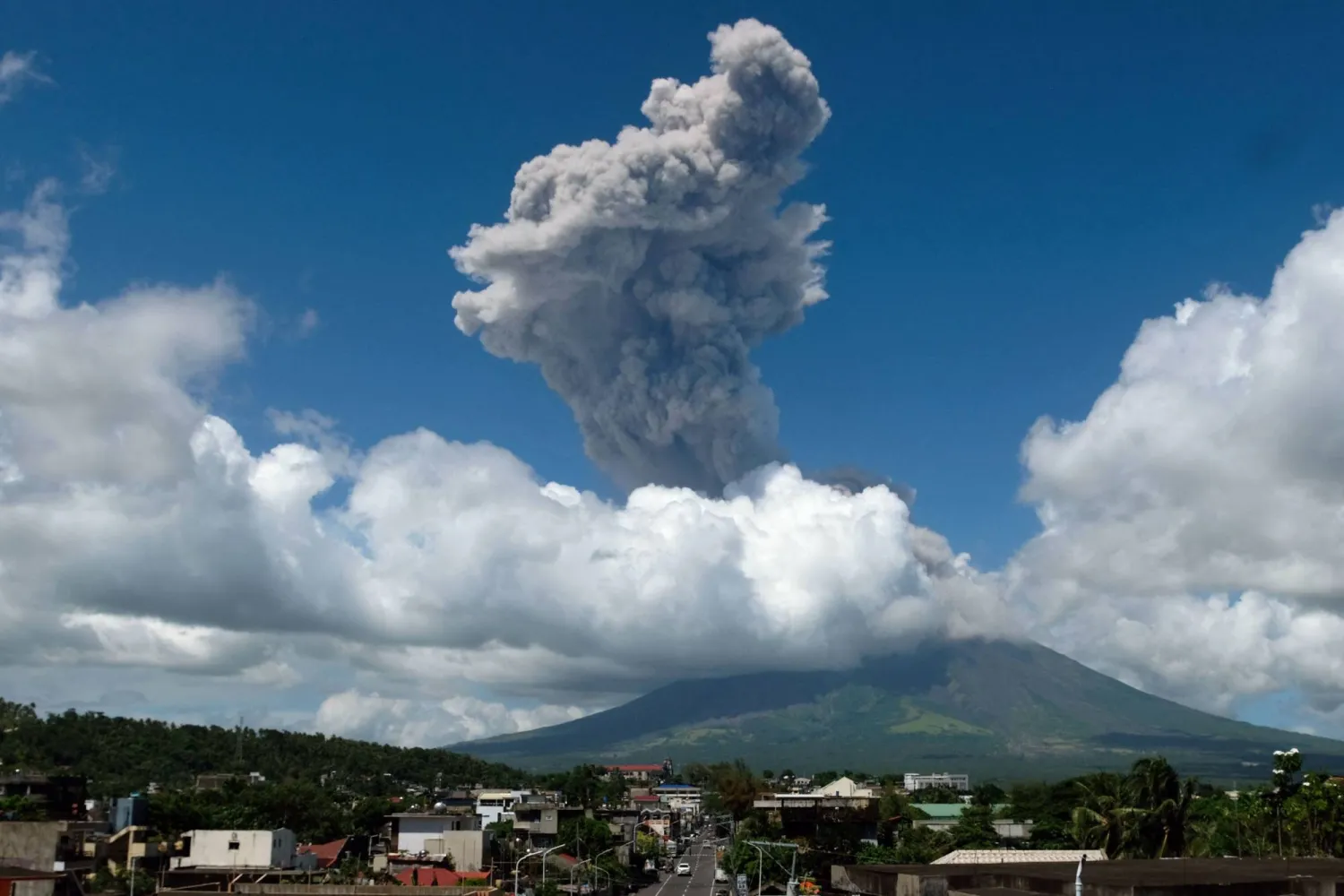
Smoke billows into the sky as Mayon volcano erupts as seen from Legaspi City, Albay province, south of Manila on October 30, 2026. (AFP)
TT

Philippines Raises Volcano Alert Level as Blast Sends Ash Skyward

Smoke billows into the sky as Mayon volcano erupts as seen from Legaspi City, Albay province, south of Manila on October 30, 2026. (AFP)

One of the Philippines' most active volcanoes fired a dark column of ash thousands of meters into the sky Friday in a "moderately explosive eruption" that lasted nearly six minutes, the state seismology office said.

There were no immediate reports of casualties or damage in towns and cities surrounding Mount Mayon, but the country's volcano institute raised the alert level from 2 to 3 on its 0-5 scale and called for evacuations within six kilometers (3.7 miles) of the crater.

The 3,000-meter (nearly 10,000 feet) ash column gradually drifted southwest onto nearby population centers, the Philippine Institute of Volcanology and Seismology said in a bulletin.

"Mayon is in a new phase of magmatic eruption, with increased chances of lava flows and hazardous PDCs (pyroclastic density currents)... affecting the upper to middle slopes of the volcano in the immediate days to weeks," it said.

It urged local officials to evacuate areas near the crater "due to the danger of PDCs, lava flows, rockfalls and other volcanic hazards", with planes also advised to avoid flying close to the mountain.

The 2,462-meter (8,000-foot) Mayon, rising in a near-perfect cone about 330 kilometers southeast of Manila, is one of three Philippine volcanoes that have shown elevated levels of activity this year, though no major eruptions occurred.

In June 2023, more than 12,000 people living on its lower slopes were moved to evacuation centers to protect them from ash and toxic gases spewing from its crater.

Earthquakes and volcanic activity are common in the Philippines due to its position on the Pacific "Ring of Fire", where tectonic plates collide.

The country's most powerful eruption in recent decades was Mount Pinatubo in 1991, which killed more than 800 people and produced an ash cloud that travelled thousands of kilometers.


Philippines Raises Volcano Alert Level as Blast Sends Ash Skyward

Smoke billows into the sky as Mayon volcano erupts as seen from Legaspi City, Albay province, south of Manila on October 30, 2026. (AFP)
TT

Philippines Raises Volcano Alert Level as Blast Sends Ash Skyward

Smoke billows into the sky as Mayon volcano erupts as seen from Legaspi City, Albay province, south of Manila on October 30, 2026. (AFP)

One of the Philippines' most active volcanoes fired a dark column of ash thousands of meters into the sky Friday in a "moderately explosive eruption" that lasted nearly six minutes, the state seismology office said.

There were no immediate reports of casualties or damage in towns and cities surrounding Mount Mayon, but the country's volcano institute raised the alert level from 2 to 3 on its 0-5 scale and called for evacuations within six kilometers (3.7 miles) of the crater.

The 3,000-meter (nearly 10,000 feet) ash column gradually drifted southwest onto nearby population centers, the Philippine Institute of Volcanology and Seismology said in a bulletin.

"Mayon is in a new phase of magmatic eruption, with increased chances of lava flows and hazardous PDCs (pyroclastic density currents)... affecting the upper to middle slopes of the volcano in the immediate days to weeks," it said.

It urged local officials to evacuate areas near the crater "due to the danger of PDCs, lava flows, rockfalls and other volcanic hazards", with planes also advised to avoid flying close to the mountain.

The 2,462-meter (8,000-foot) Mayon, rising in a near-perfect cone about 330 kilometers southeast of Manila, is one of three Philippine volcanoes that have shown elevated levels of activity this year, though no major eruptions occurred.

In June 2023, more than 12,000 people living on its lower slopes were moved to evacuation centers to protect them from ash and toxic gases spewing from its crater.

Earthquakes and volcanic activity are common in the Philippines due to its position on the Pacific "Ring of Fire", where tectonic plates collide.

The country's most powerful eruption in recent decades was Mount Pinatubo in 1991, which killed more than 800 people and produced an ash cloud that travelled thousands of kilometers.


People Enter Cages While the Animals Seem Free at a Unique Amsterdam Museum

 A crocodile stares down at the entrance of the Art Zoo in Amsterdam, Netherlands, on Oct. 27, 2026. (AP)
A crocodile stares down at the entrance of the Art Zoo in Amsterdam, Netherlands, on Oct. 27, 2026. (AP)
TT

People Enter Cages While the Animals Seem Free at a Unique Amsterdam Museum

 A crocodile stares down at the entrance of the Art Zoo in Amsterdam, Netherlands, on Oct. 27, 2026. (AP)
A crocodile stares down at the entrance of the Art Zoo in Amsterdam, Netherlands, on Oct. 27, 2026. (AP)

Look up as you enter Amsterdam's new Art Zoo museum, and a 12-foot crocodile stares down at you, mouth open, ready to chomp.

The taxidermic reptile is one of hundreds of preserved creatures on display, alongside artfully arranged piles of bones, illuminated tulips encased in apothecary jars and a cabinet of grotesque fish.

While it’s not a Halloween-themed museum, the show should appeal to anybody looking for something a little dark this spooky season.

“It was a little creepy,” admitted Tomáš Vaško, a Slovak living in the Dutch capital, after touring the museum on a dark October day.

Art Zoo is the creation of Dutch artists Jaap Sinke and Ferry van Tongeren, who draw inspiration from “wunderkammers,” or curiosity cabinets collected by wealthy Europeans in the 16th and 17th centuries to showcase objects from the natural world.

“The main thing is that we like storytelling with the animals," van Tongeren told The Associated Press. "We like to add drama. We add an attitude to the animals, where traditional taxidermists just want to mimic nature.”

Behind him, a cheetah slouched in an alcove under the watchful eye of a cassowary.

In natural history museums, animals are posed as they could be seen in the wild. At the Art Zoo, a Japanese giant spider crab stretches its 6-foot legs above a doorway beside the leg bones of a mastodon that nearly reaches the ceiling.

The duo rose to fame in 2015 after shark-pickling artist Damien Hirst purchased their entire exhibition from a London art show.

Unlike at a traditional zoo, the human visitors are confined, not the animals. The display rooms in the 17th-century canal house where the Art Zoo is located are enclosed by brooding, black metal cages.

“We really like the concept of having all the people in a cage and then all the animals free,” van Tongeren says. “In that way, the whole building becomes one artwork.”

None of the animals in the eclectic collection were taken from the wild.

“All our animals come from zoos where they died of natural causes,” said Sinke. Still, he acknowledged that the paperwork can be challenging. The pair primarily obtained specimens from Europe to ensure they know the history of the animals.

Sinke and van Tongeren actually consider themselves an artistic trio, crediting naturalist Charles Darwin as the third contributor to their work. They pitched the concept of the museum as the return of Darwin’s wonder.

Not everything in the collection is a real animal. Underneath the crocodile suspended from the ceiling is a wall of Jenny Hanivers, ray carcasses modified into grotesque creatures by 16th-century sailors who presented the macabre beasts as real sea monsters to gullible collectors.

Their misshapen faces appear to keep a beady eye on museum guests as they walk from caged room to caged room.


South Korea to Prosecute Students Cheating with Smart Glasses

An optometrist holds a pair of smart glasses at the Eyedaq eyewear store in Seoul on Friday. Jung Yeon-je / AFP
TT

South Korea to Prosecute Students Cheating with Smart Glasses

An optometrist holds a pair of smart glasses at the Eyedaq eyewear store in Seoul on Friday. Jung Yeon-je / AFP

South Korea will file criminal complaints against students caught cheating on a national university entrance exam with smart glasses and toughen penalties for their use, a government official told AFP Friday.

Sales of smart glasses -- which allow the wearer to shoot photos and videos, and interact with an AI assistant among other abilities -- are growing worldwide.

But so is a backlash around the gadgets, including concerns over people being filmed without consent and their use by exam cheats.

South Korea's notoriously grueling college entry exam, known as the "Suneung", is essential for admission to top universities and widely regarded as a gateway to economic security and even a good marriage.

"The ministry will seek criminal charges against students caught cheating with smart glasses" in the future, Lee Joon-hyuk, an education ministry official, told AFP.

Under authorities' plans, students caught cheating with smart glasses will not be able to retake their exams for three years, an extension from the current penalty of one year.

But the new rules are unlikely to apply to next month's college entrance tests, Lee said.

"With only about 20 days left until the exam, it would be realistically difficult to amend the law before then. However, we plan to push for the changes to take effect from next year's exam," he said.

It comes after three students were caught wearing or possessing smart glasses during institution-administered essay exams at universities in Seoul.

Their use is an emerging issue at schools worldwide. This summer, the prestigious National Taiwan University in Taipei reportedly disqualified an entrance exam candidate for cheating using AI smart glasses.

Seoul's education ministry's new measures to prevent cheating using smart glasses, announced Thursday, included assigning a "designated staff member" at each examination center to identify suspicious eyewear.

With so much at stake, on the day of the Suneung a 35-minute nationwide ban on flights is imposed during the English listening test, except in emergencies, while banks and public offices tell their workers to start an hour later to avoid traffic on the roads.

Enormous pressure placed on students in South Korea's ultra-competitive education system has been partly blamed for teenage depression and suicide rates that are among the highest in the world.