

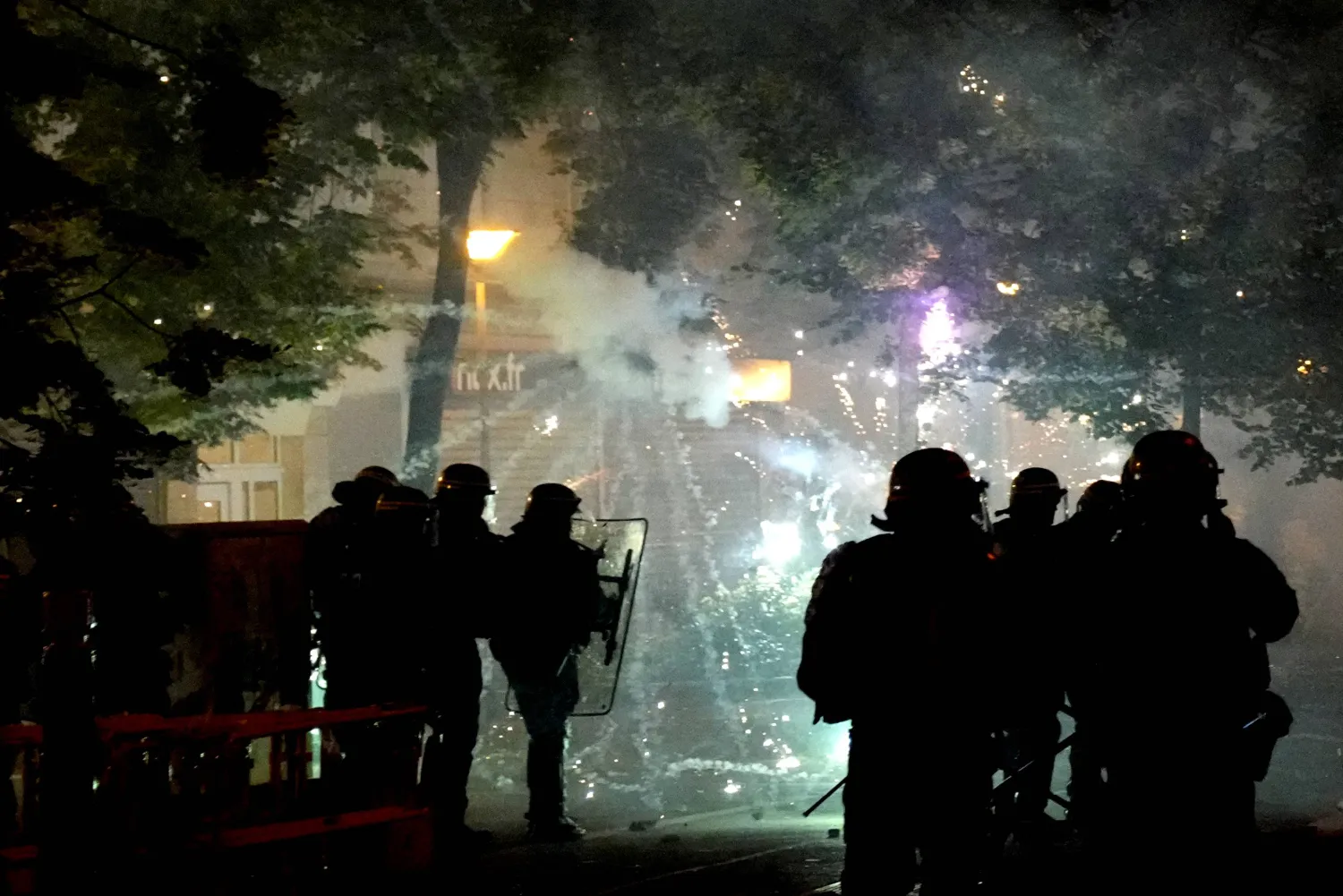

France Will Deploy 40,000 Police Officers to Quell Violence that Followed Deadly Police Shooting

Police forces clash with youths in Nanterre, outside Paris, Thursday, June 29, 2023. (AP Photo/Christophe Ena)
TT

France Will Deploy 40,000 Police Officers to Quell Violence that Followed Deadly Police Shooting

Police forces clash with youths in Nanterre, outside Paris, Thursday, June 29, 2023. (AP Photo/Christophe Ena)


A French police officer who shot and killed a 17-year-old driver will be investigated for voluntary homicide, following two days of fires and violent protests that injured scores of officers, officials said Thursday.

Some 40,000 police officers will be deployed overnight to quell violence that engulfed cities and towns in the wake of the shooting, The Associated Press said.

The killing of 17-year-old Nahel during a traffic check Tuesday, captured on video, shocked the country and stirred up long-simmering tensions between young people and police in housing projects and other disadvantaged neighborhoods around France.

Protesters set cars and public buildings ablaze in Paris suburbs and unrest spread to some other French cities and towns.

“The professionals of disorder must go home,” Interior Minister Gerald Darmanin said. “There will be a lot more police and gendarmes present tonight.”

Darmanin said 170 officers had been injured in the unrest but none of the injuries were life-threatening.

Nanterre prosecutor Pascal Prache said that he had requested that the officer be held in custody. That decision is to be made by another magistrate.

Based on an initial investigation, Prache said, he concluded that "the conditions for the legal use of the weapon were not met.”

Three persons were in the car when police tried to stop it Tuesday, the prosecutor said. Nahel managed to avoid a traffic stop by running a red light. He was later got stuck in a traffic jam.

Both officers involved said they drew their guns to prevent him from starting the car again.

The officer who fired a single shot said he wanted to prevent the car from leaving and because he feared someone may be hit by the car, including himself or his colleague, according to Prache.

Both officers said they felt “threatened” by seeing the car drive off, he added.

Two magistrates have been named to lead the investigation, Prache said. Under the French legal system, which differs from the US and British systems, magistrates are often assigned to lead investigations.

In a separate case, a police officer who fatally shot a 19-year-old Guinean man in western France earlier this month was handed preliminary charges of voluntary homicide, according to a statement by the local prosecutor on Wednesday. The man was fatally shot by an officer as he allegedly tried to escape a traffic stop. The investigation is still ongoing.

Clashes first erupted Tuesday night in and around the Paris suburb of Nanterre, where Nahel was killed, and the government deployed 2,000 police to maintain order Wednesday. But violence resumed after dusk.

Nahel’s surname has not been released by authorities or by his family. In earlier statements, lawyers for the family spelled the name Nael.

Police and firefighters struggled to contain protesters and extinguish numerous blazes through the night that damaged schools, police stations and town halls or other public buildings, according to a spokesperson for the national police. The national police on Thursday reported fires or skirmishes in multiple cities overnight, from Toulouse in the south to Lille in the north, though the nexus of tensions was Nanterre and other Paris suburbs.

Police arrested 150 people around the country, more than half of them in the Paris region, the spokesperson said. She was not authorized to be publicly named according to police rules.

The number of injured was not immediately released.

Scenes of violence in France’s suburban areas echo 2005, when the deaths of 15-year-old Bouna Traoré and 17-year-old Zyed Benna led to three weeks of nationwide riots, exposing anger and resentment in neglected, crime-ridden suburban housing projects.

The two boys entered a power substation to hide from police in the Paris suburb of Clichy-sous-Bois, and were electrocuted.

French President Emmanuel Macron held an emergency security meeting Thursday about the violence.

“These acts are totally unjustifiable,” Macron said at the beginning of the meeting, which aimed at securing hot spots and planning for the coming days “so full peace can return."

Macron also said it was time for “remembrance and respect” as Nahel’s mother called for a silent march Thursday in his honor on the square where he was killed.

Multiple vehicles were set ablaze in Nanterre and protesters shot fireworks and threw stones at police, who fired repeated volleys of tear gas. Flames shot out of three stories of a building, and a blaze was reported at an electrical plant. Fire damaged the town hall of the Paris suburb of L’Ile-Saint-Denis, not far from France’s national stadium and the headquarters of the Paris 2024 Olympics.

The police officer accused of the killing is in custody on suspicion of manslaughter and could face preliminary charges as soon as Thursday, according to the Nanterre prosecutor's office.

French activists renewed calls to tackle what they see as systemic police abuse, particularly in neighborhoods like the one where Nahel lived, where many residents struggle with poverty and racial or class discrimination. Government officials condemned the killing and sought to distance themselves from the police officer’s actions.

Macron called the killing “inexplicable and inexcusable" and called for calm. “Nothing justifies the death of a young person,” he told reporters in Marseille on Wednesday.

Videos of the shooting shared online show two police officers leaning into the driver-side window of a yellow car before the vehicle pulls away as one officer fires into the window. The videos show the car later crashed into a post nearby.

The driver died at the scene, the prosecutor’s office said.

Bouquets of orange and yellow roses now mark the site of the shooting, on Nanterre’s Nelson Mandela Square.

Speaking to Parliament, Prime Minister Elisabeth Borne said, “the shocking images broadcast yesterday show an intervention that appears clearly not to comply with the rules of engagement of our police forces.”

Deadly use of firearms is less common in France than in the United States, though several people have died or sustained injuries at the hands of French police in recent years, prompting demands for more accountability. France also saw protests against racial profiling and other injustice in the wake of George Floyd’s killing by police in Minnesota.

The most recent government statistics available show that 17 people were killed after police and gendarmerie officers shot at them in 2021.

Asked about police abuses, Macron said justice should be allowed to run its course.

A lawyer for Nahel's family, Yassine Bouzrou, told The Associated Press they want the police officer prosecuted for murder instead of manslaughter.

French soccer star Kylian Mbappe, who grew up in the Paris suburb of Bondy, was among many shocked by what happened.

“I hurt for my France,” he tweeted.


Risk of ‘Escalation’ if Iran Attacked, Warns Deputy Foreign Minister

Iranians walk past shops selling food ahead of Iftar, the Ramadan fast-breaking meal, in northern Tehran on February 23, 2026. (AFP)
TT

Risk of ‘Escalation’ if Iran Attacked, Warns Deputy Foreign Minister

Iranians walk past shops selling food ahead of Iftar, the Ramadan fast-breaking meal, in northern Tehran on February 23, 2026. (AFP)

Iran's deputy foreign minister Kazem Gharibabadi warned of a wider escalation if his country was attacked, after US President Donald Trump raised the threat of strikes.

Trump has sent a major deployment of air and sea power to the Middle East and has threatened to strike Iran if it does not reach a deal on key concerns starting with its nuclear program.

"We call upon all nations committed to peace and justice to take meaningful steps to prevent further escalation," Gharibabadi said at the Conference on Disarmament in Geneva.

"The consequences of any renewed aggression wouldn't remain confined to one country -- and responsibility would rest with those who initiate or support such actions."

Iranian and US negotiators held indirect talks in Geneva last week on Tehran's nuclear program, hosted by Oman.

A fresh round of talks in the Swiss city this Thursday has been confirmed by Muscat, though not by Washington.

"Iran remains committed to diplomacy and dialogue as the most effective path towards de-escalation and sustainable security," Gharibabadi said.

"Recent diplomatic engagement here in Geneva, which will continue this Thursday, demonstrates that a new window of opportunity exists for negotiations to address differences and build confidence -- provided that they uphold mutual respect, equitable treatment and non-selective application of international norms.

"Any sustainable and credible negotiation must respect the legitimate rights of all states under international law, and deliver tangible security benefits without coercion, unilateral demands or threats of force."

- 'Chaos and change' -

The United States and Israel threatened new military action against Iran after mass protests in the regime, which the Iranian authorities crushed at a cost of thousands of lives.

After last week's indirect talks with Washington through Omani mediators in Geneva, Tehran said they had reached broad agreement on a set of guiding principles.

Gharibabadi said that while Tehran sought the path of diplomacy, it was prepared to defend its sovereignty, territory and people, insisting it would exercise its right to self-defense "if necessary".

He said meaningful progress in disarmament and non-proliferation could only be achieved through mutual, balanced and legally-binding commitments.

He called upon nuclear weapons states to engage constructively in talks towards a comprehensive nuclear weapons convention, plus offer legally-binding security assurances for countries without nuclear weapons.

Speaking just before, UN Secretary-General Antonio Guterres said the world was living through a period of "chaos and change", with international law being brazenly violated.

"The international order that defined security relations for nearly eight decades is shifting rapidly. The reckless use of force in many regions is fomenting mistrust," he warned.


Netanyahu Says Israel Facing ‘Challenging Days’ with Iran-US Tensions

Israeli Prime Minister Benjamin Netanyahu delivers a speech during a plenary session of the Knesset, the Israeli parliament, in Jerusalem, 23 February 2026. (EPA)
TT

Netanyahu Says Israel Facing ‘Challenging Days’ with Iran-US Tensions

Israeli Prime Minister Benjamin Netanyahu delivers a speech during a plenary session of the Knesset, the Israeli parliament, in Jerusalem, 23 February 2026. (EPA)

Prime Minister Benjamin Netanyahu said Monday that Israel was facing "complex and challenging days" as tensions escalate between the United States and Iran following President Donald Trump's threat of strikes should Tehran refuse to accept a new nuclear agreement.

"We are in very complex and challenging days," Netanyahu told lawmakers in a brief address to parliament. "We are keeping our eyes open and are prepared for any scenario."

He also reiterated a warning to Iran's leadership: "I have conveyed to the Iranian regime that if they make the gravest mistake in their history and attack the State of Israel, we will respond with a force they cannot even imagine."

The premier further highlighted Israel's close military cooperation with the US, as Washington continues to build up its military presence near Iran and in the Middle East.

"The alliance with the United States has never been closer," Netanyahu said.

"Between the Israel forces and the United States military, between our security agencies and their security services, there has never been anything like this," he added.

Arch-foes Israel and Iran faced each other in a first direct confrontation last June during a 12-day war in which the Israeli military targeted Tehran's nuclear facilities and ballistic missile arsenal.

Iran responded with drone and missile strikes on Israel. Later on in the war, the United States joined Israel in targeting Iran's underground nuclear facilities.


Iranian Students Protest for Third Day as US Pressure Mounts

Iranians drive along a street in Tehran, Iran, 23 February 2026. (EPA)
TT

Iranian Students Protest for Third Day as US Pressure Mounts

Iranians drive along a street in Tehran, Iran, 23 February 2026. (EPA)

Iranian students ‌defied authorities with protests for a third day on Monday, weeks after security forces crushed mass unrest with thousands killed and as the United States weighs possible air strikes against the country.

State media outlets reported students chanting anti-government slogans at Tehran University, burning flags at the all-women al-Zahra University, and scuffles at Amir Kabir University, all located in the capital.

Reuters also verified video showing students at al-Zahra University chanting slogans including "we'll reclaim Iran", but was not able ‌to confirm ‌when it was recorded.

In a new ‌sign ⁠of the mounting ⁠tension in the Middle East, the United States began pulling non-essential personnel and family members from the embassy in Beirut, a senior State Department official said.

US President Donald Trump has repeatedly threatened Iran since major nationwide protests across the country in January, saying on Thursday that "really bad things will ⁠happen" if talks between the countries fail ‌to produce a deal.

Washington wants ‌Iran to give up much of its nuclear program, which ‌it believes is aimed at building a bomb, limit the ‌range of its missiles to short distances and stop supporting groups it backs in the Middle East.

It has built up forces across the Middle East, putting increased pressure on Iran ‌as it weighs its response to US demands amid ongoing talks.

Iranian Supreme Leader Ali ⁠Khamenei ⁠already faces the gravest crisis of his 36-year tenure, with an economy struggling under the weight of international sanctions and growing unrest that broke out into major protests in January.

On Sunday Iranian President Masoud Pezeshkian said negotiations with the US had "yielded encouraging signals" even as a second US aircraft carrier headed towards the Middle East.

Trump has not laid out in detail his thinking on any possible Iran strike. A senior White House official told Reuters last week there was still no "unified support" within the administration to go ahead with an attack.
