


Ukraine Aims to Wear Down and Outsmart a Russian Army Distracted by Infighting

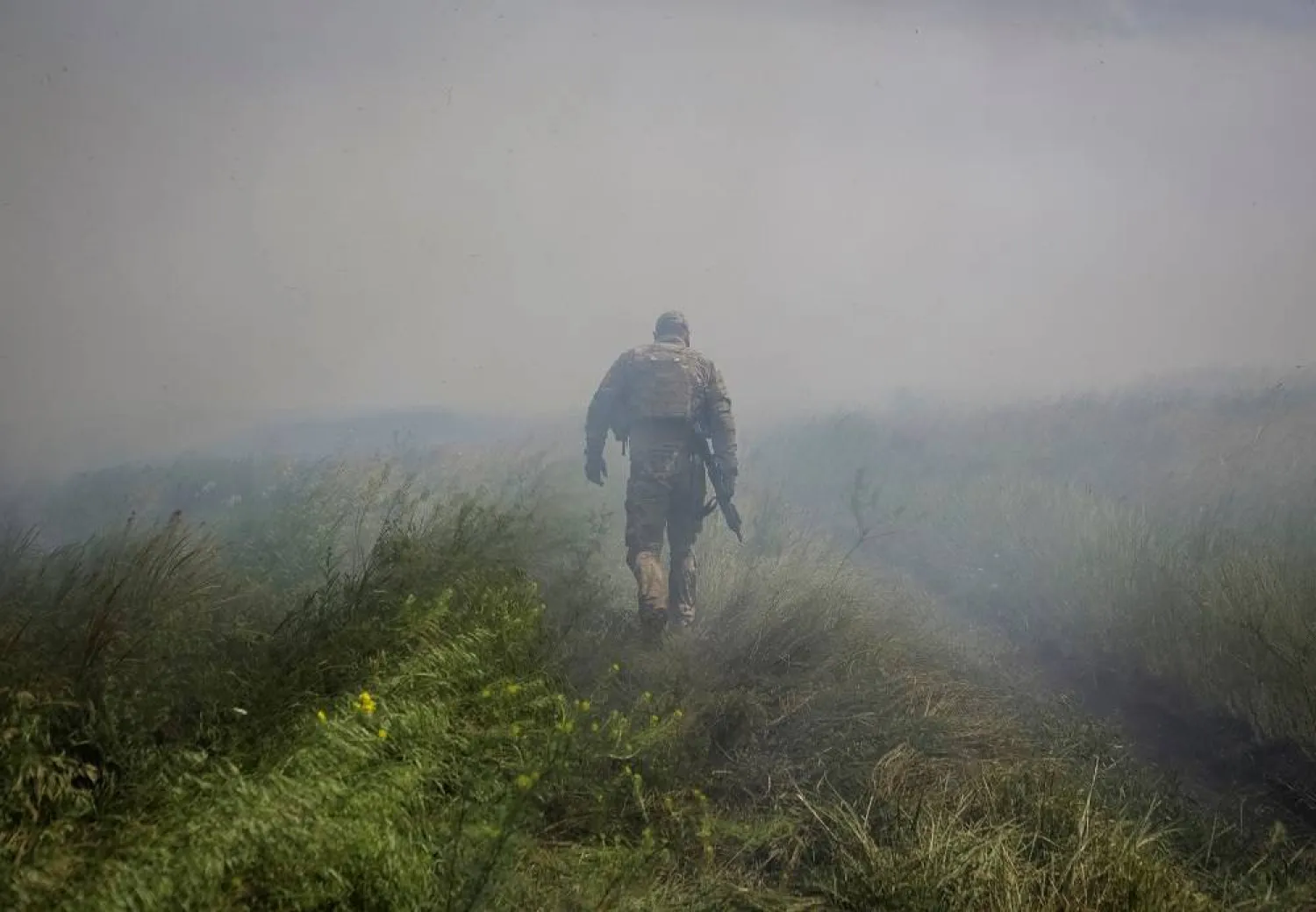
A Ukrainian service member is seen, amid Russia's attack on Ukraine, near the front line near the newly liberated village Neskuchne in Donetsk region, Ukraine June 13, 2023. (Reuters)
TT

Ukraine Aims to Wear Down and Outsmart a Russian Army Distracted by Infighting

A Ukrainian service member is seen, amid Russia's attack on Ukraine, near the front line near the newly liberated village Neskuchne in Donetsk region, Ukraine June 13, 2023. (Reuters)

The ambush had been postponed three times before Ukrainian commanders decided one recent night that conditions were finally right. Cloaked in darkness, a battalion of Kyiv’s 129th brigade pressed ahead, advancing stealthily on unsuspecting Russian soldiers.

By the time the Russians situated along the front line realized they were under attack, it was too late.

Ukraine's recapture of the small village of Neskuchne in the eastern Donetsk region on June 10 encapsulates the opening strategy of a major counteroffensive launched earlier this month. Small platoons bank on the element of surprise and, when successful, make incremental gains in territory and battlefield intelligence.

"We had a few scenarios. In the end, I think we chose the best one. To come quietly, unexpectedly," said Serhii Zherebylo, the 41-year-old deputy commander of the battalion that retook Neskuchne.

Across the 1,500-kilometer (930-mile) front line, Ukrainian forces are attempting to wear down the enemy and reshape battle lines to create more favorable conditions for a decisive, eastward advance. One strategy could be to try to split Russia's forces in two so that the Crimean Peninsula, which Moscow illegally annexed in 2014, is isolated from the rest of the territory it controls.

Ukraine's troops were given a boost of morale last week by an armed rebellion in Russia that posed the most significant threat to President Vladimir Putin's power in more than two decades. Yet how the revolt by Wagner Group mercenaries under the command of Russian warlord Yevgeny Prigozhin affects the trajectory of the war remains to be seen.

The infighting is a major distraction for Russia's military and political leaders, but experts say the impact on the battlefield so far appears minimal.

For the past four days, Ukraine has stepped up operations around the eastern city of Bakhmut, which Wagner forces seized after months of intense fighting and then handed over to Russian soldiers, who continue to lose some ground on their southern flank.

Along the front line, however, the strength of the Russian military remains unchanged since the revolt.

It is not clear where Ukraine will attempt to decisively punch through, but any success will rely on newly formed, Western-equipped brigades that are not yet deployed. For now, Russia's deeply fortified positions and relative air superiority are slowing Ukraine's advance.

Military experts say it is hard to say who has the advantage: Russia is dug-in with manpower and ammunition, while Ukraine is versatile, equipped with modern weaponry and clever on the battlefield.

But with the autumn muddy season only four months away, some Ukrainian commanders say they are racing against time.

"Although Ukrainian forces are making small and steady gains, they do not yet have the operational initiative, meaning they are not dictating the tempo and terms of action," said Dylan Lee Lehrke, an analyst with the British security intelligence firm Janes.

"This has led some observers to claim the counteroffensive is not meeting expectations," Lehrke said. But it was never going to resemble Ukraine’s blitzkrieg liberation of the eastern Kharkiv region last year, he said, because "Russian forces have had too long to prepare fortifications."

Russian authorities say Ukraine has suffered substantial losses since the start of the counteroffensive — 259 tanks and 790 armored vehicles, according to Putin, whose claims could not be independently verified.

Grinding battles are being waged in multiple combat zones.

A catastrophic dam collapse last month in the southern Kherson region has altered the geography along the Dnieper River, giving Ukrainians more freedom of movement there. Russian military bloggers claim a small group of Ukrainian fighters are making gains in the area, although Ukrainian officials have not confirmed these reports.

Across the agricultural plains of the southeastern Zaporizhzhia region, Ukrainian troops backed by tanks, artillery and drones appear to be chipping away more decisively against Russian positions.

Ukrainian troops would deal a severe blow to Russian forces if they managed to regain access to the Sea of Azov from this direction, effectively cutting off Moscow’s land bridge to Crimea. It’s too early to determine whether this is a realistic goal.

They are still a long way off.

In an underground command center on the front, a Ukrainian Special Forces commander with the call sign "Hunter" stares intently at an aerial view of the lush green battlefield.

His servicemen have just stormed an enemy position, but the return fire is constant. Russians blast rockets into the air, while his fighters hide and wait for orders.

Hunter directs the drone operator to shoot.

On the screen, a huge plume of black smoke swells in the air. A hit, he says.

The battle here will only get harder, analysts say.

Ukrainian troops are still several kilometers from Russia’s main defensive lines. As they penetrate deeper into occupied territory, the fighters will have to contend with Russian defenses organized in a diagonal pattern, 10 kilometers deep in some areas, including minefields, anti-tank ditches and pyramid-shaped obstacles known as "dragon's teeth."

And with each advance, they become more vulnerable to Russian air attacks.

At least 130 square kilometers (50 square miles) of land has been regained in the south since the start of the counteroffensive, Deputy Defense Minister Hanna Malyar said this week.

It’s not the pace many hoped for.

A US official familiar with the Biden administration thinking said the counteroffensive is a "long slog" that is testing Ukrainian forces in ways that few other episodes of the 16-month old war have. The official, who was not authorized to comment and spoke on the condition of anonymity, said that there never was expected to be a "D-Day moment," but that the early going suggests the pace of the counteroffensive will be "tough and challenging" for the Ukrainians.

Unlike some of the earlier battles in the war, in which Russian forces showed little resistance or even fled the battlefield, Ukrainian forces are currently facing stiff resistance, the official said.

In the northeast, Russian forces have stepped up offensive operations in the direction of the Kreminna forest near Lyman with the aim of securing a buffer to prevent incursions close to Moscow’s supply lines, said Lehrke. But it may well have a secondary aim — of forcing more Ukrainian deployments, he said.

The dense forested area has proven to be notoriously difficult terrain.

"The Russians have sabotage groups going into the woods and there have been cases where they enter behind the first line of Ukrainian defenses," said Pavlo Yusov, a press officer with the National Guard’s Thunderstorm brigade, currently in Lyman.

Col. Volodymyr Silenko, a commander of the 30th Mechanized Brigade operating near Bakhmut, pays no mind to criticism over the pace of attacks. It’s much more important to focus on how the adversary is thinking and responding, he said.

"A war is not a competition of raw force and strength of weapons and people, it’s more about who’s more cunning," he said.

Silenko knows the Russians watch his men, the same way he watches theirs; Moscow sees their movements, how they change, how they evolve.

"Our job is to outsmart them," he said.

Deception was a key part of Ukraine's most significant battlefield success to date, last fall's "Kherson ruse." By making it appear that the city of Kherson was the main target of that counteroffensive, Ukrainian forces were able to swiftly retake the northern Kharkiv region.

"That was a master class in deception," said Lehrke. "Whether they can do the same this time remains to be seen."



Turkish FM to Attend Trump’s Board of Peace Meeting in Washington, Italy as ‘Observer’ 

28 November 2025, Berlin: Turkish Foreign Minister Hakan Fidan during a joint press conference with German Foreign Minister Wadephul. (dpa)
TT

Turkish FM to Attend Trump’s Board of Peace Meeting in Washington, Italy as ‘Observer’ 

28 November 2025, Berlin: Turkish Foreign Minister Hakan Fidan during a joint press conference with German Foreign Minister Wadephul. (dpa)

‌Turkish Foreign Minister Hakan Fidan will travel to Washington in lieu of President Recep Tayyip Erdogan for the inaugural meeting of US President Donald Trump's "Board of Peace" on Thursday, the foreign ministry said on Wednesday.

A Turkish diplomatic source told Reuters ‌that Fidan, during the ‌talks, would call ‌for ⁠determined steps to ⁠resolve the Palestinian issue and emphasize that Israel must end actions to hinder the flow of aid into Gaza and stop its ceasefire violations.

Fidan ⁠will also reiterate Türkiye's ‌readiness ‌to contribute to Gaza's reconstruction and its ‌desire to help protect Palestinians ‌and ensure their security, the source said.

He will also call for urgent action against Israel's "illegal ‌settlement activities and settler violence in the West Bank", ⁠the ⁠source added.

According to a readout from Erdogan's office, the president separately told reporters on Wednesday that he hoped the Board of Peace would help achieve "the lasting stability, ceasefire, and eventually peace that Gaza has longed for", and would focus on bringing about a two-state solution.

The board, of which Trump is the chairman, was initially designed to oversee the Gaza truce and the territory's reconstruction after the war between Hamas and Israel.

Meanwhile, Italy will be present at the meeting as an "observer", Italian Foreign Minister Antonio Tajani said Wednesday.

"I will go to Washington to represent Italy as an observer to this first meeting of the Board of Peace, to be present when talks occur and decisions are made for the reconstruction of Gaza and the future of Palestine," Tajani said according to ANSA news agency.

Italy cannot be present as anything more than an observer as the country's constitutional rules do not allow it to join an organization led by a single foreign leader.

But Tajani said it was key for Rome to be "at the forefront, listening to what is being done".

Since Trump launched the Board of Peace at the World Economic Forum in Davos in January, at least 19 countries have signed its founding charter.


Energy Secretary: US to Stop Iran's Nuclear Ambitions 'One Way or the Other'

US Secretary of Energy Chris Wright speaks during a press conference after a meeting with Venezuela's acting president Delcy Rodriguez at the Miraflores Presidential Palace in Caracas on February 11, 2026. (Photo by Juan BARRETO / AFP)
TT

Energy Secretary: US to Stop Iran's Nuclear Ambitions 'One Way or the Other'

US Secretary of Energy Chris Wright speaks during a press conference after a meeting with Venezuela's acting president Delcy Rodriguez at the Miraflores Presidential Palace in Caracas on February 11, 2026. (Photo by Juan BARRETO / AFP)

The United States will deter Iran from acquiring nuclear weapons "one way or the other", US Energy Secretary Chris Wright warned on Wednesday.

"They've been very clear about what they would do with nuclear weapons. It's entirely unacceptable," Wright told reporters in Paris on the sidelines of meetings of the International Energy Agency.

"So one way or the other, we are going to end, deter Iran's march towards a nuclear weapon," Wright said.

US and Iranian officials held talks in Geneva on Tuesday aimed at averting the possibility of US military intervention to curb Tehran's nuclear program.

Iran said following the talks that they had agreed on "guiding principles" for a deal to avoid conflict.

US Vice President JD Vance, however, said Tehran had not yet acknowledged all of Washington's red lines.


Iran, Russia to Conduct Joint Drills in the Sea of Oman 

This handout photo released by Iran's Revolutionary Guards Corps (IRGC)'s official website Sepanews on February 17, 2026, shows boats maneuvering around a tanker vessel during a military exercise by members of the IRGC and navy in the Strait of Hormuz. (Sepahnews / AFP)
TT

Iran, Russia to Conduct Joint Drills in the Sea of Oman 

This handout photo released by Iran's Revolutionary Guards Corps (IRGC)'s official website Sepanews on February 17, 2026, shows boats maneuvering around a tanker vessel during a military exercise by members of the IRGC and navy in the Strait of Hormuz. (Sepahnews / AFP)

Iran and Russia will conduct naval maneuvers in the Sea of Oman on Thursday, following the latest round of talks between Tehran and Washington in Geneva, Iranian media reported.

On Monday, the Revolutionary Guards, the ideological arm of Iran's military, also launched exercises in the strategic Strait of Hormuz, a challenge to US naval forces deployed in the region.

"The joint naval exercise of Iran and Russia will take place tomorrow (Thursday) in the Sea of Oman and in the northern Indian Ocean," the ISNA agency reported, citing drill spokesman, Rear Admiral Hassan Maghsoudloo.

"The aim is to strengthen maritime security and to deepen relations between the navies of the two countries," he said, without specifying the duration of the drill.

The war games come as Iran struck an upbeat tone following the second round of Oman-mediated negotiations in Geneva on Tuesday.

Previous talks between the two foes collapsed following the unprecedented Israeli strike on Iran in June 2025, which sparked a 12-day war that the United States briefly joined.

US President Donald Trump has deployed a significant naval force in the region, which he has described as an "armada."

Iranian officials have repeatedly threatened to block the Strait of Hormuz, particularly during periods of tension with the United States, but it has never been closed.

A key passageway for global shipments of oil and liquefied natural gas, the Strait of Hormuz has been the scene of several incidents in the past and has returned to the spotlight as pressure has ratcheted amid the US-Iran talks.

Iran announced on Tuesday that it would partially close it for a few hours for "security" reasons during its own drills in the strait.