


Ukraine, Russia Accuse Each Other of Planning to Attack Europe’s Biggest Nuclear Plant

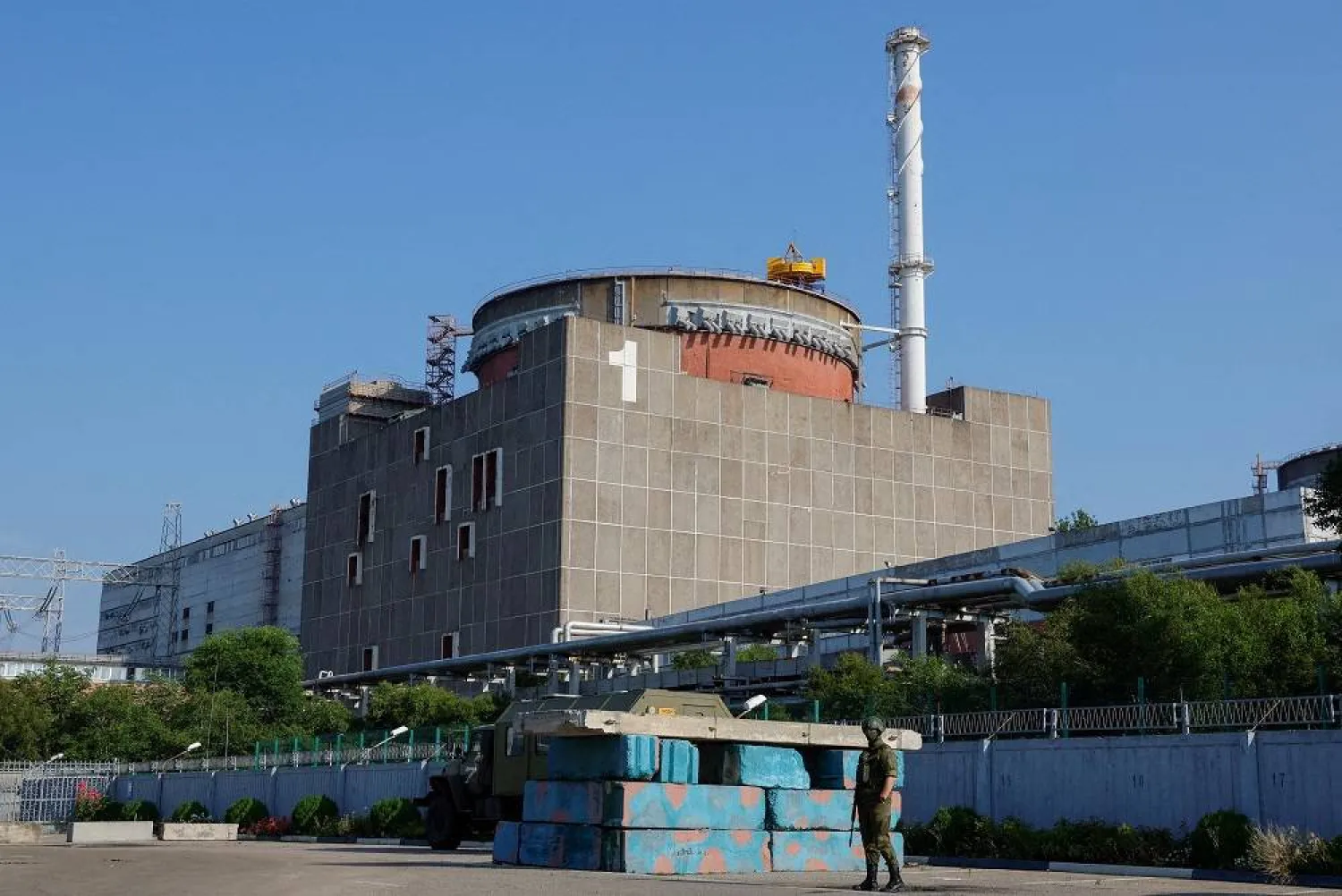
A Russian service member stands guard at a checkpoint near the Zaporizhzhia Nuclear Power Plant outside Enerhodar in the Zaporizhzhia region, Russian-controlled Ukraine, June 15, 2023. (Reuters)
TT

Ukraine, Russia Accuse Each Other of Planning to Attack Europe’s Biggest Nuclear Plant

A Russian service member stands guard at a checkpoint near the Zaporizhzhia Nuclear Power Plant outside Enerhodar in the Zaporizhzhia region, Russian-controlled Ukraine, June 15, 2023. (Reuters)

Ukraine and Russia accused each other Wednesday of planning to attack one of the world's largest nuclear power plants, but neither side provided evidence to support their claims of an imminent threat to the facility in southeastern Ukraine that is occupied by Russian troops.

The Zaporizhzhia Nuclear Power Plant has been a focus of concern since Moscow's forces took control of it and its staff in the early stages of the war. Russia and Ukraine have regularly traded blame over shelling near the plant that caused power outages. Over the last year, the UN's atomic watchdog repeatedly expressed alarm over the possibility of a radiation catastrophe like the one at Chernobyl after a reactor exploded in 1986.

The six reactors at Zaporizhzhia are shut down, but the plant still needs power and qualified staff to run crucial cooling systems and other safety features.

Ukraine has alleged more recently that Moscow might try to cause a deliberate leak in an attempt to derail Kyiv’s ongoing counteroffensive in the surrounding Zaporizhzhia region. Russia is suspected of blowing up a dam in southern Ukraine last month with a similar aim.

Citing the latest intelligence reports, Ukrainian President Volodymyr Zelenskyy alleged Tuesday night that Russian troops had placed "objects resembling explosives" on top of several of the plant's power units to "simulate" an attack from outside.

"Their detonation should not damage power units but may create a picture of shelling from Ukraine," according to a statement from the general staff of Ukraine’s armed forces.

The International Atomic Energy Agency has officials stationed at the Russian-held plant, which is still run by its Ukrainian staff. IAEA Director General Rafael Mariano Grossi said his agency's most recent inspection of the plant found no activity related to explosives, "but we remain extremely alert."

"As you know, there is a lot of combat. I have been there a few weeks ago, and there is contact there very close to the plant, so we cannot relax," Grossi said during a visit to Japan.

In Russia, Kremlin spokesman Dmitry Peskov raised the specter of a potentially "catastrophic" provocation by the Ukrainian army at the nuclear plant, which is Europe’s largest.

"The situation is quite tense. There is a great threat of sabotage by the Kyiv regime, which can be catastrophic in its consequences," Peskov said in response to a reporter’s question about the plant. He also claimed that the Kremlin was pursuing "all measures" to counter the alleged Ukrainian threat.

Grossi said he was aware of both Kyiv’s and Moscow’s claims and reiterated that "nuclear power plants should never, under any circumstances, be attacked."

"A nuclear power plant should not be used as a military base," he said.

A Russian attack on the plant would "probably not lead to the widespread dispersal of significant amounts of radiation" due to precautionary steps taken by the IAEA, according to the International Institute for Strategic Studies, a think tank.

"A blast at Zaporizhzhia would spread radiation and sow panic, but the actual off-site radiation risk would be relatively low,’’ the think tank said in a recent assessment, adding that wind might blow some radiation toward Russia.

The most likely scenarios are a Russian-engineered explosion that exposes one of the reactor cores and starts a fire that burns spent fuel, or a blast involving the dry spent fuel on site that would carry the radiation far afield via wind, the IISS said.

Neither of those scenarios would bring a disaster on the scale of Chernobyl or Fukushima, Japan’s tsunami-wrecked nuclear plant, it said.

Renat Karchaa, an adviser to Russian state nuclear company Rosenergoatom, said there was "no basis" for Zelenskyy's claims of a plot to simulate an explosion.

"Why would we need explosives there? This is nonsense" aimed at "maintaining tension around the Zaporizhzhia Nuclear Power Plant," Karchaa said.

Russian media on Tuesday cited Karchaa as saying that Ukraine’s military planned to strike the plant early Wednesday with ammunition laced with nuclear waste. As of Wednesday afternoon, there was no indication of such an attack.

Last week, Ukrainian emergency workers held a drill to prepare for a potential release of radiation from the plant. In case of a nuclear disaster at the plant, approximately 300,000 people would be evacuated from the areas closest to the facility, according to the country’s emergency services.

Ukrainian officials have said the shut-down reactors are protected by thick concrete containment domes.



Iran’s Guards in Lebanon: From War Rooms to Front Lines

Billboards showing Iranian Supreme Leader Mojtaba Khamenei and his father, Ali Khamenei, with the slogan “Thank you, Iran,” are displayed on the airport road toward southern Lebanon. (Reuters)
TT

Iran’s Guards in Lebanon: From War Rooms to Front Lines

Billboards showing Iranian Supreme Leader Mojtaba Khamenei and his father, Ali Khamenei, with the slogan “Thank you, Iran,” are displayed on the airport road toward southern Lebanon. (Reuters)

Since the latest war erupted in Lebanon, evidence has mounted of a direct role by Iran’s Revolutionary Guards in managing the fight alongside Hezbollah. But the scale and nature of that role, and the number of Iranians involved, remain unclear.

With no precise figures available, several accounts point to the presence of Iranian personnel and officers in Lebanon during the war, both in command roles and on the battlefield.

Revolutionary Guards officers in the battle

In March, Prime Minister Nawaf Salam moved to curb what was seen as the Revolutionary Guards’ chaotic access to Beirut.

He asked the authorities to take the necessary steps to prevent any military or security activity by members of the Revolutionary Guards in Lebanon ahead of their deportation. The Cabinet also decided to reinstate visa requirements for Iranians entering Lebanon.

One of the strongest signs of Revolutionary Guards' involvement was the killing of Guards officers in an Israeli strike on the Ramada Hotel in Beirut’s Raouche district on March 8.

Iran announced the deaths in a letter to the UN secretary-general. Iran’s permanent representative to the United Nations, Amir Saeid Iravani, said four Iranian diplomats had been killed in the attack. They were later mourned in Iran as Revolutionary Guards officers.

Information in Beirut indicated that the Iranians entered the capital using genuine Lebanese passports issued under different names. Additional passports belonging to others linked to the Revolutionary Guards were found inside the targeted room.

That prompted MP Ghada Ayoub to file a report with the Public Prosecutor’s Office at the Court of Cassation, requesting an investigation into information alleging that Lebanese passports had been issued under false names or in violation of legal procedures to people linked to armed groups.

The report also cited evidence that Lebanese travel documents were used to conceal the real identities of Revolutionary Guards personnel.

Other reports also pointed to a direct Iranian presence in the fighting.

During the battle over what is known as the Ali al-Taher Heights, media outlets quoted a senior Israeli security source as saying on Monday that several Iranian officers were in the area in southern Lebanon. The source said they held key positions in managing the battle and coordinating operations on the Lebanese front.

According to that information, one main reason behind Iran’s insistence on halting the Israeli ground operation there was concern for the lives of those officers, or fear they could be captured if the field advance continued.

At the same time, media outlets and online platforms in the past two days circulated posts attributed to the Revolutionary Guards offering salaries of up to $1,000 to those willing to fight alongside Hezbollah.

The posts were seen as another sign of the scale of Iranian involvement in the war in Lebanon.

“One front and a joint operations room”

Retired Brig. Gen. Hassan Jouni, a military expert, said the organic relationship between Hezbollah and Iran makes it difficult to separate the Lebanese and Iranian fronts.

“What happened in the war clearly showed that the two fronts were managed as one front, within a joint operations room and under a unified operational plan aimed at scattering and exhausting Israeli air-defense systems,” he told Asharq Al-Awsat.

He said that the pattern reflected unified battle management and decision-making. It showed, he added, that the confrontation was not two separate fronts, but one linked theater of operations coordinated directly by Iran and Hezbollah.

From operations rooms to the battlefield

While the presence of Iranian officers in operations rooms now appears settled, the number of Iranian fighters on the ground remains unclear.

Political analyst Kassem Kassir, who is close to Hezbollah, stirred controversy two days ago when he spoke of 50,000 Iranian fighters taking part in the war in Lebanon and 10,000 of them being killed. The remarks triggered surprise and questions in Lebanon.

Kassir later said his comments were made in response to accounts portraying the war as a direct Iranian-Israeli confrontation on Lebanese soil. He said the exaggerated figures were meant to show how unrealistic such claims were.

“The exaggeration in the figures I mentioned is proof that the matter is not true,” he told Asharq Al-Awsat.

Political analyst Ali al-Amine offered a different reading. He said the latest war had carried, from the start, the character of an Iranian-Israeli confrontation on Lebanese soil. He pointed first to the Revolutionary Guards officers killed in the Beirut hotel.

“After the assassination of Hezbollah’s first-tier leaders in 2024, foremost among them Hezbollah Secretary-General Hassan Nasrallah, along with a number of elite commanders and Radwan Force leaders, a major vacuum emerged inside the party’s command structure,” al-Amine told Asharq Al-Awsat.

“That required Revolutionary Guards leaders and officers to come to Lebanon to manage the battle and oversee operations. They were not ordinary fighters, but high-level specialized officers who took charge of command, coordination and field axes.”

He said the Revolutionary Guards and Hezbollah have an intertwined organizational and military structure, not merely an alliance between two separate partners.

Non-Lebanese bodies in the south

Al-Amine also spoke of a large number of non-Lebanese fighters in the south.

“After the ceasefire, operations began to recover bodies from southern villages, but in some areas, residents were initially asked not to go there,” he said.

“The scale of destruction was one main reason. But there was another reason: a large number of bodies under the rubble of homes. It emerged that some of the dead were not Lebanese, including Iranians and Palestinians from the camps, in addition to information about Iraqis who took part in the battles.”

He said the Iranians, as a core part of battle management, were not only in operations rooms but also present on some field axes.

At the same time, he said, there was a broad blackout on the scale of human losses. Hezbollah no longer publishes detailed death notices as it did in the past, he said, limiting itself to announcing the deaths of senior figures. That raised questions about the real number of dead and the identities of some of them.

He said body-recovery operations were being carried out only by Hezbollah and the Islamic Health Association, while the Red Cross was kept away.

“If that indicates anything, it is that there are people whose real identities or nationalities are not meant to be revealed, or who are not meant to be included on the official lists of Lebanese dead,” he said.

1,000 Hezbollah dead and 500 missing

Kassir, however, denied that Hezbollah faced a shortage of fighters. He said the nature of the current battle no longer required the same numbers as previous stages, and that Hezbollah had enough fighters to carry out its missions.

Hezbollah does not announce its death toll and has stopped issuing death notices since the start of this war. Kassir estimated that about 1,000 Hezbollah fighters had been killed in the latest war, with about 500 more missing.

He said the death of any Iranian fighters or officers in battle could not be hidden. The announcement of the deaths of the four Iranian officers at the Raouche hotel, he said, proved that any similar Iranian losses would have been officially announced.


‘Inhumane’: Gaza Flotilla Activists Recount Israeli Detention Ordeal

Boats of a new humanitarian flotilla bound for the Gaza Strip make a symbolic leave from Barcelona's Port Vell on April 12, 2026 as the departure of the flotilla has been postponed due to bad weather. (AFP)
TT

‘Inhumane’: Gaza Flotilla Activists Recount Israeli Detention Ordeal

Boats of a new humanitarian flotilla bound for the Gaza Strip make a symbolic leave from Barcelona's Port Vell on April 12, 2026 as the departure of the flotilla has been postponed due to bad weather. (AFP)

Cracked bones, humiliation, sexual assault: Pro-Palestinian activists recounted the abuse they say they suffered from Israeli authorities for taking part in a Gaza-bound aid flotilla last month, which has sparked multiple investigations and international outcry.

France, Italy and Australia have launched probes into the allegations of abuse, which Israeli authorities deny, after more than 430 activists from around the world were detained during the latest attempt by an aid flotilla to break the blockade of the war-battered Gaza Strip.

French nationals Meriem Hadjal, Noe Tissot and Malika Baouya were on the boat Peluxo carrying school supplies, infant formula and medicines when Israeli speedboats intercepted them in international waters.

The activists said they were taken from the boat and violently herded together at sea onto what some called the "torture prison ship".

"I was dragged by the arm and lifted up with my hands tied behind my back. I screamed in pain, I thought my arm had been torn off," said nurse Baouya.

"We walked with our heads down, hands behind our necks. We were made to lie on the floor, in stagnant seawater. Men were tased," she added.

Stripped to little clothing and fitted with numbered wristbands, the activists -- backs bent and limbs shackled -- say they were led one by one towards a dark container.

- 'Afraid they would kill me' -

"When the door opened, I saw a fellow prisoner lying on the floor with his trousers down," said Hadjal, 38.

"A soldier started groping my breasts... I was slapped hard. Then again. Some soldiers tried to push me towards the back of the container. I was afraid they would kill me."

Baouya said she saw an activist on the ground being beaten before three men grabbed her.

One soldier "lifted me up by my hair", while another "tried to rip off my underwear", she said.

The Israeli army told AFP it "rejects allegations of abuse by Israeli soldiers during the operations to protect the legal naval security blockade", saying it requires "respectful and appropriate treatment of flotilla participants on the intercepted vessels".

Speaking to AFP in Melbourne, Australia, activist Violet Coco said soldiers had laughed as they "bashed" her, hitting her in the head and kicking her repeatedly.

Her hand was injured as she tried to protect herself from their blows, she said.

"They were groping into my private parts, I ended up with bruises on my breasts and other places."

The activists were confined for several days to a part of the ship's deck surrounded by containers topped with barbed wire, visible in a highly criticized video released by Israel's far-right National Security Minister Itamar Ben Gvir.

There, Baouya -- who says she suffered a cervical spine fracture after the ordeal -- was with "around a hundred others with disheveled hair and bloodied faces".

Hadjal, who says her foot was injured, said she saw another detainee "come out of the torture container with a swollen face, in a state of shock".

The activists said they slept on the freezing metal and wood floors of the containers, lacking water, hygiene and food, as seawater seeped everywhere.

They accused soldiers of aiming stun grenades and rubber bullets at them.

- 'Speaking out' -

The activists were taken ashore in Israel and detained in Ktziot prison, where they said they met further abuse -- allegations the Israeli prison service has denied.

Security personnel "were insulting us, making animal noises and hitting us with their rifle butts" as we arrived near the port, 32-year-old Tissot told officers of France's crimes against humanity unit.

Inside a tent, "a soldier landed a massive punch on my head and ribs", cracking one, he said in his official statement.

Back in Germany after his release, 29-year-old social worker Johannes Happel told AFP his head had been "slammed against a tent pole" and he "saw a friend being punched and repeatedly thrown to the ground".

"Cruel, sadistic and inhumane are the adjectives that spring to mind for everything I saw," he added.

Another Australian activist, Neve O'Connor, described being forcefully taken off the boat and thrown onto a concrete floor.

"All you can hear is the Israeli national anthem as they're playing it on repeat," she said. "It's so loud and you can hear your friends screaming."

"What we experienced, protected by our passports, is just a taste of what Palestinian prisoners go through," said Hadjal, who sees her testimony as "a weapon".

Baouya, who will give evidence in the French investigation, said she and others were "speaking out not for ourselves, but for the Palestinians".


Italy Slams NATO Chief's Comments on Iran War Flights

NATO Secretary General Mark Rutte holds a press conference ahead of a Defense Ministers meeting at the Alliance's headquarters in Brussels, Belgium June 17, 2026. REUTERS/Yves Herman
TT

Italy Slams NATO Chief's Comments on Iran War Flights

NATO Secretary General Mark Rutte holds a press conference ahead of a Defense Ministers meeting at the Alliance's headquarters in Brussels, Belgium June 17, 2026. REUTERS/Yves Herman

Italy on Wednesday criticized comments by NATO chief Mark Rutte on the politically sensitive issue of US forces using bases in Italy during the Iran war.

Responding to President Donald Trump's criticism of NATO allies for not supporting the US, Rutte told Fox News that Europe was in fact a "platform of power projection for the United States".

"Five hundred US planes took off from US bases in Italy to support (Operation) Epic Fury. So this is massive," Rutte told the network ahead of an expected meeting with Trump.

He said there were between 4,000 to 5,000 sorties by US planes from European bases during the conflict.

Italy's defense ministry in a statement said Rutte's words gave "a completely misleading message by confusing the type of flights that were authorized".

It said Italy had allowed only "technical and logistical, non-kinetic" US flights during Epic Fury under existing agreements with the United States.

"On the occasions when a request was put forward that fell outside this scope, as is well known, Italy did not grant authorization," the statement said.

Authorization for any use of the bases for combat missions has to come from the government which in turn needs to get the go-ahead from parliament.

Trump and Italian Prime Minister Giorgia Meloni have sparred publicly in recent months after the US president criticized Italy for not helping US action in Iran.

He said Meloni was doing "poorly in Italy" and suggested this was linked to her refusal to let the United States use Italian "landing strips or runways" during the conflict with Iran.

Trump also revived his long-running complaint that the United States spends heavily to protect "so-called" NATO allies, saying Washington contributes hundreds of billions of dollars to defend Italy and others.