

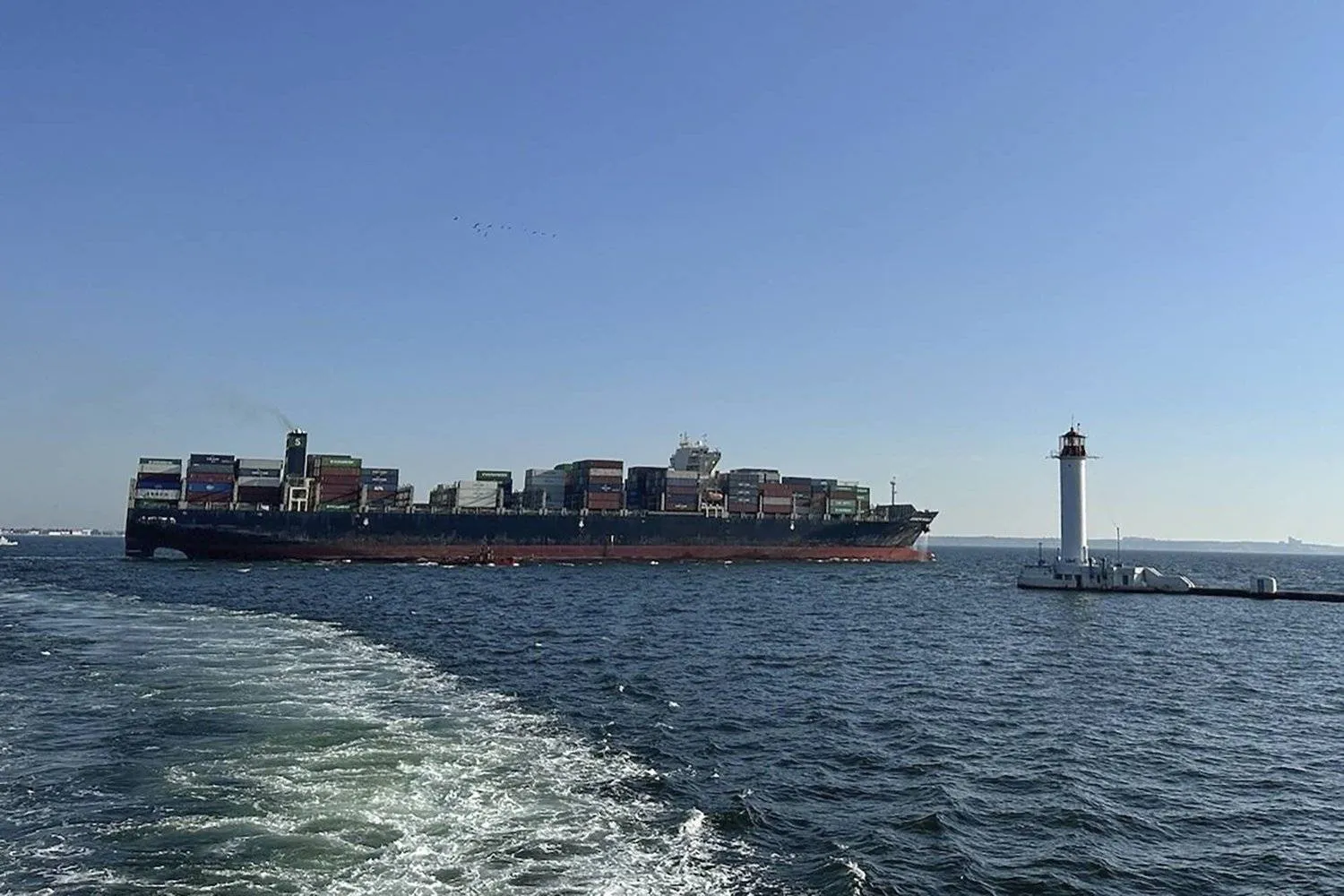

Cargo Ship Leaves Ukrainian Port despite Russian Threat of Attack

In this photo provided by Ukraine's Infrastructure Ministry Press Office, container ship Joseph Schulte (Hong Kong flag) leaves the port of Odesa to proceed through the temporary corridor established for merchant vessels from Ukraine's Black Sea ports in Odesa, Ukraine, Wednesday, Aug. 16, 2023. (Ukraine's Infrastructure Ministry Press Office via AP)
TT

Cargo Ship Leaves Ukrainian Port despite Russian Threat of Attack

In this photo provided by Ukraine's Infrastructure Ministry Press Office, container ship Joseph Schulte (Hong Kong flag) leaves the port of Odesa to proceed through the temporary corridor established for merchant vessels from Ukraine's Black Sea ports in Odesa, Ukraine, Wednesday, Aug. 16, 2023. (Ukraine's Infrastructure Ministry Press Office via AP)

A container ship set off from Ukraine's Black Sea port of Odesa on Wednesday in a test of Russia's threat to attack shipping after it abandoned a deal last month allowing Ukraine to export grain.

The departure of the Hong-Kong-flagged Joseph Schulte, which had been in the port since Feb. 23, 2022 - the day before Russia's invasion - followed a new Russian attack on Ukraine's grain export infrastructure.

Russian airstrikes damaged grain silos and warehouses at one of the Danube river ports, the governor of the Odesa region said, releasing photos showing destroyed storage facilities and piles of scattered grain and sunflowers.

Governor Oleh Kiper said it was a key facility for grains shipments and the president's chief of staff Andriy Yermak named the port as Reni. There was no immediate comment from Moscow. An industry source said the port was continuing operations.

Benchmark Chicago wheat futures were up about 1% after the news broke on Wednesday morning, adding to a slight earlier gain as they recovered from a two-month low on Tuesday, Reuters reported.

Russia has made regular airstrikes on Ukrainian ports and grain silos since pulling out of the UN-backed deal in mid-July and has threatened to treat any ships leaving Ukraine as potential military targets. On Sunday it fired warning shots at a ship travelling towards Ukraine.

Despite the threats, Ukraine last week announced a "humanitarian corridor" in the Black Sea to release cargo ships that have been trapped in its ports, pledging full transparency to make clear they were serving no military purpose.

"A first vessel used the temporary corridor for merchant ships to/from the ports of Big Odesa," Deputy Prime Minister Oleksandr Kubrakov said on Facebook.

Bernhard Schulte Shipmanagement (BSM), which owns the ship jointly with a Chinese bank, confirmed that the ship was en route to Istanbul.

The ship was carrying more than 30,000 metric tons of cargo in 2,114 containers, Kubrakov said, adding that the corridor would primarily be used to evacuate ships stuck in the Black Sea ports of Chornomorsk, Odesa and Pivdennyi since Russia's invasion.

Moscow has not indicated whether it would respect the shipping corridor, and shipping and insurance sources have expressed concerns about safety.

Ukraine is a major grain and oilseeds exporter and the United Nations says its supplies are vital to developing countries where hunger is a growing concern.

The attacks on Ukraine's grain followed its launch of a Western-backed counteroffensive in early June to try to dislodge Russian forces the territory they occupy in the south and east.

Extensive Russian fortifications and minefields along the front line have made it hard for Ukrainian forces to break through, but they announced they had retaken another village on Wednesday, the first settlement they have declared recaptured since June 27.

"Urozhaine liberated," Deputy Defense Minister Hanna Maliar said on Telegram. "Our defenders are entrenched on the outskirts."

There was no immediate comment from Russia. Russian military bloggers said fierce fighting raged near the village and that Russian units were trying to prevent Ukraine strengthening its positions in Urozhaine. Reuters was not able to verify the reports.

The village's recapture would indicate Ukraine is pressing ahead with an offensive drive towards the Sea of Azov just over 90 km to the south, aiming to cut Russian forces occupying its southeastern coastline in half.

Ukraine turned to its Danube river ports after Russia pulled out of the Black Sea grain deal seeking better terms for exports of its own food and fertilizer.

The river ports, which had accounted for around a quarter of grain exports, have since become the main route out for Ukrainian grain, which is also sent on barges to Romania's Black Sea port of Constanta for shipment onwards.

Earlier this month, Russia attacked Izmail - Ukraine's main inland port across the Danube River from Romania, sending global food prices higher as it ramped up its use of force to prevent Ukraine from exporting grain.

A Russian warship on Sunday fired warning shots at a cargo ship in the southwestern Black Sea as it made its way northwards, the first time Russia has fired on merchant shipping beyond Ukraine since exiting the grain deal.

Moscow said the ship's captain had failed to respond to a request to halt for an inspection. Kyiv said the incident was a gross violation of international law and "exemplified Russia's deliberate policy of endangering the freedom of navigation and safety of commercial shipping in the Black Sea.”

Turkey, which brokered the grain deal alongside the United Nations, has expressed hope that Russia will rejoin it this month.



Iran-Linked Ships Hover Over Subsea Cables in Gulf of Oman

Vessels at the Strait of Hormuz, as seen from Musandam, Oman, November 3, 2026. (Reuters)
TT

Iran-Linked Ships Hover Over Subsea Cables in Gulf of Oman

Vessels at the Strait of Hormuz, as seen from Musandam, Oman, November 3, 2026. (Reuters)

Ships linked to Iran have been hovering over subsea telecoms cables in the Middle East after Tehran threatened to attack cables and data centers if the US and Israel launch a fresh bombing campaign, reported the Financial Times on Friday.

At least four vessels tracked by the maritime analytics company Windward have been observed taking unusual routes and loitering over subsea cables traversing the Gulf of Oman in the days after Iran warned of disruption to digital infrastructure if the US escalated the conflict.

Three were tankers subject to US sanctions, while the fourth was a small Iranian fishing craft that loitered over the Europe India Gateway and Transworld cables between October 21 and 26, according to Windward data.

According to data from TeleGeography, six cables run through the Strait of Hormuz, while three more — Fiber in Gulf, Sea-Me-We 6 and 2Africa — are under construction. 2Africa is the closest to completion.

Iraq, Kuwait, Bahrain and Qatar are wholly dependent on cables running under the strait for their internet connectivity.

Tehran has been vocal in its threats against cables and data centers running through the Strait of Hormuz over the past month, in response to suggestions from US President Donald Trump and other senior US figures in the run-up to this week’s midterm elections that they would launch further attacks on Iran.

Hossein Mohebbi, spokesperson for Iran’s Revolutionary Guard Corps, said on October 19: “Seven major undersea internet cables run through the Strait of Hormuz, carrying all commercial and internet data. We just want [the US] to realize that new targets and new weapons shall be unveiled.”

That echoed comments by Mohsen Rezaei, secretary of Iran’s Supreme National Security Council, a week earlier threatening that “data centers and artificial intelligence facilities will be destroyed”.

Yadollah Javani, deputy commander of the IRGC for political affairs, said later in October that assets “including internet cables” would be damaged in retaliation for attacks on Iran’s own infrastructure.

Masha Kotkin, a former US state department official and fellow at the Center for Strategic and International Studies think-tank, said AI, cloud computing, data centers and other digital activities in the Gulf depended on subsea fiberoptic cables.

Any damage would result in “slower internet [and] financial transactions” and would “disrupt communications networks, ecommerce and cloud computing”, Kotkin said.

Connectivity is also a significant part of the Gulf countries’ efforts to diversify away from hydrocarbons and become a hub for digital businesses, Kotkin noted.

The US has continued to move military assets into the region. An aircraft carrier, the USS Theodore Roosevelt, was seen on satellite images in the South China Sea travelling towards Singapore early on Wednesday, potentially adding to two carriers already in the Middle East region.


Iran Says Two Tankers Caught Fire in Hormuz after Hitting Mines

Vessels at the Strait of Hormuz, as seen from Musandam, Oman, November 3, 2026. REUTERS/Stringer
TT

Iran Says Two Tankers Caught Fire in Hormuz after Hitting Mines

Vessels at the Strait of Hormuz, as seen from Musandam, Oman, November 3, 2026. REUTERS/Stringer

Two oil tankers caught fire in the Strait of Hormuz after hitting mines, Iran's Revolutionary Guards said on Sunday, according to state news agency IRNA.

Since the outbreak of the Iran war in late February, Tehran has severely restricted traffic through the strategic waterway, insisting vessels use routes authorized by the Iranian republic.

The United States has in response imposed a naval blockade on Iranian ports and helped tankers travel the strait, which normally carries about one-fifth of global oil consumption.

"Two oil tankers violating regulations -- one in the eastern part of the Strait of Hormuz and the other within the strait -- caught fire and are currently engulfed in intense flames after striking naval mines while attempting to cross through unauthorized routes," the Iranian Revolutionary Guard Corps, the ideological arm of Iran's military, said in a statement.

"The two tankers had reportedly committed multiple violations, including switching off their navigation and positioning systems, as they attempted to transit through an unauthorized route," the statement added.

The Guards did not specify the name or nationality of the tankers.

Tehran has made multiple announcements in recent weeks saying that ships have caught fire in the Hormuz strait.

US Central Command has recently said that all mines have been cleared from the waterway.

The IRNA separately reported late on Saturday that sounds of explosions were heard in parts of the country.

"Sounds resembling explosions were heard in Qeshm, Sirik, Jask, and Bandar Abbas. The cause of the sounds remains unknown," the news agency wrote on Telegram.

Officials confirmed an "impact" in the port city of Jask, the IRNA said.

US President Donald Trump previously talked up the possibility of resuming heavy strikes on Iran but has since walked back from the idea.

Nevertheless, the US military has conducted occasional limited strikes.


Iran Executes Three Men over Armed Unrest during January Protests

Iranians protest to stop death penalty executions (Archive - Reuters)
TT

Iran Executes Three Men over Armed Unrest during January Protests

Iranians protest to stop death penalty executions (Archive - Reuters)

Iran executed three men on Sunday after they were convicted of carrying out operations for Israel and the US and taking part in armed unrest during anti-government protests in January, state media reported.
The executions are the latest in a ‌series Iran has ‌carried out in recent ‌months ⁠over the January ⁠protests, including of people accused of links to Israel and the US, Reuters reported.
Hassan Dioband, Hamid Kazemi and Reza Zanganeh were accused of using firearms, grenades and Molotov ⁠cocktails, setting fire to public facilities ‌and ‌damaging an electricity substation in the city of ‌Karaj, causing power outages ‌in some areas, according to the judiciary.
The judiciary said Dioband was arrested on January 11 after investigations identified him ‌as a suspect in attacks on public property and incitement ⁠to ⁠violence.
Ten others accused of participating in the unrest under his supervision were subsequently arrested.
The three were sentenced to death and ordered to have their assets confiscated. Their executions were carried out after the Supreme Court upheld their sentences, while the other defendants received prison terms of 5 to 10 years.