

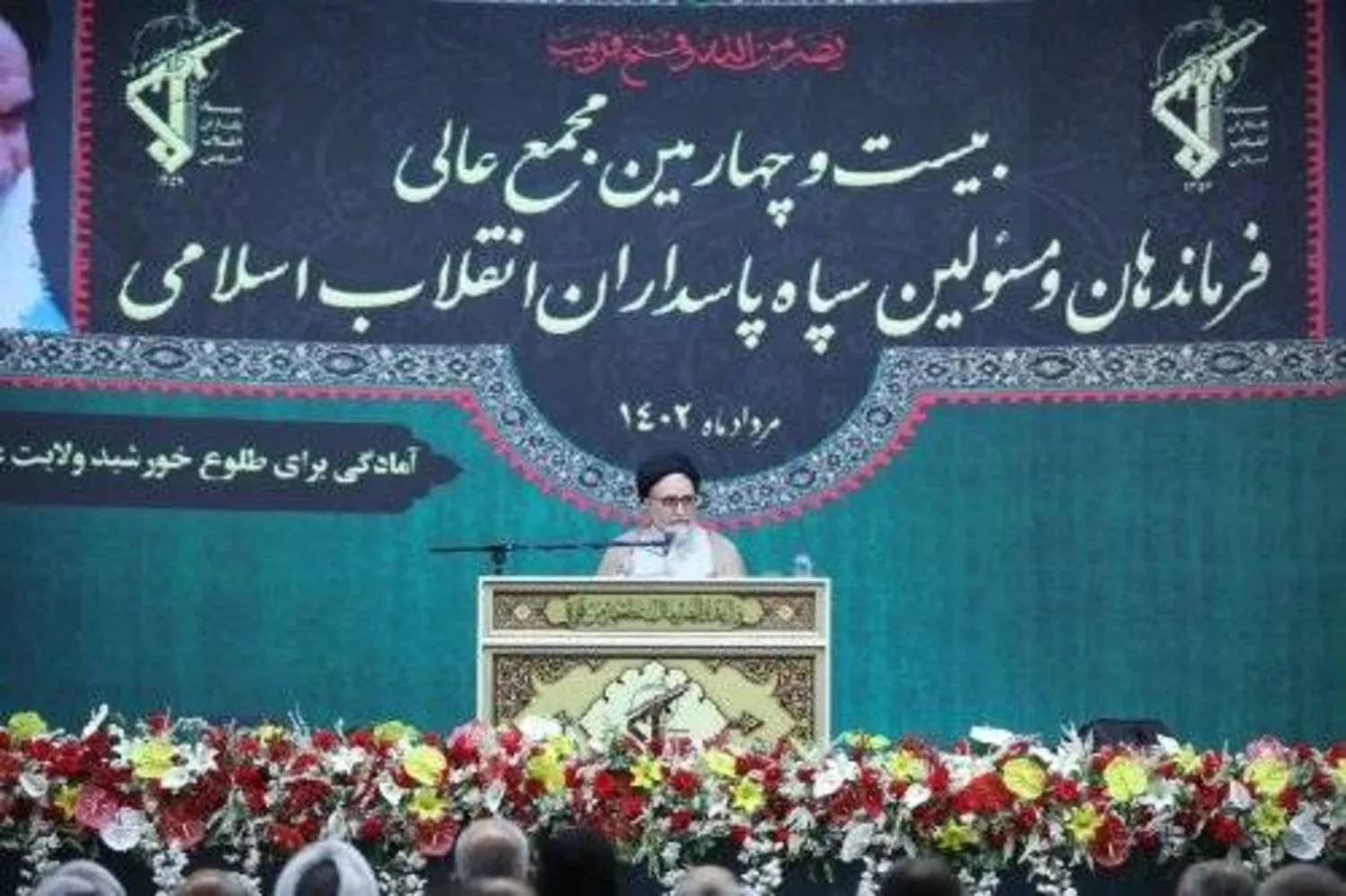

Iranian Minister of Intelligence Says His Country Holds ‘Spies’ from France, Sweden, UK

Khatib delivers a speech before the Supreme Assembly of Commanders of the IRGC. (ISNA) 
TT

Iranian Minister of Intelligence Says His Country Holds ‘Spies’ from France, Sweden, UK

Khatib delivers a speech before the Supreme Assembly of Commanders of the IRGC. (ISNA) 

Iran’s Minister of Intelligence Esmail Khatib said that Iran is holding spies from Sweden, France, Britain, and several other countries and that some of them had been put to death.

Speaking at the 24th Supreme Assembly of Commanders of the IRGC, Khatib warned that “the enemy’s” aim is to destabilize Iran and reduce participation in the upcoming parliamentary elections in March.

Reiterating Khamenei's statements, Khatib said that the enemies are trying to use the Baha'is, public frustration, trade union movements, and political currents that incite sedition and change, to provoke crises in society.

The intelligence chief said more than 50 foreign intelligence agencies have established an “Iran desk” to counter Iran.

The minister also blasted the US for creating the ISIS terrorist group.

Iran has foiled many plots after about 200 terrorists entered Iran and were looking to destabilize the country and the region during the 40th of Imam Hussain rituals in Iraq, the minister revealed.

Iran announced that ISIS claimed responsibility for an attack on a shrine in Iran's city of Shiraz that killed two and wounded seven. Iranian officials said that they apprehended the logistics official for the group’s operations and the link between "ISIS Khorasan" and "ISIS in the Syrian territories".

The officials, however, didn’t provide any evidence.

Khatib revealed that spies from Sweden, France, Britain, and several other countries, are in Iran’s captivity.

“Despite pressure from abroad, some of those spies were sentenced to death and executed,” said the minister.

He emphasized that coordination and collaboration among all parts of the intelligence community are key factors in Iran’s success in apprehending spies, said ISNA news agency.

Iran’s “Revolutionary Guards” have arrested dozens of dual nationals during the past two years, mostly on spying charges.

While rights activists accuse Iran of arresting dual nationals to use them as bargaining chips, some Western capitals describe their detained citizens as “state hostages”.

In January, Iran executed a former senior official over charges of espionage in favor of Britain.

Tension worsened between London and Tehran after the execution of dual Iranian-British national Ali Shamkhani, who once held a high-ranking position in the country's defense ministry.

Iran does not recognize dual nationality for Iranians. This means that if dual nationals are detained, the government will not grant consular access to foreign officials to visit them in detention.

Earlier this year, Iran freed Belgian aid worker Olivier Vandecasteele, a Danish, and two Austrians in return for Iranian diplomat Asadollah Assadi who was serving a 20-year jail for his role in a bomb plot targeting a rally by opponents of the Iranian regime in 2018.

This month, Iran has moved five Iranian-Americans from prison to house arrest in exchange for billions of dollars frozen in South Korea. After the funds are transferred to the Swiss Central Bank account in Germany, they will be transferred to two bank accounts in Qatar.

The White House stressed last week that there would be restrictions on what Iran could do with any funds unfrozen under an emerging agreement.

Meanwhile, the adviser to the commander in chief of the “Revolutionary Guards”, Hossein Taeb said that protests and riots are decreasing as the elections approach, but the political confrontations are increasing.

In this context, he said that the enemies now plot to destabilize political stability instead of security stability, according to ISNA.

More than 500 protesters were killed in the violent crackdown on the protests in the wake of Mahsa Amini’s death. Over 20,000 people were arrested and seven were executed on charges of attacking the security forces.



Israeli Air Force Deploys First Laser Interception System

FILED - 26 March 2024, Israel, Jerusalem: Israel Katz attends a meeting at a hotel in Jerusalem. Photo: Christoph Soeder/dpa
TT

Israeli Air Force Deploys First Laser Interception System

FILED - 26 March 2024, Israel, Jerusalem: Israel Katz attends a meeting at a hotel in Jerusalem. Photo: Christoph Soeder/dpa

Israel's defense ministry said on Sunday it had deployed a new "Iron Beam" laser system for the air force to intercept aerial threats.

The laser system's main developers, the ministry's research and development department and defense contractor Rafael, delivered it to the air force at a ceremony in northern Israel.

"For the first time globally, a high-power laser interception system has achieved full operational maturity, successfully executing multiple interceptions," Defense Minister Israel Katz said at the ceremony, according to a statement.

"This monumental achievement... delivers a critical message to our enemies, near and far alike: do not challenge us, or face severe consequences," AFP quoted him as saying.

The handover marks a major milestone in a project more than a decade old.
"Israel has become the first country in the world to field an operational laser system for the interception of aerial threats, including rockets and missiles," said Yuval Steinitz, chairman of Rafael.

The laser system seeks to enhance and slash the cost of Israel's interception of projectiles, and will supplement other aerial defense capacities such as the more well-known Iron Dome.

Iron Dome offers short-range protection against missiles and rockets. The David's Sling system and successive generations of Arrow missiles are Israeli-American technology built to bring down ballistic missiles.

The defense ministry announced in early December that the laser system was complete, and would be deployed by the end of the month.

During the 12-day war launched by Israel against Iran in June, the country's missile defense system failed to intercept all the projectiles fired by Tehran toward Israeli territory.

Israel has since acknowledged being hit by more than 50 missiles during the war with Iran, resulting in 28 deaths.


Trump Says Had 'Productive' Call with Putin Ahead of Zelensky Meeting

US President Donald Trump takes part in a Christmas Eve dinner in the ballroom of his Mar-a-Lago club in Palm Beach, Florida, US, December 24, 2025. REUTERS/Jessica Koscielniak
TT

Trump Says Had 'Productive' Call with Putin Ahead of Zelensky Meeting

US President Donald Trump takes part in a Christmas Eve dinner in the ballroom of his Mar-a-Lago club in Palm Beach, Florida, US, December 24, 2025. REUTERS/Jessica Koscielniak

US President Donald Trump said he had a productive telephone call with his Russian counterpart Vladimir Putin on Sunday ahead of a planned meeting in Florida with Ukraine's leader Volodymyr Zelensky.

"I just had a very good and productive telephone call with President Putin of Russia" before the planned talks with Zelensky at Trump's Florida estate at 1:00 pm local time (1800 GMT), the US leader said on Truth Social.

Putin said Ukraine was in no hurry for peace and if it did not want to resolve their conflict peacefully, Moscow would accomplish all its goals by force.

Putin's remarks on Saturday, carried by state news agency TASS, followed a vast Russian drone and missile attack that prompted Zelensky to say Russia was demonstrating its wish to continue the war while Kyiv wanted peace.


Russia Sends 3 Iranian Satellites into Orbit, Report Says

In this photo released by Roscosmos space corporation on Thursday, Feb. 29, 2024, the Soyuz-2.1b rocket blasts off at the Vostochny cosmodrome outside the city of Tsiolkovsky, about 200 kilometers (125 miles) from the city of Blagoveshchensk in the far eastern Amur region, Russia. A Russian Soyuz rocket successfully put an Iranian satellite into orbit along with 18 Russian satellites on Thursday. (Roscosmos space corporation via AP)
TT

Russia Sends 3 Iranian Satellites into Orbit, Report Says

In this photo released by Roscosmos space corporation on Thursday, Feb. 29, 2024, the Soyuz-2.1b rocket blasts off at the Vostochny cosmodrome outside the city of Tsiolkovsky, about 200 kilometers (125 miles) from the city of Blagoveshchensk in the far eastern Amur region, Russia. A Russian Soyuz rocket successfully put an Iranian satellite into orbit along with 18 Russian satellites on Thursday. (Roscosmos space corporation via AP)

Russia on Sunday sent three Iranian communications satellites into orbit, the second such launch since July, Iranian state television reported.

The report said that a Russian rocket sent the satellites to circle the Earth on a 500-kilometer (310-mile) orbit from the Vostochny launchpad in eastern Russia. The three satellites are dubbed Paya, Kowsar and Zafar-2.

The report said that Paya, weighing 150 kilograms (330 pounds), is the heaviest satellite that Iran has ever deployed into orbit. Kowsar weighs 35 kilograms (77 pounds), but the report didn't specify how heavy Zafar-2 is.

The satellites feature up to 3-meter resolution images, applicable in the management of water resources, agriculture and the environment. Their life span is up to five years.

Russia occasionally sends Iran's satellites into orbit, highlighting the strong ties between the two countries. In July, a Russian rocket sent Iranian communications satellite Nahid-2 into orbit.

Russia, which signed a “strategic partnership” treaty with Iran in January, strongly condemned the Israeli and US strikes on Iran that came during a 12-day air war in June and killed nearly 1,100 Iranians, including military commanders and nuclear scientists. Retaliatory missile barrages by Iran killed 28 people in Israel.

As a long-standing project, Iran from time-to-time launches satellite carriers to send its satellites into space.

The United States has said that Iran’s satellite launches defy a UN Security Council resolution and called on Tehran to undertake no activity involving ballistic missiles capable of delivering nuclear weapons. UN sanctions related to Iran’s ballistic missile program expired in 2023.