


South Korea’s Yoon Warns against Russia-North Korea Military Cooperation

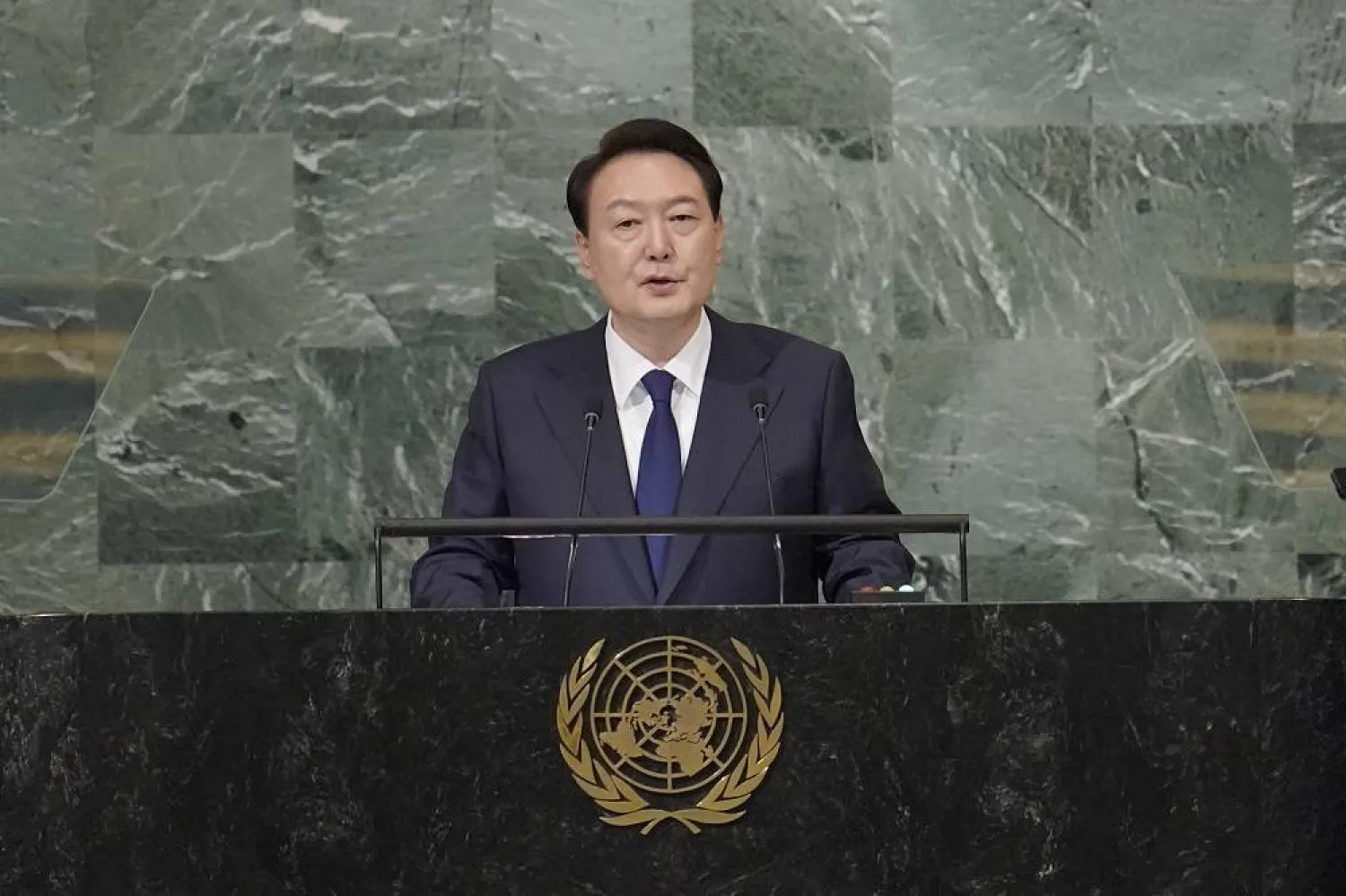
South Korean President Yoon Suk Yeol addresses the 77th session of the United Nations General Assembly on Sept. 20, 2022 at the UN headquarters. (AP)
TT

South Korea’s Yoon Warns against Russia-North Korea Military Cooperation

South Korean President Yoon Suk Yeol addresses the 77th session of the United Nations General Assembly on Sept. 20, 2022 at the UN headquarters. (AP)

South Korea’s president said the international community “will unite more tightly” to cope with deepening military cooperation between Russia and North Korea, as he plans to raise the issue with world leaders at the UN General Assembly this week.

Worries about Russian-North Korean ties have flared since North Korean leader Kim Jong Un traveled to Russia last week for a summit with President Vladimir Putin and to tour a slew of high-profile military and technology sites.

Foreign experts speculate Kim could refill Russia’s ammunition inventory drained in its 18-month war with Ukraine in return for economic aid and technologies to modernize his weapons systems targeting South Korea and the US.

“Military cooperation between North Korea and Russia is illegal and unjust as it contravenes UN Security Council resolutions and various other international sanctions,” South Korean President Yoon Suk Yeol said in written responses to questions from The Associated Press before his departure to New York to attend the UN General Assembly.

“The international community will unite more tightly in response to such a move,” he said.

In his address Wednesday at the annual UN gathering, Yoon will speak about his assessment of the Russian-North Korean moves, according to his office in South Korea, which added it is discussing countermeasures with the US, Japan and other partners.

While Russian-North Korean cooperation is feared to fuel Russia’s war efforts in Ukraine, it has also stoked security jitters in South Korea, where many think a Russian transfer of sophisticated weapons technologies would help North Korea acquire a functioning spy satellite, a nuclear-powered submarine and more powerful missiles.

Some experts still say North Korea would end up receiving food and cash in return for supplying ammunition and shells because Russia closely guards its high-tech weapons technologies.

North Korea’s advancing nuclear arsenal has been a major source of tensions in the region, with the North openly threatening to use nuclear weapons in potential conflicts with its rivals and conducting a barrage of missile tests since last year. In response, Yoon and US President Joe Biden in April agreed to expand joint military exercises, increase the temporary deployments of US strategic assets and launch a bilateral nuclear consultative group.

“Our two countries (South Korea and the US) reaffirmed that any nuclear attack by North Korea will be met with a swift, overwhelming and decisive response that will bring about the end of the regime,” Yoon said.

“Going forward, (South Korea)-US extended deterrence will develop into a joint system in which both countries discuss, decide and act together,” he said. “We will also enhance the ability to deter and respond to any nuclear or missile threat from North Korea.”

Since entering Russia last Tuesday in his first foreign travel in 4 1/2 years, Kim has inspected some of Russia's most advanced weapons systems including nuclear-capable bombers, fighter jets, hypersonic missiles and a warship. During a summit with Putin at Russia's most important space launch center on Wednesday, Kim vowed "full and unconditional support” for Putin.

Some South Koreans call on their government to consider providing lethal weapons to Ukraine in retaliation against Russia's possible weapons technology transfers. But South Korea's Defense Ministry said its policy of not supplying weapons to countries at war remained unchanged.

Yoon recently announced South Korea will provide an additional $300 million to Ukraine next year, on top of the $150 million promised this year. He said South Korea will prepare for a mid- to long-term support package worth more than $2 billion.

South Korea has provided Ukraine with demining equipment, emergency evacuation vehicles, pickup trucks, medical supplies, tablet PCs and other items. Yoon said in the coming year South Korea will continue to communicate closely with Ukraine to send it what is truly needed.

Since taking office last year, Yoon, a conservative, has made a bolstered military alliance with the US the heart of his foreign policy while pushing to move beyond history disputes with Japan — Korea’s former colonial ruler — and expand a trilateral Seoul-Washington-Tokyo security cooperation. That has triggered concerns that South Korea's relations with China, its biggest trading partner, will be hurt.

Yoon dismissed such a notion, saying “the trilateral cooperation harbors no intention of marginalizing any particular nation or establishing an exclusive coalition.”

Citing his meetings with Chinese President Xi Jinping last November and Premier Li Qiang this month, both on the margins of regional gatherings, Yoon said he learned that “China also attaches importance to (South Korea)-China relations.”

During their November meeting, Yoon said Xi expressed his willingness to visit South Korea when the COVID-19 pandemic situation stabilized. Yoon said Li and Japanese Prime Minister Fumio Kishida had also expressed their support for resuming a trilateral Seoul-Beijing-Tokyo summit in South Korea for the first time in four years.

“All three countries — the Republic of Korea, the United States and Japan — share a common understanding that it is important for China to play a responsible and constructive role not only in resolving pending issues on the Korean Peninsula and in the region but also in addressing global challenges,” Yoon said.

In his UN speech, Yoon said that he'll also raise the issue of gaps in three areas — development, climate responses and digital transformation — and present how South Korea will contribute to resolving them.

Yoon said that as a non-permanent member of the Security Council for the 2024-25 term, he'll also mention that South Korea will play a responsible role on security issues that require international solidarity like the war in Ukraine and the North Korean nuclear program. While in New York, Yoon said he will hold bilateral summits with the leaders of about 30 countries.



Trump Warns of 'Bad Things' if Iran Doesn't Make a Deal, as Second US Carrier Nears Mideast

The US Navy's Nimitz-class aircraft carrier USS Abraham Lincoln leads its strike group during a photo exercise in the Arabian Sea, February 6, 2026.  US Navy/Mass Communication Specialist 1st Class Jesse Monford/Handout via REUTERS
The US Navy's Nimitz-class aircraft carrier USS Abraham Lincoln leads its strike group during a photo exercise in the Arabian Sea, February 6, 2026. US Navy/Mass Communication Specialist 1st Class Jesse Monford/Handout via REUTERS
TT

Trump Warns of 'Bad Things' if Iran Doesn't Make a Deal, as Second US Carrier Nears Mideast

The US Navy's Nimitz-class aircraft carrier USS Abraham Lincoln leads its strike group during a photo exercise in the Arabian Sea, February 6, 2026.  US Navy/Mass Communication Specialist 1st Class Jesse Monford/Handout via REUTERS
The US Navy's Nimitz-class aircraft carrier USS Abraham Lincoln leads its strike group during a photo exercise in the Arabian Sea, February 6, 2026. US Navy/Mass Communication Specialist 1st Class Jesse Monford/Handout via REUTERS

Iran held annual military drills with Russia on Thursday as a second American aircraft carrier drew closer to the Middle East, with both the United States and Iran signaling they are prepared for war if talks on Tehran's nuclear program fizzle out.

President Donald Trump said Thursday he believes 10 to 15 days is “enough time” for Iran to reach a deal. But the talks have been deadlocked for years, and Iran has refused to discuss wider US and Israeli demands that it scales back its missile program and sever ties to armed groups. Indirect talks held in recent weeks made little visible progress, and one or both sides could be buying time for final war preparations.

Iran’s theocracy is more vulnerable than ever following 12 days of Israeli and US strikes on its nuclear sites and military last year, as well as mass protests in January that were violently suppressed.

In a letter to the UN Security Council on Thursday, Amir Saeid Iravani, the Iranian ambassador to the UN, said that while Iran does not seek “tension or war and will not initiate a war,” any US aggression will be responded to “decisively and proportionately.”

“In such circumstances, all bases, facilities, and assets of the hostile force in the region would constitute legitimate targets in the context of Iran’s defensive response,” Iravani said.

Earlier this week, Iran conducted a drill that involved live-fire in the Strait of Hormuz, the narrow opening of the Arabian Gulf through which a fifth of the world's traded oil passes.

Tensions are also rising inside Iran, as mourners hold ceremonies honoring slain protesters 40 days after their killing by security forces. Some gatherings have seen anti-government chants despite threats from authorities.

Trump again threatens Iran

The movements of additional American warships and airplanes, with the USS Gerald R. Ford aircraft carrier near the mouth of the Mediterranean Sea, don't guarantee a US strike on Iran — but they bolster Trump's ability to carry out one should he choose to do so.

He has so far held off on striking Iran after setting red lines over the killing of peaceful protesters and mass executions, while reengaging in nuclear talks that were disrupted by the war in June.

Iran has agreed to draw up a written proposal to address US concerns raised during this week’s indirect nuclear talks in Geneva, according to a senior US official who was not authorized to comment publicly and spoke on the condition of anonymity.

The official said top national security officials gathered Wednesday to discuss Iran, and were briefed that the “full forces” needed to carry out potential military action are expected to be in place by mid-March. The official did not provide a timeline for when Iran is expected to deliver its written response.

“It’s proven to be, over the years, not easy to make a meaningful deal with Iran, and we have to make a meaningful deal. Otherwise, bad things happen,” Trump said Thursday.

With the US military presence in the region mounting, one senior regional government official said he has stressed to Iranian officials in private conversations that Trump has proven that his rhetoric should be taken at face value and that he’s serious about his threat to carry out a strike if Iran doesn’t offer adequate concessions.

The official, who spoke on the condition of anonymity to discuss delicate diplomatic conversations, said he has advised the Iranians to look to how Trump has dealt with other international issues and draw lessons on how it should move forward.

The official added that he’s made to case to the Trump administration it could draw concessions from Iran in the near-term if it focuses on nuclear issues and leaves the push on Tehran to scale back its ballistic missile program and support for proxy group for later.

The official also said that Trump ordering a limited strike aimed at pressuring Iran could backfire and lead to Supreme Leader Ali Khamenei withdrawing Iran from the talks.

Growing international concern Polish Prime Minister Donald Tusk urged his nation's citizens to immediately leave Iran as “within a few, a dozen, or even a few dozen hours, the possibility of evacuation will be out of the question.” He did not elaborate, and the Polish Embassy in Tehran did not appear to be drawing down its staff.

The German military said that it had moved “a mid-two digit number of non-mission critical personnel” out of a base in northern Iraq because of the current situation in the region and in line with its partners’ actions. It said that some troops remain to help keep the multinational camp running in Irbil, where they train Iraqi forces.

Iran holds drill with Russia Iranian forces and Russian sailors conducted the annual drills in the Gulf of Oman and the Indian Ocean aimed at “upgrading operational coordination as well as exchange of military experiences,” Iran's state-run IRNA news agency reported.

Footage released by Iran showed members of the paramilitary Revolutionary Guard's naval special forces board a vessel in the exercise. Those forces are believed to have been used in the past to seize vessels in key international waterways.

Iran also issued a rocket-fire warning to pilots in the region, suggesting it planned to launch anti-ship missiles in the exercise.

Meanwhile, tracking data showed the Ford off the coast of Morocco in the Atlantic Ocean midday Wednesday, meaning the carrier could transit through Gibraltar and potentially station in the eastern Mediterranean with its supporting guided-missile destroyers.

It would likely take more than a week for the Ford to be off the coast of Iran.

Netanyahu warns Iran Israel is making its own preparations for possible Iranian missile strikes in response to any US action.

“We are prepared for any scenario,” Israeli Prime Minister Benjamin Netanyahu said Thursday, adding that if Iran attacks Israel, “they will experience a response they cannot even imagine.”

Netanyahu, who met with Trump last week, has long pushed for tougher US action against Iran and says any deal should not only end its nuclear program but curb its missile arsenal and force it to cut ties with militant groups like Hamas and Hezbollah.

Iran has said the current talks should only focus on its nuclear program, and that it hasn't been enriching uranium since the US and Israeli strikes last summer. Trump said at the time that the strikes had “obliterated” Iran's nuclear sites, but the exact damage is unknown as Tehran has barred international inspectors.

Iran has always insisted its nuclear program is peaceful. The US and others suspect it is aimed at eventually developing weapons. Israel is widely believed to have nuclear weapons but has neither confirmed nor denied that.


US Pays $160 Million of More than $4 Billion Owed to UN

US President Donald Trump during the Board of Peace meeting at the Donald J. Trump US Institute of Peace in Washington, USA, 19 February 2026. EPA/ALESSANDRO DI MEO
TT

US Pays $160 Million of More than $4 Billion Owed to UN

US President Donald Trump during the Board of Peace meeting at the Donald J. Trump US Institute of Peace in Washington, USA, 19 February 2026. EPA/ALESSANDRO DI MEO

The United States has paid about $160 million of the more than $4 billion it owes to the UN, a United Nations spokesperson said on Thursday as President Donald Trump hosted the first meeting of his "Board of Peace" initiative that experts say could undermine the United Nations.

"Last week, we received about $160 million from the United States as a partial payment of its past dues for the UN regular budget," the UN spokesperson said ‌in a ‌statement.

Trump said during his comments at the opening "Board of Peace" ‌meeting ⁠that Washington would ⁠give the United Nations money to strengthen it.

The US is the biggest contributor to the UN budget, but under the Trump administration it has refused to make mandatory payments to regular and peacekeeping budgets, and slashed voluntary funding to UN agencies with their own budgets.

Washington has withdrawn from dozens of UN agencies.

UN officials say the US owed $2.19 billion to the regular UN budget as of the start ⁠of February, more than 95% of the total owed by ‌countries globally. The US also owes another $2.4 billion ‌for current and past peacekeeping missions and $43.6 million for UN tribunals.

"We're going to help ‌them (UN) money-wise, and we're going to make sure the United Nations is viable," ‌Trump said.

"I think the United Nations has great potential, really great potential. It has not lived up to (that) potential."

Countries, including major powers of the Global South and key US allies in the West, have been reluctant to join Trump's "Board of Peace" where ‌Trump himself is the chair. Many experts have said such an initiative undermines the United Nations.

Trump launched the board ⁠last month ⁠and proposed it late last year as part of his plan to end Israel's war in Gaza.

A UN Security Council resolution recognized the board late last year through 2027, limiting its scope to Gaza, the Palestinian territory it was meant to oversee following Israel's devastating more than two-year assault. Under Trump's plan to end Israel's war in Gaza, the board was meant to oversee Gaza's temporary governance. Trump subsequently said the board will tackle global conflicts and look beyond Gaza as well.

UN experts say that Trump's oversight of a board to supervise a foreign territory's affairs resembles a colonial structure and criticized the board for not having Palestinian representation. There was no UN representative at the "Board of Peace" meeting on Thursday.


Türkiye Says Greece-Chevron Activity off Crete Unlawful 

A Chevron gas station sign is pictured at one of their retain gas stations in Cardiff, California October 9, 2013. REUTERS/Mike Blake/File Photo
TT

Türkiye Says Greece-Chevron Activity off Crete Unlawful 

A Chevron gas station sign is pictured at one of their retain gas stations in Cardiff, California October 9, 2013. REUTERS/Mike Blake/File Photo

Türkiye said on Thursday it opposed Greece's "unilateral activities" in energy fields south of Crete with a consortium led by US major Chevron as a violation of international law and good neighbourly relations.

Athens responded that its policies abide international law.

The Chevron-led consortium signed exclusive lease agreements on Monday to look for natural gas off southern Greece, expanding US presence in the eastern Mediterranean.

"We oppose this unlawful activity, which is being attempted in violation of the 2019 Memorandum of Understanding on Maritime Jurisdiction between Libya and our country," the Turkish Defense Ministry said at a press briefing.

It said the activity, while not directly impacting Türkiye's continental shelf, also violated Libya's maritime jurisdiction that was declared to the United Nations in May last year.

"We continue to provide the necessary support to the Libyan authorities to take action against these unilateral and unlawful activities by Greece," the ministry said.

A 2019 agreement signed by Türkiye and Libya set out maritime boundaries in the Mediterranean Sea. It was rejected by Greece as it ignored the presence of the Greek island of Crete between the coasts of Türkiye and Libya. The Chevron deal doubles the amount of Greek maritime acreage available for exploration and is the second in months involving a US energy major, as the European Union seeks to phase out supplies from Russia and the US seeks to replace them.

Asked about the Turkish objections later on Thursday, Greek government spokesman Pavlos Marinakis told a press briefing that Athens followed an "active policy" and "exercises its rights in accordance with international law and respects international law steadfastly - and I think no one questions that, period."

There was no immediate comment from Chevron.

Neighbors and NATO members Türkiye and Greece have been at odds over a range of issues for decades, primarily maritime boundaries and rights in the Aegean, an area widely believed to hold energy resources and with key implications for airspace and military activity.

A 2023 declaration on friendly relations prompted a thaw between the sides and leaders have voiced a desire to address remaining issues.