


Blinken Sends Starkest Warning Yet to Iran Against Getting Involved in War

The Security Council meeting on Tuesday (EPA)
TT

Blinken Sends Starkest Warning Yet to Iran Against Getting Involved in War

The Security Council meeting on Tuesday (EPA)

Secretary of State Antony Blinken issued the starkest warning yet to the regime in Tehran as the Biden administration tries to keep Tehran from joining the war between Israel and Hamas, saying the US would respond “decisively” if Iran or its proxies attack Americans.

“The United States does not seek conflict with Iran,” Blinken told a UN Security Council meeting Tuesday. “We do not want this war to widen. But if Iran or its proxies attack US personnel anywhere, make no mistake: We will defend our people, we will defend our security, swiftly and decisively.”

The Security Council met in New York on Tuesday for a scheduled quarterly open debate on the ongoing conflict between Israel and Palestine, now given greater urgency by the Hamas attacks of October 7and the deepening humanitarian crisis as the Israeli bombardment of the Gaza Strip continues.

“The situation in the Middle East is growing more dire by the hour,” UN Secretary-General Antonio Guterres warned the Council. He added: “the war in Gaza is raging and risks spiraling throughout the region.”

Guterres said that he has condemned unequivocally the horrifying and unprecedented October 7 “acts of terror” by Hamas in Israel, but stressed that “nothing can justify the deliberate killing, injuring and kidnapping of civilians – or the launching of rockets against civilian targets.”

He also said that protecting civilians can never mean using them as human shields.

The UN chief called on making the delivery of aid easier and safer, and facilitating the release of hostages to ease epic suffering. “I reiterate my appeal for an immediate humanitarian ceasefire,” he said.

“Even in this moment of grave and immediate danger, we cannot lose sight of the only realistic foundation for a true peace and stability: a two-State solution,” Guterres affirmed.

His comments were followed by those of the UN Special Coordinator for the Middle East Peace Process, Tor Wennesland, who said it is critical that the international community employ all its collective efforts to end the bloodletting and prevent the further expansion of hostilities, including in the region. “The stakes are astronomically high, and I appeal for all relevant actors to act responsibly,” he said.

Speaking on behalf of Martin Griffiths, Lynn Hastings, the Humanitarian Coordinator for the Occupied Palestinian Territory, urged all countries with influence to exert it and ensure respect for international humanitarian law.

She said civilians must have the essentials to survive. As such, the passage of rapid and unimpeded humanitarian relief must be facilitated, and water and electricity connections resumed, Hastings added.

For his part, Palestinian Foreign Minister Riyad al-Maliki stated that the Security Council and the international community has a duty and an obligation to save lives.

“Continued failure at this [Security] Council is inexcusable,” he stressed.

“By the time representatives are done delivering their speeches today, 150 Palestinians will have been killed, including 60 children,” he said, adding that, in the last two weeks, over 5,000 Palestinians have been killed, including over 2,300 children and 1,300 women. “Almost all those killed by Israel are civilians,” Maliki underscored.

He said more injustice and more killing will not make Israel safer, adding that no amount of weapons and no alliance will bring to it security, but only peace with Palestine and its people will.

Maliki’s speech was directly followed by Israeli Foreign Minister Eli Cohen, who described the Hamas attack as the most brutal and vicious terror attack in modern history.

“Hamas are the new Nazis,” he said, and the civilized world must stand united behind Israel to defeat them.

Following a statement by Brazil’s Foreign Minister and President of the Council for October Mauro Vieira who said that achieving peace requires strict adherence to international law as well as working towards the two-State solution, the US Secretary of State again recognized the right of states to defend themselves against terrorism.

Also, Blinken said humanitarian pauses must be considered. “We continue to coordinate closely with Egypt, Israel, and partners across the region as well as with the United Nations to build mechanisms that will enable sustained humanitarian assistance to flow to civilians in Gaza without benefiting Hamas or any other terrorist group,” he said.

Blinken then called on all Council members to use their leverage to secure the release of the 200 hostages still in the grip of Hamas.

The US Secretary of State told the Security Council that he will work with China's top diplomat, Wang Yi, to prevent the conflict in the Middle East from spreading when they meet later this week.

However, he warned that it would act swiftly and decisively if Tehran or its proxies attack US personnel anywhere.

“To all of the members of this council: If you, like the United States, want to prevent this conflict from spreading, tell Iran, tell its proxies – in public, in private, through every means – do not open another front against Israel in this conflict; do not attack Israel’s partners,” he added.

Finally, the US top diplomat said, “We all agree that we must redouble our collective efforts to build an enduring political solution to the conflict between Israelis and Palestinians.”

Blinken’s French counterpart, Catherine Colonna, said, “It is our duty to pave the way to peace."

She added that the only viable solution is the two-State solution. “We need to do all we can. This Council must act and it must act now.”

Colonna affirmed her country’s solidarity with Israel and underscored its right to defend itself and protect its people, while noting that Israel must do so while respecting international law, in particular international humanitarian law.

Meanwhile, the UN General Assembly will meet on Thursday to discuss the war in Gaza, its president announced Monday in a letter to member states.

Jordan on behalf of the Arab grouping, Russia, Syria, Bangladesh, Vietnam and Cambodia, formally requested General Assembly President Dennis Francis to schedule the meeting.



Poland Bars Chinese-Made Cars from Military Sites Over Data Security Fears 

A soldier from the 18th Mechanized Division stands guard on a Light Strike Vehicle "Zmija" during a media tour organized by the country's military to demonstrate the security measures on the Polish Belarusian border, near Bialowieza, Poland, January 10, 2025. (Reuters)
TT

Poland Bars Chinese-Made Cars from Military Sites Over Data Security Fears 

A soldier from the 18th Mechanized Division stands guard on a Light Strike Vehicle "Zmija" during a media tour organized by the country's military to demonstrate the security measures on the Polish Belarusian border, near Bialowieza, Poland, January 10, 2025. (Reuters)

Poland has barred Chinese-made vehicles from entering military facilities due to concerns their onboard sensors could be used to collect sensitive data, the Polish Army said on Tuesday evening.

The army said in ‌a statement ‌that such vehicles ‌may ⁠still be allowed onto ⁠secured sites if specified functions are disabled and other safeguards required under each facility's security rules are in place.

To ⁠limit the risk ‌of ‌exposing confidential information, the military has ‌also banned connecting company ‌phones to infotainment systems in vehicles manufactured in China.

The restrictions do not apply ‌to publicly accessible military locations such as hospitals, ⁠clinics, ⁠libraries, prosecutors' offices or garrison clubs, the army said.

It added that the measures are precautionary and align with practices used by NATO members and other allies to ensure high standards of protection for defense infrastructure.


Starmer, Trump discussed Russia-Ukraine, Iran after Geneva Talks, Downing Street Says 

US President Donald Trump and British Prime Minister Keir Starmer announce an agreement between the two countries as they hold a press conference at Chequers at the conclusion of a state visit on September 18, 2025 in Aylesbury, Britain. (Reuters)
TT

Starmer, Trump discussed Russia-Ukraine, Iran after Geneva Talks, Downing Street Says 

US President Donald Trump and British Prime Minister Keir Starmer announce an agreement between the two countries as they hold a press conference at Chequers at the conclusion of a state visit on September 18, 2025 in Aylesbury, Britain. (Reuters)

British ‌Prime Minister Keir Starmer spoke to US President Donald Trump on Tuesday night about US-mediated Russia-Ukraine peace talks in Geneva, as well as talks between the US and Iran on ‌their nuclear ‌dispute, a Downing Street ‌spokesperson ⁠said.

Starmer also discussed ⁠Gaza with Trump and stressed on the importance of securing further access for humanitarian aid, the spokesperson said.

Negotiators ⁠from Ukraine and ‌Russia ‌concluded the first of two days ‌of the US-mediated ‌peace talks in Geneva on Tuesday, with Trump pressing Kyiv to act fast ‌to reach a deal.

Separately, Iranian Foreign Minister ⁠Abbas ⁠Araqchi said Tehran and Washington reached an understanding on Tuesday on "guiding principles" aimed at resolving their longstanding nuclear dispute, but that did not mean a deal is imminent.


Japan PM Takaichi Reappointed Following Election

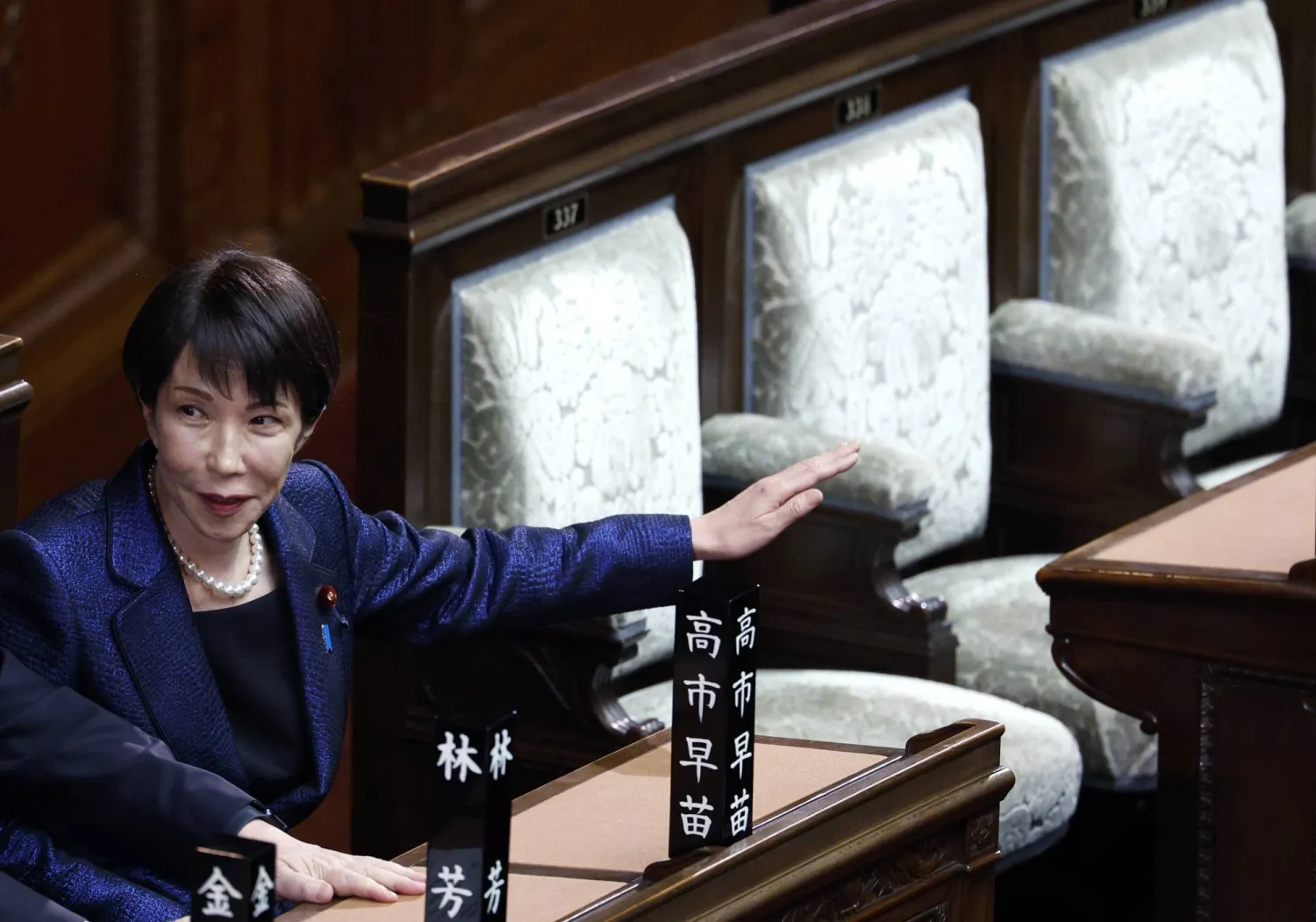
Sanae Takaichi gestures at the Lower House of the Parliament in Tokyo, Japan, 18 February 2026. EPA/FRANCK ROBICHON
TT

Japan PM Takaichi Reappointed Following Election

Sanae Takaichi gestures at the Lower House of the Parliament in Tokyo, Japan, 18 February 2026. EPA/FRANCK ROBICHON

Japan's lower house formally reappointed Sanae Takaichi as prime minister on Wednesday, 10 days after her historic landslide election victory.

Takaichi, 64, became Japan's first woman premier in October and won a two-thirds majority for her party in the snap lower house elections on February 8.

She has pledged to bolster Japan's defenses to protect its territory and waters, likely further straining relations with Beijing, and to boost the flagging economy.

Takaichi suggested in November that Japan could intervene militarily if Beijing sought to take Taiwan by force.

China, which regards the democratic island as part of its territory and has not ruled out force to annex it, was furious.

Beijing's top diplomat Wang Yi told the Munich Security Conference on Saturday that forces in Japan were seeking to "revive militarism".

In a policy speech expected for Friday, Takaichi will pledge to update Japan's "Free and Open Indo-Pacific" strategic framework, local media reported.

"Compared with when FOIP was first proposed, the international situation and security environment surrounding Japan have become significantly more severe," chief government spokesman Minoru Kihara said Monday.

In practice this will likely mean strengthening supply chains and promoting free trade through the Trans-Pacific Partnership (CPTPP) that Britain joined in 2024.

Takaichi's government also plans to pass legislation to establish a National Intelligence Agency and to begin concrete discussions towards an anti-espionage law, the reports said.

Takaichi has promised too to tighten rules surrounding immigration, even though Asia's number two economy is struggling with labor shortages and a falling population.

On Friday Takaichi will repeat her campaign pledge to suspend consumption tax on food for two years in order to ease inflationary pressures on households, local media said, according to AFP.

This promise has exacerbated market worries about Japan's colossal debt, with yields on long-dated government bonds hitting record highs last month.

Rahul Anand, the International Monetary Fund chief of mission in Japan, said Wednesday that debt interest payments would double between 2025 and 2031.

"Removing the consumption tax (on food) would weaken the tax revenue base, since the consumption tax is an important way to raise revenues without creating distortions in the economy," Anand said.

To ease such concerns, Takaichi will on Friday repeat her mantra of having a "responsible, proactive" fiscal policy and set a target on reducing government debt, the reports said.

She will also announce the creation of a cross-party "national council" to discuss taxation and how to fund ageing Japan's ballooning social security bill.

But Takaichi's first order of business will be obtaining approval for Japan's budget for the fiscal year beginning on April 1 after the process was delayed by the election.

The ruling coalition also wants to pass legislation that will outlaw destroying the Japanese flag, according to the media reports.

It wants too to accelerate debate on changing the constitution and on revising the imperial family's rules to ease a looming succession crisis.

Takaichi and many within her Liberal Democratic Party (LDP) oppose making it possible for a woman to become emperor, but rules could be changed to "adopt" new male members.