Ukraine Awaits Brutal Winter with World Attention Focused on Middle East

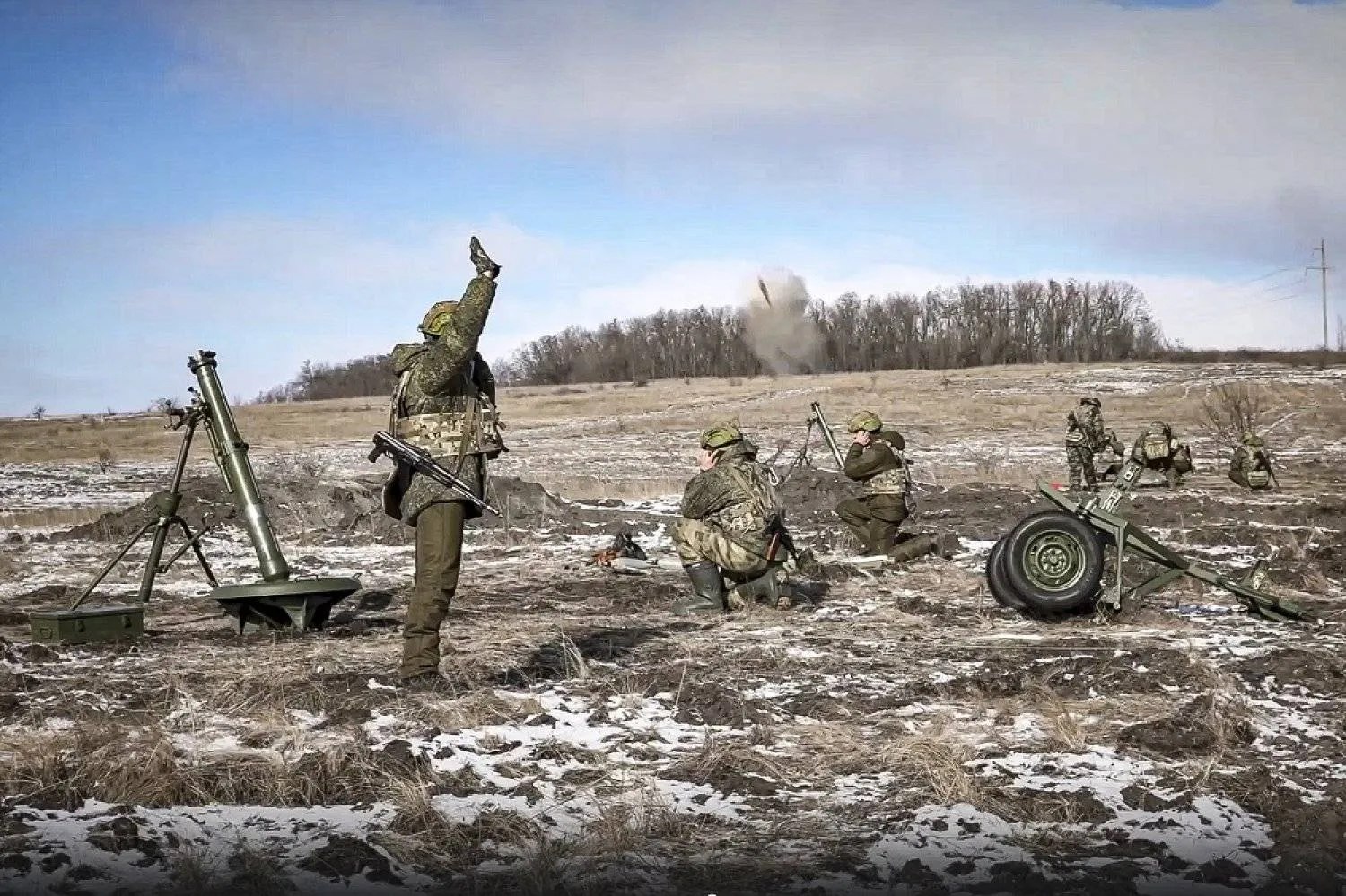
In this handout photo taken from video and released by Russian Defense Ministry Press Service on Friday, Feb. 17, 2023, the Russian army's 120 mm mortars fire at Ukrainian troops at an undisclosed location. (Russian Defense Ministry Press Service via AP)
TT

Ukraine Awaits Brutal Winter with World Attention Focused on Middle East

In this handout photo taken from video and released by Russian Defense Ministry Press Service on Friday, Feb. 17, 2023, the Russian army's 120 mm mortars fire at Ukrainian troops at an undisclosed location. (Russian Defense Ministry Press Service via AP)

With the world’s attention fixed on the Middle East, officials in Ukraine say they are facing a new threat: crude Russian drones that appear to be launched with the sole intention of exhausting Ukrainian rockets fired to shoot them down.
According to Ukrainian national television, the small drones carry reflectors to ensure they are detected, sometimes taking pictures to identify the sites of anti-aircraft radars and missile systems. Built from cheap components readily available online, each drone is estimated to cost around $1,500, less than each of the sometimes multiple rockets fired to bring them down, Reuters said.
Russian television pundits have reacted to the unexpected Oct. 7 Hamas assault against Israel with barely concealed glee, predicting conflict in the Middle East will dramatically reduce Western support for Kyiv.
Many Ukrainian commentators offer the same analysis, worrying in particular that outrage at mounting Palestinian casualties in Gaza and at the Hamas attacks will devastate already fragile support for Ukraine among poorer "Global South" nations and divert military aid the Kyiv government badly needs.
Earlier this month, Russia announced its defense spending for 2024 would be almost $110 billion, three times the level before its February 2022 invasion of Ukraine and almost 30% of government spending.
Ukraine intends to spend around $40 billion on defense next year, roughly half the government budget and 20% of the country’s entire economic output – but it is also counting on tens of billions more in foreign military aid, as long as Western donors are still willing to provide it.
When it comes to air defense rockets and artillery shells, Kyiv is now competing directly with Israel for Western supplies, especially from the United States. In recent weeks, Russian and Ukrainian forces have been on the offensive ahead of deteriorating weather likely to limit movement.
Each has made occasional advances, with elements of two Ukrainian marine brigades reported to have broken through on the eastern bank of the Dnipro river, potentially threatening Russian artillery positions that have repeatedly shelled the recaptured Ukrainian city of Kherson.
An advance there might allow Kyiv to better threaten Russian-held Crimea, already under Ukrainian strikes from newly supplied Western missiles that have forced Russia’s Black Sea Fleet to seek another base.
While Ukrainian officials would not confirm the landings, military bloggers and media citing military sources said the marines had seized at least three small settlements. Ukrainian troops on the far bank were being resupplied by small boats under heavy fire, they said.
Russian forces foiled several attempts by Ukrainian units to cross the Dnipro River, Russia's defense ministry said on Sunday.
On Monday, the Kyiv Post reported an appeal by Robert Brovdi, commander of a Ukrainian drone unit supported through crowdfunding, for Zodiac-type dinghies to support the offensive. By Tuesday, he said he had raised almost $1 million, roughly a third of the amount he said was needed to deliver up to 100 craft.
Further east in the Donbas, Russian forces have been making their own assault against heavily fortified Ukrainian strongholds around Avdiivka, among the last significant settlements in the region not under the control of Russian-speaking separatists.
WINTER INFRASTRUCTURE BATTLE
A shortage of personnel is a growing problem for both sides. US officials estimated in August that 70,000 to 80,000 Russian troops had been killed or wounded so far in Ukraine, with recruitment challenges forcing the Kremlin to turn to prisoners and unfit and older conscripts. Ukraine will not discuss its losses, but in August President Volodymyr Zelenskiy fired the heads of each regional recruiting command after a string of scandals over bribery and other efforts to avoid the draft.
Ukrainian officials say they expect Russia to again strike Ukraine’s energy infrastructure this winter in the hope of freezing the population, also attacking Kyiv’s ability to earn money from exports.
Russian drones and missiles have also repeatedly hit the port of Odessa and along the Danube, damaging harbor infrastructure. Ukraine’s September grain exports were 50% down on a year earlier, something traders and industry experts said was largely down to those attacks.
Russia has often used Iranian drones to target infrastructure – although it remains unclear if conflict in the Middle East will prompt Tehran, a strong supporter of Hamas, to limit such supplies.
Russian Foreign Minister Sergei Lavrov was in Iran this week as part of a meeting of nations in the Caucasus, following a visit to North Korea. Both he and Russian leader Vladimir Putin also visited China, signing a 12-year deal to export grain.
Ukraine will need every air defense missile it can get throughout the winter – hence Russia’s willingness to sacrifice its most basic drones. A growing shortage of artillery shells is if anything more serious, with frontline reports suggesting Ukrainian troops are struggling to get enough ammunition to use roughly 350 donated Western-caliber artillery pieces.
The United States and European Union have each pledged to send Ukraine roughly a million 155-mm shells, with the US donation in part coming from strategic stocks the Pentagon keeps in Israel. On Monday, a senior Pentagon official confirmed some of those were being reallocated back to Israeli forces.
NORTH KOREAN SHIPMENTS
Whether the Pentagon will find replacement stocks for Ukraine is unclear. Ukrainian officials say both their war and the Middle East conflict show the West must dramatically increase its arms manufacturing capability, pointing to a new deal with Germany to manufacture weapons in Ukraine as something to be replicated.
This month has also seen Ukraine announce the arrival of long-range US ATACMS missiles with a range of around 100 miles (160 km), giving it much greater ability to strike Russian rear areas including airfields. Ukrainian officials said the first strikes – which use cluster munitions to hit a larger area – destroyed nine Russian helicopters and other equipment.
Russia is believed to be lobbying for its own foreign arms supplies, including from China and North Korea. While the former appears to have limited its support to weapons components such as chips, a meeting between Putin and North Korean counterpart Kim Jong Un in September appears to have seen the Pyongyang government opening its arsenals.
Since August, two cargo ships have been sailing repeatedly between North Korean ports and Dunay in Russia, unloading at least 1,000 sea containers then shipped by rail to armaments bunkers at Tikhoretsk in the Caucasus.
The shipments were revealed last week in private satellite footage published by the London-based Royal United Services Institute. Estonian officials told reporters they believed the North Korean shipment might total around 350,000 shells, roughly the amount Russia fires each month.
Coupled with Russia’s remaining stockpile estimated by Estonia at around four million shells, that would allow Russia to maintain its current rate of fire throughout 2024, potentially outgunning Ukraine.
While some East European countries have pledged to further increase weapons shipments to Kyiv, others – including Italy and a new government in Slovakia – have said they will cut back.
By early 2025, the Kremlin may hope Donald Trump will be back in the White House, making good on his pre-election promises to halt support for Ukraine and make Kyiv sue for peace.
Whether or not that happens, the coming months will bring more death and destruction, as each side works to shape the battlefield ahead of a perhaps inevitably political decision on how the conflict ends.
* Peter Apps is a Reuters columnist writing on defense and security issues. He joined Reuters in 2003, reporting from southern Africa and Sri Lanka and on global defense issues. He has been a columnist since 2016. He is also the founder of a think-tank, the Project for Study of the 21st Century, and, since 2016, has been a Labor Party activist and British Army reservist.



North Korean Leader's Daughter in First Visit to Symbolic Mausoleum

North Korean leader Kim Jong Un watching a New Year's performance with his daughter Kim Ju Ae (L) at the May Day Stadium in Pyongyang. STR / KCNA VIA KNS/AFP
TT

North Korean Leader's Daughter in First Visit to Symbolic Mausoleum

North Korean leader Kim Jong Un watching a New Year's performance with his daughter Kim Ju Ae (L) at the May Day Stadium in Pyongyang. STR / KCNA VIA KNS/AFP

The North Korean leader's daughter Kim Ju Ae has made her first visit to a mausoleum housing her grandfather and great-grandfather, state media images showed Friday, further solidifying her place as her father's successor.

The Kim family has ruled North Korea with an iron grip for decades, and a cult of personality surrounding their so-called "Paektu bloodline" dominates daily life in the isolated country.

Current leader Kim Jong Un is the third in line to rule in the world's only communist monarchy, following father Kim Jong Il and grandfather Kim Il Sung.

The two men -- dubbed "eternal leaders" in state propaganda -- are housed in the Kumsusan Palace of the Sun, a vast mausoleum in downtown Pyongyang.

The state-run Korean Central News Agency (KCNA) reported that Kim Jong Un had visited the palace, accompanied by top officials.

And images released by the agency showed daughter Ju Ae in tow.

South Korea's spy agency said last year she was now understood to be the next in line to rule North Korea after she accompanied her father on a high-profile visit to Beijing.

Ju Ae was publicly introduced to the world in 2022, when she accompanied her father to an intercontinental ballistic missile launch.

North Korean state media have since referred to her as "the beloved child", and a "great person of guidance" -- "hyangdo" in Korean -- a term typically reserved for top leaders and their successors.

Before 2022, the only confirmation of her existence had come from former NBA star Dennis Rodman, who made a visit to the North in 2013.


Russia Blames Ukraine for Deadly New Year Drone Strike

The Russia-appointed governor of the Kherson region said 'the enemy' had fired three drones that struck a cafe and hotel. The Governor of Kherson region Vladimir Saldo/AFP
TT

Russia Blames Ukraine for Deadly New Year Drone Strike

The Russia-appointed governor of the Kherson region said 'the enemy' had fired three drones that struck a cafe and hotel. The Governor of Kherson region Vladimir Saldo/AFP

Russia on Thursday said Kyiv was behind a drone strike on a hotel in the Moscow-held part of Ukraine's southern Kherson region that killed at least 20 people celebrating the New Year, accusing it of "torpedoing" peace attempts.

The accusation came at a crunch moment, after weeks of diplomacy aimed at brokering an end to the nearly four-year war, and as Ukrainian President Volodymyr Zelensky said his country was "10 percent" away from a peace deal.

Tens of thousands of people have been killed, eastern Ukraine decimated and millions forced to flee their homes since Russia launched its all-out offensive in 2022.

According to the Russia-appointed governor of the Kherson region, Vladimir Saldo, "the enemy" fired three drones that struck a cafe and hotel on the Black Sea coast in Khorly where "civilians were celebrating the New Year".

A building gutted by fire, piles of smoldering rubble and charred bodies were seen in pictures he posted on Telegram.

Kyiv has not commented on the allegations.

Russia's Investigative Committee said it had opened a probe into the attack, which had "killed more than 20 people and injured many more". The Russian foreign ministry said the death toll was still being clarified.

According to Saldo, more than 100 revelers gathered at the hotel the night of the attack.

The Russian foreign ministry accused Ukraine of carrying out a "terrorist attack", called on international organizations to condemn it and warned Kyiv of "appropriate consequences" in a statement.

It also accused the Ukrainian authorities of "deliberately torpedoing any attempts to find a peaceful resolution to the conflict".

Zelensky meanwhile said Russia was carrying the war "into the New Year" with more than 200 drones fired overnight, mainly targeting energy facilities.

"A significant number of consumers" had their electricity cut, said Ukraine's power operator Ukrenergo. Railway and port infrastructure was also damaged in the latest barrage.

In the Kharkiv region, Russia struck a park with a zoo, wounding one person. The attack also wounded animals, including lions, and killed pheasants and parrots, the park's owner Oleksandr Feldman told Ukrainian media.

New talks in sight

Ukraine came under intense pressure in 2025, both from Russian bombardment and on the battlefield, where it has steadily ceded ground to Russia's army.

An AFP analysis based on Ukrainian air force data showed a slight fall in overnight Russian drone and missile attacks on Ukraine in December.

Russia fired at least 5,134 drones in overnight attacks in the final month of 2025, six percent less than the month before, while the number of missiles declined by 18 percent in the same period, according to the data.

However, the same data showed Ukraine destroyed a smaller share of the total sum of missiles and drones in December -- 80 percent, compared with 82 percent in November.

US President Donald Trump, who regularly complains he does not receive credit as a peacemaker, has engaged in talks with both sides in a bid to end the fighting.

Ukraine says Russia is not interested in peace and is deliberately trying to sabotage diplomatic efforts to seize more Ukrainian territory.

Moscow earlier this week accused Ukraine of attempting a drone attack on one of Russian President Vladimir Putin's residences, drawing a sharp rebuttal from Kyiv, which said there was no "plausible" evidence of such an attack.

Ukraine's allies have also expressed skepticism about Russia's claim -- but Moscow on Thursday said it would hand over to the United States "decrypted data" from the drone that was allegedly targeting the secluded residence.

"These materials will be transferred to the American side through established channels," Russia's defense ministry said in a statement.

Zelensky said on Tuesday he would hold a meeting with leaders of Kyiv's allies from the so-called coalition of the willing next week in France.

The summit will be preceded by a meeting of security advisers from the allied countries on Saturday in Ukraine.


Maduro Elusive on US Attack, Open to Dialogue

Venezuela's President Nicolas Maduro says the door is open to dialogue with Washington. STRINGER / AFP/File
TT

Maduro Elusive on US Attack, Open to Dialogue

Venezuela's President Nicolas Maduro says the door is open to dialogue with Washington. STRINGER / AFP/File

President Nicolas Maduro Thursday dodged a question about an alleged US attack on a dock in Venezuela but said he was open to cooperation with Washington after weeks of American military pressure.

"Wherever they want and whenever they want," Maduro said of the idea of dialogue with the United States on drug trafficking, oil and migration in an interview on state TV.

Maduro's government has neither confirmed nor denied what President Donald Trump announced Monday: a US attack on a docking facility that served Venezuelan drug trafficking boats.

Asked point-blank if he confirmed or denied the attack, Maduro said Thursday "this could be something we talk about in a few days."

The attack would amount to the first known land strike of the US military campaign against drug trafficking from Latin America.

Trump on Monday said the United States hit and destroyed a docking area for alleged Venezuelan drug boats.

Trump would not say if it was a military or CIA operation or where the strike occurred, noting only that it was "along the shore."

"There was a major explosion in the dock area where they load the boats up with drugs," he told reporters at his Mar-a-Lago resort in Florida.

"So we hit all the boats and now we hit the area, it's the implementation area, that's where they implement. And that is no longer around."

In the interview, Maduro insisted that Venezuela has defended itself well as the US carried out its military campaign at sea.

"Our people are safe and in peace," he said.

Colombian President Gustavo Petro fueled rumors about the location of the attack, saying "Trump bombed a factory in Maracaibo" where "they mix coca paste to make cocaine."

That led some to speculate on social media that a fire at wholesale chemical distributor Primazol's warehouses in Maracaibo may have been related to the attack.

Primazol chief Carlos Eduardo Siu denied those rumors, saying "President Petro, not here -- we neither package nor manufacture any kind of narcotics."

Unpleasant evolution

Maduro said he has not spoken to Trump since a conversation they had on November 12, which he described as cordial and respectful.

"I think that conversation was even pleasant, but since then the evolution has not been pleasant. Let's wait," he said.

"If they want to talk seriously about an agreement to fight drug trafficking, we are ready," the Venezuelan leader said.

The Trump administration has accused Maduro of heading a drug cartel and says it is cracking down on trafficking, but the leftist leader denies any involvement in the narcotics trade, saying the US seeks a coup because Venezuela has the largest known reserves of oil on Earth.

Washington has ramped up pressure on Caracas by informally closing Venezuela's airspace, imposing more sanctions and ordering the seizure of tankers loaded with Venezuelan oil.

For weeks Trump has threatened ground strikes on drug cartels in the region, saying they would start "soon," but this is the first apparent example.

US forces have also carried out numerous strikes on boats in both the Caribbean Sea and eastern Pacific Ocean since September, targeting what Washington says are drug smugglers.

The deadly maritime campaign has killed at least 107 people in at least 30 strikes, according to information released by the US military.

The administration has provided no evidence that the targeted boats were involved in drug trafficking, however, prompting debate about the legality of these operations.

International law experts and rights groups say the strikes likely amount to extrajudicial killings, a charge that Washington denies.