

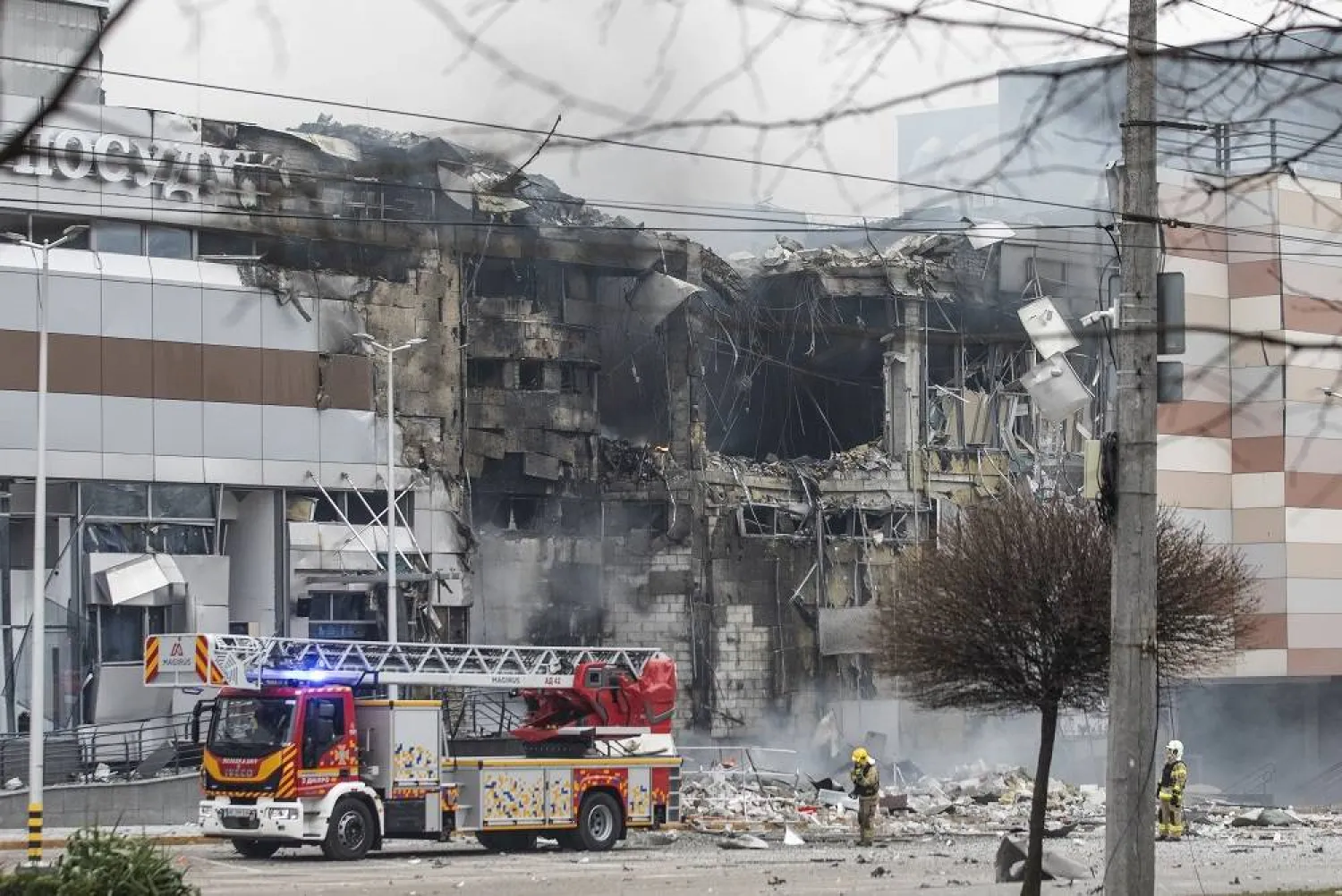

Russia Launches Biggest Aerial Barrage of War, Kills 30 Civilians, Ukraine Says

Emergency services work at the site of an overnight rocket attack on a shopping mall in Dnipro, Dnipropetrovsk region, southeastern Ukraine, 29 December 2023, amid the Russian invasion. (EPA)
TT

Russia Launches Biggest Aerial Barrage of War, Kills 30 Civilians, Ukraine Says

Emergency services work at the site of an overnight rocket attack on a shopping mall in Dnipro, Dnipropetrovsk region, southeastern Ukraine, 29 December 2023, amid the Russian invasion. (EPA)

Russia launched 122 missiles and dozens of drones against Ukrainian targets, officials said Friday, killing at least 30 civilians across the country in what an air force official called the biggest aerial barrage of the war.

At least 144 people were injured and an unknown number were buried under rubble during the roughly 18-hour onslaught, Ukrainian officials said. A maternity hospital, apartment blocks and schools were among the buildings reported damaged across Ukraine.

In the capital, Kyiv, broken glass and mangled metal littered city streets. Air raid and emergency service sirens wailed as plumes of smoke drifted into a bright blue sky.

Kateryna Ivanivna, a 72-year-old Kyiv resident, said she threw herself to the ground when a missile struck.

“There was an explosion, then flames,” she said. “I covered my head and got down in the street. Then I ran into the subway station.”

Meanwhile, in Poland, authorities said that what apparently was a Russian missile entered the country’s airspace Friday morning from the direction of Ukraine and then vanished off radars.

In the attack on Ukraine, the air force intercepted most of the ballistic and cruise missiles and the Shahed-type drones overnight, said Ukraine’s military chief, Valerii Zaluzhnyi.

Western officials and analysts had recently warned that Russia limited its cruise missile strikes for months in an apparent effort to build up stockpiles for massive strikes during the winter, hoping to break the Ukrainians’ spirit.

The result was “the most massive aerial attack” since Russia’s full-scale invasion in February 2022, Air Force commander Mykola Oleshchuk wrote on his official Telegram channel. It topped the previous biggest assault, in November 2022 when Russia launched 96 missiles, and this year’s biggest, with 81 missiles on March 9, according to air force records.

Fighting along the front line is largely bogged down by winter weather after Ukraine’s summer counteroffensive failed to make a significant breakthrough along the roughly 1,000-kilometer (620-mile) line of contact.

Ukrainian officials have urged the country's Western allies to provide it with more air defenses. Their appeals have come as signs of war fatigue strain efforts to keep support in place.

British Prime Minister Rishi Sunak said the attack should stir the world to further action in support of Ukraine.

“These widespread attacks on Ukraine’s cities show (Russian President Vladimir) Putin will stop at nothing to achieve his aim of eradicating freedom and democracy,” Sunak said on social media platform X, formerly Twitter. “We must continue to stand with Ukraine — for as long as it takes.”

Ukrainian Foreign Minister Dmytro Kuleba said the scale of the attack should wake people up to Ukraine's continuing needs.

“Today, millions of Ukrainians awoke to the loud sound of explosions,” he wrote on X. “I wish those sounds of explosions in Ukraine could be heard all around the world. In all major capitals, headquarters, and parliaments, which are currently debating further support for Ukraine.”

In Kyiv, the bombardment damaged a subway station that lies across the street from a factory belonging to the Artem company, which produces components for various military-grade missiles. Officials did not say whether the factory was directly hit.

Overall, the attack hit six cities, and reports of deaths and damage came in from across the country. Several dozen missiles were launched towards Kyiv, with more than 30 intercepted, said Serhii Popko, head of the Kyiv military administration. Eight people were killed there, officials said.

In Boyarka, near Kyiv, the debris of a shot-down drone fell on a home and started a fire. Andrii Korobka, 47, said his mother was sleeping next to the room where the wreckage landed and was taken to hospital suffering from shock.

“The war goes on, and it can happen to any house, even if you think yours will never be affected,” Korobka said.

Tetiana Sakhnenko lives next door and said neighbors ran with buckets of water to put out the blaze, but it spread quickly. “It’s so scary,” she said.

In the eastern city of Dnipro, four maternity hospital patients were rescued from a fire, five people were killed and 20 injured, officials said.

In Odesa, on the southern coast, falling drone wreckage started a fire at a multistory residential building, according to the regional head, Oleh Kiper. Two people were killed and 15, including two children, were injured, he said.

The mayor of the western city of Lviv, Andrii Sadovyi, said one person was killed there, with three schools and a kindergarten damaged in a drone attack. Local emergency services said 30 people were injured.

In northeastern Ukraine, Kharkiv Mayor Ihor Terekhov said the city was subjected to at least three waves of aerial attacks that included S-300 and Kh-21 missile launches. One person was killed and at least nine injured, officials said.




Search Teams in Türkiye Recover Recorders after Plane Crash that Killed Libyan Military Officials

Turkish army soldiers stand guard as rescue teams search for the remains of a private jet carrying Libya's military chief and four others that crashed after taking off from Ankara, killing everyone on board, in Ankara, Turkey, early Wednesday, Dec. 24, 2025. (AP Photo/Efekan Akyuz)
TT

Search Teams in Türkiye Recover Recorders after Plane Crash that Killed Libyan Military Officials

Turkish army soldiers stand guard as rescue teams search for the remains of a private jet carrying Libya's military chief and four others that crashed after taking off from Ankara, killing everyone on board, in Ankara, Turkey, early Wednesday, Dec. 24, 2025. (AP Photo/Efekan Akyuz)

Search teams in Türkiye on Wednesday recovered the cockpit voice and flight data recorders from a jet crash that killed eight people, including western Libya’s military chief, while efforts to retrieve the victims' remains were still underway, Türkiye's interior minister said.

The private jet carrying Gen. Muhammad Ali Ahmad al-Haddad, four other military officials and three crew members crashed on Tuesday, after taking off from Türkiye's capital, Ankara, killing everyone on board. Libyan officials said that the cause of the crash was a technical malfunction on the plane.

The high-level Libyan delegation was on its way back to Tripoli after holding defense talks in Ankara aimed at boosting military cooperation between the two countries.

Turkish Interior Minister Ali Yerlikaya told journalists at the site of the crash that wreckage was scattered across an area covering three square kilometers (more than a square mile), complicating recovery efforts. Authorities from the Turkish forensic medicine authority were working to recover and identify the remains, he said.

A 22-person delegation — including five family members — arrived from Libya early on Wednesday to assist in the investigation, he said.

Tripoli-based Libyan Prime Minister Abdul-Hamid Dbeibah confirmed the deaths on Tuesday, describing the crash on Facebook as a “tragic accident” and a “great loss” for Libya.

Turkish President Recep Tayyip Erdogan held a telephone call with Dbeibah, during which he conveyed his condolences and expressed his sorrow over the deaths, his office said.

The Turkish leader later also offered his condolences during a televised speech, voicing solidarity with Libya.

"An investigation has been launched into this tragic incident that has deeply saddened us, and our ministries will provide information about its progress,” Erdogan said.

Al-Hadad was the top military commander in western Libya and played a crucial role in the ongoing, UN-brokered efforts to unify Libya’s military, which has split, much like the nation's other institutions.

The four other military officials who died in the crash were Gen. Al-Fitouri Ghraibil, the head of Libya’s ground forces, Brig. Gen. Mahmoud Al-Qatawi, who led the military manufacturing authority, Mohammed Al-Asawi Diab, adviser to the chief of staff, and Mohammed Omar Ahmed Mahjoub, a military photographer with the chief of staff’s office.

The identities of the three crew members weren't immediately released.

Turkish officials said that the Falcon 50-type business jet took off from Ankara’s Esenboga airport at 8:30 p.m. and that contact was lost around 40 minutes later. The plane notified air traffic control of an electrical fault and requested an emergency landing. The aircraft was redirected back to Esenboga, where preparations for its landing began.

The plane, however, disappeared from radar while descending for the emergency landing, the Turkish presidential communications office said.

The Libyan government declared a three-day period of national mourning. Flags would be flown half-staff at all state institutions, according to the government’s announcement on Facebook.

The wreckage was found near the village of Kesikkavak, in Haymana, a district about 70 kilometers (45 miles) south of Ankara.

At the crash site, search and recovery teams intensified their operations on Wednesday after a night of heavy rain and fog, the state-run Anadolu Agency reported. Gendarmerie police sealed off the area while the Turkish disaster management agency, AFAD, set up a mobile coordination center. Specialized vehicles, such as tracked ambulances, were deployed because of the muddy terrain.

Türkiye has assigned four prosecutors to lead the investigation, and Yerlikaya that said the Turkish search and recovery teams included 408 personnel.

While in Ankara, al-Haddad had met with Turkish Defense Minister Yasar Guler and other officials.


Netanyahu: Israel to Spend $110 billion to Develop Independent Arms Industry in Next Decade

Two Israeli soldiers inside Gaza (AFP)
TT

Netanyahu: Israel to Spend $110 billion to Develop Independent Arms Industry in Next Decade

Two Israeli soldiers inside Gaza (AFP)

Israeli Prime Minister Benjamin Netanyahu said ​on Wednesday Israel would spend 350 billion shekels ($110 billion) on developing an independent arms to reduce ‌dependency on other ‌countries, AFP reported.

"We ‌will ⁠continue ​to ‌acquire essential supplies while independently arming ourselves," Netanyahu said at a ceremony for new pilots.

"I ⁠don't know if ‌a country can ‍be ‍completely independent but we ‍will strive ... to ensure our arms are produced as ​much as possible in Israel," he said.

"Our ⁠goal is to build an independent arms industry for the State of Israel and reduce the dependency on any party, including allies."


EU, France, Germany Slam US Visa Bans as 'Censorship' Dispute Deepens

European Commissioner for Internal Market Thierry Breton holds a press conference in Brussels, Belgium March 25, 2024. REUTERS/Yves Herman/File Photo
TT

EU, France, Germany Slam US Visa Bans as 'Censorship' Dispute Deepens

European Commissioner for Internal Market Thierry Breton holds a press conference in Brussels, Belgium March 25, 2024. REUTERS/Yves Herman/File Photo

The European Union, France and Germany condemned US visa bans on European citizens combating online hate and ​disinformation, with Brussels saying on Wednesday it could "respond swiftly and decisively" against the "unjustified measures".

US President Donald Trump's administration imposed visa bans on Tuesday on five European citizens, including French former EU commissioner Thierry Breton, who it accuses of working to censor freedom of speech or unfairly target US tech giants with overly burdensome regulation.

A European Commission spokesperson said it "strongly condemns the US decision", adding: "Freedom of expression is a fundamental right in Europe and a shared core value with the United States across the democratic world."

EU FINED ELON MUSK'S X THIS MONTH

The visa bans are likely to exacerbate growing divergences between Washington and some European capitals over issues including free speech, defense, immigration, far-right politics, trade and the Russia-Ukraine war.

They come just weeks after a US National Security ‌Strategy document warned Europe ‌faced "civilizational erasure" and must change course if it is to remain a reliable ‌US ⁠ally.

Breton ​was one ‌of the architects of the EU's Digital Services Act, a landmark piece of legislation aimed at making the internet safer that has irritated US officials.

They were particularly riled by Brussels' sanction earlier this month against Elon Musk's X platform, which was fined 120 million euros for breaching online content rules. Musk and Breton have often sparred online over EU tech regulation, with Musk referring to him as the "tyrant of Europe".

The bans also targeted Imran Ahmed, the British CEO of the US-based Center for Countering Digital Hate; Anna-Lena von Hodenberg and Josephine Ballon of the German non-profit HateAid; and Clare Melford, co-founder of the Global Disinformation Index, according to US Under Secretary for Public ⁠Diplomacy Sarah Rogers.

EU LAW AIMS TO MAKE ONLINE WORLD SAFER

The EU's DSA is meant to make the online environment safer, in part by compelling tech giants to do ‌more to tackle illegal content, including hate speech and child sexual abuse material.

Washington ‍has said the EU was pursuing "undue" restrictions on freedom of ‍expression in its efforts to combat hateful speech, misinformation and disinformation, and that the DSA unfairly targets US tech giants ‍and US citizens.

The European Commission spokesperson said the EU had the right to regulate economic activity, and had requested more information from Washington about the measures.

"If needed, we will respond swiftly and decisively to defend our regulatory autonomy against unjustified measures," they said.

French President Emmanuel Macron said: "These measures amount to intimidation and coercion aimed at undermining European digital sovereignty."

On X, he said the DSA was approved in a democratic process, and existed "to ​ensure fair competition among platforms, without targeting any third country, and to ensure that what is illegal offline is also illegal online."

Breton, a former French finance minister and the European commissioner for the internal ⁠market from 2019 to 2024, was the most high-profile individual targeted.

"Is McCarthy's witch hunt back?" he wrote on X.

"As a reminder: 90% of the European Parliament - our democratically elected body - and all 27 Member States unanimously voted the DSA. To our American friends: Censorship isn't where you think it is."

GERMANY SAYS BANS ON ACTIVISTS 'UNACCEPTABLE'

Germany's justice ministry said the two German activists had the government's "support and solidarity" and the visa bans on them were unacceptable, adding that HateAid supported people affected by unlawful digital hate speech.

"Anyone who describes this as censorship is misrepresenting our constitutional system," it said in a statement. "The rules by which we want to live in the digital space in Germany and in Europe are not decided in Washington."

A Global Disinformation Index spokesperson called the visa bans "an authoritarian attack on free speech and an egregious act of government censorship."

"The Trump Administration is, once again, using the full weight of the federal government to intimidate, censor, and silence voices they disagree with," they said. "Their actions today are immoral, unlawful, and un-American."

Breton is not the first French person to ‌be sanctioned by the Trump administration.

In August, Washington sanctioned French judge Nicolas Yann Guillou, who sits on the International Criminal Court, for the tribunal's targeting of Israeli leaders and a past decision to investigate US officials.