Out of Options, Rohingya are Fleeing Myanmar and Bangladesh by Boat Despite Soaring Death Toll

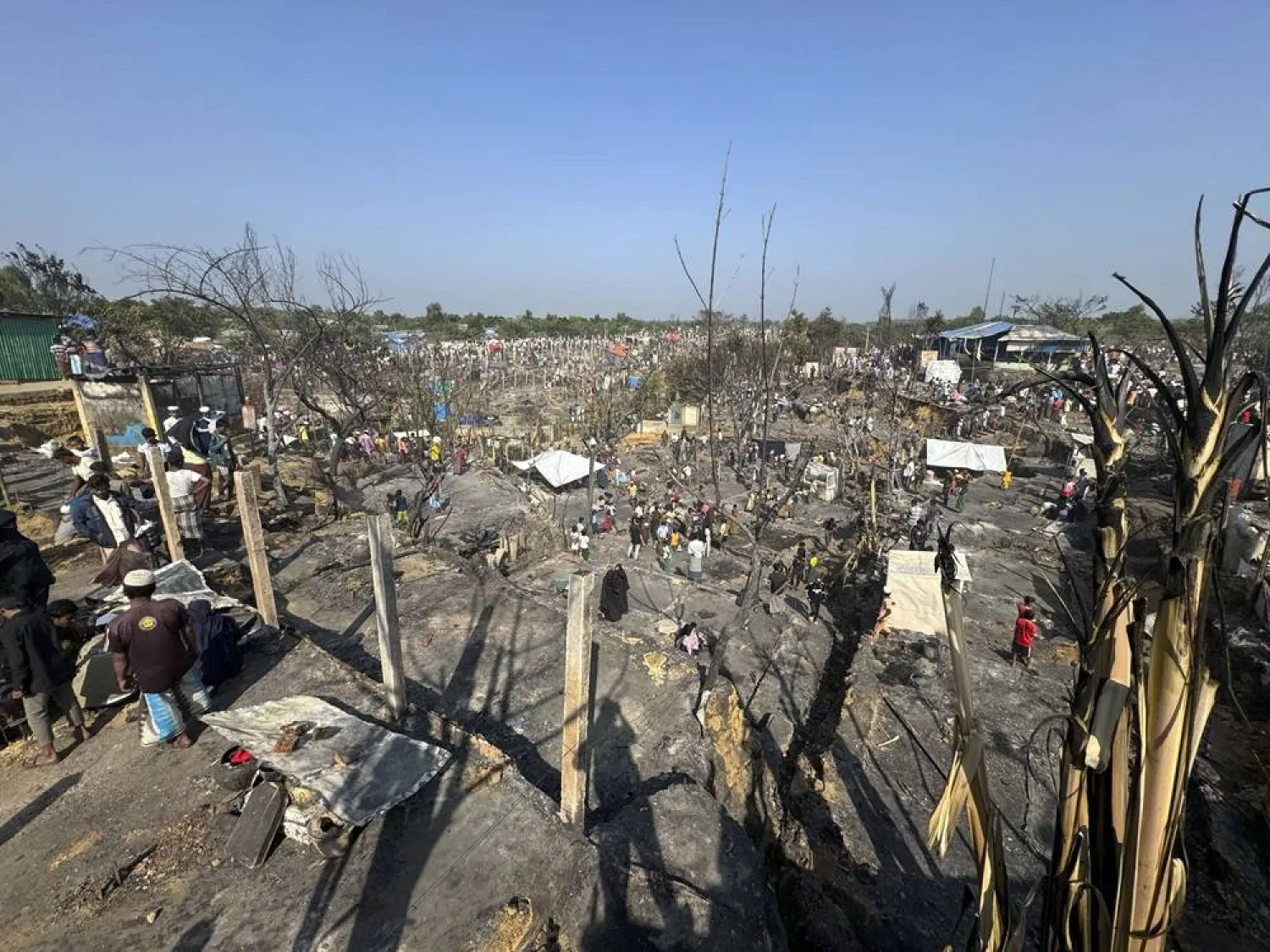
 Rohingya refugees look on after a midnight fire raced through their refugee camp at Kutupalong in Cox's Bazar district, Bangladesh, Sunday, Jan. 7, 2024. (AP)
Rohingya refugees look on after a midnight fire raced through their refugee camp at Kutupalong in Cox's Bazar district, Bangladesh, Sunday, Jan. 7, 2024. (AP)
TT

Out of Options, Rohingya are Fleeing Myanmar and Bangladesh by Boat Despite Soaring Death Toll

 Rohingya refugees look on after a midnight fire raced through their refugee camp at Kutupalong in Cox's Bazar district, Bangladesh, Sunday, Jan. 7, 2024. (AP)
Rohingya refugees look on after a midnight fire raced through their refugee camp at Kutupalong in Cox's Bazar district, Bangladesh, Sunday, Jan. 7, 2024. (AP)

Across a treacherous stretch of water, the Rohingya came by the thousands, then died by the hundreds. And though they know the dangers of fleeing by boat, many among this persecuted people say they will not stop — because the world has left them with no other choice.
Last year, nearly 4,500 Rohingya — two-thirds of them women and children — fled their homeland of Myanmar and the refugee camps in neighboring Bangladesh by boat, the United Nations’ refugee agency reported. Of those, 569 died or went missing while crossing the Bay of Bengal and Andaman Sea, the highest death toll since 2014, The Associated Press said.
The numbers mean one out of every eight Rohingya who attempted the crossing never made it, the United Nations High Commissioner for Refugees said last week.
Yet despite the risks, there are no signs the Rohingya will stop. On Thursday, Indonesian officials said another boat carrying Rohingya refugees landed in the country’s northern province of Aceh.
Fishermen provided food and water to 131 Rohingya, mostly women and children, who had been on board, said Marzuki, the leader of the local tribal fishing community, who like many Indonesians goes by one name.
Some passengers told officials they had been at sea for weeks and their boat's engine had broken down, leaving them adrift, said Lt. Col. Andi Susanto, commander of the navy base in Lhokseumawe.
“Southeast Asian waters are one of the deadliest stretches in the world and a graveyard for many Rohingya who have lost their lives,” says Babar Baloch, UNHCR’s spokesperson for Asia and the Pacific. “The rate of Rohingya who are dying at sea without being rescued — that’s really alarming and worrying.”
Inside the squalid refugee camps in Bangladesh, where more than 750,000 ethnic Rohingya Muslims fled in 2017 following sweeping attacks by Myanmar’s military, the situation has grown increasingly desperate. Not even the threat of death at sea is enough to stop many from trying to traverse the region’s waters in a bid to reach Indonesia or Malaysia.
“We need to choose the risky journey by boat because the international community has failed their responsibility,” says Mohammed Ayub, who is saving up money for a spot on one of the rickety wooden fishing boats traffickers use to ferry passengers 1,800 kilometers (1,100 miles) from Bangladesh to Indonesia.
Global indifference toward the Rohingya crisis has left those languishing in the overcrowded camps with few alternatives to fleeing. Because Bangladesh bans the Rohingya from working, their survival is dependent upon food rations, which were slashed last year due to a drop in global donations.
Returning safely to Myanmar is virtually impossible for the Rohingya, because the military that attacked them overthrew Myanmar’s democratically elected government in 2021. And no country is offering the Rohingya any large-scale resettlement opportunities.
Meanwhile, a surge in killings, kidnappings and arson attacks by militant groups in the camps has left residents fearing for their lives. And so, starving, scared and out of options, they continue to board the boats.
Ayub has lived in a sweltering, cramped shelter for more than six years in a camp where security and sanitation are scarce, and hope even scarcer. There is no formal schooling for his children, no way for him to earn money, no prospects for returning to his homeland and no refuge for his family amid spiraling gang violence.
“Of course I understand how dangerous the boat journey by sea is,” Ayub says. “We could die during the journey by boat. But it depends on our fate. ... It’s better to choose the dangerous way even if it’s risky, because we are afraid to stay in the camps.”
Two hundred of the people who died or went missing at sea last year were aboard one boat that left Bangladesh in November. Eyewitnesses on a nearby boat told The Associated Press that the missing vessel, which was crowded with babies, children and mothers, broke down and was taking on water before it drifted off during a storm as its passengers screamed for help. It has not been seen since.
It was one of several distressed boats that the region’s coastal countries neglected to save, despite the United Nations refugee agency's requests for those countries to launch search and rescue missions.
“When no action is taken, lives are lost,” says UNHCR’s Baloch. “If there is no hope restored in Rohingya lives either in Myanmar or in Bangladesh, there are no rescue attempts, (then) sadly we could see more desperate people dying in Southeast Asian seas under the watch of coastal authorities who could act to save lives.”
Six of Mohammed Taher’s family members were aboard the boat that vanished in November, including his 15-year-old brother, Mohammed Amin, and two of Taher’s nephews, ages 3 and 4. Their ultimate destination was Malaysia, a Muslim-majority country where many Rohingya seek relative safety.
Taher and his parents now struggle to sleep or eat, and spend their days agonizing over what became of their loved ones. Taher’s mother saw a fortune teller who said her relatives were still alive. Taher, meanwhile, dreamed that the boat made it to shore, where his relatives took refuge in a school and were able to bathe in warm water. But he remains unconvinced their journey ended so happily.
And so he has vowed to tell everyone to stay off the boats, no matter how unbearable life on land has become.
“I will never leave by boat on this difficult journey,” Taher says. “All the people who reached their destination are saying that it’s horrific traveling by boat.”
Yet such warnings are often futile. Ayub is now preparing to sell his daughter’s jewelry to help pay for his spot on a boat. While he is frightened by the stories of those who didn’t make it, he is motivated by the stories of those who did.
“Nobody would consider taking a risk by boat on a dangerous journey if they had better opportunities,” he says. “Fortunately, some people did reach their destination and got a better life. I am staying positive that Allah will save us.”



Macron Urges 'Calm' ahead of Tense Rally for Slain Far-right Activist

French police secure the area after a bomb threat at the headquarters of France's hard-left party La France Insoumise (France Unbowed - LFI) and its evacuation in Paris, France, February 18, 2026. REUTERS/Sarah Meyssonnier
TT

Macron Urges 'Calm' ahead of Tense Rally for Slain Far-right Activist

French police secure the area after a bomb threat at the headquarters of France's hard-left party La France Insoumise (France Unbowed - LFI) and its evacuation in Paris, France, February 18, 2026. REUTERS/Sarah Meyssonnier

French President Emmanuel Macron appealed on Saturday for cooler heads to prevail ahead of a rally for a far-right activist whose killing, blamed on the hard left, has put the country on edge.

Macron also said his government would hold a meeting next week to discuss "violent action groups" in the wake of the fatal beating of Quentin Deranque, which has ignited tensions between the left and right ahead of the 2027 presidential vote.

The 23-year-old died from head injuries following clashes between radical left and far-right supporters on the sidelines of a demonstration against a politician from the left-wing France Unbowed (LFI) party in the southeastern city of Lyon last week.

A rally, widely publicized online by ultra-nationalist and far-right groups, is expected to be attended by 2,000 to 3,000 people, with the authorities fearing further clashes with left-wing protesters.

Speaking at a farming trade fair in Paris, Macron urged "everyone to remain" calm ahead of the rally for Deranque in Lyon, which is set to go ahead under high security later on Saturday despite Lyon's left-wing green mayor asking the state to ban it.

"In the Republic, no violence is legitimate," said Macron, who will be unable to contest next year's election after hitting the two-term limit. "There is no place for militias, no matter where they come from."

- 'Over 1,000 neo-Nazis' -

Ahead of the Lyon rally, some residents living near the march's planned route had barricaded the ground floor windows of their apartments, fearing unrest.

"At my age, I'm not going to play the tough guy. If I have to go out somewhere, I'll avoid the places where they're marching," said Lyon local Jean Echeverria, 87.

"They'll just keep fighting each other, it'll never end. Between the extreme of this and the extreme of that, it's non-stop," he added.

Two friends of Deranque's were behind the official call to march in his honor.

But according to the Deranque family's lawyer, Fabien Rajon, his parents will not take part in the rally, which they have urged to go ahead "without violence" and "without political statements".

Several ultra-right-wing groups, including Deranque's nationalist Allobroges Bourgoin faction, have nonetheless heavily publicized the march on social media.

The authorities fear that far-right and hard-left activists from elsewhere in Europe might travel to France for the event, stoking concerns of further unrest.

Jordan Bardella, the head of the anti-immigration National Rally (RN) party -- which senses its best chance ever of scoring the presidency in next year's vote -- has urged supporters not to go.

"We ask you, except in very specific and strictly supervised local situations not to attend these gatherings nor to associate the National Rally with them," he wrote in a message sent to party officials and seen by AFP.

LFI coordinator Manuel Bompard backed the Lyon mayor's call for a ban, warning on X that the march would be a "fascist demonstration" which "over 1,000 neo-Nazis from all over Europe" were expected to attend.

But Interior Minister Laurent Nunez declined to ban the rally, arguing that he had to "strike a balance between maintaining public order and freedom of expression" and pledging an "extremely large police deployment".

- 'Wound' -

Deranque's death has provoked a reaction from US President Donald Trump's administration, with state department official Sarah Rogers on Friday branding the killing "terrorism" and claiming that "violent radical leftism is on the rise".

Likewise, Italian Prime Minister Giorgia Meloni on Wednesday called Deranque's death "a wound for all Europe", prompting Macron to urge the far-right leader to stay out of French matters.

Six men suspected of involvement in the fatal assault have been charged over the killing, while a parliamentary assistant to a radical left-wing MP has also been charged with complicity.

A far-right collective called Nemesis, which claims to "defend Western women" from the violence allegedly wrought by immigrants, said Deranque had been at the protest in Lyon to protect its members when he was assaulted by "anti-fascist" activists.

Having urged both the far right and hard left to clean up their acts, Macron said his administration would hold a meeting next week "take stock of violent action groups which are active and have links with political parties of any description".


US Military Strikes Another Alleged Drug Boat in Eastern Pacific, Killing 3

A shot of a boat targeted by a US raid in the Caribbean (archive - Reuters)
TT

US Military Strikes Another Alleged Drug Boat in Eastern Pacific, Killing 3

A shot of a boat targeted by a US raid in the Caribbean (archive - Reuters)

The US military said Friday that it has carried out another deadly strike on a vessel accused of trafficking drugs in the Eastern Pacific Ocean.

US Southern Command said on social media that the boat “was transiting along known narco-trafficking routes in the Eastern Pacific and was engaged in narco-trafficking operations.” It said the strike killed three people. A video linked to the post shows a boat floating in the water before bursting into flames.

Friday’s attack raises the death toll from the Trump administration’s strikes on alleged drug boats to at least 148 people in at least 43 attacks carried out since early September in the Caribbean Sea and eastern Pacific Ocean.

President Donald Trump has said the US is in “armed conflict” with cartels in Latin America and has justified the attacks as a necessary escalation to stem the flow of drugs. But his administration has offered little evidence to support its claims of killing “narcoterrorists.”

Critics have questioned the overall legality of the strikes as well as their effectiveness, in part because the fentanyl behind many fatal overdoses is typically trafficked to the US over land from Mexico.


Afghanistan Quake Causes No ‘Serious’ Damage, Injuries, Says Official

Afghan men prepare meals during the holy fasting month of Ramadan in Kabul, Afghanistan, 19 February 2026. (EPA)
TT

Afghanistan Quake Causes No ‘Serious’ Damage, Injuries, Says Official

Afghan men prepare meals during the holy fasting month of Ramadan in Kabul, Afghanistan, 19 February 2026. (EPA)

A 5.8-magnitude earthquake that rocked eastern Afghanistan including the capital Kabul has resulted in only minor damage and one reported injury, a disaster official told AFP on Saturday.

The quake hit on Friday just as people in the Muslim-majority country were sitting down to break their Ramadan fast.

The epicenter was near several remote villages around 130 kilometers (80 miles) northeast of Kabul, the United States Geological Survey said.

"There aren't any serious casualties or damages after yesterday's earthquake," said Mohammad Yousuf Hamad, spokesman for the National Disaster Management Authority.

He added that one person had sustained "a minor injury in Takhar", in Afghanistan's north, "and three houses had minor damage in Laghman" province.

Zilgay Talabi, a resident of Khenj district near the epicenter, said the tremor was "very strong, it went on for almost 30 seconds".

Earthquakes are common in Afghanistan, particularly along the Hindu Kush mountain range, near where the Eurasian and Indian tectonic plates meet.

In August last year, a shallow 6.0-magnitude quake in the country's east wiped out mountainside villages and killed more than 2,200 people.

Weeks later, a 6.3-magnitude quake in northern Afghanistan killed 27 people.

Large tremors in western Herat, near the Iranian border, in 2023, and in Nangarhar province in 2022, killed hundreds and destroyed thousands of homes.

Many homes in the predominantly rural country, which has been devastated by decades of war, are shoddily built.

Poor communication networks and infrastructure in mountainous Afghanistan have hampered disaster responses in the past, preventing authorities from reaching far-flung villages for hours or even days before they could assess the extent of the damage.