White House Downplays Biden, National Security Aide’s Blunt Comments on Israel

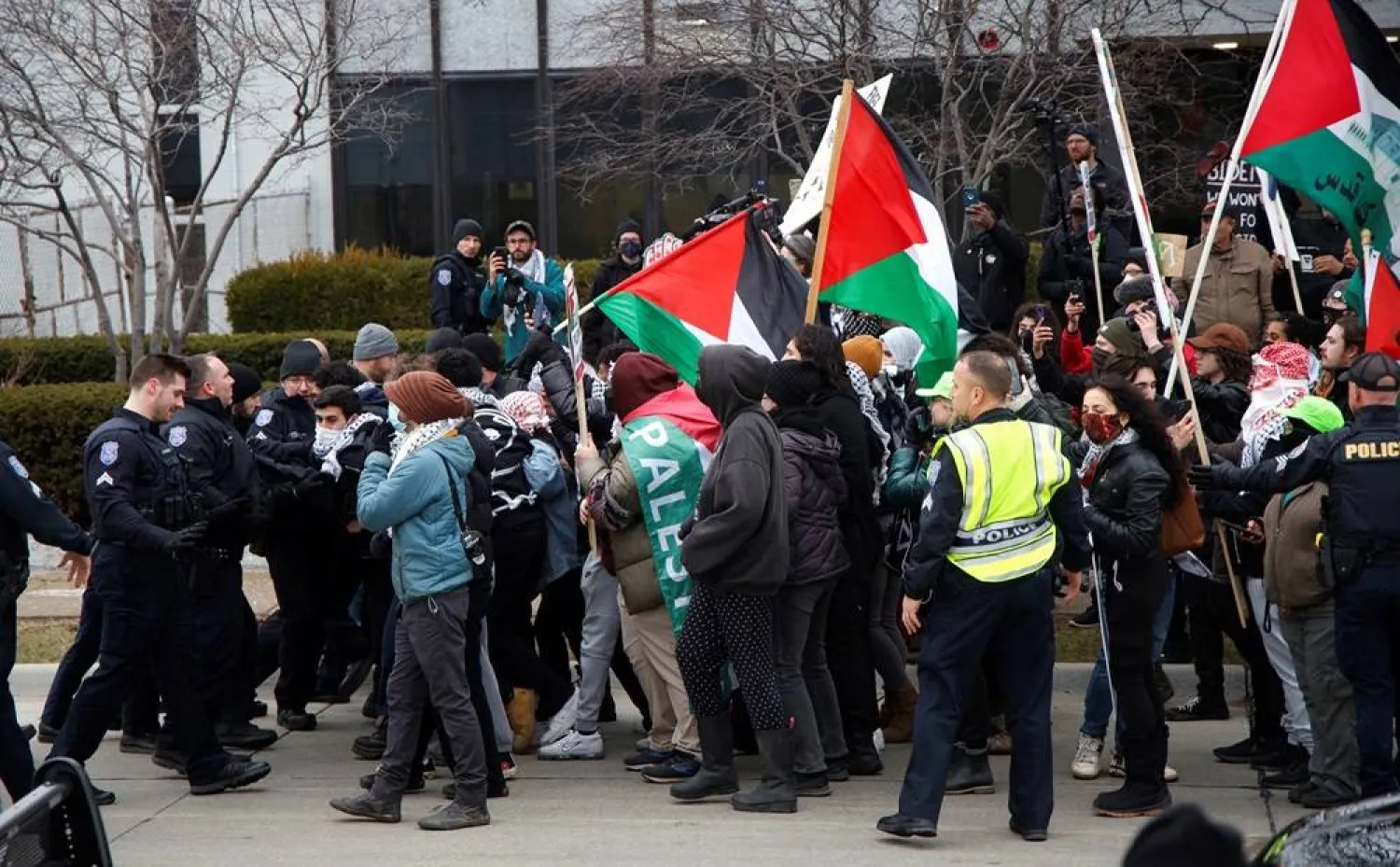
 Protestors face-off against police during a rally for a ceasefire in Gaza outside a UAW union hall during a visit by US President Joe Biden in Warren, Michigan, US February 1, 2024. (Reuters)
Protestors face-off against police during a rally for a ceasefire in Gaza outside a UAW union hall during a visit by US President Joe Biden in Warren, Michigan, US February 1, 2024. (Reuters)
TT

White House Downplays Biden, National Security Aide’s Blunt Comments on Israel

 Protestors face-off against police during a rally for a ceasefire in Gaza outside a UAW union hall during a visit by US President Joe Biden in Warren, Michigan, US February 1, 2024. (Reuters)
Protestors face-off against police during a rally for a ceasefire in Gaza outside a UAW union hall during a visit by US President Joe Biden in Warren, Michigan, US February 1, 2024. (Reuters)

The White House on Friday sought to downplay sharp criticism levied against Israel by President Joe Biden and a senior national security official over how Prime Minister Benjamin Netanyahu's government has conducted Israel's four-month-old war aimed at rooting out Hamas militants from Gaza.

Biden, speaking to reporters Thursday evening, called Israel's military operations in Gaza “over the top” and said the suffering of innocent people has “got to stop.” While Biden has previously expressed concern about the mounting Palestinian civilian toll — more than 27,000 have been killed in Gaza since the conflict erupted — his direct criticism of the Israelis has been muted.

Then on Friday, the New York Times reported it had obtained a recording in which the president's deputy principal national security adviser, Jon Finer, expressed a “lack of confidence” in Prime Minister Benjamin Netanyahu’s right-wing government during a meeting with Arab American and Muslim community leaders this week. The White House National Security Council confirmed that Finer’s comments, as reported by the Times, were accurate.

An administration official told The Associated Press that Finer was speaking specifically about the Netanyahu government's commitment to pursuing a two-state solution — one in which Israel would co-exist with an independent Palestinian state — once the war ends. Netanyahu throughout his political career has consistently opposed the creation of a Palestinian state.

“The President and Mr. Finer were reflecting on concerns we have had for some time and will continue to have as the Israeli operation proceeds, about the loss of Palestinian lives in this conflict and the need to reduce civilian harm,” National Security Council spokesperson Adrienne Watson said in a statement.

“The President has made clear since the first days of this conflict that we share the aim of defeating Hamas, but that Israel must reduce, as much as possible, the impact of its operation on innocent civilians.”

Finer in the recording also spoke of “missteps” by the Biden administration and expressed regret that the administration may have left a “a very damaging impression” early in the war with its “wholly inadequate public accounting for how much the president, the administration and the country values the lives of Palestinians.”

The comments appear to reflect a growing frustration in the White House with the conflict that was sparked on Oct. 7 after Hamas militants launched an attack on Israel, killing 1,200 and taking about 250 others hostage. Earlier pauses in fighting led to release of mostly women and children taken by Hamas, but US officials believe more than 100 remain in captivity.

Biden on Thursday said he hasn't given up on a US-Egypt-Qatar effort to get the two sides to agree to an extended pause in fighting to facilitate the release of the remaining hostages.

Hamas, however, has demanded that Israel release hundreds of Palestinian prisoners and end the war as part of a hostage deal. Netanyahu has refused to agree to those terms.

Biden said he still is hopeful that a deal can be worked out that might create a path to ending the war.

“I am pushing very hard now to deal with this hostage ceasefire,” Biden said. “I’ve been working tirelessly on this deal.”

Biden had dispatched Finer and other senior aides to Michigan on Thursday to meet with Arab American and Muslim community leaders as his administration has been looking to mend rifts with a key constituency in a 2024 battleground state.

Samantha Power, head of the US Agency for International Development, Steven Benjamin, who directs the Office of Public Engagement, and Tom Perez, who leads the Office of Intergovernmental Affairs, were among administration officials who took part in the Michigan visit.

Some of Biden's campaign team have faced a tough reception from Michigan's sizable Arab American and Muslim community.

Biden’s campaign manager, Julie Chavez Rodriguez, and other campaign aides went to suburban Detroit late last month, but found a number of community leaders unwilling to meet with them.

Other community activists have gone even further as they press their disapproval of the president’s handling of the war and have formed a group called “Abandon Biden,” a movement discouraging voters from supporting the president in November.

Michigan has the largest concentration of Arab Americans in the nation and over 310,000 residents are of Middle Eastern or North African ancestry. Nearly half of Dearborn’s roughly 110,000 residents claim Arab ancestry.

After Donald Trump won Michigan by fewer than 11,000 votes in 2016, Wayne County and its large Muslim communities helped Biden retake the state for the Democrats in 2020 by a roughly 154,000-vote margin. Biden enjoyed a roughly 3-to-1 advantage in Dearborn and 5-1 advantage in Hamtramck, and he won Wayne County by more than 330,000 votes.


UK Police Hold NATO-assigned US Soldier Suspected of Russia Spying

Soldiers talk with a DJI drone in the background during the NATO exercise STEADFAST DART 26 in Bergen, Germany, February 20, 2026. (Reuters)
TT

UK Police Hold NATO-assigned US Soldier Suspected of Russia Spying

Soldiers talk with a DJI drone in the background during the NATO exercise STEADFAST DART 26 in Bergen, Germany, February 20, 2026. (Reuters)

UK police were questioning Wednesday a US soldier assigned to NATO and suspected of spying for Russia, following his arrest amid a joint investigation with American military and law enforcement.

The case, the latest espionage allegation involving suspected Russian agents in Britain and elsewhere in Europe, comes with tensions heightened between Moscow and various European capitals after its 2022 full-scale invasion of Ukraine.

It also follows recent security scares at two British air force bases hosting the US military, which officials have accused Iran of being behind.

UK police have said the 41-year-old American soldier was detained near Gloucester, southwest England, on suspicion of violating national security laws and taken to a London police station.

Later Tuesday, a senior NATO military official confirmed that he was assigned to its Allied Rapid Reaction Corps (ARRC), the alliance's multinational, high-readiness military headquarters led by the British Army.

Based at Imjin Barracks in the village of Innsworth, the Corps can deploy at short notice anywhere in Europe or globally under the direct operational command of NATO's Supreme Allied Commander Europe.

Imjin is also just a few miles from the UK's sensitive GCHQ intelligence, security and cyber agency headquarters.

Vicki Evans, senior national coordinator for UK Counter Terrorism Policing, said the "significant arrest and investigation" followed close collaboration between UK and US authorities.

"The allegations are serious and our investigation is very much ongoing," she said in a statement late Tuesday.

US Federal Bureau of Investigation (FBI) director Kash Patel thanked British police and intelligence agencies.

"This important arrest involves allegations of espionage, which is of the utmost concern to the United States and our allies," he said, according to the UK police statement.

- 'Sobering' -

It noted officers were carrying out searches at two locations in Gloucestershire.

Police arrested the US soldier under two sections of the UK's national security laws, one relating to obtaining or disclosing protected information and the other to assisting a foreign intelligence service.

The law allows counter terrorism police to hold him without charge for up to 14 days.

Sean Stinchon, the commanding general of US Army Counterintelligence Command described the alleged actions of the "senior solider, entrusted with sensitive information" as a "sobering reminder that insider threats are real and persistent".

The probe is not linked to any other ongoing investigations, the police statement said.

Western countries have for years accused the Kremlin of espionage within their borders, as well as masterminding a string of incidents to undermine support for Ukraine as it battles Russia's invasion.

In September, a British man appeared in a London court over allegations he was preparing to sabotage a drone factory and drone manufacturing sites on behalf of Russian military intelligence.

Last year, a 66-year-old British man was jailed for seven years for his attempts to spy for Russia.

Meanwhile, a loose network of young UK men were also imprisoned for their involvement in torching a warehouse storing supplies for Ukraine, after Russia's paramilitary Wagner group recruited the attack's orchestrator.


Iran’s Revolutionary Guards Unveil Underground ‘Missile City’

An image broadcast by Iranian state television on Tuesday shows missiles ready for launch at an underground missile facility at an undisclosed location.
TT

Iran’s Revolutionary Guards Unveil Underground ‘Missile City’

An image broadcast by Iranian state television on Tuesday shows missiles ready for launch at an underground missile facility at an undisclosed location.

Iran’s Armed Forces Chief of Staff Maj. Gen. Ali Abdollahi declared that Iran would “certainly” destroy Israel during an inspection of a strategic missile facility belonging to the Iranian Revolutionary Guard Corps (IRGC).

Iranian state television aired footage of the visit on Tuesday, hours after US President Donald Trump described Iran as “effectively finished militarily” and days after the IRGC announced it had lifted its 2,000-kilometer limit on ballistic missile ranges.

Accompanied by IRGC Aerospace Force Commander Brig. Gen. Majid Mousavi, Abdollahi toured the underground complex, which state-run news agencies described as a new “missile city.”

State television reported the unveiling of new weapons, including a “surprise” missile, without disclosing its name, range or specifications. Iranian media revealed neither the facility’s location nor the date of the visit.

IRGC spokesman Hossein Mohebbi had announced on Saturday that a new underground complex would soon be unveiled.

The footage showed ballistic missiles inside tunnels, warheads, mobile launchers and storage facilities for missiles and drones.

Abdollahi and Mousavi addressed officers whose faces were concealed. No other officials appeared in the footage.

State television claimed the facility housed liquid- and solid-fueled ballistic missiles and cruise missiles that had penetrated Israeli and American air defenses during the “last two wars,” striking every target designated by Iran’s operations command.

‘We will certainly destroy them’

Addressing the officers, Abdollahi praised their work as “extraordinary.”

Referring to Israeli Prime Minister Benjamin Netanyahu, he declared: “Netanyahu recently said, ‘Either we destroy Iran or they destroy us.’ ... Clearly, we will certainly destroy them.”

“They came with everything they had but failed to achieve their objective,” he added, describing Israel and the United States as the clear losers in the war.

“If the enemy makes a foolish move, our response will extend beyond the region,” he warned, promising further “surprises” in the next war.

Mousavi described capabilities inherited from previous missile commanders as a reliable defensive force serving Iran and implementing the supreme leader’s directives.

“We now have a credible level of readiness to confront any threat, both within and beyond the region,” he declared.

“If necessary, we will bring all enemy capabilities, inside and outside the region, under fire and leave them with nothing but defeat.”

He promised additional weapons and equipment as preparations progressed, pledging that his forces would serve the Iranian regime on every battlefield, as during the war that began last February and the 12-day war in June 2025.

Beyond the 2,000-kilometer limit

A state television correspondent reported that a “new defensive doctrine” had taken effect following Supreme Leader Mojtaba Khamenei’s order to respond to threats of any scale or type with an “immediate and effective response without geographical restrictions.”

The broadcaster presented the inspection as an implementation of that directive.

Its correspondent interpreted Abdollahi’s remarks as confirmation that missile-range restrictions had been lifted and claimed upgraded warheads were substantially more destructive.

The report provided neither technical specifications nor evidence supporting claims that the missiles could penetrate air defenses.

Khamenei issued the directives on October 31 during his first publicly announced meeting with senior military commanders since taking office.

Participants included Abdollahi, Iranian Army Commander Amir Hatami and IRGC Commander Ahmad Vahidi.

Khamenei also ordered an updated target list covering US and Israeli “material and non-material” assets.

On Saturday, Mohebbi confirmed the removal of the 2,000-kilometer ceiling.

“That restriction has been lifted for us,” he declared, without specifying a new range or whether Iran possessed missiles exceeding the previous limit. He promised to demonstrate those capabilities “in practice.”


Thune, Jordan Emerge as Republican Minority Leaders for Next US Congress

US Rep. Jim Jordan (R-OH) speaks during a press conference after House Republicans elected new leadership for the upcoming session of Congress at the US Capitol on November 10, 2026 in Washington, DC. (Getty Images/AFP)
TT

Thune, Jordan Emerge as Republican Minority Leaders for Next US Congress

US Rep. Jim Jordan (R-OH) speaks during a press conference after House Republicans elected new leadership for the upcoming session of Congress at the US Capitol on November 10, 2026 in Washington, DC. (Getty Images/AFP)

Republicans chose US Senate Majority Leader John Thune and House Judiciary Committee Chairman Jim Jordan on Tuesday to lead them against a Democratic-controlled Congress that will take power in January for the final two years of Donald Trump's presidency.

A week after Republicans lost their majority in a stinging midterm election defeat, Senate Republicans chose Thune by acclamation at a closed-door meeting for the task of trying to thwart Democratic initiatives that do not meet with their approval, including by wielding the Senate filibuster.

"We're not going to be running this place next year," Thune told reporters. "But you can be assured we will ‌be very, very active ‌in asserting conservative priorities in all of the legislating ... that goes on ‌here."

Jordan's ⁠election as House ⁠minority leader elevates a combative Trump ally to the forefront of the party’s fight to defend the US president’s agenda in the lower chamber. Jordan defeated House Majority Leader Steve Scalise in a secret ballot. House Speaker Mike Johnson opted not to stand for the leadership position.

The House and Senate leadership elections will help to determine what role Republicans intend to play as the minority party in Congress during the final two years of Trump's presidency.

Democrats will need Republican support to move major initiatives in the 100-member Senate, where ⁠the filibuster rule requires 60 votes for most legislation. Their majorities in ‌both chambers also fall well short of the two-thirds of votes ‌needed to override presidential vetoes.

Thune, 65, a South Dakota Republican known for his consensus-building leadership style, is respected ‌by Republicans and Democrats alike. But he has run afoul of Trump's MAGA supporters who say he ‌did not move aggressively enough to enact Trump's policies on immigration and election reform.

After the midterm elections, Thune vowed that Republicans would work with Trump to block "Democrat extremism" and work against any attempt by Democrats to unwind Republican achievements, including border security and judicial appointments.

Jordan, 62, was first elected in 2006 to represent a deeply conservative rural ‌district in northern Ohio and was a founder of the House Freedom Caucus, a group that former Republican House Speaker John Boehner labeled "legislative terrorists."

Before ⁠entering politics, Jordan honed ⁠his pugilistic style during a career as a high school and university champion wrestler, and later as a wrestling coach at Ohio State University.

That past threatened his political career in 2018 when former students accused him of turning a blind eye to rampant sexual abuse of college wrestlers by the wrestling team's doctor, when Jordan was an assistant coach.

Jordan denied all allegations, and a university investigation found no hard evidence that he knew of the abuse. But former wrestlers said the doctor's abuse was well-known and the report itself found that students had complained about the doctor's voyeurism in front of coaching staff.

Jordan has often referred to his wrestling background in terms of his reputation as a fighter in Congress.

He is known for his aggressive style of questioning in committee hearings.

"I look at it like a wrestling match," Jordan told the New York Times in an April 2023 interview, explaining how he prepares for hearings. "I'm going to try to get as ready as I can. You can't just wing it."