


US Senate Passes $95.3 Billion Aid Package for Ukraine, Israel and Taiwan After Rare All-Night Session 

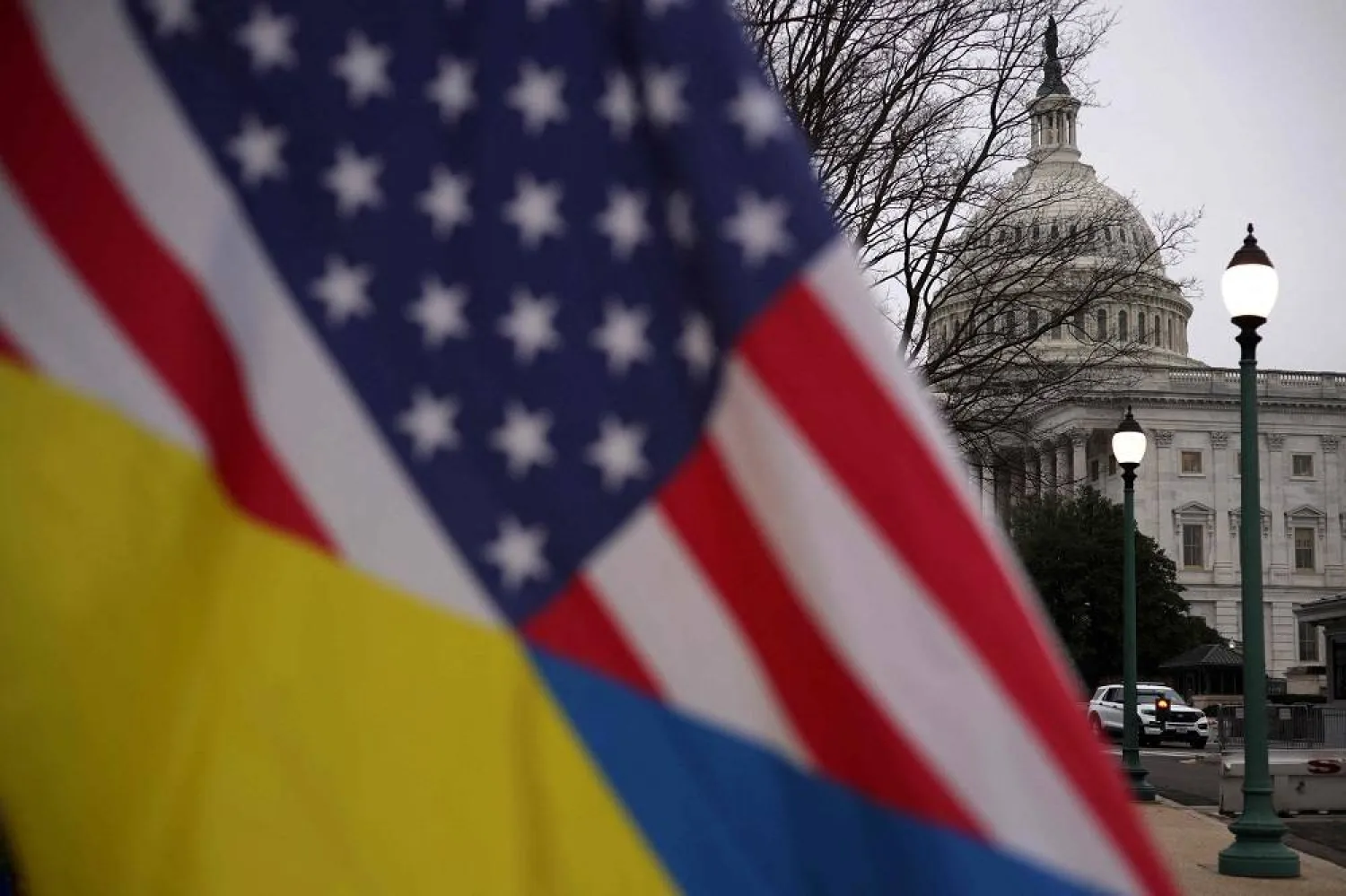
A man holds a mixed flag of Ukraine and America outside the US Capitol on February 12, 2024 in Washington, DC. (AFP/Getty Images)
TT

US Senate Passes $95.3 Billion Aid Package for Ukraine, Israel and Taiwan After Rare All-Night Session 

A man holds a mixed flag of Ukraine and America outside the US Capitol on February 12, 2024 in Washington, DC. (AFP/Getty Images)

The Senate early Tuesday passed a $95.3 billion aid package for Ukraine, Israel and Taiwan, pushing ahead after months of difficult negotiations and amid growing political divisions in the Republican Party over the role of the United States abroad.

The vote came after a small group of Republicans opposed to the $60 billion for Ukraine held the Senate floor through the night, using the final hours of debate to argue that the US should focus on its own problems before sending more money overseas. But 22 Republicans voted with nearly all Democrats to pass the package 70-29, with supporters arguing that abandoning Ukraine could embolden Russian President Vladimir Putin and threaten national security across the globe.

“With this bill, the Senate declares that American leadership will not waiver, will not falter, will not fail,” said Senate Majority Leader Chuck Schumer, who worked closely with Republican Leader Mitch McConnell on the legislation.

The bill’s passage through the Senate was a welcome sign for Ukraine amid critical shortages on the battlefield.

Yet the package faces a deeply uncertain future in the House, where hardline Republicans aligned with former President Donald Trump — the front-runner for the GOP presidential nomination, and a critic of support for Ukraine — oppose the legislation.

Speaker Mike Johnson cast new doubt on the package in a statement Monday evening, making clear that it could be weeks or months before Congress sends the legislation to President Joe Biden's desk — if at all.

Still, the vote was a win for both Senate leaders. Schumer noted the strong bipartisan support and projected that if the House speaker brings it forward it would have the same strong support in that chamber. McConnell has made Ukraine his top priority in recent months, and was resolute in the face of considerable pushback from his own GOP conference.

Speaking directly to his detractors in a floor speech on Sunday, McConnell said that “the eyes of the world” were on the US Senate.

“Will we give those who wish us harm more reason to question our resolve, or will we recommit to exercising American strength?” McConnell asked.

Dollars provided by the legislation would purchase US-made defense equipment, including munitions and air defense systems that authorities say are desperately needed as Russia batters the country. It also includes $8 billion for the government in Kyiv and other assistance.

“For us in Ukraine, continued US assistance helps to save human lives from Russian terror,” Ukrainian President Volodymyr Zelenskyy posted on social media. “It means that life will continue in our cities and will triumph over war.”

In addition, the legislation would provide $14 billion for Israel’s war with Hamas, $8 billion for Taiwan and partners in the Indo-Pacific to counter China, and $9.2 billion in humanitarian assistance for Gaza.

Two Democrats, Sens. Jeff Merkley of Oregon and Peter Welch of Vermont, as well as Sen. Bernie Sanders, an independent, voted against it. The progressive lawmakers have objected to sending offensive weaponry to Israel.

“I cannot in good conscience support sending billions of additional taxpayer dollars for Prime Minister Netanyahu's military campaign in Gaza,” Welch said. “It’s a campaign that has killed and wounded a shocking number of civilians. It’s created a massive humanitarian crisis.”

The bill’s passage followed almost five months of torturous negotiations over an expansive bill that would have paired the foreign aid with an overhaul of border and asylum policies. Republicans demanded the trade-off, saying the surge of migration into the United States had to be addressed alongside the security of allies.

But a bipartisan deal on border security fell apart just days after its unveiling, a head-spinning development that left negotiators deeply frustrated. Republicans declared the bill insufficient and blocked it on the Senate floor.

After the border bill collapsed, the two leaders abandoned the border provisions and pushed forward with passing the foreign aid package alone — as Democrats had originally intended.

While the slimmed-down foreign aid bill eventually won enough Republican support to pass, several GOP senators who had previously expressed support for Ukraine voted against it. The episode further exposed divisions in the party, made more public as Trump dug in and a handful of lawmakers openly called for McConnell to step down.

Sen. J.D. Vance, an Ohio Republican, argued that the US should step back from the conflict and help broker an end to it with Russia's Putin. He questioned the wisdom of continuing to fuel Ukraine’s defense when Putin appears committed to fighting for years.

“I think it deals with the reality that we’re living in, which is they’re a more powerful country, and it’s their region of the world,” he said.

Vance, along with Kentucky Sen. Rand Paul and other opponents, spent several hours on the floor railing against the aid and complaining about Senate process. They dug in their heels to delay a final vote, speaking on the floor until daybreak.

Supporters of the aid pushed back, warning that bowing to Russia would be a historic mistake with devastating consequences. In an unusually raw back-and-forth, GOP senators who support the aid challenged some of the opponents directly on the floor.

North Carolina Sen. Thom Tillis angrily rebutted some of their arguments, noting that the money would only help Ukraine for less than a year and that much of it would go to replenishing US military stocks.

“Why am I so focused on this vote?” Tillis said. “Because I don’t want to be on the pages of history that we will regret if we walk away. You will see the alliance that is supporting Ukraine crumble. You will ultimately see China become emboldened. And I am not going to be on that page of history.”

Sen. Jerry Moran, R-Kan., became emotional as he talked about the drudgery of the Senate and spending time away from his family to get little done. “But every so often there are issues that come before us that seem to be the ones that explain why we are here,” he said, his voice cracking.

Moran conceded that the cost of the package was heavy for him, but pointed out that if Putin were to attack a NATO member in Europe, the US would be bound by treaty to become directly involved in the conflict — a commitment that Trump has called into question as he seeks another term in the White House.

At a rally Saturday, Trump said that he had once told a NATO ally he would encourage Russia “to do whatever the hell they want” to members that are “delinquent” in their financial and military commitments to the alliance. The former president has led his party away from the foreign policy doctrines of aggressive American involvement overseas and toward an “America First” isolationism.

Evoking the slogan, Moran said, “I believe in America first, but unfortunately America first means we have to engage in the world.”

While the vast majority of House Republicans have opposed the aid and are unlikely to cross Trump, a handful of GOP lawmakers have signaled they will push to get it passed.

House Intelligence Committee Chairman Mike Turner, R-Ohio, traveled to Ukraine last week with a bipartisan delegation and met with Zelenskyy. Turner posted on X, formerly Twitter, after the trip that “I reiterated America’s commitment to support Ukraine in its fight against Russia.”

But Speaker Johnson is in a tough position. A majority of his conference opposes the aid, and he is trying to lead the narrowest of majorities and avoid the fate of his predecessor, former Speaker Kevin McCarthy, who was ousted in October.

Johnson, R-La., said in a statement Monday that because the foreign aid package lacks border security provisions, it is “silent on the most pressing issue facing our country.” It was the latest — and potentially most consequential — sign of opposition to the Ukraine aid from House GOP leadership, who had rejected the bipartisan border plan as a “non-starter,” contributing to its rapid demise.

“Now, in the absence of having received any single border policy change from the Senate, the House will have to continue to work its own will on these important matters,” Johnson said. “America deserves better than the Senate’s status quo.”

Rep. Abigail Spanberger, a Virginia Democrat, traveled to Kyiv last week with Turner and other House members. She said the trip underscored to her how Ukraine is still in a fight for its very existence.

As the group traveled through Kyiv in armored vehicles, she said, they witnessed signs of an active war, from sandbagged shelters to burned-out cars and memorials to those killed. During the meeting with Zelenskyy, she said the US lawmakers tried to offer assurances that the American people still stand with his country.

“He was clear that our continued support is critical to their ability to win the war,” Spanberger said. “It’s critical to their own freedom. And importantly, it’s critical to US national security interests.”




UK Foreign Minister to Meet Rubio amid Tensions over Joint Air Base

British Foreign Secretary Yvette Cooper, president of the United Nations Security Council for February speaks during a press conference before the Security Council meeting, at UN headquarters in New York City, US, February 19, 2026. REUTERS/Jeenah Moon
TT

UK Foreign Minister to Meet Rubio amid Tensions over Joint Air Base

British Foreign Secretary Yvette Cooper, president of the United Nations Security Council for February speaks during a press conference before the Security Council meeting, at UN headquarters in New York City, US, February 19, 2026. REUTERS/Jeenah Moon

Britain's foreign minister Yvette Cooper ‌will meet with US Secretary of State Marco Rubio on Friday, after President Donald Trump renewed his criticism of London for ceding sovereignty of ​the Chagos Islands, which is home to a US-UK air base.
Last year, British Prime Minister Keir Starmer agreed a deal to transfer sovereignty of the Indian Ocean islands to Mauritius, while keeping control of one - Diego Garcia - through a 99-year lease that preserved US operations at the base, Reuters said.
Washington last year gave its blessing to the agreement, but Trump has since ‌changed his mind ‌several times. In January, Trump described it ​as ‌an ⁠act ​of "great stupidity", ⁠but earlier this month said he understood the deal was the best Starmer could make, before then renewing his criticism this week.
Cooper is meeting Rubio to discuss defense and security issues in Washington as Trump also toughens his rhetoric on Iran, saying Tehran must make a deal over its nuclear program in the ⁠next 10 to 15 days, or "really bad ‌things" will happen.
The Diego Garcia ‌base has recently been used for ​operations in the Middle East against ‌Yemen's Houthis and in humanitarian aid to Gaza.
Although on Tuesday ‌Rubio's State Department said it backed the Chagos accord, the next day Trump said Britain was making a big mistake.
"DO NOT GIVE AWAY DIEGO GARCIA!" Trump wrote in a post on Truth Social, saying the ‌base could be called upon in any future military operation to "eradicate a potential attack" from ⁠Iran.
Under the ⁠conditions for using the joint base, Britain would need to agree in advance to any operations out of Diego Garcia.
On Thursday, Britain's The Times newspaper reported that Trump's latest criticism of the Chagos deal came because Britain was yet to give permission to use the bases for future strikes against Iran, owing to concerns they may breach international law.
Asked about The Times report, Britain's Ministry of Defence said on Thursday it does not comment on operational matters and that Britain supported ​the ongoing political process between ​the US and Iran.


Turkish Police Detain Deutsche Welle Journalist over Social Media Posts

19 February 2026, Canada: Deutsche Welle (DW) logo is seen displayed on a smartphone screen. Photo: Thomas Fuller/SOPA Images via ZUMA Press Wire/dpa
TT

Turkish Police Detain Deutsche Welle Journalist over Social Media Posts

19 February 2026, Canada: Deutsche Welle (DW) logo is seen displayed on a smartphone screen. Photo: Thomas Fuller/SOPA Images via ZUMA Press Wire/dpa

Turkish police have detained investigative journalist Alican Uludag on suspicion of insulting President Recep Tayyip Erdogan and spreading misinformation, sparking outrage among journalism groups.
Uludag, who works for German broadcaster Deutsche Welle’s Turkish service, was taken from his home in Ankara late Thursday as part of an investigation into social media posts. The Istanbul Chief Prosecutor’s Office said he is suspected of “insulting the president” and “disseminating misleading information.”
The journalist, whose reporting focuses mainly on the judiciary and on corruption cases, was later transferred to Istanbul for questioning.
His detention drew sharp condemnation from press freedom advocates, who described it as an attack on media independence and democratic norms, The Associated Press said.
Deutsche Welle’s director‑general, Barbara Massing, demanded his release, calling the arrest “a deliberate act of intimidation.”
On Friday, journalists gathered outside Istanbul’s Çaglayan Courthouse to protest Uludag’s detention and to call for his immediate release.
The advocacy group, Reporters Without Borders considers Türkiye to be one of the most repressive countries for journalists, nothing that most media organizations are under government control and journalists face frequent legal pressure or intimidation.
At least 14 journalists or media sector workers are currently in prison, according to the Turkish Journalists Syndicate.


South Korea’s Ex-President Yoon Apologizes After Life Sentence Over Martial Law 

South Korean President Yoon Suk Yeol  delivers a speech to declare martial law in Seoul, South Korea, December 3, 2024. (The Presidential Office/Handout via Reuters/File Photo)
South Korean President Yoon Suk Yeol delivers a speech to declare martial law in Seoul, South Korea, December 3, 2024. (The Presidential Office/Handout via Reuters/File Photo)
TT

South Korea’s Ex-President Yoon Apologizes After Life Sentence Over Martial Law 

South Korean President Yoon Suk Yeol  delivers a speech to declare martial law in Seoul, South Korea, December 3, 2024. (The Presidential Office/Handout via Reuters/File Photo)
South Korean President Yoon Suk Yeol delivers a speech to declare martial law in Seoul, South Korea, December 3, 2024. (The Presidential Office/Handout via Reuters/File Photo)

Former ‌South Korean President Yoon Suk Yeol apologized on Friday for his short-lived declaration of martial law in December 2024, a day after a Seoul court sentenced him to life in prison for masterminding an insurrection.

In a statement released by his lawyers, Yoon said that while he was sorry for the "frustration and hardship" brought upon the people by his martial law decree, he stood behind the "sincerity and purpose" behind his actions.

The Seoul Central District Court's decision ‌to hand him ‌a life sentence on Thursday was "predetermined," he ‌said, ⁠adding that the verdict ⁠against him was political retaliation.

"Forces that seek to smear a decision made to save the nation as an 'insurrection' and to use it beyond political attacks as an opportunity to purge and eliminate their opponents will only grow more rampant going forward," he said.

Yoon also questioned ⁠whether an appeal would have meaning ‌in what he described as an ‌environment where judicial independence could not be guaranteed, while telling ‌supporters to "unite and rise."

His lawyers separately said the statement ‌did not amount to an intention to forgo an appeal.

Yoon's martial law declaration lasted around six hours before being voted down by parliament, but it sent shockwaves through the country and ‌sparked street protests.

The court found Yoon guilty of subverting constitutional order by deploying troops ⁠to storm ⁠parliament and move to detain opponents, capping a dramatic fall that saw him stripped of office and end up behind bars.

Yoon, a former career prosecutor, denied the charges, arguing he had presidential authority to declare martial law and his action was aimed at sounding the alarm over opposition parties' obstruction of government.

A special prosecutor had sought the death penalty for Yoon, though South Korea has not carried out an execution since 1997.

A prosecutor said on Thursday the team had some "regret" over the sentencing, but declined to say whether they planned to appeal.