


Ukraine’s Zelenskyy Pleads for More Ammunition at Albania Summit of Southeastern European Nations

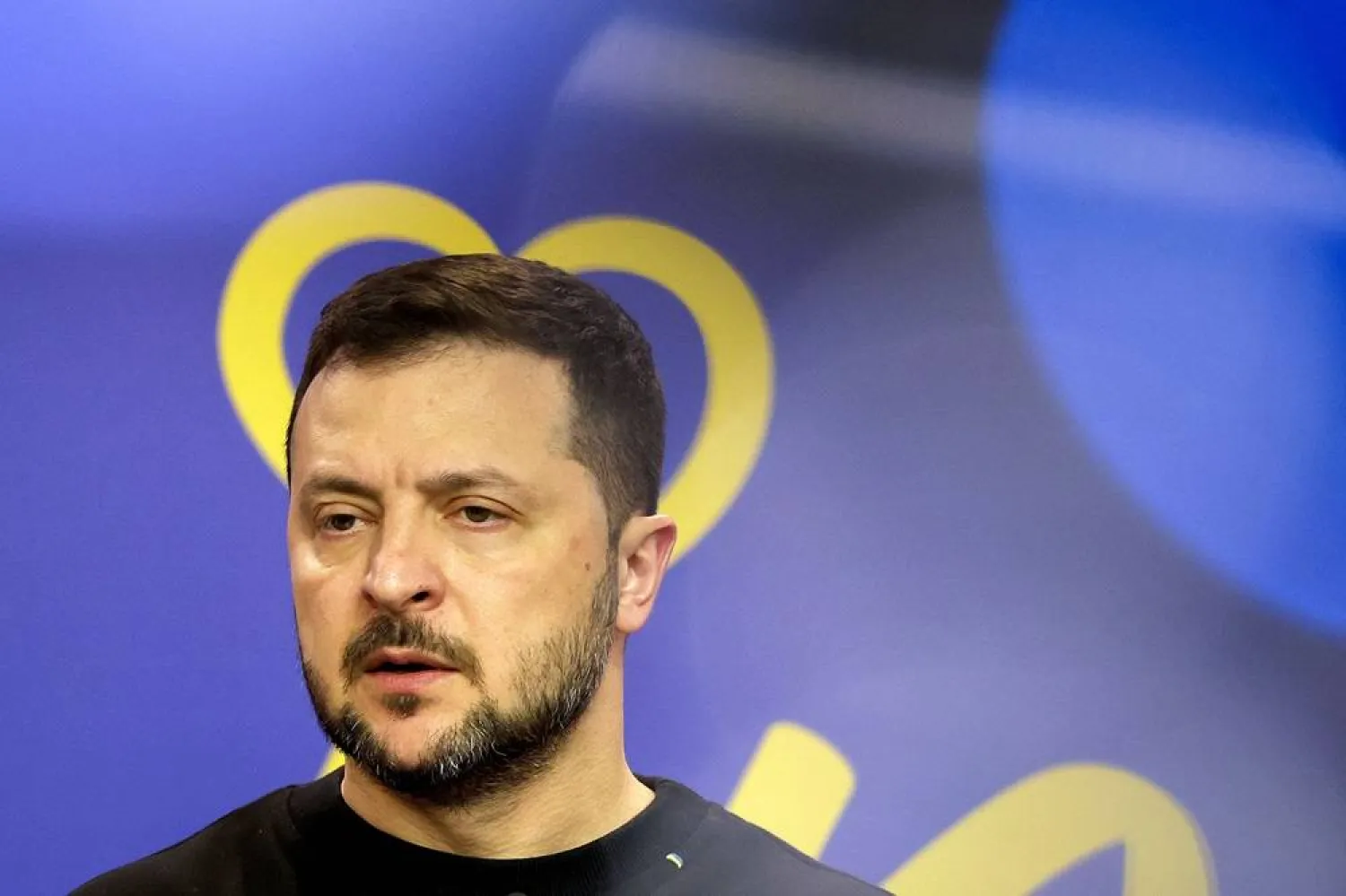
Ukraine's President Volodymyr Zelenskyy addresses the audience during a joint press conference with Albania's Prime Minister, as part of the "Ukraine Southeast Europe Summit" in Tirana on February 28, 2024. (AFP)
TT

Ukraine’s Zelenskyy Pleads for More Ammunition at Albania Summit of Southeastern European Nations

Ukraine's President Volodymyr Zelenskyy addresses the audience during a joint press conference with Albania's Prime Minister, as part of the "Ukraine Southeast Europe Summit" in Tirana on February 28, 2024. (AFP)

Ukraine’s president pleaded Wednesday for more ammunition to repel Russian advances as he co-hosted a summit with Albania's government to build further support for Kyiv among southeastern European countries while signs of war fatigue grow.

Ukrainian President Volodymyr Zelenskyy said that increasing the supply of armaments, and especially ammunition, was paramount for Ukraine just over two years since Russia’s full-scale invasion. “I think this is the question of: Will we stand or not,” he said during his speech to the summit.

His impassioned plea comes as Russian troops have seized the initiative on the battlefield in Ukraine amid worsening shortages of weapons and soldiers for Ukraine's military. Western analysts and observers say the Russians are attacking in strength along four parallel axes in the northeast, aiming to press deeper into the Ukraine-held western part of the Donetsk region and also penetrating into the Kharkiv region north of it.

Russia took the strategic eastern city of Avdiivka earlier this month by overwhelming Ukrainian forces with large numbers of troops and superior air and artillery firepower. Fierce fighting has continued with Russia pushing Kyiv’s forces out of another three villages to the city’s west in the last few days.

Zelenskyy arrived in Albania overnight to join a summit of eleven countries from southeastern Europe, along with officials from the European Union and other international organizations. It was the latest stop in an international tour that saw him in Saudi Arabia on Tuesday to push for a peace plan and the return of prisoners of war from Russia.

Zelenskyy sought to build solidarity among his country and those of the Western Balkans, saying that all of them deserved to be members of the European Union and NATO if they choose.

“The European Union and NATO have provided Europe with the longest and most reliable era of security and economic development, and we are all equally worthy of being a part of the European and Euro-Atlantic communities,” Zelenskyy said.

Securing further support is key to Ukraine’s leader while his country faces battlefield challenges. Zelenskyy on Sunday announced that 31,000 Ukrainian soldiers have been killed in action since Russia’s invasion — the first time that Kyiv had confirmed the number of its losses.

He acknowledged, again, in Tirana that “the problems with the supply of ammunition" were impacting the situation on the battlefield.

Russia’s tactics in Avdiivka, including its use of dozens of glide bombs to obliterate Ukrainian positions in the city, has raised concerns it could replicate the same methods elsewhere along the frontline if Western aid to support air-defense systems and supplies of long-range weapons and artillery do not come through soon.

Around Bakhmut, which fell to Russia last May after the longest battle since the full-scale invasion began, Russian troops are trying to push towards Chasiv Yar, according to a spokesman for the operational group overseeing the eastern front line. Illia Yevlash said Tuesday that Russia is reinforcing its troops with assault units, using air attacks, and that heavy fighting was ongoing on the outskirts of the city.

Meanwhile, further north on the frontline, Russian troops are pressing forward around Lyman and Kupiansk, in the Kharkiv region that borders Russia.

Ukraine has urged Western leaders to increase the joint production of weapons and ammunition, improve Ukrainian air defenses and put new pressure on Russia via expanded sanctions.

Not all the countries at the meeting are in full support for Ukraine in its war against Russia. Kremlin ally Serbia is the only European country that has refused to align with EU sanctions following Russia’s invasion. It continues signing cooperation agreements with Moscow.

Serbian President Aleksandar Vucic said he insisted that the summit statement should not include any call for sanctions on Russia and should not include proposed wording about Russia's negative influence in the Balkan region.

Albania, a NATO member since 2009 and a candidate for EU membership, has voiced its full support for Kyiv against Russia’s invasion. It has provided military assistance in the form of ammunition and training of Ukrainian military. It was among the first countries offering shelter to Ukrainian refugees. It has joined international sanctions against Russian officials and institutions.

As a non-permanent member of the United Nations Security Council in the last two years, Albania joined the US in initiating resolutions against Russia’s invasion.

Zelenskyy said all of the countries at the summit must remain vigilant over what Russian President Vladimir Putin does next.

“The interaction between us, between neighbors, between neighboring regions, between all partners, has become a factor that along with the resilience of our people in Ukraine, does not allow Putin to prevail,” Zelenskyy said.



Turkish Police Detain Deutsche Welle Journalist over Social Media Posts

19 February 2026, Canada: Deutsche Welle (DW) logo is seen displayed on a smartphone screen. Photo: Thomas Fuller/SOPA Images via ZUMA Press Wire/dpa
TT

Turkish Police Detain Deutsche Welle Journalist over Social Media Posts

19 February 2026, Canada: Deutsche Welle (DW) logo is seen displayed on a smartphone screen. Photo: Thomas Fuller/SOPA Images via ZUMA Press Wire/dpa

Turkish police have detained investigative journalist Alican Uludag on suspicion of insulting President Recep Tayyip Erdogan and spreading misinformation, sparking outrage among journalism groups.
Uludag, who works for German broadcaster Deutsche Welle’s Turkish service, was taken from his home in Ankara late Thursday as part of an investigation into social media posts. The Istanbul Chief Prosecutor’s Office said he is suspected of “insulting the president” and “disseminating misleading information.”
The journalist, whose reporting focuses mainly on the judiciary and on corruption cases, was later transferred to Istanbul for questioning.
His detention drew sharp condemnation from press freedom advocates, who described it as an attack on media independence and democratic norms, The Associated Press said.
Deutsche Welle’s director‑general, Barbara Massing, demanded his release, calling the arrest “a deliberate act of intimidation.”
On Friday, journalists gathered outside Istanbul’s Çaglayan Courthouse to protest Uludag’s detention and to call for his immediate release.
The advocacy group, Reporters Without Borders considers Türkiye to be one of the most repressive countries for journalists, nothing that most media organizations are under government control and journalists face frequent legal pressure or intimidation.
At least 14 journalists or media sector workers are currently in prison, according to the Turkish Journalists Syndicate.


South Korea’s Ex-President Yoon Apologizes After Life Sentence Over Martial Law 

South Korean President Yoon Suk Yeol  delivers a speech to declare martial law in Seoul, South Korea, December 3, 2024. (The Presidential Office/Handout via Reuters/File Photo)
South Korean President Yoon Suk Yeol delivers a speech to declare martial law in Seoul, South Korea, December 3, 2024. (The Presidential Office/Handout via Reuters/File Photo)
TT

South Korea’s Ex-President Yoon Apologizes After Life Sentence Over Martial Law 

South Korean President Yoon Suk Yeol  delivers a speech to declare martial law in Seoul, South Korea, December 3, 2024. (The Presidential Office/Handout via Reuters/File Photo)
South Korean President Yoon Suk Yeol delivers a speech to declare martial law in Seoul, South Korea, December 3, 2024. (The Presidential Office/Handout via Reuters/File Photo)

Former ‌South Korean President Yoon Suk Yeol apologized on Friday for his short-lived declaration of martial law in December 2024, a day after a Seoul court sentenced him to life in prison for masterminding an insurrection.

In a statement released by his lawyers, Yoon said that while he was sorry for the "frustration and hardship" brought upon the people by his martial law decree, he stood behind the "sincerity and purpose" behind his actions.

The Seoul Central District Court's decision ‌to hand him ‌a life sentence on Thursday was "predetermined," he ‌said, ⁠adding that the verdict ⁠against him was political retaliation.

"Forces that seek to smear a decision made to save the nation as an 'insurrection' and to use it beyond political attacks as an opportunity to purge and eliminate their opponents will only grow more rampant going forward," he said.

Yoon also questioned ⁠whether an appeal would have meaning ‌in what he described as an ‌environment where judicial independence could not be guaranteed, while telling ‌supporters to "unite and rise."

His lawyers separately said the statement ‌did not amount to an intention to forgo an appeal.

Yoon's martial law declaration lasted around six hours before being voted down by parliament, but it sent shockwaves through the country and ‌sparked street protests.

The court found Yoon guilty of subverting constitutional order by deploying troops ⁠to storm ⁠parliament and move to detain opponents, capping a dramatic fall that saw him stripped of office and end up behind bars.

Yoon, a former career prosecutor, denied the charges, arguing he had presidential authority to declare martial law and his action was aimed at sounding the alarm over opposition parties' obstruction of government.

A special prosecutor had sought the death penalty for Yoon, though South Korea has not carried out an execution since 1997.

A prosecutor said on Thursday the team had some "regret" over the sentencing, but declined to say whether they planned to appeal.


Russia Hits Ukraine's Oil, Gas Infrastructure in Poltava Region, Naftogaz Says

FILE PHOTO: A Ukrainian service member of the 14th Unmanned Aerial Systems Regiment prepares a deep strike unmanned aerial vehicle before its launch toward Russian territory, amid Russia's attack on Ukraine, in an undisclosed location in Ukraine, undisclosed date, 2025. REUTERS/Valentyn Ogirenko/File Photo
TT

Russia Hits Ukraine's Oil, Gas Infrastructure in Poltava Region, Naftogaz Says

FILE PHOTO: A Ukrainian service member of the 14th Unmanned Aerial Systems Regiment prepares a deep strike unmanned aerial vehicle before its launch toward Russian territory, amid Russia's attack on Ukraine, in an undisclosed location in Ukraine, undisclosed date, 2025. REUTERS/Valentyn Ogirenko/File Photo

Russian drones hit Ukraine's oil and gas infrastructure in the central Poltava region, causing ‌damage ‌and a ‌fire, ⁠the state energy company ⁠Naftogaz said on Friday.

"This is yet another targeted ⁠attack on ‌our ‌oil and ‌gas infrastructure. ‌Since the beginning of the year, the ‌enemy has attacked Naftogaz Group facilities ⁠more ⁠than 20 times," Sergii Koretskyi, Naftogaz CEO said in a post on Facebook.